So what is aluminum nitride (AlN)? It is a non-oxide technical ceramic that combines high thermal conductivity (170–200 W/mK) with excellent electrical insulation (volume resistivity >1014 Ω·cm). That pairing makes it one of the few substrate materials that can move serious heat away from a die while keeping circuits electrically isolated — a requirement in power electronics, RF modules, and high-brightness LEDs. Engineers evaluating what is aluminum nitride AlN for a specific project should understand both its strengths and its real-world limitations before committing to it.
Key Takeaways
- AlN thermal conductivity ranges from 170 to 200 W/mK at 25 °C, roughly 6–8× that of 96% alumina (24–28 W/mK), per Kyocera and Maruwa datasheets.
- Its coefficient of thermal expansion (CTE) is 4.5–4.8 ppm/°C (20–400 °C), close to silicon (2.6 ppm/°C) and SiC (4.0 ppm/°C), reducing solder-joint fatigue in die-attach applications.
- AlN is significantly more expensive than alumina — typically 3–5× per unit area for equivalent substrate dimensions — and is harder to metallize reliably.
- The material is chemically sensitive to moisture: unprotected AlN hydrolyses in humid environments, degrading surface conductivity over time.
- AlN substrates are processed by DBC (direct bond copper), AMB (active metal brazing), and thin-film/thick-film metallization, but not by HTCC or LTCC co-firing in standard production.
What Is Aluminum Nitride AlN as a Material?
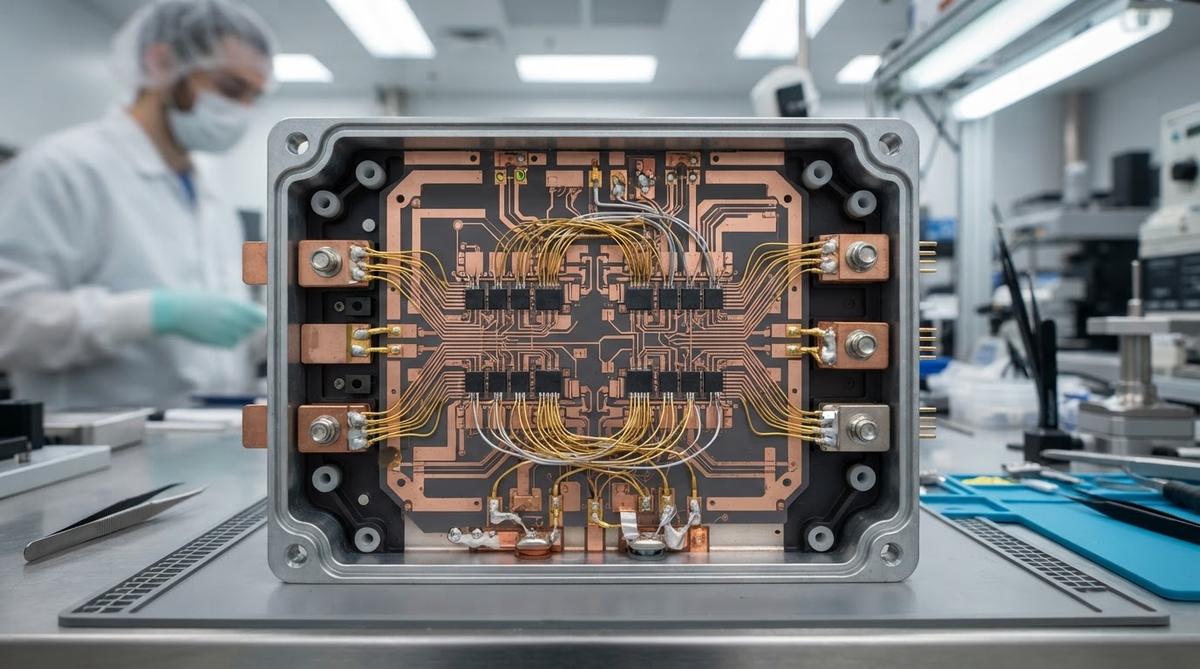
Aluminum nitride is a covalently bonded compound of aluminum and nitrogen with the chemical formula AlN. It crystallises in a wurtzite structure — the same lattice type as GaN — and is sintered from powder into dense polycrystalline substrates at 1,750–1,900 °C under nitrogen atmosphere. The resulting ceramic is white to grey, depending on sintering aids (typically yttria, Y2O3) and purity.
Unlike alumina (Al2O3), which conducts heat primarily through phonon scattering in an oxide lattice, AlN achieves high thermal conductivity because its lighter nitrogen atoms and strong covalent bonds create long phonon mean free paths. Grain-boundary oxygen is the main enemy: every 1 wt% increase in oxygen content can reduce thermal conductivity by roughly 15–25 W/mK, according to data published by CoorsTek and Tokuyama. This is why high-purity (≥99%) AlN powder and tightly controlled sintering atmospheres matter so much.
Aluminum Nitride Material Properties
| Parameter | Value | Unit | Condition | Source |
|---|---|---|---|---|
| Thermal conductivity | 170–200 | W/mK | 25 °C | Kyocera SH-170 / Maruwa AN-200 |
| Dielectric constant (εr) | 8.5–8.9 | — | 1 MHz, 25 °C | Kyocera datasheet |
| Dielectric strength | 15–17 | kV/mm | 25 °C, ASTM D149 | CoorsTek |
| Volume resistivity | >1014 | Ω·cm | 25 °C | Maruwa |
| CTE | 4.5–4.8 | ppm/°C | 20–400 °C | Kyocera |
| Flexural strength | 300–400 | MPa | 3-point bend, ASTM C1161 | CoorsTek / Maruwa |
| Density | 3.26–3.30 | g/cm³ | — | Kyocera |
| Max use temperature (inert/N₂) | ~1,000 | °C | Non-oxidising atmosphere | Tokuyama |
| Max use temperature (air) | ~700 | °C | Oxidation onset | CoorsTek |
Typical values for commercially available material, for comparison only. Confirm against the datasheet for your specific grade.
For a complete downloadable specification sheet, see the AlN substrate datasheet. A deeper discussion of how grain size and oxygen content shift these numbers is covered on the AlN material properties page.
How Does AlN Compare to Alumina and Other Ceramics?
Understanding what is aluminum nitride AlN in context requires a direct comparison with competing ceramics. The table below puts the key parameters side by side.
| Parameter | AlN | Al₂O₃ 96% | Si₃N₄ | Unit |
|---|---|---|---|---|
| Thermal conductivity (25 °C) | 170–200 | 24–28 | 60–90 | W/mK |
| CTE (20–400 °C) | 4.5–4.8 | 7.2–7.4 | 2.7–3.2 | ppm/°C |
| Flexural strength | 300–400 | 300–380 | 600–900 | MPa |
| Fracture toughness (KIC) | 2.5–3.0 | 3.5–4.0 | 6–7 | MPa·m½ |
| Relative substrate cost | 3–5× | 1× (baseline) | 4–8× | — |
Sources: Kyocera, CoorsTek, CeramTec datasheets. Values are typical ranges for standard commercial grades.
AlN wins on raw thermal conductivity, but silicon nitride (Si₃N₄) is far tougher mechanically — roughly 2× the fracture toughness. For applications where thermal cycling induces high mechanical stress (traction inverters, for example), Si₃N₄ AMB substrates often outlast AlN DBC substrates despite lower thermal conductivity. The trade-off is cost: Si₃N₄ substrates run 4–8× the price of 96% alumina.
Enter your substrate material, thickness, and heat load below to see how AlN stacks up against alumina and Si₃N₄ for your specific thermal scenario.
Common Applications for AlN Substrates
Power electronics. IGBT and SiC MOSFET modules use AlN DBC or AMB substrates to pull 100–300 W/cm² away from the die while maintaining 2.5 kV or higher isolation. The CTE match to SiC (4.0 ppm/°C) is a specific advantage over alumina.
High-brightness LEDs. UV-C and high-power visible LEDs generate concentrated heat in a small footprint. AlN submounts keep junction temperatures low enough to preserve lumen output and lifetime. Per Nichia application notes, a 30% reduction in thermal resistance can extend LED rated life by 2×.
RF and microwave. AlN’s dielectric constant of 8.5–8.9 at 1 MHz and low loss tangent (~0.001 at 1 GHz) suit it to GaN HEMT carrier boards and MMIC packages up to millimetre-wave frequencies.
Semiconductor test and burn-in. Probe card substrates and burn-in boards benefit from AlN’s CTE match to silicon and its dimensional stability at elevated temperatures.
For guidance on designing circuits on AlN, the AlN thermal design guide walks through junction-to-case resistance calculations with worked examples.
How AlN Substrates Are Processed
Substrate Fabrication
AlN powder (≥99% purity) is mixed with 3–5 wt% yttria sintering aid, tape-cast or dry-pressed, then sintered at 1,750–1,900 °C in a nitrogen atmosphere. After sintering, substrates are lapped and polished to surface roughness values from Ra 0.05 µm (polished) to Ra 0.5 µm (as-fired), depending on metallization requirements.
Metallization
Because AlN is a nitride rather than an oxide, standard thick-film pastes designed for alumina do not bond reliably to it. The main metallization routes are:
- DBC (Direct Bond Copper): Copper foil is bonded at ~1,065 °C via a Cu–O eutectic. Requires a thin, controlled oxide layer on the AlN surface.
- AMB (Active Metal Brazing): A TiCuAg or TiCuSn braze alloy wets the AlN directly. Produces stronger bonds and handles thicker copper (up to 0.8 mm) than DBC.
- Thin-film sputtering: Ti/Pt/Au or TiW/Ni/Au stacks deposited by PVD. Used for fine-line RF circuits with trace widths below 50 µm.
Details on each route, including adhesion-strength benchmarks, are available on the AlN metallization page.
Moisture Sensitivity: The Overlooked Risk
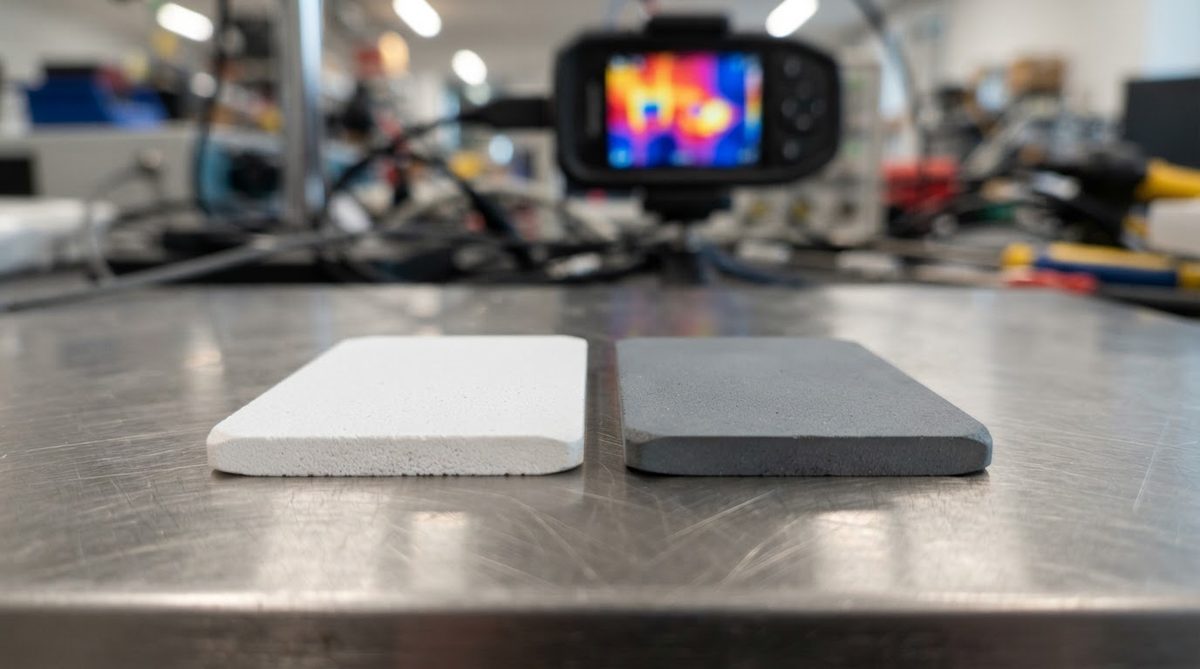
AlN reacts with water. Exposed surfaces hydrolyse according to: AlN + 3H₂O → Al(OH)₃ + NH₃. In practice, this means unmetallized AlN left in a humid environment (≥85% RH, 85 °C) will develop a porous aluminium hydroxide layer within hundreds of hours, degrading thermal conductivity at the surface and weakening metallization adhesion.
Mitigation is straightforward: metallize or passivate all exposed surfaces, store substrates in dry nitrogen, and avoid water-based cleaning steps after final metallization. If your process requires aqueous cleaning, a thin oxidation passivation layer (formed by controlled heating at 900–1,000 °C in air for 1–2 hours) provides a barrier, though it adds a processing step and slightly reduces near-surface thermal conductivity.
When Not to Use AlN
Budget-constrained designs below 50 W. If your total dissipation is under 50 W and board area is not severely constrained, 96% alumina or a metal-core PCB (MCPCB) will manage the heat at a fraction of the cost.
Mechanically demanding environments with thermal cycling. AlN’s fracture toughness (2.5–3.0 MPa·m½) is lower than alumina’s and far below Si₃N₄’s. If your application sees thousands of deep thermal cycles (ΔT > 150 °C), Si₃N₄ AMB substrates offer better long-term reliability despite their higher price.
Humid, unenclosed environments. Without encapsulation or metallization on all surfaces, AlN degrades in moisture. If your product is exposed to outdoor humidity without a sealed housing, alumina is a safer choice.
Large-area substrates on a tight timeline. AlN substrates are typically available in sizes up to about 114 × 114 mm (standard) and 190 × 140 mm (specialty). If you need panel sizes above 150 mm, alumina is easier to source quickly.
Worked Example: Thermal Resistance Through an AlN Substrate
Suppose you have a 10 × 10 mm AlN substrate, 0.635 mm thick, and you need to estimate conduction thermal resistance from top surface to bottom surface.
Using Rth = t / (k × A):
- t = 0.000635 m
- k = 180 W/mK (mid-range for commercial AlN)
- A = 0.01 × 0.01 = 0.0001 m²
Rth = 0.000635 / (180 × 0.0001) = 0.035 °C/W
The same calculation for 96% alumina (k = 26 W/mK) gives 0.244 °C/W — nearly 7× higher. At 100 W dissipation, that difference is 0.035 × 100 = 3.5 °C across the AlN substrate versus 24.4 °C across the alumina. For a GaN-on-SiC die running at junction limits, that 21 °C margin is often the difference between meeting and missing a reliability target. This example illustrates concretely what is aluminum nitride AlN’s practical advantage in thermal management.
Frequently Asked Questions
Is aluminum nitride toxic?
AlN dust is an irritant to the respiratory tract, but it is not classified as a carcinogen or acutely toxic material. Standard ceramic dust PPE (N95 respirator, safety glasses) is sufficient for handling and machining. It is far less hazardous than beryllium oxide (BeO), which is a confirmed carcinogen.
Can AlN be machined after sintering?
Yes. AlN is routinely laser-cut and laser-drilled for vias and outlines. Diamond grinding and ultrasonic machining also work, though they are slower. For details on tolerances and edge quality, see the page on AlN laser machining.
Does AlN work at high temperatures?
AlN is stable to approximately 1,000 °C in inert or nitrogen atmospheres. In air, surface oxidation begins around 700 °C. For most electronics applications, the practical ceiling is set by the metallization and solder, not the ceramic itself — typically 300–400 °C for DBC/AMB assemblies. More detail is on the AlN high-temperature performance page.
What surface finishes can be applied to AlN substrates?
Common finishes include electroless Ni/Au (ENIG), electrolytic Ni/Au, and thin-film Ti/Pt/Au. The choice depends on the metallization base layer and the intended bonding method (solder, wire bond, or sintered silver). Thick-film Au and Ag are also used on DBC copper layers.
How does AlN compare to BeO for thermal management?
Beryllium oxide offers 250–300 W/mK thermal conductivity, roughly 30–50% higher than AlN. However, BeO dust is a confirmed human carcinogen, and its use is increasingly restricted by regulation. AlN is the preferred replacement in most new designs because it avoids the health and compliance burden while still delivering 170–200 W/mK.
Next Step
If AlN fits your thermal and electrical requirements, the next step is to confirm substrate dimensions, metallization type, and surface finish against your layout. Now that you know what is aluminum nitride AlN and where it excels, you can download specifications from the AlN datasheet page or request a quote for custom AlN PCB fabrication.