Aluminum nitride (AlN) substrates offer thermal conductivity of 170–200 W/mK at 25 °C, a CTE of 4.5 ppm/°C closely matched to silicon, and volume resistivity above 1013 Ω·cm. This aluminum nitride AlN datasheet consolidates the values hardware engineers need when specifying AlN for power electronics, RF modules, or high-brightness LED assemblies.
Aluminum Nitride AlN Datasheet — Full Property Table
The table below is the core of this aluminum nitride AlN datasheet. It covers the two grades most commonly available from substrate manufacturers: standard-purity AlN (≥ 98%) and high-purity AlN (≥ 99.5%). Values are drawn from published datasheets by Maruwa and Kyocera.
| Parameter | Standard AlN (≥ 98%) | High-Purity AlN (≥ 99.5%) | Unit | Condition / Standard | Source |
|---|---|---|---|---|---|
| Thermal conductivity | 170–180 | 180–200 | W/mK | 25 °C, laser flash per ASTM E1461 | Maruwa HA-series datasheet; Kyocera SH-series datasheet |
| CTE | 4.5 | 4.5 | ppm/°C | 20–400 °C, ASTM E228 | Maruwa HA-200 |
| Dielectric constant (εr) | 8.5–8.9 | 8.6–8.9 | — | 1 MHz, 25 °C | Kyocera SH-30 |
| Dielectric strength | ≥ 15 | ≥ 17 | kV/mm | AC, 25 °C, IEC 60672 | Maruwa HA-200 |
| Volume resistivity | > 1013 | > 1014 | Ω·cm | 25 °C | Kyocera SH-30 |
| Flexural strength | 300–350 | 350–400 | MPa | 3-point bend, ASTM C1161 | Maruwa HA-200 |
| Density | 3.26 | 3.26 | g/cm³ | ASTM C373 | Kyocera SH-30 |
| Young’s modulus | 310–320 | 310–330 | GPa | 25 °C | CoorsTek ADS-996 |
| Max continuous use temp. | 1 000 | 1 000 | °C | In inert / N₂ atmosphere | Maruwa HA-200 |
| Surface roughness (as-fired) | 0.4–0.8 | 0.3–0.6 | µm Ra | Contact profilometer | Maruwa HA-200 |
Typical values for commercially available material, for comparison only. Confirm against the datasheet for your specific grade.
How to Read an Aluminum Nitride AlN Datasheet
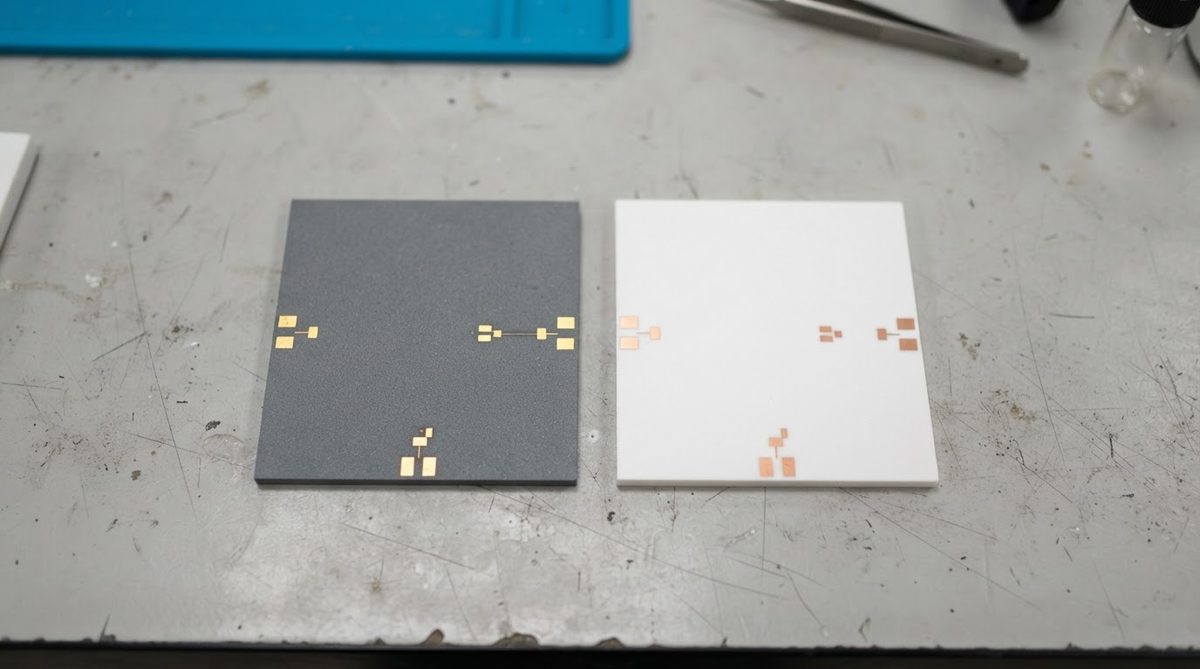
Thermal conductivity is the headline number, but it varies with grain size, oxygen content, and sintering additives. An aluminum nitride AlN datasheet quoting 170 W/mK at 25 °C via laser flash (ASTM E1461) is not directly comparable to one quoting 185 W/mK measured by the hot-disk method. Always check the test standard before comparing vendors.
When reviewing any AlN datasheet, pay attention to these items in particular:
- Test standard for thermal conductivity — ASTM E1461 (laser flash) is the industry norm; other methods can yield different numbers for the same material.
- Purity grade — oxygen and yttria content directly affect thermal performance; ≥ 99.5% AlN typically gains 10–20 W/mK over ≥ 98% grades.
- CTE temperature range — a CTE quoted at 20–400 °C differs from one quoted at 20–800 °C; confirm the range matches your operating window.
- Surface roughness specification — as-fired vs. lapped vs. polished values can differ by an order of magnitude, affecting metallization adhesion.
- Atmosphere for max use temperature — 1 000 °C ratings typically assume inert gas; in air, surface oxidation begins near 700 °C.
Dielectric constant matters for RF and high-frequency power designs. AlN sits at εr ≈ 8.6–8.9 at 1 MHz, which is lower than 96% alumina (≈ 9.4) but higher than silicon nitride (≈ 7.5–8.0). For a deeper look at how εr and loss tangent affect impedance, see the page on AlN dielectric properties for PCB design.
CTE of 4.5 ppm/°C is close to silicon (2.6 ppm/°C) and GaN-on-SiC (≈ 4.2 ppm/°C), which reduces solder-joint fatigue in direct die-attach configurations. By comparison, 96% alumina has a CTE of about 7.1 ppm/°C — a significantly wider mismatch to silicon.
AlN Compared to Other Ceramic Substrates
Engineers often shortlist AlN alongside 96% alumina and silicon nitride. The table below puts the three side by side so you can cross-reference against your own aluminum nitride AlN datasheet values.
| Parameter | AlN (≥ 98%) | Al₂O₃ 96% | Si₃N₄ | Unit |
|---|---|---|---|---|
| Thermal conductivity (25 °C) | 170–200 | 24–28 | 60–90 | W/mK |
| CTE (20–400 °C) | 4.5 | 7.1 | 2.5–3.2 | ppm/°C |
| Flexural strength | 300–400 | 300–380 | 600–900 | MPa |
| Fracture toughness (KIC) | 2.5–3.0 | 3.5–4.0 | 6.0–7.0 | MPa·m½ |
| Relative substrate cost | 3–5× | 1× (baseline) | 5–8× | — |
Typical values for commercially available material, for comparison only. Confirm against the datasheet for your specific grade.
AlN wins on thermal conductivity by a wide margin. Silicon nitride wins on mechanical toughness, which matters in power modules subjected to thermal cycling above 10 000 cycles. For a full comparison of Si₃N₄ grades, see the silicon nitride substrate datasheet. For broader material selection guidance, the guide to choosing a ceramic substrate walks through the decision tree.
Worked Example: Thermal Resistance of an AlN Substrate
Suppose you mount a 10 mm × 10 mm GaN die dissipating 50 W onto a 0.635 mm thick AlN substrate (k = 180 W/mK). The one-dimensional conduction resistance through the substrate is:
Rth = t / (k × A) = 0.000635 / (180 × 0.0001) = 0.035 °C/W
At 50 W, the temperature drop across the substrate is 50 × 0.035 = 1.75 °C. Replace AlN with 96% alumina (k = 26 W/mK) and the drop becomes 50 × (0.000635 / (26 × 0.0001)) = 12.2 °C. That 10 °C difference can shift a junction temperature from safe to marginal in a GaN HEMT application.
Enter your own substrate dimensions, material, and power dissipation below to estimate the temperature rise for your specific design.
Practical Notes on Specifying AlN
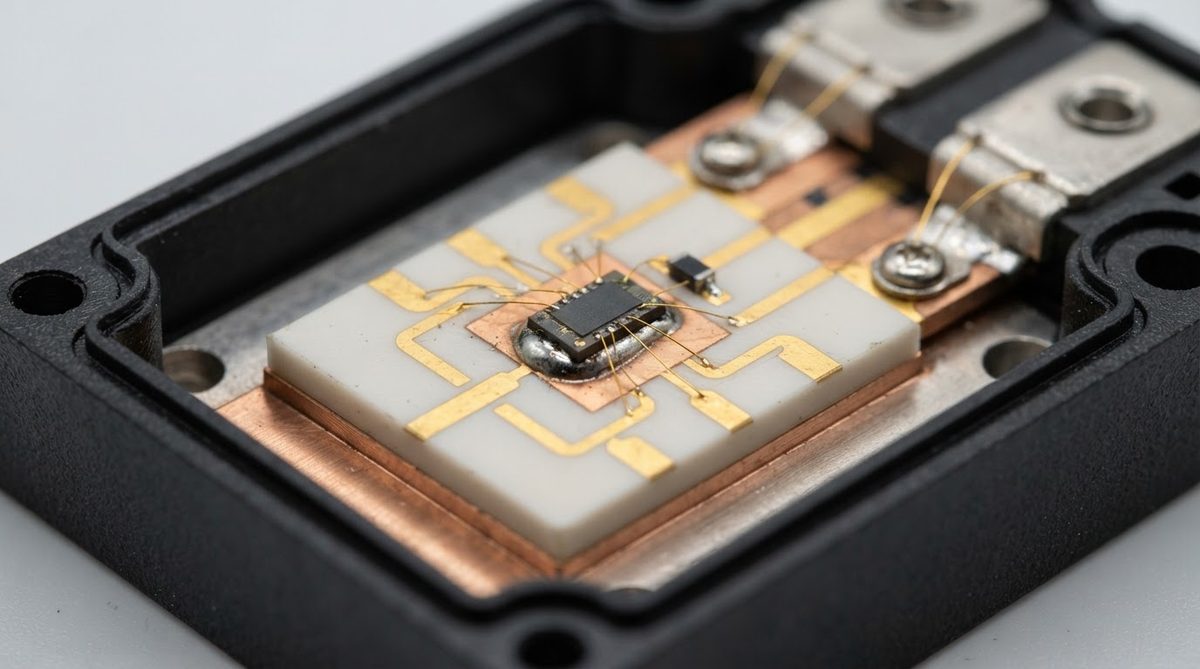
AlN substrates oxidize at the surface above roughly 700 °C in air, forming a thin alumina layer. For most PCB applications operating below 300 °C, this is irrelevant. For high-temperature sensor or heater applications in air, confirm the atmosphere and duration with your substrate supplier.
Surface roughness affects metallization adhesion. As-fired AlN typically measures 0.4–0.8 µm Ra; lapped and polished substrates can reach below 0.1 µm Ra. If you need tight roughness control, the page on AlN surface finish and roughness covers lapping, polishing, and their effect on thin-film adhesion.
When Not to Use AlN
AlN costs three to five times more than 96% alumina per unit area. If your heat flux is below roughly 5 W/cm² and junction temperature targets are comfortable, alumina or an aluminum-core MCPCB will do the job at a fraction of the cost. No aluminum nitride AlN datasheet advantage matters if the thermal budget is already met by a cheaper material.
AlN is also more brittle than silicon nitride (KIC 2.5–3.0 vs. 6.0–7.0 MPa·m½). In power modules subjected to aggressive thermal cycling — automotive inverters, for example, with lifetime targets above 15 000 power cycles — Si₃N₄ substrates survive longer because they resist crack propagation far better.
For large-area boards (> 100 mm × 100 mm) with moderate thermal demands, FR-4 or metal-core PCBs remain the practical choice. Ceramic substrates are strongest where thermal density is high and footprint is small.
Frequently Asked Questions
Is AlN better than alumina for every thermal application?
No. AlN is justified when heat flux exceeds roughly 5–10 W/cm² or when CTE match to silicon or GaN is critical. Below that threshold, 96% alumina at one-third the cost often meets thermal targets.
Can I get AlN substrates thinner than 0.5 mm?
Yes. AlN substrates are commercially available down to 0.25 mm (250 µm) and even thinner in specialty grades. Thinner substrates reduce thermal resistance but are more fragile during handling and assembly.
Does AlN degrade in humid environments?
Unmetallized AlN can hydrolyze slowly in prolonged high-humidity, high-temperature conditions, forming aluminum hydroxide on the surface. Standard practice is to protect exposed AlN with metallization or a passivation layer. In sealed modules this is rarely an issue.
What metallization methods work on AlN?
Thin-film sputtering (Ti/Pt/Au, TiW/Au) and thick-film (DBC copper, active metal brazing) are both used. DPC (direct plated copper) is also common for fine-line circuitry. The choice depends on line width, current capacity, and thermal cycling requirements.
How does AlN compare to BeO on thermal conductivity?
Beryllium oxide reaches 250–300 W/mK, roughly 40–60% higher than AlN. However, BeO dust is a confirmed human carcinogen and causes chronic beryllium disease. Regulatory and handling costs make BeO impractical for most new designs, and AlN has largely replaced it in power electronics.