If you are asking what is silicon nitride Si3N4, the short answer is this: it is a covalently bonded ceramic composed of silicon and nitrogen atoms arranged in a hexagonal crystal structure. It stands apart from other engineering ceramics because it combines high mechanical strength (700–900 MPa flexural strength per ASTM C1161) with useful thermal conductivity (28–90 W/mK depending on grade) and exceptional fracture toughness (6–7 MPa·√m). For power-electronics engineers, that combination means substrates that survive severe thermal cycling without cracking—something alumina and even aluminum nitride struggle to match.
Key Takeaways
- Si3N4 fracture toughness of 6–7 MPa·√m is roughly 3× that of Al2O3 (96%) and 2× that of AlN, per CoorsTek published datasheets.
- Thermal conductivity of commercial Si3N4 substrates ranges from 28 W/mK (reaction-bonded grades) to 90 W/mK (high-purity sintered grades, e.g., Kyocera SN-90).
- Si3N4 substrates are metallized via active metal brazing (AMB) or direct bonded copper (DBC), not HTCC or LTCC.
- Primary applications: EV traction inverters, IGBT/SiC power modules, and high-reliability aerospace converters.
- Si3N4 substrates cost roughly 5–10× more per unit area than 96% Al2O3, so they are justified only where thermal-cycling reliability is the binding constraint.
What Is Silicon Nitride Si3N4 at the Crystal Level?
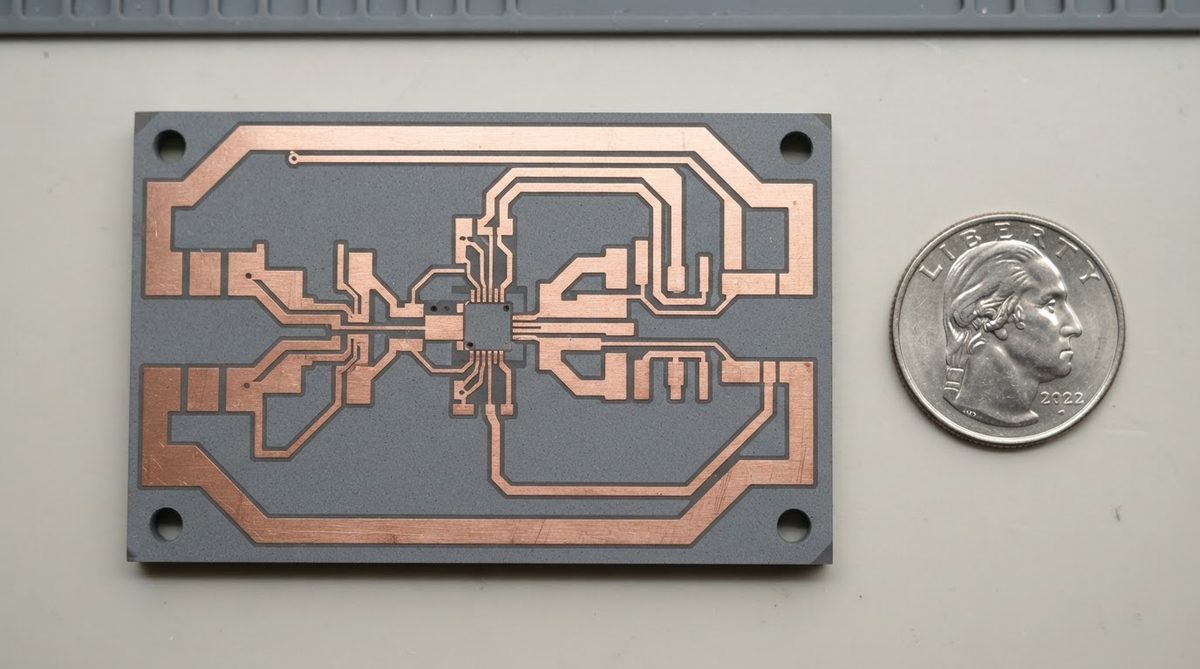
Silicon nitride exists in two main crystallographic phases: α-Si3N4 and β-Si3N4. The α phase forms during initial synthesis and converts to the β phase during sintering above 1700 °C. β-Si3N4 develops elongated, interlocking grain structures that act as a self-reinforcing microstructure. This is the mechanism behind the material’s unusually high fracture toughness for a ceramic.
Sintering aids—typically Y2O3 and MgO—are added at 3–8 wt% to promote densification. The type and amount of sintering aid directly affect both the grain-boundary glass phase and the final thermal conductivity. High-purity grades with minimal oxygen content in the lattice achieve the highest conductivity values because phonon scattering at lattice defects is reduced. Kyocera’s SN-90 grade, for example, reaches 90 W/mK by controlling oxygen impurity below 1 wt%.
Material Properties of Silicon Nitride Si3N4
Understanding what is silicon nitride Si3N4 in practice requires looking at measured properties across commercial grades. The table below summarizes the ranges you will encounter when specifying substrates.
| Parameter | Value | Unit | Condition | Source |
|---|---|---|---|---|
| Density | 3.20–3.27 | g/cm³ | Sintered, room temp | CoorsTek datasheet |
| Flexural strength | 700–900 | MPa | 4-point bend, ASTM C1161 | Kyocera SN series |
| Fracture toughness (KIC) | 6–7 | MPa·√m | SEVNB, room temp | CeramTec technical data |
| Thermal conductivity | 28–90 | W/mK | 25 °C, grade-dependent | Kyocera SN-28 to SN-90 |
| CTE | 2.5–3.3 | ppm/°C | 25–400 °C | Maruwa datasheet |
| Dielectric strength | 15–18 | kV/mm | AC, 50 Hz, 0.32 mm thick | CoorsTek datasheet |
| Volume resistivity | >1013 | Ω·cm | 25 °C | CoorsTek datasheet |
| Max service temperature | 1000–1200 | °C | Oxidizing atmosphere | CeramTec technical data |
Typical values for commercially available material, for comparison only. Confirm against the datasheet for your specific grade.
For a deeper dive into thermal performance, see the full discussion of Si3N4 thermal conductivity and how grade selection affects it.
How Si3N4 Compares to Other Ceramic Substrates
Engineers evaluating what is silicon nitride Si3N4 for their design usually have alumina (Al2O3) and aluminum nitride (AlN) on the same shortlist. The table below puts the three side by side on the parameters that matter most for power-module substrates.
| Parameter | Al2O3 96% | AlN | Si3N4 (high-κ) | Unit |
|---|---|---|---|---|
| Thermal conductivity (25 °C) | 24–28 | 170–200 | 70–90 | W/mK |
| Flexural strength | 300–380 | 300–400 | 700–900 | MPa |
| Fracture toughness | 3.5–4.0 | 2.5–3.5 | 6–7 | MPa·√m |
| CTE | 7.0–8.0 | 4.5–5.0 | 2.5–3.3 | ppm/°C |
| Relative substrate cost | 1× | 3–5× | 5–10× | — |
Sources: CoorsTek, Kyocera, and Maruwa published datasheets. Values are typical ranges for commercial grades.
AlN wins on raw thermal conductivity. Si3N4 wins on mechanical toughness and thermal-cycling endurance. In an EV traction inverter that will see 500,000+ power cycles over a 15-year life, the substrate that cracks first determines the module’s field-failure rate. This is why major automotive Tier 1s have shifted SiC-MOSFET modules from AlN to Si3N4 AMB substrates since roughly 2019.
How Silicon Nitride Substrates Are Made
Si3N4 powder is mixed with sintering aids, tape-cast or dry-pressed into green sheets, and sintered at 1750–1900 °C under nitrogen atmosphere (gas-pressure sintering or hot-press sintering). After sintering, substrates are laser-scribed, lapped, or polished to final dimensions.
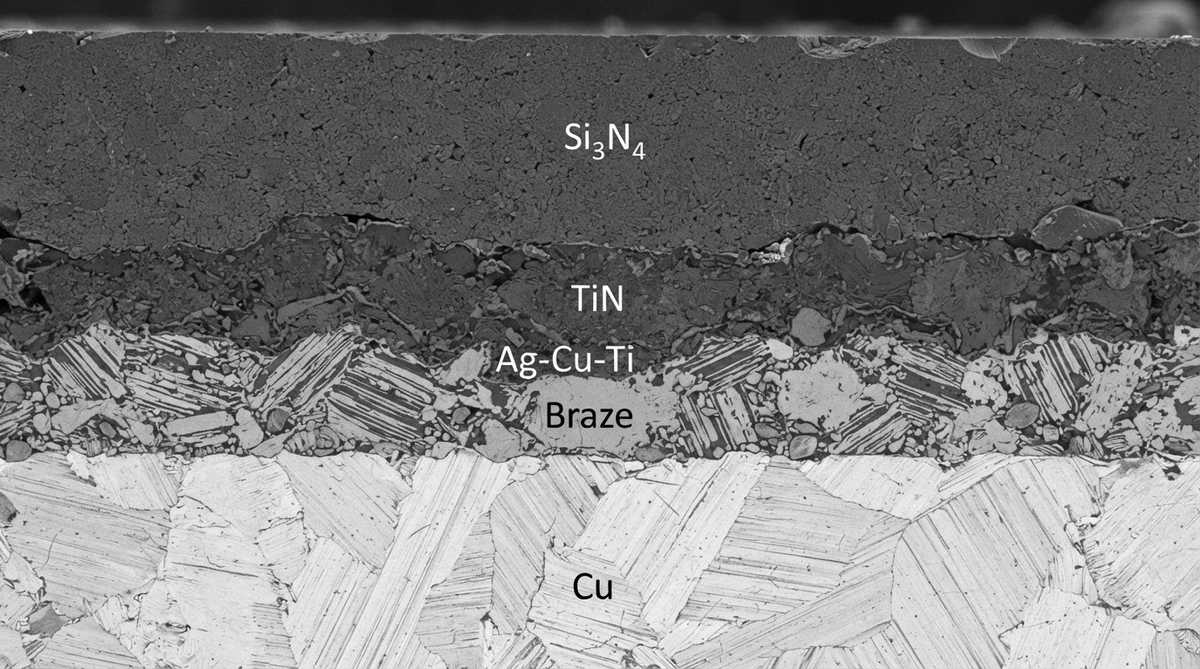
Metallization follows one of two routes. DBC bonds a copper foil to the Si3N4 surface using a Cu-O eutectic at around 1065 °C. AMB uses a Ti-containing braze alloy (typically Ag-Cu-Ti) at 800–900 °C to chemically bond copper to the ceramic. AMB produces a stronger bond to Si3N4 than DBC because the titanium reacts with the nitride surface to form a TiN interlayer. Most Si3N4 power-module substrates today use AMB for this reason.
For a complete look at Si3N4 material properties and available grades, see the dedicated properties page.
Where Silicon Nitride Si3N4 Is Used
EV traction inverters. SiC MOSFETs operate at junction temperatures up to 175–200 °C and impose extreme thermal cycling on the substrate. Si3N4 AMB substrates are now standard in modules from Infineon, Wolfspeed, and several automotive OEMs.
Railway and industrial IGBT modules. Long service lives (20–30 years) and wide ambient temperature swings demand substrates that resist fatigue crack initiation. Si3N4’s high KIC provides margin here.
Aerospace DC-DC converters. Weight savings from thinner substrates (0.2–0.32 mm) are possible because Si3N4 retains adequate strength at reduced thickness. Other ceramics would need to stay thicker to avoid fracture.
LED and RF applications are possible but rarely justified economically. For most LED thermal substrates, alumina or AlN is sufficient. Explore Si3N4 PCB options, uses, and sourcing for a broader application overview.
Worked Example: Thermal Resistance Through a Si3N4 Substrate
Assume a 20 mm × 20 mm SiC die dissipates 150 W through a 0.32 mm thick Si3N4 substrate with κ = 90 W/mK.
Thermal resistance of the substrate alone:
Rth = t / (κ × A) = 0.00032 m / (90 W/mK × 0.0004 m²) = 0.0089 K/W
Temperature drop across the substrate: ΔT = 150 W × 0.0089 K/W ≈ 1.3 °C.
For comparison, the same geometry in 96% Al2O3 (κ = 26 W/mK) yields Rth = 0.031 K/W and ΔT ≈ 4.6 °C. AlN at 180 W/mK gives ΔT ≈ 0.7 °C. The substrate thermal resistance is a small fraction of the total junction-to-coolant stack, so the mechanical advantage of Si3N4 often outweighs the modest thermal penalty versus AlN.
When Not to Use Silicon Nitride
Si3N4 is expensive. If your module sees fewer than 50,000 thermal cycles or operates below 150 °C junction temperature, AlN or even Al2O3 DBC substrates will likely provide adequate reliability at a fraction of the cost. For prototype runs or low-volume industrial controls, the price premium of Si3N4 rarely pays back.
Si3N4 is also not available in HTCC or LTCC co-fired multilayer form. If you need embedded vias, internal routing layers, or co-fired resistors, alumina LTCC or AlN HTCC is the correct choice. Si3N4 is a single-layer substrate metallized after sintering.
For projects where zirconia-toughened alumina might offer a middle ground on toughness and cost, see the guide on zirconia-toughened alumina (ZTA).
Frequently Asked Questions
Can Si3N4 substrates be soldered like alumina PCBs?
Yes. Once metallized via AMB or DBC, the exposed copper surface accepts standard SAC305 or high-lead solders. Surface finishes such as Ni/Au or Ni/Ag are applied to the copper before soldering, just as with any other ceramic substrate.
What thickness does Si3N4 come in?
Commercial Si3N4 substrates are available from 0.2 mm to 0.635 mm. The most common thickness for power-module use is 0.32 mm, which balances dielectric isolation (>5 kV) with thermal resistance. Download the Si3N4 substrate datasheet for detailed thickness and tolerance specifications.
Is Si3N4 better than AlN for power modules?
It depends on the dominant failure mode. AlN has higher thermal conductivity (170–200 W/mK vs. 70–90 W/mK) but lower fracture toughness (2.5–3.5 vs. 6–7 MPa·√m). In applications with severe thermal cycling—EV inverters, for example—Si3N4 lasts significantly longer. In steady-state high-heat applications with mild cycling, AlN may be the better thermal choice.
Does Si3N4 work at cryogenic temperatures?
Si3N4 retains its mechanical strength down to cryogenic temperatures (–196 °C and below) without embrittlement. Its low CTE (2.5–3.3 ppm/°C) minimizes thermal stress when cooling from room temperature. This makes it suitable for aerospace and superconducting-magnet power supplies.
Why is Si3N4 so much more expensive than alumina?
Sintering Si3N4 requires temperatures above 1750 °C under nitrogen pressure, using high-purity powders and precise sintering-aid chemistry. Cycle times are long, yields are lower than alumina, and the raw powder itself costs more. These factors combine to make Si3N4 substrates 5–10× the price of 96% Al2O3 on a per-area basis.