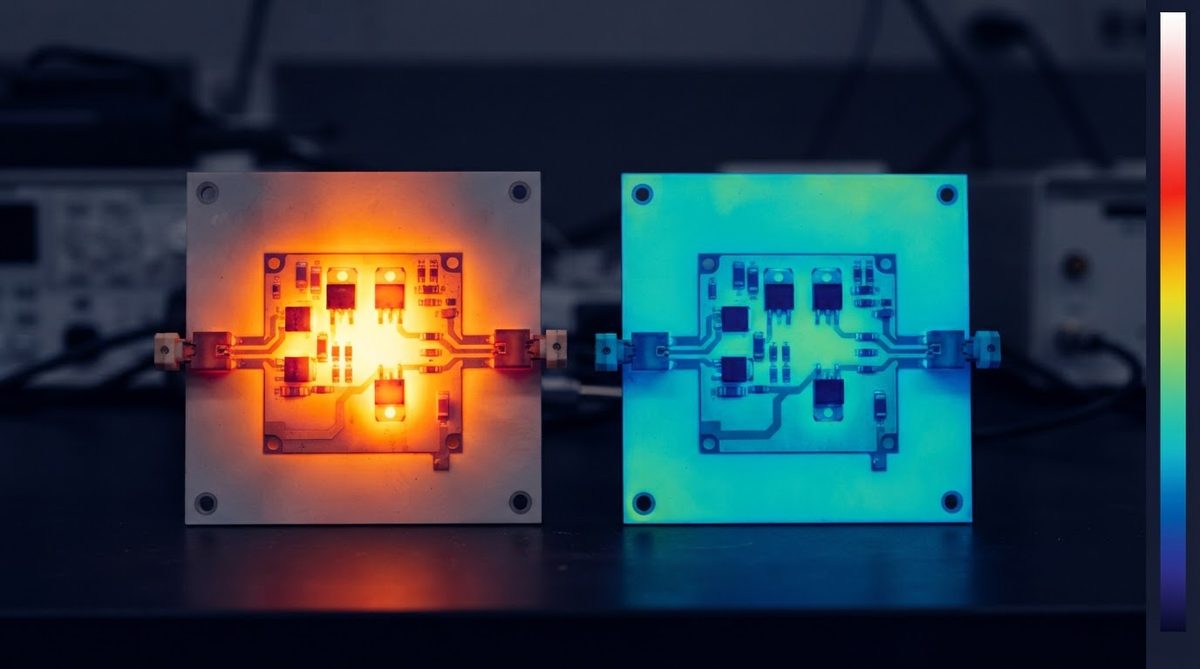
Aluminum nitride (AlN) ceramic substrates are available for purchase as blank wafers, laser-scribed panels, metallized circuit boards, and fully assembled modules. If you are searching for aluminum nitride AlN for sale, the critical specs to compare are purity grade, thermal conductivity (170–200 W/mK at 20 °C), thickness, surface finish, and product form. AlN delivers six to eight times the thermal conductivity of 96 % alumina, making it the standard substrate for high-power LED, RF, and power-module applications where heat must leave the die fast.
Key Takeaways
- Commercial AlN substrates typically achieve 170–200 W/mK thermal conductivity, depending on purity and sintering process (per Maruwa and Kyocera published datasheets).
- AlN’s coefficient of thermal expansion (CTE) of 4.5–4.7 ppm/°C closely matches silicon (2.6 ppm/°C) and SiC (4.0 ppm/°C), reducing solder-joint fatigue in die-attach applications.
- Standard substrate thicknesses range from 0.25 mm to 2.0 mm; thinner and thicker options exist but increase lead time and cost.
- AlN substrates cost roughly 3–5× more per unit area than 96 % alumina, driven by raw-material cost and the oxygen-free sintering atmosphere required.
Aluminum Nitride AlN for Sale: Grades and What the Numbers Mean
Most suppliers listing aluminum nitride AlN for sale offer two broad purity tiers. The difference matters because thermal conductivity is highly sensitive to oxygen dissolved in the AlN lattice. Even 1–2 % extra oxygen content can drop conductivity by 20–30 W/mK.
| Parameter | Standard Grade | High-Purity Grade | Unit | Condition | Source |
|---|---|---|---|---|---|
| AlN purity | ≥ 95 % | ≥ 98 % | — | — | Maruwa HA-series datasheet |
| Thermal conductivity | 170–180 | 180–200 | W/mK | 20 °C, laser flash per ASTM E1461 | Maruwa / Kyocera |
| Dielectric strength | 15–17 | 15–17 | kV/mm | AC, 60 Hz, 25 °C | CoorsTek ADS-995 datasheet |
| Flexural strength | 300–350 | 300–350 | MPa | 3-point bend, ASTM C1161 | Kyocera SN-200 series |
| CTE | 4.5–4.7 | 4.5–4.7 | ppm/°C | 20–400 °C | Maruwa |
| Surface roughness (as-fired) | 0.4–0.8 | 0.3–0.6 | µm Ra | Non-contact profilometer | Maruwa |
Typical values for commercially available material, for comparison only. Confirm against the datasheet for your specific grade.
For die-attach and thin-film metallization work, AlN surface finish and roughness matter as much as bulk conductivity. A polished substrate with Ra ≤ 0.05 µm enables sputtered thin-film traces with tighter line definition and better adhesion.
Available Product Forms When Buying AlN
Aluminum nitride AlN for sale comes in several forms depending on where you are in the design cycle:
- Blank substrates — as-fired or polished and lapped AlN substrates, cut to standard or custom dimensions. These are the starting point for houses that do their own metallization.
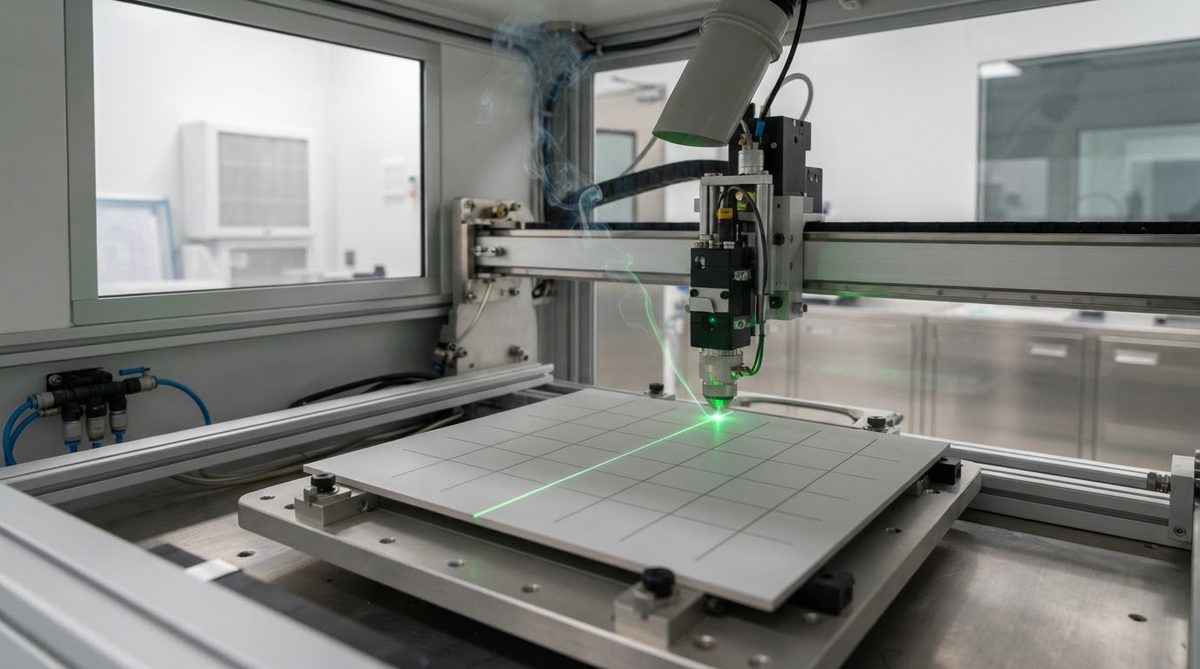
- Laser-scribed panels — substrates with pre-scribed snap lines for singulation after assembly. See AlN laser-scribed substrates for scribe-depth and kerf-width details.
- Metallized PCBs — DPC (direct plated copper), DBC (direct bond copper), or thin-film patterned boards ready for component mounting.
- Fully assembled modules — substrates with die-attach, wire bonding, and encapsulation completed.
Thickness selection affects both thermal resistance and mechanical handling. AlN thickness and tolerance options typically span 0.25 mm to 1.0 mm for PCB use, with 0.381 mm (15 mil) and 0.635 mm (25 mil) being the most common off-the-shelf sizes.
Worked Example: Thermal Resistance Through an AlN Substrate
Suppose you need to mount a 10 × 10 mm power die dissipating 50 W on a 0.635 mm thick AlN substrate. The one-dimensional thermal resistance through the ceramic is:
Rth = t / (k × A)
Where t = 0.635 × 10⁻³ m, k = 180 W/mK, A = 10 × 10 × 10⁻⁶ m² = 1 × 10⁻⁴ m².
Rth = 0.635 × 10⁻³ / (180 × 1 × 10⁻⁴) = 0.035 °C/W.
At 50 W, the temperature drop across the substrate alone is 1.8 °C. The same geometry in 96 % alumina (k = 25 W/mK) yields Rth = 0.254 °C/W and a 12.7 °C drop—seven times worse. This is why AlN dominates high-flux applications.
Enter your own substrate dimensions, material, and power dissipation below to estimate junction-to-baseplate thermal resistance for any AlN or alumina configuration.
What Drives the Price of Aluminum Nitride AlN for Sale
AlN costs more than alumina for three main reasons. First, aluminum nitride powder itself is more expensive because synthesis requires a nitrogen atmosphere at 1700–1900 °C. Second, sintering must occur in an oxygen-free environment (typically N₂ or N₂/H₂), which adds furnace complexity. Third, machining is harder—AlN is tougher to drill and route than alumina, so laser processing is preferred over mechanical methods. Laser machining of AlN substrates yields cleaner edges and tighter tolerances than diamond scribing.
For volume orders, buying wholesale AlN ceramic substrates in standard panel sizes reduces per-piece cost significantly versus custom dimensions. When evaluating aluminum nitride AlN for sale from different vendors, always compare on a per-cm² basis at matched purity and surface finish to get an accurate cost picture.
When NOT to Use AlN
AlN is overkill—and overpriced—for many boards. Consider alternatives in these cases:
- Heat flux below ~5 W/cm²: 96 % alumina (24–28 W/mK) handles moderate power at a fraction of the cost.
- Mechanical shock or vibration priority: Silicon nitride (Si₃N₄) offers 600–800 MPa flexural strength versus AlN’s 300–350 MPa. If your module faces thermal cycling with large ΔT or mechanical shock, Si₃N₄ ceramic substrates may be the better investment.
- Large board area, low power density: Metal-core PCBs (MCPCBs) with aluminum bases cost far less per cm² and handle modest thermal loads adequately.
- Budget-constrained consumer electronics: FR-4 with thermal vias is sufficient for most consumer designs under 1–2 W/cm².
Frequently Asked Questions
How long does it take to get AlN substrates after ordering?
Standard blank substrates in common thicknesses (0.381 mm, 0.635 mm) typically ship in 1–3 weeks. Custom dimensions, metallization, or polishing add 2–4 weeks depending on volume and specification.
Can AlN substrates be soldered with standard lead-free solder?
Yes, metallized AlN boards accept SAC305 and other lead-free solders without issue. The metallization layer (typically Ti/Cu or TiW/Cu for thin film, or direct bond copper for DBC) provides the solderable surface. Bare, unmetallized AlN cannot be soldered directly.
Does AlN absorb moisture?
AlN is susceptible to hydrolysis at the surface when exposed to moisture over extended periods, forming aluminum hydroxide. Proper storage in sealed, desiccated packaging prevents degradation. Metallized or passivated surfaces are not affected under normal conditions.
What is the minimum order quantity for AlN substrates?
MOQ varies by form factor and supplier. Many suppliers offer prototype quantities as low as 5–25 pieces for standard sizes. Custom tooling or non-standard thicknesses may require higher minimums, typically 50–100 pieces.
Is AlN safe to handle?
Fired AlN ceramic is inert and safe to handle with standard ESD precautions. Unlike beryllium oxide (BeO), AlN poses no inhalation toxicity risk during normal handling. Machining dust should still be managed with proper ventilation, as with any ceramic powder.