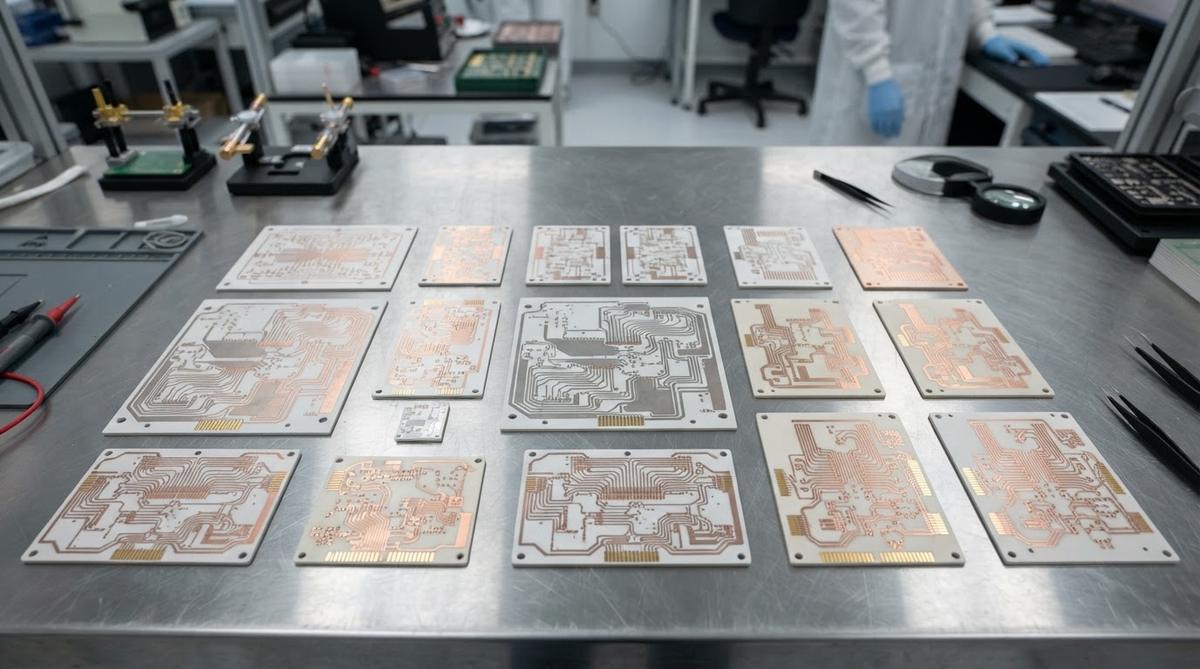
99.6% alumina (Al2O3) is a high-purity ceramic substrate used where 96% alumina falls short on thermal conductivity, dielectric performance, or surface finish. As an alumina 99.6% Al2O3 manufacturer, AluminaPCB supplies bare and metallized substrates in this grade for power electronics, RF modules, sensor packages, and medical implants. The purity jump from 96% to 99.6% raises thermal conductivity from roughly 24–28 W/mK to 30–35 W/mK (at 25 °C) and tightens the microstructure, which matters for thin-film metallization and hermetic sealing.
Key takeaways:
- 99.6% Al2O3 provides 30–35 W/mK thermal conductivity at 25 °C, roughly 25–30% higher than 96% alumina, per Kyocera A-493 and CoorsTek ADS-996 datasheets.
- Dielectric strength reaches 25–30 kV/mm (ASTM D149), making it suitable for high-voltage isolation in power modules.
- The finer grain structure (1–3 µm average grain size vs. 5–10 µm for 96%) yields smoother as-fired surfaces (Ra 0.3–0.6 µm), critical for sputtered thin-film circuits.
- Cost per substrate runs 1.5–2.5× that of 96% alumina, depending on size and finish.
- Available processes include DPC (direct plated copper), thick film, thin film, and DBC (direct bond copper).
What Makes 99.6% Alumina Different from 96%?
The 3.6-percentage-point purity gap is mostly about what replaces the alumina. In 96% substrates, the remaining 4% is a glassy silicate phase that acts as a sintering aid. It lowers the firing temperature but also reduces thermal conductivity, introduces dielectric loss, and coarsens the grain boundary. In 99.6% alumina, the glass phase is nearly eliminated. The result is a denser body (3.86–3.89 g/cm³ vs. 3.72–3.78 g/cm³), tighter grain boundaries, and measurably better electrical and thermal performance.
For most general-purpose ceramic PCBs, custom-fabricated 96% alumina boards are the right choice. You pay less, lead times are shorter, and the material is easier to laser-scribe and metallize with thick-film pastes. Specify 99.6% when your design hits one of these walls: junction temperatures above 150 °C where every W/mK counts, RF circuits above 10 GHz where loss tangent matters, thin-film metallization requiring sub-micron surface roughness, or hermetic packages for implantable medical devices.
99.6% vs. 96% Alumina: Property Comparison
| Parameter | 96% Al2O3 | 99.6% Al2O3 | Unit | Condition | Source |
|---|---|---|---|---|---|
| Thermal conductivity | 24–28 | 30–35 | W/mK | 25 °C | Kyocera A-479 / A-493 |
| Dielectric constant (εr) | 9.0–9.5 | 9.7–9.9 | — | 1 MHz, 25 °C | CoorsTek ADS-996 |
| Loss tangent (tan δ) | 0.0002–0.0010 | 0.0001–0.0003 | — | 1 MHz, 25 °C | CoorsTek ADS-996 |
| Dielectric strength | 15–20 | 25–30 | kV/mm | ASTM D149 | Kyocera A-493 |
| Flexural strength | 340–380 | 350–400 | MPa | ASTM C1161, 3-pt bend | CeramTec Rubalit 710 |
| Density | 3.72–3.78 | 3.86–3.89 | g/cm³ | — | Kyocera A-493 |
| Surface roughness (as-fired) | Ra 0.5–1.0 | Ra 0.3–0.6 | µm | — | Maruwa HA-996 |
| CTE | 7.2–8.0 | 7.5–8.2 | ppm/°C | 25–400 °C | CoorsTek ADS-996 |
| Max continuous use temp | 1 600 | 1 700 | °C | Inert atmosphere | Kyocera A-493 |
Typical values for commercially available material, for comparison only. Confirm against the datasheet for your specific grade.
Manufacturing Processes for 99.6% Alumina PCBs
The higher sintering temperature of 99.6% alumina (1 650–1 750 °C vs. 1 500–1 600 °C for 96%) limits which PCB manufacturing processes are practical. LTCC is not an option because the co-fired metal conductors cannot survive the higher temperatures. HTCC is possible but uncommon for 99.6% purity because tungsten or molybdenum pastes must be formulated for the tighter shrinkage tolerance of the high-purity body.
The most common routes are post-fire metallization methods:
- DPC (Direct Plated Copper): Sputtered Ti/Cu seed layer followed by photolithographic patterning and electroplated copper. Achieves line/space down to 30/30 µm. The smooth surface of 99.6% alumina is ideal for DPC because it reduces seed-layer voids.
- Thin film: Sputtered or evaporated resistor and conductor layers (TaN, NiCr, Au). Used for precision resistor networks and RF matching circuits. Surface roughness below Ra 0.4 µm is often required, which 99.6% alumina meets as-fired or with light lapping.
- Thick film: Screen-printed Ag, AgPd, or Au pastes, fired at 850–950 °C. Works fine on 99.6% substrates, though adhesion testing (per ASTM F1842) should confirm pull strength ≥ 3 lb on the specific paste/substrate combination.
- DBC (Direct Bond Copper): Oxygen-assisted bonding of copper foil at ~1 065 °C. Produces 0.2–0.5 mm copper layers for high-current power modules. CTE mismatch between copper (17 ppm/°C) and 99.6% alumina (7.5–8.2 ppm/°C) limits thermal cycling life, so AlN or Si3N4 is often preferred for DBC in demanding power applications.
If your project requires laser-scribed 99.6% alumina panels, note that the higher density and absence of glass phase make laser scribing slightly slower than on 96% material. Scribe depth and kerf width should be verified on a pilot panel.
Typical Applications
Power electronics: Insulated substrates for IGBTs and SiC MOSFETs where 96% alumina’s thermal conductivity creates a bottleneck. A 25 × 25 mm substrate carrying 50 W sees roughly 15% lower thermal resistance with 99.6% alumina compared to 96%, which can translate to a 5–10 °C junction temperature reduction depending on the rest of the thermal stack.
RF and microwave: The lower loss tangent (tan δ ≤ 0.0003 at 1 MHz) and tighter εr tolerance make 99.6% alumina a practical choice for filters, couplers, and antenna feed networks up to 40 GHz. For higher frequencies or lower loss, consider aluminum nitride (AlN) substrates, which offer even lower dielectric loss.
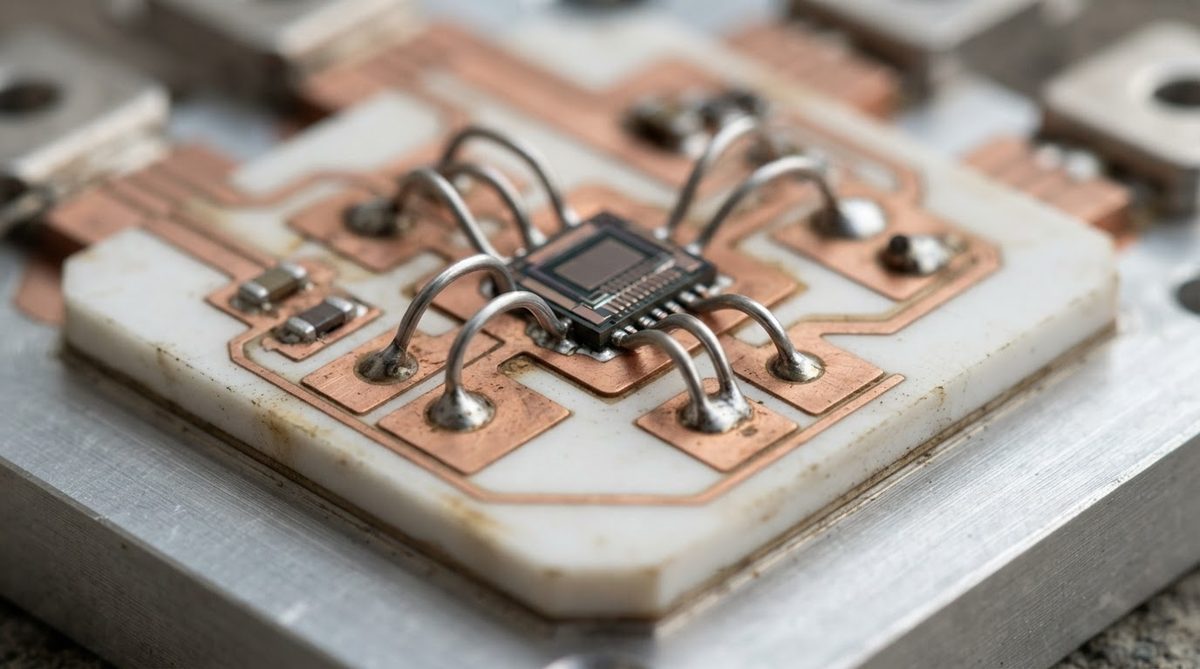
Medical implants and sensors: The high purity and bio-inertness of 99.6% alumina meet the requirements of ISO 6474-1 for surgical-grade ceramics. Hermetic brazed packages on 99.6% substrates achieve helium leak rates below 1 × 10⁻⁹ atm·cm³/s.
High-voltage isolation: 25–30 kV/mm dielectric strength allows thinner substrates for the same isolation voltage, saving Z-height in compact assemblies.
Worked Example: Thermal Resistance Comparison
Consider a bare substrate used as a thermal spreader under a 10 × 10 mm die, dissipating 30 W. Substrate dimensions: 25.4 × 25.4 × 0.635 mm.
One-dimensional thermal resistance through the substrate (simplified, ignoring spreading):
Rth = t / (k × A)
- 96% Al2O3 (k = 26 W/mK): Rth = 0.000635 / (26 × 0.000645) = 0.0379 °C/W → ΔT = 30 × 0.0379 = 1.14 °C
- 99.6% Al2O3 (k = 33 W/mK): Rth = 0.000635 / (33 × 0.000645) = 0.0298 °C/W → ΔT = 30 × 0.0298 = 0.89 °C
The 99.6% grade saves 0.25 °C at the substrate level. That sounds small in isolation, but in a full thermal stack where the substrate sits between a solder die-attach layer and a thermal interface material, every fraction of a degree compounds. For designs already at the thermal limit, this margin can avoid a costly redesign to AlN.
When NOT to Use 99.6% Alumina
Cost-sensitive, high-volume consumer products. If your thermal budget is comfortable with 96% alumina, the 1.5–2.5× cost premium of 99.6% buys nothing useful. Start with 96% alumina at wholesale pricing and upgrade only if testing shows a thermal or electrical shortfall.
Designs requiring thermal conductivity above 50 W/mK. At that point, 99.6% alumina’s 30–35 W/mK is still insufficient. AlN (170–200 W/mK) or silicon nitride (Si3N4) for mechanical toughness are better choices.
Thick multilayer stackups. 99.6% alumina is not compatible with LTCC co-firing. If you need more than two metal layers with embedded vias, LTCC on 96% alumina or a hybrid approach is the practical path.
Prototype budgets under pressure. 99.6% substrates have longer lead times for raw blanks and fewer suppliers keep them in stock. If your schedule is tight and the performance delta is marginal, 96% alumina ships faster.
Sourcing Considerations
The global supply of 99.6% alumina substrates is concentrated among a handful of manufacturers: Kyocera, Maruwa, CoorsTek, and CeramTec produce the majority of blanks. When evaluating a ceramic PCB fabrication partner, confirm that they stock or have allocation agreements for 99.6% blanks, rather than ordering spot from distributors, which adds lead time and cost variability.
Ask for a Certificate of Analysis (CoA) with each lot. Key items to verify: Al2O3 purity (should be ≥ 99.6% by weight), density (≥ 3.86 g/cm³), and surface roughness if you are running thin-film metallization. Grain size distribution is worth requesting for mission-critical applications.
Frequently Asked Questions
Is 99.6% alumina stronger than 96%?
Flexural strength is comparable: 350–400 MPa for 99.6% vs. 340–380 MPa for 96% (ASTM C1161, 3-point bend). The practical difference is small. Both grades are brittle ceramics that fracture under impact or point loading.
Can I use the same solder paste for 99.6% alumina as for 96%?
Yes. Standard SAC305 or AuSn solder pastes work on both grades, provided the metallization (Ni/Au, ENIG, or Ag) is compatible. The substrate purity does not change the soldering process.
Does 99.6% alumina cost twice as much as 96%?
Typically 1.5–2.5× more per substrate, not a flat 2×. The premium narrows at larger order volumes because raw blank pricing improves. Metallization and patterning costs are roughly the same for both grades.
What is the maximum operating temperature of a 99.6% alumina PCB?
The ceramic itself is stable to 1 700 °C in inert atmosphere. The practical limit is set by the metallization: thick-film silver and gold conductors are rated to 300–500 °C depending on paste chemistry, while DBC copper joints degrade above 400 °C. Design to the weakest link in the assembly, not the substrate alone.
Can 99.6% alumina be polished to optical flatness?
Yes. Lapping and polishing can bring the surface to Ra < 0.05 µm. This is sometimes required for eutectic die attach or optical component mounting. Polishing adds cost and lead time, so specify it only where the application demands it.
Next Step
If your design calls for 99.6% alumina, start by requesting a quote with your substrate dimensions, metallization type, and target volume. Upload your Gerber files or substrate drawing to 99.6% alumina custom fabrication for a detailed proposal. For questions about material selection or process compatibility, contact the engineering team directly.