Silicon nitride is the toughest ceramic substrate commercially available for power-electronics PCBs, with a fracture toughness of 6–7 MPa·m½ compared to 3–4 MPa·m½ for alumina and aluminum nitride. That mechanical advantage makes Si3N4 the default choice for high-reliability power modules that must survive deep thermal cycling — EV inverters, traction drives, and railway converters. Choosing a silicon nitride Si3N4 manufacturer means evaluating not just price but sintering quality, surface finish consistency, and metallization compatibility.
Key Takeaways
- Si3N4 substrates achieve flexural strengths of 600–900 MPa (per ASTM C1161, 3-point bend), roughly 2–3× higher than AlN or 96% Al₂O₃.
- Thermal conductivity of commercial Si3N4 ranges from 28 W/mK (standard grade) to 90 W/mK (high-κ grade), measured at 25 °C per ASTM E1461.
- Active Metal Brazing (AMB) is the primary metallization process for Si3N4 power substrates; DBC is possible but less common due to lower copper-peel strength on nitride surfaces.
- Si3N4 substrates cost 3–8× more than equivalent-size AlN substrates, depending on grade and volume.
- Typical substrate thicknesses range from 0.25 mm to 0.635 mm, with 0.32 mm the most common for automotive power modules.
What Makes Si3N4 Different from Other Ceramic Substrates
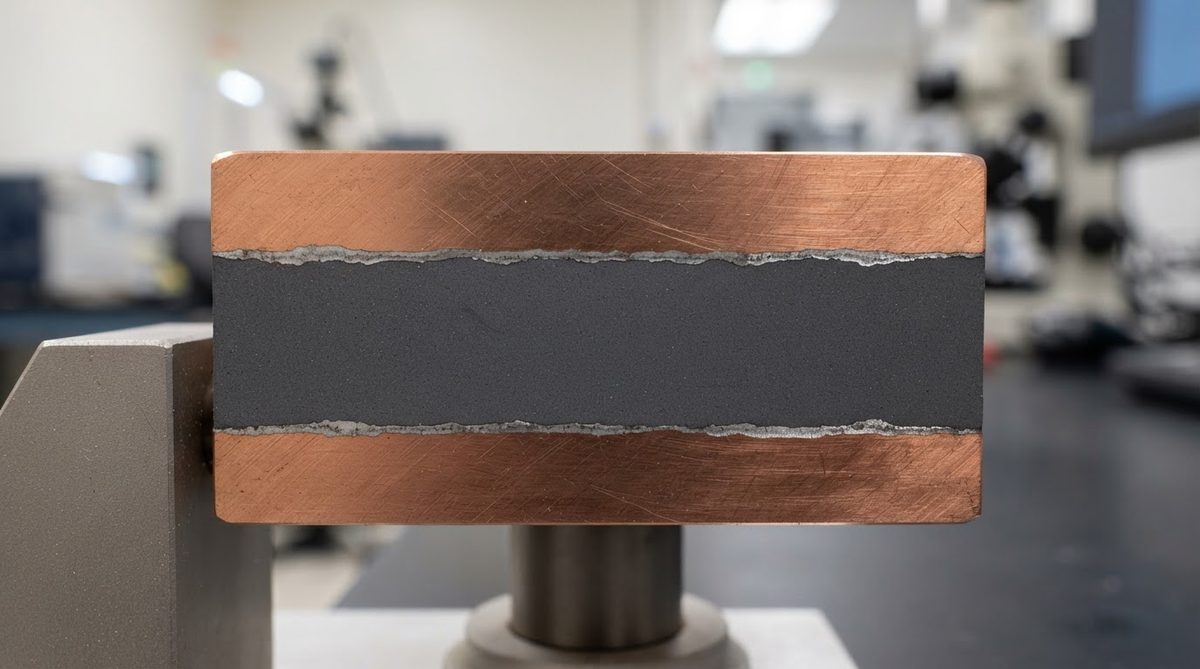
The defining property of silicon nitride is its interlocking grain microstructure. During gas-pressure sintering, elongated β-Si3N4 grains grow into a self-reinforcing network. This gives the material crack-deflection behavior that alumina and aluminum nitride simply lack. When a thermal-cycling crack initiates at a copper-ceramic interface, Si3N4 arrests it before it propagates through the substrate. AlN, by contrast, is prone to catastrophic fracture under the same stress.
That toughness comes with a thermal-conductivity trade-off. Standard Si3N4 sits around 28–30 W/mK — adequate for many power modules but far below AlN’s 170–200 W/mK. High-purity, high-κ Si3N4 grades (such as those from Toshiba Materials or SRM) push toward 90 W/mK by reducing oxygen content at grain boundaries, but they carry a significant cost premium. For a deeper look at these thermal numbers, see Si3N4 thermal conductivity explained.
Si3N4 Material Properties — Comparison Table
| Parameter | Si3N4 (standard) | Si3N4 (high-κ) | AlN | Al₂O₃ 96% | Unit | Condition / Source |
|---|---|---|---|---|---|---|
| Thermal conductivity | 28–30 | 80–90 | 170–200 | 24–28 | W/mK | 25 °C, ASTM E1461 / Kyocera SN series datasheet |
| Flexural strength | 600–700 | 700–900 | 300–400 | 300–380 | MPa | ASTM C1161, 3-pt bend |
| Fracture toughness | 6.0–6.5 | 6.5–7.0 | 2.5–3.5 | 3.5–4.0 | MPa·m½ | ASTM C1421 |
| CTE | 2.7–3.2 | 2.7–3.2 | 4.5–4.7 | 7.0–7.4 | ppm/°C | 25–400 °C |
| Dielectric strength | 15–18 | 15–18 | 15–17 | 10–15 | kV/mm | ASTM D149 |
| Density | 3.20–3.25 | 3.20–3.25 | 3.25–3.30 | 3.70–3.80 | g/cm³ | ASTM C373 |
Typical values for commercially available material, for comparison only. Confirm against the datasheet for your specific grade. Full Si3N4 property data is available on the Si3N4 material properties page.
Which Metallization Processes Work with Si3N4
Active Metal Brazing (AMB) is the dominant process. A titanium-containing braze alloy (typically AgCuTi) wets the nitride surface and bonds copper foil at 800–900 °C under vacuum. AMB on Si3N4 consistently delivers copper-peel strengths above 8 N/mm, significantly higher than DBC on the same material. This is why virtually every automotive-qualified Si3N4 power substrate uses AMB.
Direct Bond Copper (DBC) can be applied to Si3N4, but the process window is narrow. The Cu₂O eutectic that bonds copper to oxide ceramics does not form naturally on a nitride surface, so a thin oxide interlayer must be pre-deposited. Peel strength is typically 3–5 N/mm — acceptable for some industrial applications but below automotive thresholds. For an overview of how these processes fit into the broader PCB manufacturing process, start there.
Thin-film and thick-film metallization (sputtering, screen printing) are used on Si3N4 for sensor and RF applications but are not common in high-current power modules.
Worked Example: Thermal Resistance Through a Si3N4 Substrate
Consider a 40 mm × 40 mm Si3N4 substrate, 0.32 mm thick, standard grade (κ = 28 W/mK). The one-dimensional thermal resistance through the substrate is:
Rth = t / (κ × A) = 0.00032 m / (28 W/mK × 0.0016 m²) = 0.00714 K/W
For the same geometry in high-κ Si3N4 (κ = 90 W/mK):
Rth = 0.00032 / (90 × 0.0016) = 0.00222 K/W
And in AlN (κ = 180 W/mK):
Rth = 0.00032 / (180 × 0.0016) = 0.00111 K/W
The standard Si3N4 substrate adds roughly 6.4× more thermal resistance than AlN. High-κ Si3N4 closes that gap to about 2×. In a power module where junction-to-case thermal budget is tight, this difference matters. But if your module must survive 3,000+ active power cycles (ΔTj > 100 K), the mechanical reliability of Si3N4 often outweighs the thermal penalty.
What to Evaluate in a Si3N4 Manufacturer
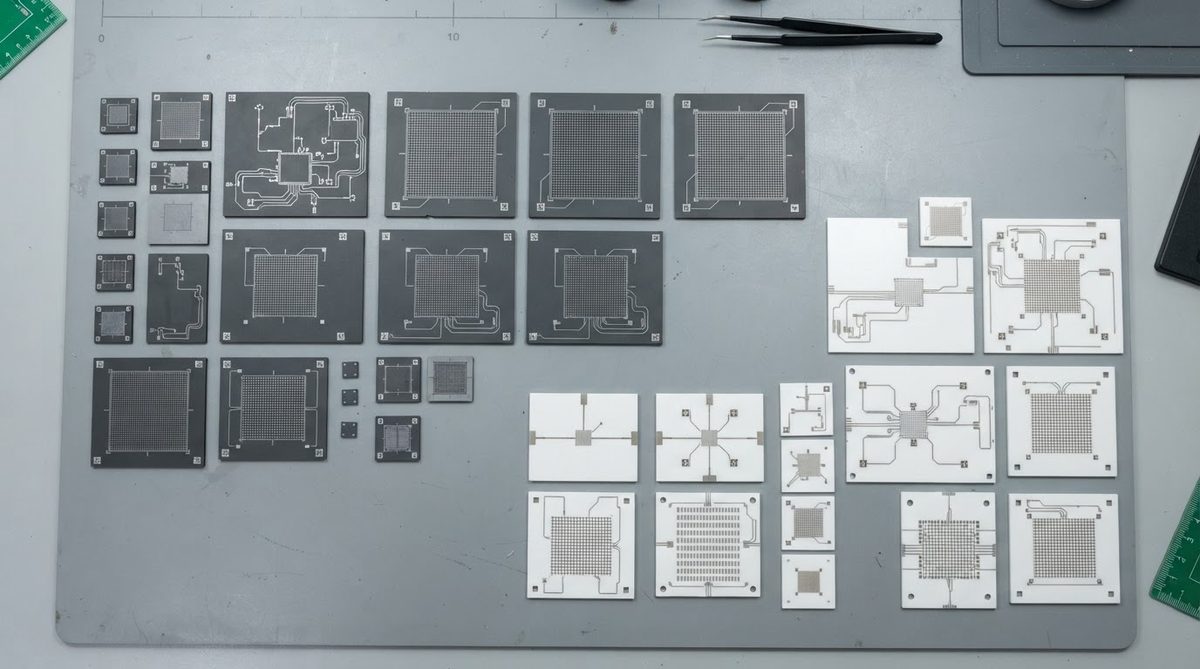
Sintering Consistency
Si3N4 quality depends on gas-pressure sintering conditions. Variations in peak temperature, hold time, or nitrogen partial pressure change grain morphology and directly affect both thermal conductivity and fracture toughness. Ask for lot-to-lot thermal conductivity data — not just a single datasheet value. A spread wider than ±5 W/mK within the same grade is a warning sign.
Surface Finish and Flatness
AMB braze quality depends on substrate surface roughness. Most AMB houses specify Ra ≤ 0.4 µm and total thickness variation (TTV) under 15 µm across the substrate. If you need tighter tolerances — for instance, for die-attach void control — look for suppliers offering polished or lapped Si3N4 substrates.
Supply Chain Transparency
The Si3N4 substrate market is concentrated among a handful of sintering houses (Toshiba Materials, Kyocera, Maruwa, SRM, and a growing number of Chinese producers). Many “manufacturers” are actually distributors re-selling from these sources. This is not inherently bad, but you should know who sintered your substrate, because it determines the grade and traceability. For more on how the ceramic substrate supply chain works, see that page.
Metallization Capability
Some suppliers sell bare substrates only. Others provide AMB-metallized substrates ready for circuit patterning. Buying metallized substrates from a single source reduces handling damage (Si3N4 is tough, but edges chip under careless handling) and simplifies incoming inspection.
When NOT to Use Si3N4
Si3N4 is expensive and thermally inferior to AlN in steady-state conduction. Choose a different substrate when:
- Thermal cycling is mild (< 500 cycles, ΔT < 80 K). AlN with DBC or AMB will perform adequately at a fraction of the cost.
- Steady-state heat flux is the dominant concern. AlN’s 170–200 W/mK will deliver a lower junction temperature than any Si3N4 grade.
- Budget is constrained and reliability targets are moderate. 96% alumina DBC substrates cost roughly 10–20% of Si3N4 AMB substrates and are sufficient for many industrial drives.
- You need LTCC or HTCC multilayer integration. Si3N4 is not processed via LTCC or HTCC. For embedded passives or multilayer routing, consider multilayer ceramic PCB builds on alumina.
Available Si3N4 Substrate Formats
AluminaPCB supplies Si3N4 substrates in several formats to match different stages of your design and production workflow:
- Bare substrates — as-sintered or laser-scribed for snap separation, in standard or custom panel sizes.
- Thin substrates — 0.25 mm Si3N4 for compact module stacks. Details on the Si3N4 thin substrate page.
- Custom-patterned PCBs — AMB-metallized, etched, and finished substrates ready for die attach.
Frequently Asked Questions
Is Si3N4 compatible with lead-free solder reflow?
Yes. Si3N4 substrates withstand peak reflow temperatures of 260 °C and above without degradation. The substrate itself is stable to over 1,000 °C in air. Solder joint reliability on AMB-metallized Si3N4 is well established in automotive power modules per AQG 324 qualification.
Can I get Si3N4 substrates thinner than 0.3 mm?
Yes. 0.25 mm Si3N4 substrates are commercially available and used in SiC power modules where package height is constrained. Thinner substrates reduce thermal resistance but require careful handling during AMB processing to avoid warpage.
How does Si3N4 compare to Si3N4-clad or ZTA for power modules?
Zirconia-toughened alumina (ZTA) offers higher toughness than plain alumina but does not match Si3N4’s fracture toughness or thermal-cycling endurance. ZTA is a cost-intermediate option for applications with moderate cycling demands. Si3N4 remains the benchmark for automotive-grade reliability.
What is the typical lead time for Si3N4 substrates?
Bare substrates from stock ship in 1–2 weeks. Custom-sized or metallized substrates typically require 4–8 weeks depending on volume and surface-finish requirements. High-κ grades may have longer lead times due to limited sintering capacity globally.
Does Si3N4 need any special storage conditions?
No. Si3N4 is chemically inert and does not absorb moisture. Standard ESD-safe packaging and dry, clean storage are sufficient. Unlike AlN, Si3N4 does not hydrolyze in humid environments, which simplifies incoming inspection and shelf-life management.
Next Step
If your power module design requires thermal-cycling reliability beyond what AlN or alumina can deliver, Si3N4 is the substrate to evaluate. Download the Si3N4 substrate datasheet for full property data, or request a quote with your substrate dimensions and metallization requirements at AluminaPCB.com.