So, what is alumina 99.6% Al2O3? It is a high-purity aluminum oxide ceramic that contains no more than 0.4% sintering additives by weight. Alumina 99.6% Al2O3 offers higher thermal conductivity (28–35 W/mK at 25 °C), greater dielectric strength (14–16 kV/mm), and better chemical inertness than the more common 96% grade — at roughly 1.5–2.5× the substrate cost. Engineers choose it for power electronics, high-frequency circuits, and sensor packages where the tighter property envelope justifies the price difference.
Key Takeaways
- Alumina 99.6% conducts heat at 28–35 W/mK (25 °C), roughly 20–30% more than 96% alumina’s 24–28 W/mK, per CoorsTek and Kyocera datasheets.
- Dielectric strength reaches 14–16 kV/mm (AC, 1 mm thick, per ASTM D149), enabling thinner substrates in high-voltage isolation designs.
- Flexural strength is 350–400 MPa (ASTM C1161, 4-point bend), compared to 300–350 MPa for 96% alumina.
- The material is compatible with DPC (direct plated copper), thick-film, and thin-film metallization processes.
- Substrate cost runs 1.5–2.5× that of 96% alumina; it remains far cheaper than aluminum nitride (AlN).
What Is Alumina 99.6% Al2O3 and How Does It Differ from 96%?
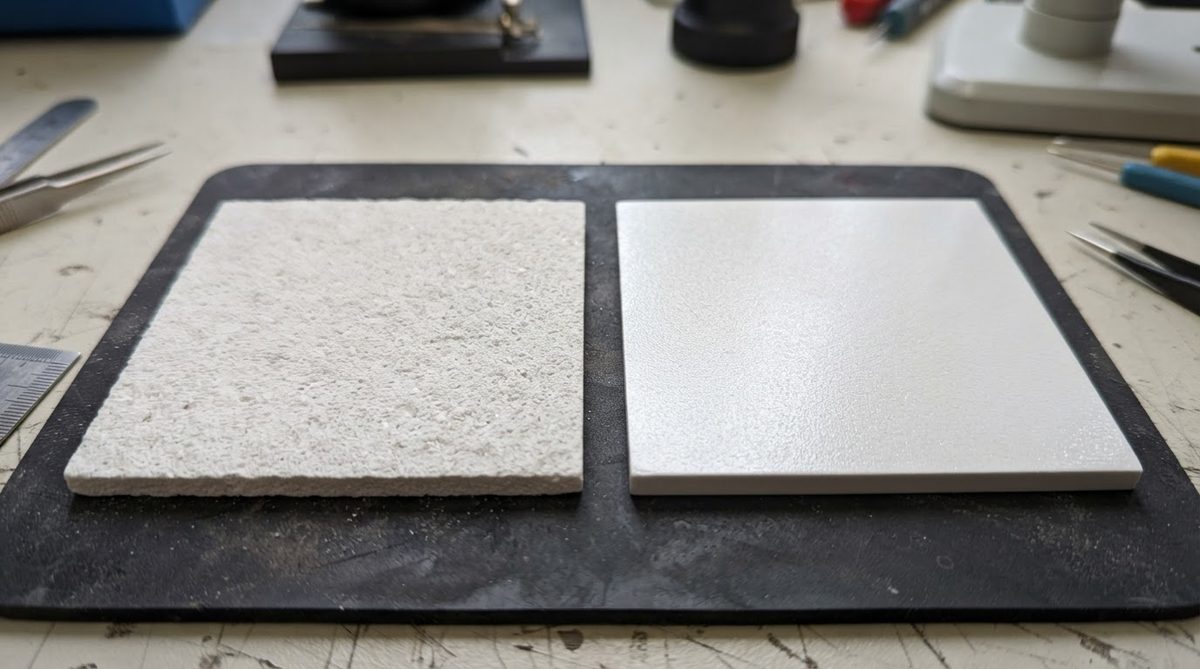
The “96%” and “99.6%” labels refer to the weight fraction of Al2O3 in the sintered body. The remaining material is a glassy phase — typically SiO2, MgO, and CaO — that acts as a sintering aid. Reducing that glassy phase from ~4% to ~0.4% changes the microstructure: grain boundaries are cleaner, porosity is lower, and the alumina grains themselves are more tightly packed.
In practical terms, this means three things. First, thermal conductivity rises because phonons scatter less at grain boundaries. Second, dielectric loss drops, which matters above 1 GHz. Third, chemical resistance improves because the glassy phase is the weakest link against acids and alkalis. If your design does not stress any of these three axes, standard 96% alumina substrates will serve you well at lower cost.
Material Properties of Alumina 99.6% Al2O3
| Parameter | Value | Unit | Condition | Source |
|---|---|---|---|---|
| Purity | ≥ 99.6 | wt% | — | CoorsTek ADS-996 |
| Density | 3.89–3.96 | g/cm³ | Sintered | Kyocera A-493 |
| Thermal conductivity | 28–35 | W/mK | 25 °C | CoorsTek ADS-996 |
| CTE | 7.1–8.0 | ppm/°C | 25–400 °C | Kyocera A-493 |
| Dielectric strength | 14–16 | kV/mm | AC, 1 mm, ASTM D149 | CoorsTek ADS-996 |
| Dielectric constant (εr) | 9.7–9.9 | — | 1 MHz, 25 °C | Kyocera A-493 |
| Loss tangent (tan δ) | 0.0001–0.0003 | — | 1 MHz, 25 °C | CoorsTek ADS-996 |
| Flexural strength | 350–400 | MPa | 4-pt bend, ASTM C1161 | CoorsTek ADS-996 |
| Volume resistivity | ≥ 1014 | Ω·cm | 25 °C | Kyocera A-493 |
| Max continuous use temp | 1600–1700 | °C | In air, no load | CeramTec |
Typical values for commercially available material, for comparison only. Confirm against the datasheet for your specific grade.
For a full downloadable property sheet, see the alumina 99.6% substrate datasheet. A deeper discussion of thermal behavior is covered in the 99.6% alumina thermal conductivity guide.
99.6% Alumina vs. 96% Alumina vs. AlN: Structured Comparison
Understanding what is alumina 99.6% Al2O3 becomes clearer when you compare it directly against the two materials it most often competes with: standard 96% alumina and aluminum nitride.
| Parameter | 96% Al2O3 | 99.6% Al2O3 | AlN | Unit / Condition |
|---|---|---|---|---|
| Thermal conductivity | 24–28 | 28–35 | 170–200 | W/mK, 25 °C |
| CTE | 7.0–8.2 | 7.1–8.0 | 4.5–5.0 | ppm/°C, 25–400 °C |
| Dielectric strength | 10–14 | 14–16 | 15–17 | kV/mm, 1 mm |
| Flexural strength | 300–350 | 350–400 | 300–350 | MPa, 4-pt bend |
| tan δ at 1 MHz | 0.0002–0.001 | 0.0001–0.0003 | 0.0003–0.001 | — |
| Relative substrate cost | 1× | 1.5–2.5× | 5–8× | per cm², comparable thickness |
Sources: CoorsTek ADS-960, ADS-996; Kyocera A-493; Maruwa AlN datasheet. Ranges reflect supplier variation.
The table shows that alumina 99.6% Al2O3 sits in a middle ground. It does not approach AlN’s thermal conductivity, but it costs far less and offers higher flexural strength. It edges out 96% alumina on every electrical and thermal parameter by a modest margin. The decision often comes down to whether that margin matters for your thermal budget.
Worked Example: Does 99.6% Save You a Degree?
Consider a 10 mm × 10 mm substrate, 0.635 mm thick, conducting 5 W uniformly through its thickness.
Thermal resistance (Rth) = thickness / (k × area)
- 96% alumina (k = 26 W/mK): Rth = 0.000635 / (26 × 0.0001) = 0.244 °C/W → ΔT = 5 × 0.244 = 1.22 °C
- 99.6% alumina (k = 32 W/mK): Rth = 0.000635 / (32 × 0.0001) = 0.198 °C/W → ΔT = 5 × 0.198 = 0.99 °C
The upgrade saves about 0.23 °C in this scenario. At 5 W over 1 cm², that is marginal. Scale the power to 50 W (a power MOSFET die on a DBC substrate) and the difference grows to 2.3 °C — enough to shift a junction temperature below a derating threshold. The value of 99.6% alumina is proportional to your power density.
Enter your own substrate dimensions, thickness, and dissipated power below to estimate the temperature rise for both 96% and 99.6% alumina grades.
Common Applications for Alumina 99.6% Al2O3
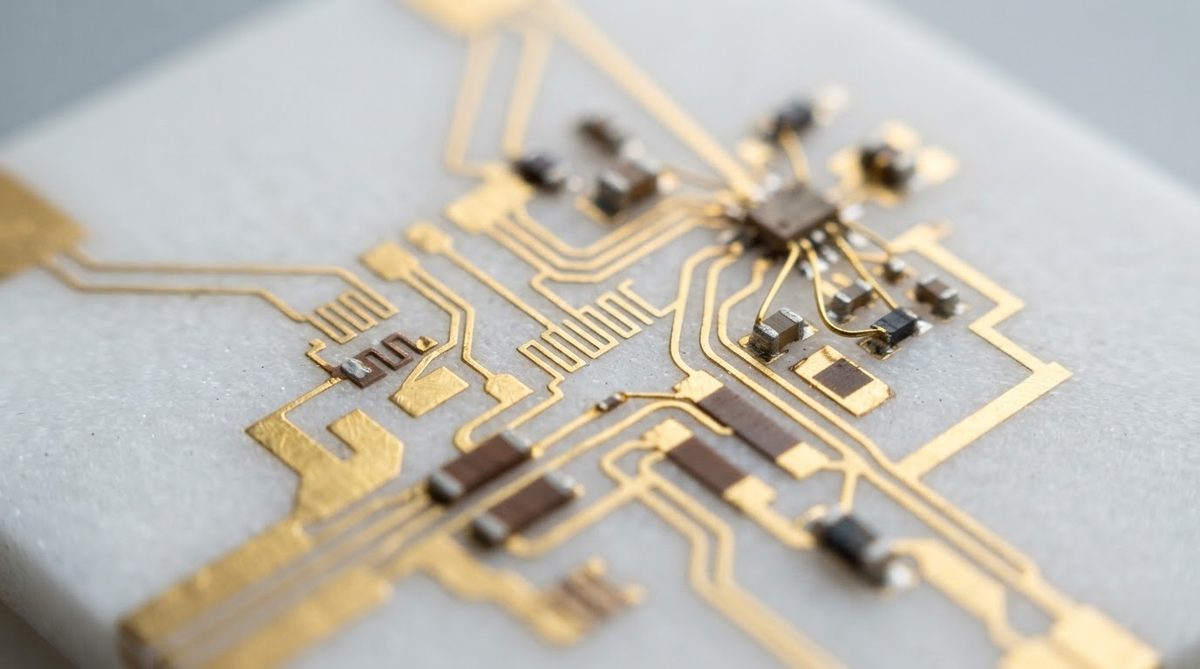
Now that you know what is alumina 99.6% Al2O3 in terms of properties, here is where those properties pay off in practice:
- Thin-film resistor networks and hybrid circuits — the smooth, low-porosity surface (Ra < 0.2 µm after polishing) supports consistent thin-film deposition.
- High-voltage isolation substrates — the higher dielectric strength allows thinner substrates for the same isolation voltage per IEC 60664.
- RF and microwave packages — the lower loss tangent reduces insertion loss above 1 GHz compared to 96% alumina.
- Medical implant electronics — the reduced glassy phase improves resistance to body fluids.
- Sensor housings in corrosive environments — chemical inertness exceeds 96% alumina in strong acids and alkalis.
If your project needs custom metallized substrates in this grade, custom alumina 99.6% PCB fabrication covers design rules and ordering details.
Compatible Metallization and Processing
Alumina 99.6% Al2O3 works with the same metallization methods as 96% alumina: thick-film screen printing (Au, Ag, AgPd, W, Mo), thin-film sputtering (TiW/Au, Cr/Cu, NiCr), and DPC (direct plated copper). It is also used as a base substrate in DBC (direct bonded copper) assemblies, though AlN and silicon nitride (Si3N4) are more common for DBC in high-power modules.
One processing difference: the lower glassy phase content means 99.6% alumina sinters at a higher temperature (~1650–1750 °C vs. ~1550–1650 °C for 96%). This does not affect PCB fabrication — you receive a finished substrate — but it contributes to the cost premium.
When Not to Use 99.6% Alumina
If 96% alumina meets your thermal and electrical requirements, use it. The cost premium of 99.6% is wasted on designs that are not thermally or electrically marginal. Specifically:
- Low-power LED boards or general sensor PCBs — 96% alumina at 24–28 W/mK handles most designs under 10 W/cm². See the 96% alumina thermal design guide for worked examples.
- High-power modules above ~80 W/cm² — the 28–35 W/mK of 99.6% alumina is still insufficient. AlN (170–200 W/mK) or Si3N4 with DBC/AMB is the right call.
- Cost-sensitive, high-volume consumer products — FR-4 or metal-core PCBs are orders of magnitude cheaper and perfectly adequate for modest thermal loads.
- Designs requiring mechanical toughness over hardness — alumina is hard but brittle. For substrates that must survive mechanical shock or vibration without fracture, consider zirconia-toughened alumina (ZTA), which trades some thermal conductivity for fracture toughness.
Frequently Asked Questions
Is 99.6% alumina the same as “high-purity alumina”?
Yes, in the PCB substrate industry “high-purity alumina” almost always means 99.5% or 99.6% Al2O3. Purities above 99.9% exist (for sapphire windows, optical components) but are rarely used as PCB substrates due to extreme cost and limited availability in standard substrate sizes.
Can I solder components directly to a 99.6% alumina substrate?
You can solder to it after metallization, not to the bare ceramic. Standard reflow soldering (SAC305, peak 245–260 °C) works fine on thick-film or thin-film metallized 99.6% substrates. The ceramic itself tolerates temperatures well above any solder liquidus.
Does 99.6% alumina have better surface finish than 96%?
Typically yes. As-fired 99.6% alumina achieves Ra 0.3–0.8 µm, versus Ra 0.5–1.2 µm for 96% alumina, because the lower glassy phase produces a finer, more uniform grain structure. After lapping and polishing, 99.6% substrates reach Ra < 0.1 µm, which is important for thin-film circuit uniformity.
How does 99.6% alumina perform at cryogenic temperatures?
Alumina retains its dielectric properties and mechanical strength down to cryogenic temperatures (4 K and below). Thermal conductivity actually peaks around 30–40 K for high-purity grades before dropping again, a behavior well-documented in NIST cryogenic materials data. This makes 99.6% alumina suitable for superconducting electronics and cryogenic sensor packages.
What thickness options are available for 99.6% alumina substrates?
Standard substrate thicknesses range from 0.25 mm to 2.0 mm, with 0.381 mm (0.015″) and 0.635 mm (0.025″) being the most commonly stocked sizes. Thinner substrates (down to 0.127 mm) are available from some suppliers but require careful handling due to fragility.
Next Step
If you are comparing 99.6% alumina against other substrate materials for a specific design, the 99.6% alumina material properties page provides downloadable data in a format you can plug into your thermal model. For questions not covered here, the ceramic PCB FAQ addresses over 60 common engineering and sourcing questions.
Last reviewed: 2025-07