If you are asking what is zirconia toughened ZTA, the short answer is this: zirconia-toughened alumina (ZTA) is a ceramic composite made by dispersing 10–20 vol% zirconia (ZrO₂) particles throughout an alumina (Al₂O₃) matrix. The zirconia phase undergoes a stress-induced tetragonal-to-monoclinic transformation at crack tips, absorbing energy and roughly doubling the fracture toughness compared with standard 96% or 99.6% alumina. ZTA retains much of alumina’s high stiffness, electrical insulation, and thermal stability, making it useful where mechanical shock or vibration would crack a pure alumina substrate.
Key Takeaways
- ZTA typically contains 10–20 vol% ZrO₂ in an Al₂O₃ matrix, yielding fracture toughness of 5–8 MPa·√m versus 3–4 MPa·√m for 96% alumina (per ASTM C1421 indentation fracture testing).
- Thermal conductivity drops modestly: 20–24 W/mK for ZTA versus 24–28 W/mK for 96% Al₂O₃ at 25 °C.
- ZTA is processed by conventional sintering at 1500–1600 °C and can be laser-cut into custom substrate shapes after firing.
- The material is a good fit for high-vibration or mechanically loaded environments, but costs 1.5–3× more than standard alumina substrates.
- ZTA is not compatible with HTCC or LTCC co-firing processes; it is used as a pre-sintered substrate that is metallized afterward.
What Is Zirconia Toughened ZTA and How Does It Work?
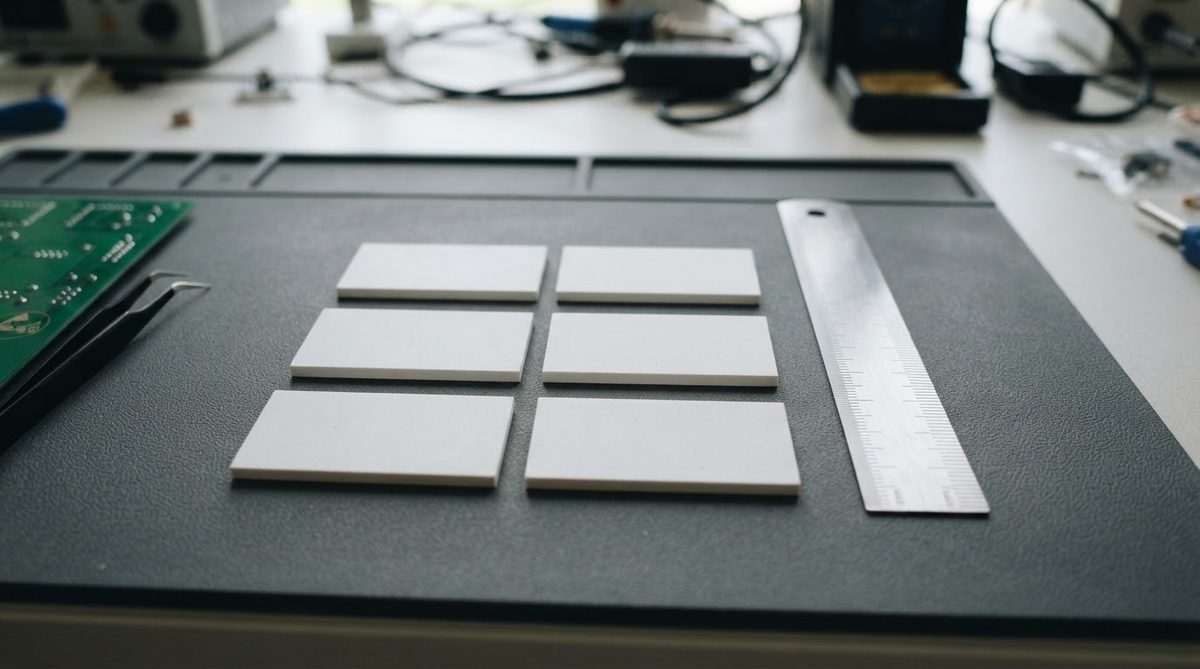
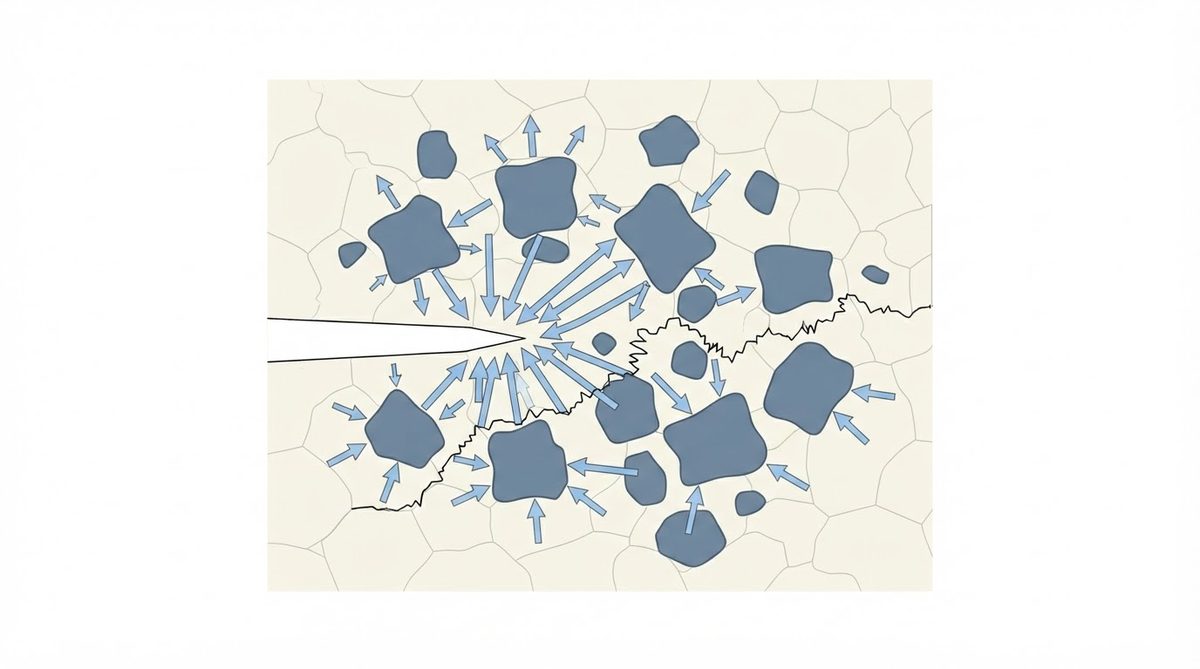
Pure alumina is hard and stiff but brittle. A crack, once initiated, propagates with little resistance. Understanding what is zirconia toughened ZTA starts with the mechanism called transformation toughening, first described by Garvie, Hannink, and Pascoe in 1975.
Metastable tetragonal ZrO₂ particles are dispersed throughout the alumina grain structure during powder processing and sintering. When a crack tip approaches a zirconia grain, the local stress field triggers a phase transformation from tetragonal to monoclinic ZrO₂. This transformation involves a 3–5% volume expansion that compresses the region around the crack tip, effectively clamping it shut and demanding more energy for further propagation.
The amount and particle size of the zirconia phase matter. Too little ZrO₂ (below ~8 vol%) gives negligible toughening. Too much (above ~25 vol%) reduces thermal conductivity and dielectric performance without proportional toughness gains. Most commercial ZTA grades settle on 10–20 vol% stabilized with small amounts of yttria (Y₂O₃) or ceria (CeO₂) to keep the tetragonal phase metastable at room temperature.
ZTA Material Properties Compared with Standard Alumina
Engineers evaluating what is zirconia toughened ZTA for a real project need hard numbers. The table below compares ZTA against the two most common alumina grades used in ceramic PCB substrates.
| Parameter | 96% Al₂O₃ | 99.6% Al₂O₃ | ZTA (85/15 vol%) | Unit | Condition | Source |
|---|---|---|---|---|---|---|
| Fracture toughness (K_IC) | 3.5–4.0 | 3.8–4.2 | 5.5–8.0 | MPa·√m | ASTM C1421, 25 °C | CoorsTek technical data; CeramTec |
| Flexural strength | 350–380 | 400–450 | 500–700 | MPa | ASTM C1161 4-pt bend, 25 °C | CeramTec; Kyocera |
| Thermal conductivity | 24–28 | 30–35 | 20–24 | W/mK | 25 °C | CoorsTek; Maruwa |
| CTE | 7.2–7.4 | 7.6–8.0 | 7.8–8.5 | ppm/°C | 25–300 °C | CeramTec |
| Dielectric constant (εr) | 9.4–9.8 | 9.8–10.0 | 10.0–11.5 | — | 1 MHz, 25 °C | CoorsTek |
| Volume resistivity | >10¹⁴ | >10¹⁴ | >10¹³ | Ω·cm | 25 °C | CeramTec |
| Max use temperature | 1600 | 1700 | 1500 | °C | In air, no load | CeramTec |
Typical values for commercially available material, for comparison only. Confirm against the datasheet for your specific grade.
The table shows the core trade-off. ZTA gains 50–100% in fracture toughness and flexural strength at the expense of a modest drop in thermal conductivity (roughly 15–20%) and a slight increase in dielectric constant. For most substrate applications, these electrical and thermal penalties are acceptable when mechanical reliability is the primary concern. For a deeper look at standard 96% alumina properties, see our dedicated datasheet page.
Enter your substrate dimensions and operating conditions below to see how ZTA’s thermal performance compares at elevated temperatures.
Where ZTA Substrates Make Sense
High-Vibration Electronics
Avionics, downhole drilling sensors, and vehicle-mounted power modules experience sustained vibration that can fatigue-crack standard alumina. ZTA’s higher K_IC extends the fatigue life of the substrate under cyclic loading. If your board sees random vibration above 10 g RMS, ZTA deserves evaluation.
Mechanically Loaded Sensor Packages
Pressure sensors and load cells sometimes use the ceramic substrate as a structural member. ZTA’s flexural strength of 500–700 MPa provides a meaningful safety margin over the 350–380 MPa of 96% alumina, reducing the risk of brittle failure under proof-pressure testing.
Thick-Film Hybrid Circuits
ZTA substrates accept standard thick-film pastes (Ag, Au, Ag-Pd) and can be processed through the same screen-printing and firing steps used for alumina hybrids. The ceramic PCB manufacturing process is essentially unchanged; only the raw substrate differs. For projects requiring copper metallization, metallized ceramic substrates are available in ZTA as well as standard alumina.
Worked Example: Fracture Risk Under Thermal Shock
Consider a 25 × 25 × 0.635 mm substrate cooled rapidly from 300 °C to 25 °C in a quench test. The thermal stress (σ_th) can be estimated as:
σ_th = E · α · ΔT / (1 − ν)
For 96% Al₂O₃: E ≈ 370 GPa, α ≈ 7.3 × 10⁻⁶ /°C, ν ≈ 0.22, ΔT = 275 °C.
σ_th ≈ 370 × 10³ × 7.3 × 10⁻⁶ × 275 / (1 − 0.22) ≈ 952 MPa.
This exceeds the flexural strength of 96% alumina (350–380 MPa), so surface flaws will propagate. In practice, the actual stress is lower due to heat-transfer limitations, but the calculation shows the substrate is deep in the danger zone.
For ZTA (E ≈ 350 GPa, α ≈ 8.1 × 10⁻⁶ /°C, ν ≈ 0.23): σ_th ≈ 350 × 10³ × 8.1 × 10⁻⁶ × 275 / (1 − 0.23) ≈ 1012 MPa. The thermal stress is actually similar. ZTA does not reduce the stress; it increases the energy needed to propagate a crack once stress exceeds the initiation threshold. A ZTA substrate with the same surface flaw population survives more thermal cycles before catastrophic failure because each cycle dissipates more energy in the transformation zone around the crack tip. This distinction matters: ZTA is not more thermal-shock resistant in the classical ΔT_c sense, but it is more damage-tolerant. This nuance is central to understanding what is zirconia toughened ZTA and where its real advantage lies.
When Not to Use ZTA
Cost-sensitive, low-vibration applications. If your board sits in a benchtop instrument or a consumer LED module, standard 96% alumina at roughly half the substrate cost is the rational choice. ZTA’s toughness premium is wasted in a static, thermally benign environment.
High-frequency RF circuits. ZTA’s dielectric constant (10–11.5 at 1 MHz) is higher and less tightly controlled than 99.6% alumina. For impedance-controlled RF lines above a few GHz, the added ZrO₂ phase introduces dielectric variability that complicates trace-width calculations.
Maximum thermal conductivity. If heat spreading is the primary design driver, aluminum nitride (170–200 W/mK) or even 99.6% alumina (30–35 W/mK) outperforms ZTA. See our ceramic PCB FAQ for guidance on choosing between substrate materials.
HTCC or LTCC co-firing. ZTA is a pre-sintered substrate. It is not available as a green tape for multilayer co-fired processing.
Frequently Asked Questions
Is ZTA the same as zirconia (ZrO₂)?
No. ZTA is primarily alumina (80–90 vol%) with a minority zirconia addition. Pure zirconia ceramics (such as yttria-stabilized zirconia, YSZ) are a different material family with higher toughness but much lower thermal conductivity (2–3 W/mK) and different sintering requirements.
Can I solder components directly onto a ZTA substrate?
Yes, provided the substrate is metallized first. ZTA accepts the same thick-film and thin-film metallization processes used on alumina. Standard Sn-Ag-Cu (SAC) and Au-Sn solders wet properly on metallized ZTA surfaces.
Does ZTA cost more than alumina?
Expect 1.5–3× the raw substrate cost versus 96% Al₂O₃, depending on volume and size. The zirconia powder itself is more expensive, and tighter particle-size control during powder processing adds cost. Downstream metallization and assembly costs are essentially the same.
What zirconia content is typical in commercial ZTA?
Most commercial ZTA grades contain 10–20 vol% ZrO₂. CeramTec’s Rubalit® ZTA line uses approximately 15 vol%. Higher zirconia fractions exist in research but are rarely offered as standard substrates because the dielectric and thermal penalties grow faster than the toughness gains.
Can ZTA be machined after sintering?
Yes. Diamond grinding and laser cutting both work on sintered ZTA. Laser cutting is preferred for complex outlines and small features because it avoids the micro-cracking risk of mechanical grinding. For more on this, see our page on laser-cut ceramic substrates.
Next Step
If your application involves vibration, mechanical loading, or repeated thermal cycling and you need better damage tolerance than standard alumina, ZTA is worth prototyping. Review the full ZTA PCB product page for available substrate sizes and metallization options, or request a quote to get pricing for your specific layout.