Silicon nitride Si3N4 thermal conductivity typically falls between 20 and 90 W/mK at 25 °C, depending on grain structure, sintering additives, and density. That places Si3N4 well below aluminum nitride (170–230 W/mK) but above standard 96% alumina (24–28 W/mK) for most commercial grades. Engineers choose Si3N4 not for raw thermal throughput but for its exceptional fracture toughness and thermal-shock resistance, which allow thinner substrates that partially offset the lower bulk conductivity.
Key Takeaways
- Commercial Si3N4 substrates range from roughly 20 W/mK (reaction-bonded grades) to 80–90 W/mK (high-purity sintered grades) at 25 °C, per published data from Kyocera (SN series) and CoorsTek.
- Si3N4 fracture toughness of 6–8 MPa·√m (ASTM C1421) is 3–4× higher than AlN or Al2O3, enabling substrates as thin as 0.32 mm without cracking under thermal cycling.
- Effective thermal resistance through a 0.32 mm Si3N4 substrate at 90 W/mK can match a 0.635 mm AlN substrate at 170 W/mK for the same footprint area.
- Si3N4 is the dominant substrate for SiC and GaN power modules in automotive traction inverters, where thermal-cycle reliability matters more than peak conductivity.
- Cost per substrate is typically 2–4× higher than AlN and 5–10× higher than 96% alumina.
What Controls Silicon Nitride Si3N4 Thermal Conductivity?
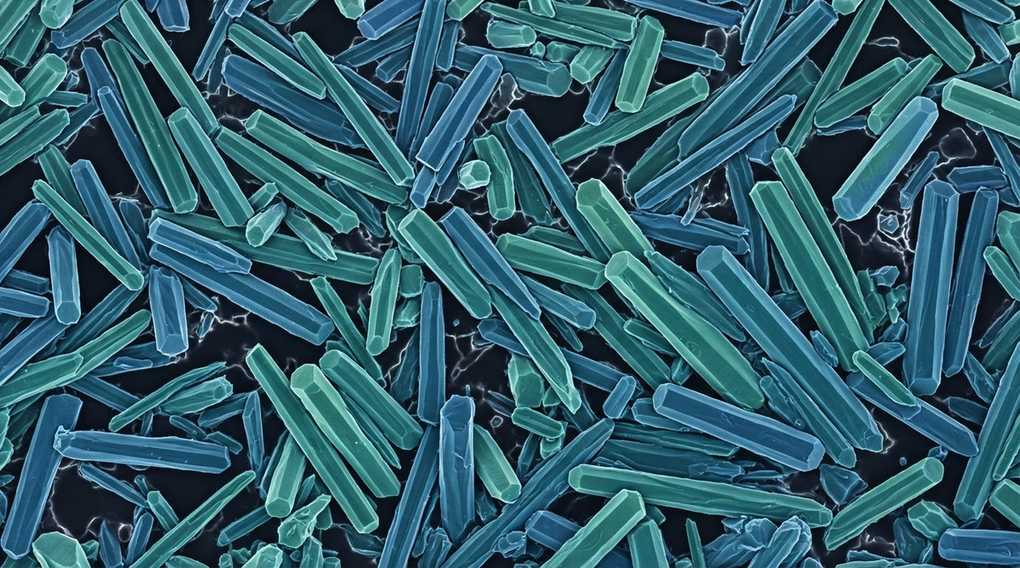
Thermal conductivity in silicon nitride is governed by phonon transport through the β-Si3N4 crystal lattice. Anything that scatters phonons—grain boundaries, oxygen impurities, residual sintering-aid phases at triple junctions—reduces conductivity. Three factors dominate:
Grain morphology. β-Si3N4 grains are elongated and anisotropic. Larger, more aligned grains create longer mean free paths for phonons. Hot-pressed and gas-pressure-sintered (GPS) grades develop coarser microstructures, reaching 60–90 W/mK. Reaction-bonded silicon nitride (RBSN), which retains fine, equiaxed grains and residual porosity, stays in the 15–25 W/mK range.
Oxygen and additive content. Sintering aids such as Y2O3 and MgO form a glassy grain-boundary phase. This amorphous layer is a thermal bottleneck. Reducing total oxygen content below 2 wt% and minimizing additive volume pushes silicon nitride Si3N4 thermal conductivity above 70 W/mK. Kyocera’s SN-90 grade, for example, achieves ~90 W/mK by controlling both parameters (Kyocera Advanced Ceramics datasheet, SN series).
Density. Porosity kills conductivity. Fully dense Si3N4 (≥ 99% theoretical density, ~3.21 g/cm³) is necessary to approach the 80–90 W/mK ceiling. Each percent of porosity can drop conductivity by 5–10 W/mK.
Si3N4 Thermal Conductivity Compared to Other Ceramic Substrates
| Parameter | Si3N4 (high κ grade) | Si3N4 (standard grade) | AlN | 96% Al2O3 | 99.6% Al2O3 |
|---|---|---|---|---|---|
| Thermal conductivity (W/mK, 25 °C) | 80–90 | 20–30 | 170–230 | 24–28 | 28–35 |
| Flexural strength (MPa, ASTM C1161) | 700–900 | 600–800 | 300–400 | 300–380 | 350–400 |
| Fracture toughness (MPa·√m, ASTM C1421) | 6–8 | 5–7 | 2.5–3.5 | 3–4 | 3.5–4.5 |
| CTE (ppm/°C, 25–400 °C) | 2.5–3.4 | 2.5–3.4 | 4.5–5.0 | 7.0–8.0 | 7.2–8.2 |
| Min practical thickness (mm) | 0.25–0.32 | 0.32 | 0.50–0.635 | 0.38–0.50 | 0.38–0.50 |
| Typical substrate cost (relative) | 8–12× | 5–8× | 3–5× | 1× (baseline) | 1.5–2× |
Typical values for commercially available material, for comparison only. Confirm against the datasheet for your specific grade. Sources: Kyocera SN-series datasheet; CoorsTek CERALLOY® 147 series; Maruwa HA-series Al2O3.
For a broader comparison across all common substrate ceramics, see the ceramic substrate material comparison.
Worked Example: Effective Thermal Resistance of Si3N4 vs. AlN
Thermal resistance through a flat substrate is Rth = t / (κ × A), where t is thickness, κ is thermal conductivity, and A is the heat-spreading area. Consider a 10 mm × 10 mm die footprint:
Case 1 — AlN, 0.635 mm thick, κ = 180 W/mK:
Rth = 0.000635 / (180 × 0.0001) = 0.035 °C/W
Case 2 — Si3N4, 0.32 mm thick, κ = 90 W/mK:
Rth = 0.00032 / (90 × 0.0001) = 0.036 °C/W
The two are nearly identical. Si3N4’s lower conductivity is compensated by the thinner substrate that its mechanical strength permits. This equivalence is exactly why automotive OEMs and Tier-1 suppliers have moved to Si3N4 AMB (active metal brazed) substrates for SiC traction inverters. The thinner substrate matches AlN on steady-state thermal resistance while surviving 3,000+ deep thermal cycles (−40 °C to +175 °C) that would crack AlN. For a more detailed breakdown of the math, walk through the ceramic substrate thermal resistance calculation.
Enter your substrate thickness, area, and dissipated power below to estimate junction temperature rise for Si3N4 or any other ceramic material.
Why Si3N4 Wins on Reliability, Not Peak Conductivity
Silicon nitride Si3N4 thermal conductivity is only one term in the system-level equation. Substrate cracking during power cycling is a primary failure mode in high-power modules. Si3N4’s fracture toughness (6–8 MPa·√m) and relatively low CTE (2.5–3.4 ppm/°C) make it far more resistant to thermomechanical fatigue than AlN. Published reliability data from Infineon and Hitachi Energy show Si3N4 AMB modules surviving 5–10× more power cycles than equivalent AlN DBC modules under the same ΔT conditions.
If your design must survive aggressive thermal cycling—automotive, aerospace, or downhole applications—Si3N4 is often the only ceramic substrate that meets the lifetime requirement. For context on how high ceramic substrates can operate, see maximum operating temperature of ceramic PCBs.
Metallization Options for Si3N4 Substrates
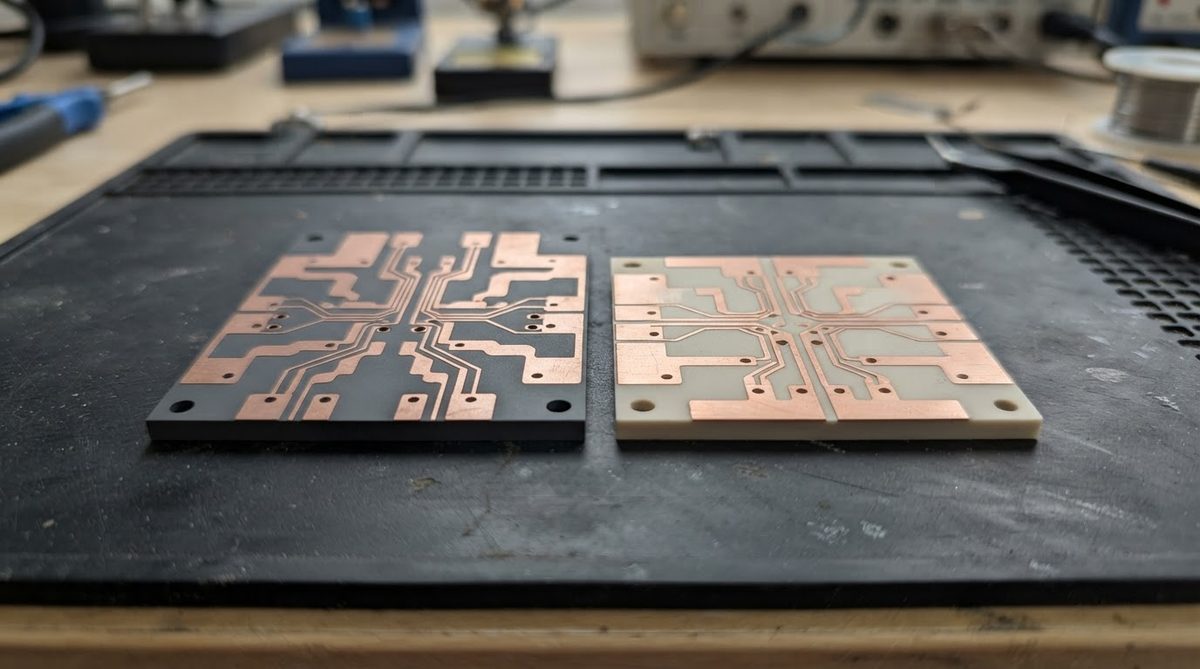
Si3N4 is almost exclusively metallized by active metal brazing (AMB). In AMB, a braze alloy containing titanium (typically AgCuTi) bonds copper foil directly to the ceramic at 800–900 °C. The titanium reacts with nitrogen at the Si3N4 surface to form a TiN interfacial layer, creating a strong chemical bond.
Direct bond copper (DBC), the standard process for Al2O3 and AlN, does not work well on Si3N4 because DBC relies on a copper-oxide eutectic that needs an oxide ceramic surface. Si3N4 is a nitride, so DBC does not form a reliable bond. Thick-film and thin-film metallization are also uncommon on Si3N4 due to adhesion challenges and the material’s primary use in power-module packaging rather than printed circuitry.
To understand how thermal vias and copper planes interact with these substrates, the thermal via design for ceramic boards covers layout strategies.
When NOT to Use Si3N4
If thermal conductivity is the primary constraint and reliability requirements are moderate, AlN at 0.635 mm will outperform Si3N4 at lower cost. LED thermal substrates, RF power amplifier carriers, and many industrial IGBT modules fall into this category.
If cost is the primary constraint, 96% alumina at 24–28 W/mK handles most applications below roughly 30 W of dissipated power per cm². Si3N4 substrates cost 5–12× more. For a detailed look at alumina’s thermal behavior, see ceramic thermal management options.
If you need fine-line circuitry (trace/space below 100 µm), DPC or thin-film processes on alumina or AlN are better suited. Si3N4 AMB substrates typically support minimum trace widths of 0.3–0.5 mm, adequate for power busbars but not for signal routing.
If your operating temperature stays below 125 °C and thermal cycles are mild, the mechanical advantage of Si3N4 is wasted. An AlN DBC substrate will perform identically at half the substrate cost. Understanding silicon nitride Si3N4 thermal conductivity in context means recognizing where that toughness premium pays off and where it does not.
Modeling Si3N4 Thermal Performance
When building FEA models, use temperature-dependent conductivity data. Silicon nitride Si3N4 thermal conductivity drops roughly 15–20% between 25 °C and 300 °C for most commercial grades. Kyocera publishes κ vs. temperature curves in their SN-series datasheets. If you are setting up a simulation, the thermal simulation guide for ceramic boards walks through boundary conditions and meshing recommendations specific to ceramic substrates.
Frequently Asked Questions
Is 90 W/mK the highest silicon nitride Si3N4 thermal conductivity available?
Commercially, yes—roughly 80–90 W/mK is the current ceiling for production-grade Si3N4 substrates (e.g., Kyocera SN-90, Toshiba TSN-90). Laboratory samples have exceeded 100 W/mK by further reducing oxygen content and growing very large β-grains, but these are not yet available in volume.
Can I use Si3N4 substrates with DBC metallization?
No. DBC requires a copper-oxide eutectic bond to an oxide ceramic surface. Si3N4 is a nitride, so DBC does not form a reliable bond. Active metal brazing (AMB) is the standard metallization method for Si3N4 power substrates.
Does Si3N4 thermal conductivity change with temperature?
Yes. Conductivity decreases as temperature rises because phonon-phonon scattering increases. A grade rated at 90 W/mK at 25 °C may drop to 70–75 W/mK at 300 °C. Always use temperature-dependent data in thermal simulations rather than a single room-temperature value.
Why is Si3N4 so much more expensive than AlN or alumina?
Sintering Si3N4 to full density requires gas-pressure sintering at 1,700–1,900 °C under nitrogen atmosphere, which is slower and more energy-intensive than sintering Al2O3 or AlN. High-conductivity grades also demand ultra-pure raw powders and tightly controlled additive chemistries, further increasing cost.
What thickness of Si3N4 should I specify for a power module?
Most automotive SiC power modules use 0.32 mm Si3N4 AMB substrates. This thickness balances thermal resistance, dielectric withstand voltage (typically > 5 kV per IEC 60664), and mechanical robustness under thermal cycling. Thinner substrates (0.25 mm) exist but require careful handling and may limit copper thickness.
Next Step
If you are evaluating Si3N4 alongside AlN or alumina for a power-module or high-reliability application, start by running the thermal resistance numbers for your actual die size and power dissipation. For questions about substrate availability, thickness options, or AMB metallization, the ceramic PCB FAQ covers common sourcing topics.