Silicon nitride (Si3N4) is a covalent-bonded ceramic with a rare combination of high fracture toughness (6–7 MPa·√m), high flexural strength (600–900 MPa), and moderate thermal conductivity (70–90 W/mK at 25 °C). Understanding silicon nitride Si3N4 properties is essential for engineers selecting substrates for power-electronics modules. Among the ceramics used for these substrates, Si3N4 is the only material that can survive repeated thermal cycling without crack propagation, which is why it dominates EV traction inverter and railway converter module designs.
Key Takeaways
- Si3N4 flexural strength is 600–900 MPa (ASTM C1161, 3-point bend), roughly 3× that of 96% alumina and 2× that of AlN.
- Thermal conductivity of substrate-grade Si3N4 ranges from 70 to 90 W/mK at 25 °C, between alumina (24–28 W/mK) and AlN (170–200 W/mK).
- CTE of 2.6–3.0 ppm/K (20–400 °C) closely matches silicon (2.6 ppm/K), reducing solder-joint stress in die-attach.
- Fracture toughness of 6–7 MPa·√m allows Si3N4 substrates to be thinned to 0.32 mm or even 0.20 mm without cracking during AMB or DBC metallisation.
- Si3N4 substrates cost roughly 4–8× more than 96% alumina per unit area, so they are justified only where reliability under thermal cycling is the primary design driver.
What Is Silicon Nitride?
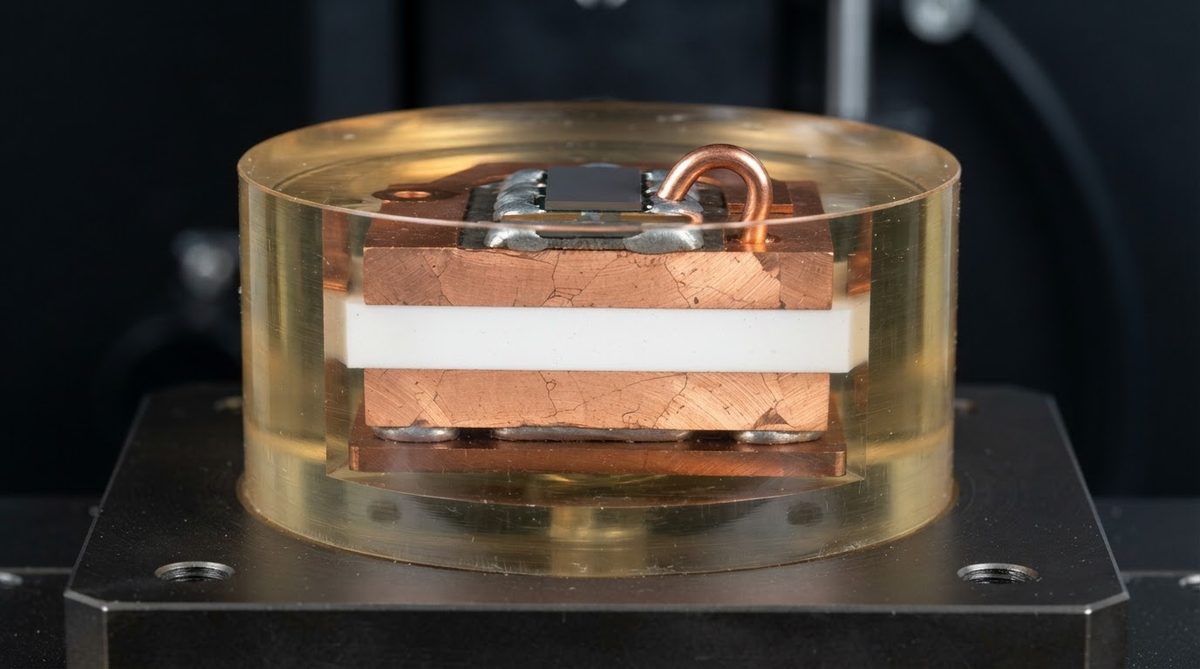
Silicon nitride is a non-oxide ceramic with the chemical formula Si3N4. It exists in two main crystallographic phases: α-Si3N4 (equiaxed grains, used in powder form) and β-Si3N4 (elongated rod-like grains, the phase that gives sintered bodies their toughness). Substrate-grade material is hot-pressed or gas-pressure sintered with small additions of sintering aids—typically Y2O3 and MgO—that form a thin intergranular glassy phase. The elongated β grains interlock, creating a microstructure that deflects and bridges cracks rather than letting them propagate. This is the mechanism behind Si3N4’s exceptional fracture toughness.
For a broader comparison of substrate ceramics, see the ceramic substrate material selection guide.
Silicon Nitride Si3N4 Properties: Full Data Table
| Property | Value | Unit | Condition | Source |
|---|---|---|---|---|
| Density | 3.20–3.26 | g/cm³ | Sintered, room temp. | Kyocera SN-220 / Toshiba TSN-03NH datasheets |
| Flexural strength | 600–900 | MPa | 3-pt bend, ASTM C1161, 25 °C | Kyocera SN-220 (≥ 650 MPa); Toshiba TSN-03NH (≥ 700 MPa) |
| Fracture toughness (KIC) | 6–7 | MPa·√m | SEVNB or IF method, 25 °C | CoorsTek SC-211; Kyocera SN-220 |
| Elastic modulus (Young’s) | 290–320 | GPa | 25 °C | Kyocera SN-220 |
| Vickers hardness | 13–15 | GPa | HV 1.0, 25 °C | CoorsTek SC-211 |
| Thermal conductivity | 70–90 | W/mK | 25 °C, substrate grade | Toshiba TSN-03NH (90 W/mK); Kyocera SN-220 (70 W/mK) |
| CTE | 2.6–3.0 | ppm/K | 20–400 °C | Kyocera SN-220 (2.7); Toshiba TSN-03NH (2.7) |
| Dielectric constant (εr) | 7.9–8.5 | — | 1 MHz, 25 °C | Kyocera SN-220 |
| Dielectric strength | 15–18 | kV/mm | AC, 25 °C | Toshiba TSN-03NH |
| Volume resistivity | ≥ 1013 | Ω·cm | 25 °C | Kyocera SN-220 |
| Max. continuous use temp. | 1,000–1,200 | °C | In air, unloaded | CoorsTek SC-211 |
| Thermal shock resistance (ΔT) | 600–800 | °C | Water quench, no crack | Literature review, Krstic 1992 |
| Weibull modulus | 15–25 | — | 3-pt bend | Toshiba TSN-03NH |
Typical values for commercially available material, for comparison only. Confirm against the datasheet for your specific grade.
Thermal Conductivity: How Si3N4 Compares
Substrate-grade Si3N4 reaches 70–90 W/mK at 25 °C. Standard grades used for structural bearings are lower, around 20–30 W/mK, because they contain more intergranular glass phase. The high-conductivity grades achieve their performance by reducing oxygen content in the lattice and growing larger, more aligned β-Si3N4 grains during sintering. Toshiba’s TSN-03NH specifies 90 W/mK; Kyocera’s SN-220 specifies 70 W/mK.
This puts Si3N4 well below aluminum nitride (AlN) substrates at 170–200 W/mK, but roughly 3× above 96% alumina at 24–28 W/mK. The trade-off is clear: if pure thermal conductivity is the only concern, AlN wins. If the substrate must survive thousands of –40 °C to +150 °C thermal cycles without cracking, the silicon nitride Si3N4 properties that matter most are mechanical, not thermal.
Worked Example: Thermal Resistance Through a 0.32 mm Si3N4 Substrate
Assume a 10 mm × 10 mm die footprint on a 0.32 mm thick Si3N4 substrate with k = 85 W/mK. The one-dimensional thermal resistance through the ceramic is:
Rth = t / (k × A) = 0.00032 / (85 × 0.0001) = 0.038 °C/W
For the same geometry in AlN (k = 180 W/mK, 0.635 mm thick):
Rth = 0.000635 / (180 × 0.0001) = 0.035 °C/W
Si3N4 at half the thickness achieves nearly the same thermal resistance as AlN at standard thickness. This is why Si3N4 substrates are routinely supplied at 0.32 mm—and sometimes as thin Si3N4 substrates down to 0.20 mm—to close the thermal gap with AlN while retaining far superior mechanical reliability.
Enter your own substrate dimensions and power dissipation below to estimate junction temperature rise for any ceramic grade.
Mechanical Strength and Fracture Toughness
The defining advantage of Si3N4 over every other substrate ceramic is mechanical. At 600–900 MPa flexural strength and 6–7 MPa·√m fracture toughness, it tolerates stresses that would crack alumina (300–380 MPa, 3.5–4.0 MPa·√m) or AlN (300–400 MPa, 2.5–3.5 MPa·√m). This matters in two places:
- Metallisation: AMB (Active Metal Brazing) and DBC (Direct Bonded Copper) processes apply thick copper (0.3–1.0 mm) to the ceramic. During cool-down, CTE mismatch between copper (17 ppm/K) and the substrate generates tensile stress in the ceramic. AlN substrates often micro-crack at copper thicknesses above 0.5 mm. Si3N4 survives 1.0 mm copper without issue.
- Thermal cycling in service: Power modules in EV inverters see –40 °C to +175 °C junction swings. Industry data from Infineon and Danfoss application notes shows Si3N4-AMB substrates surviving > 3,000 cycles at ΔT = 200 K, while AlN-DBC substrates fail at 500–1,000 cycles under the same profile.
These silicon nitride Si3N4 properties—strength and toughness together—are what separate it from every other substrate ceramic on the market.
Si3N4 vs. AlN vs. 96% Alumina: Side-by-Side Comparison
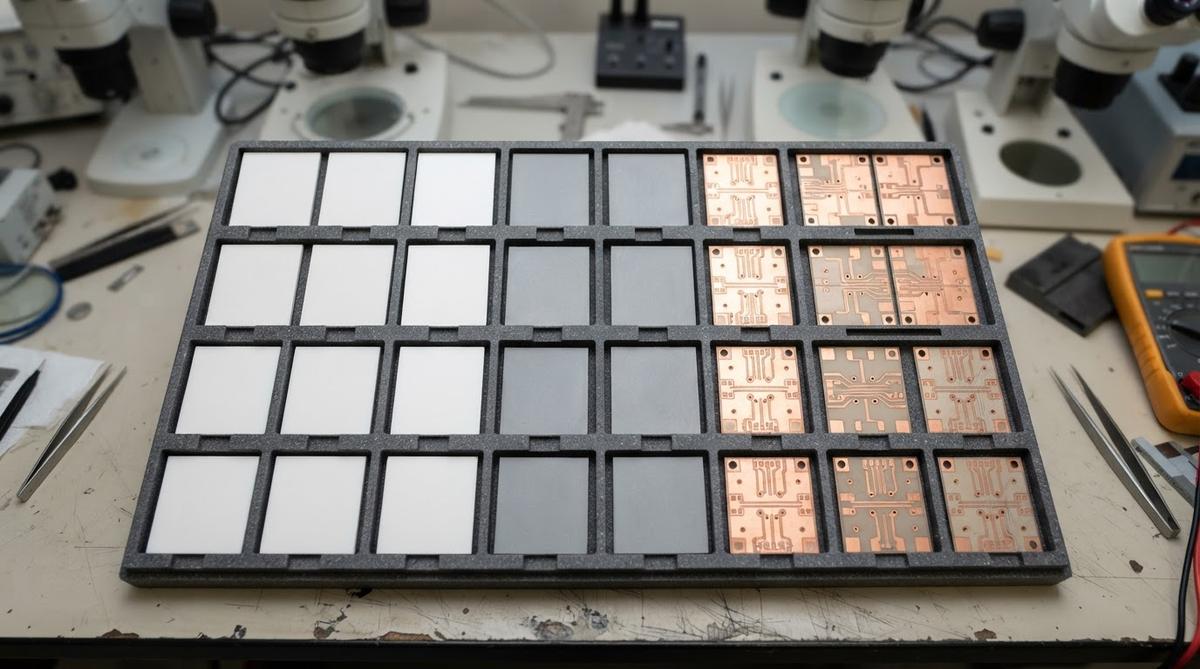
| Parameter | Si3N4 | AlN | 96% Al2O3 | Unit |
|---|---|---|---|---|
| Thermal conductivity (25 °C) | 70–90 | 170–200 | 24–28 | W/mK |
| Flexural strength | 600–900 | 300–400 | 300–380 | MPa |
| Fracture toughness | 6–7 | 2.5–3.5 | 3.5–4.0 | MPa·√m |
| CTE (20–400 °C) | 2.6–3.0 | 4.4–4.8 | 7.0–8.0 | ppm/K |
| Dielectric strength | 15–18 | 15–17 | 10–15 | kV/mm |
| Typical substrate thickness | 0.20–0.635 | 0.38–1.0 | 0.38–1.0 | mm |
| Relative cost (per cm²) | 4–8× | 2–4× | 1× (baseline) | — |
Typical values for commercially available material, for comparison only. Confirm against the datasheet for your specific grade.
For full property data on the alumina baseline, see ceramic PCB materials overview.
Typical Applications for Si3N4 Substrates
The silicon nitride Si3N4 properties outlined above make it the default substrate in applications where long-term reliability under harsh thermal cycling is non-negotiable:
- EV traction inverters: SiC MOSFET modules from Infineon, Wolfspeed, and Rohm use Si3N4-AMB substrates rated for > 15-year automotive lifetimes.
- Railway power converters: IGBT modules in rail traction see ambient swings from –40 °C to +60 °C and junction temperatures above 150 °C.
- Wind turbine converters: 20-year field life with minimal maintenance access drives the choice toward Si3N4.
- High-reliability industrial drives: Harsh environments with wide temperature excursions.
If you are sourcing Si3N4 substrates in volume, Si3N4 ceramic PCB wholesale options can reduce per-unit cost significantly at quantities above 500 pieces.
When Si3N4 Is Not the Right Choice
Si3N4 substrates are expensive and slower to source than alumina or AlN. Skip them if:
- Thermal conductivity is the sole priority and cycling is mild. AlN at 170–200 W/mK is cheaper and thermally superior. If your module sits in a climate-controlled rack and never sees more than ΔT = 80 K cycles, AlN-DBC is a better value.
- The application is cost-sensitive and low-power. 96% alumina at 24–28 W/mK handles LED boards, sensor substrates, and many RF circuits at a fraction of the cost.
- You need HTCC or LTCC multilayer processing. Si3N4 is not processed via HTCC or LTCC. It is sintered as a monolithic substrate and metallised by AMB or DBC. If you need embedded vias or multilayer routing, alumina (HTCC) or glass-ceramic (LTCC) is the path.
- Prototyping speed matters more than field life. Alumina substrates ship faster and cost less for design iteration. See ceramic PCB cost factors for a detailed breakdown.
Frequently Asked Questions
Can Si3N4 substrates be used with DBC copper bonding?
Yes. Si3N4 is compatible with both DBC and AMB metallisation. AMB is more common for Si3N4 because it produces a stronger bond at the ceramic-copper interface, but DBC is used where thinner copper (≤ 0.3 mm) is acceptable. The substrate’s high fracture toughness prevents cracking during the bonding thermal cycle.
Why is Si3N4 more expensive than AlN?
Si3N4 requires higher sintering temperatures (1,700–1,900 °C in nitrogen atmosphere) and longer hold times than AlN. The raw powder also needs tighter control of oxygen impurities to achieve high thermal conductivity grades. These processing demands, plus lower production volumes compared to alumina, drive the 4–8× cost premium over 96% Al2O3.
What is the maximum operating temperature for Si3N4 in air?
Unloaded Si3N4 can operate continuously at 1,000–1,200 °C in air without significant oxidation degradation. In practice, the copper metallisation on a substrate limits the assembly to around 400–500 °C (solder reflow or braze temperature), so the ceramic itself is never the thermal bottleneck. More detail is available on the ceramic PCB max operating temperature page.
Does Si3N4 have a lower CTE than silicon?
Si3N4’s CTE of 2.6–3.0 ppm/K (20–400 °C) is nearly identical to silicon’s 2.6 ppm/K. This close match reduces thermomechanical stress at the die-attach interface, improving solder-joint reliability over thousands of power cycles. AlN’s CTE of 4.4–4.8 ppm/K is a less ideal match.
Is Si3N4 suitable for RF or microwave circuits?
Si3N4’s dielectric constant of 7.9–8.5 at 1 MHz is higher than alumina (9.0–9.8) and AlN (8.5–9.0), and its loss tangent is low enough for some RF applications. However, it is rarely chosen for RF because alumina and specialty low-loss ceramics offer lower cost and well-characterised RF performance. The silicon nitride Si3N4 properties that justify its cost are mechanical, not dielectric.
How thin can Si3N4 substrates be made?
Commercial Si3N4 substrates are available at 0.32 mm as a standard thickness, and some suppliers offer 0.20 mm and 0.25 mm. The material’s high fracture toughness makes these thin formats viable; an alumina substrate at 0.20 mm would be impractical due to handling breakage. Thinner substrates reduce thermal resistance and total module height.
Next Step
If the silicon nitride Si3N4 properties above match your thermal-cycling and reliability requirements, download the Si3N4 substrate datasheet for full grade-specific data. For a quote on custom Si3N4 AMB or DBC substrates, submit your design files through the Si3N4 wholesale inquiry page.
Last reviewed: 2025-07