An alumina 99.6% Al2O3 thick film ceramic substrate is a high-purity oxide ceramic base used for screen-printed conductor, resistor, and dielectric layers. Compared to the more common 96% alumina, the 99.6% grade delivers higher thermal conductivity (28–35 W/mK vs. 24–28 W/mK at 25 °C), better surface finish after polishing, and tighter dielectric loss. These advantages make alumina 99.6% Al2O3 thick film ceramic the preferred choice for precision resistor networks, hybrid microelectronics, and high-frequency sensor modules.
Key Properties of Alumina 99.6% Al2O3 Thick Film Ceramic
| Parameter | 99.6% Al2O3 | 96% Al2O3 | Unit | Condition | Source |
|---|---|---|---|---|---|
| Purity | ≥ 99.6 | ≥ 96 | % | — | CoorsTek ADS-996 / Kyocera A-493 |
| Thermal conductivity | 28–35 | 24–28 | W/mK | 25 °C, ASTM E1461 | CoorsTek ADS-996 |
| Dielectric constant (εr) | 9.7–9.9 | 9.4–9.6 | — | 1 MHz, 25 °C | Kyocera A-493 |
| Dielectric loss (tan δ) | 0.0001–0.0002 | 0.0002–0.0010 | — | 1 MHz, 25 °C | Kyocera A-493 |
| Flexural strength | 350–400 | 340–380 | MPa | ASTM C1161, 4-pt bend | CoorsTek ADS-996 |
| Surface roughness (as-fired) | 0.3–0.6 | 0.5–1.0 | µm Ra | Profilometer | Maruwa HA-996 |
| CTE | 7.2–8.0 | 7.0–7.8 | ppm/°C | 25–300 °C | CoorsTek ADS-996 |
| Volume resistivity | > 1014 | > 1014 | Ω·cm | 25 °C | CoorsTek |
Typical values for commercially available material, for comparison only. Confirm against the datasheet for your specific grade.
The lower glassy-phase content in the 99.6% grade is what drives the improvements. At 96% purity, the remaining 4% is a silica-rich glass binder that aids sintering but increases dielectric loss and reduces thermal conductivity. Removing most of that glass phase produces a denser, more thermally uniform substrate with a smoother as-fired surface—exactly what thick film printing demands.
Why Choose Alumina 99.6% Al2O3 Thick Film Ceramic for Hybrid Circuits?
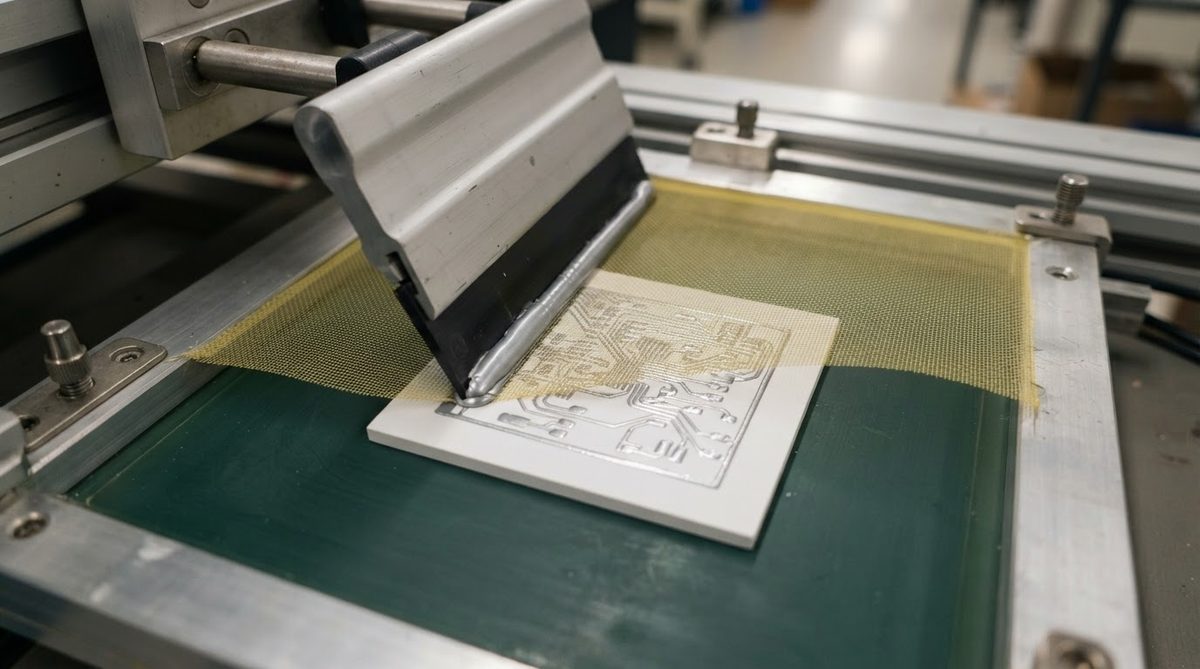
Thick film metallization—screen-printed pastes of Ag, Au, Ag/Pd, or Ag/Pt fired at 850–1000 °C—bonds well to high-purity alumina because the small amount of remaining glass phase still provides adequate adhesion sites for the paste’s glass frit. The smoother surface of 99.6% alumina also yields more uniform print thickness, which directly improves resistor tolerance and conductor impedance control.
Common thick film applications on 99.6% alumina include:
- Precision thick film resistor networks (TCR ≤ ±25 ppm/°C) for instrumentation
- Hybrid integrated circuits for aerospace and medical devices
- High-frequency sensor substrates where low tan δ reduces signal loss
- Power resistors requiring better thermal spreading than 96% alumina provides
For circuits requiring silver metallized ceramic conductors, the 99.6% grade’s smoother surface helps maintain line definition at trace widths below 150 µm.
99.6% vs. 96% Alumina: When Does Purity Matter?
The 99.6% grade typically costs 1.5–3× more than 96% alumina per unit area, depending on substrate size and finish. That premium is justified when your design hits one of these thresholds:
- Resistor TCR spec below ±50 ppm/°C. The more uniform substrate surface and lower thermal gradient improve fired resistor consistency.
- Operating frequency above 1 GHz. The tan δ difference (roughly 5× lower) reduces substrate-related insertion loss.
- Thermal density above ~5 W/cm². The 20–30% improvement in thermal conductivity lowers peak junction temperature. A quick estimate: for a 10 × 10 mm substrate at 0.635 mm thick dissipating 5 W, thermal resistance through the substrate drops from ~2.4 °C/W (96% at 26 W/mK) to ~1.9 °C/W (99.6% at 33 W/mK), saving roughly 2.5 °C at the die.
- Surface finish requirement below 0.4 µm Ra. The 99.6% grade can be lapped and polished to < 0.1 µm Ra, which is harder to achieve consistently with 96%.
Use the tool below to estimate how substrate thermal conductivity and thickness affect junction temperature rise for your specific layout.
If none of these thresholds apply, 96% alumina thick film substrates will perform well and cost less. Most standard hybrid circuits use 96% alumina without issue.
Thick Film vs. Thin Film on 99.6% Alumina
The same 99.6% alumina substrate can serve both thick film and thin film metallization, but the two processes have different strengths. Thick film is faster and cheaper for moderate line widths (≥ 100 µm trace/space) and handles high-power conductors well. Thin film (sputtered and etched) achieves finer geometries (down to 10–25 µm trace/space) and tighter resistor tolerances (≤ ±0.1%).
If your design needs sub-100 µm features or ±1% laser-trimmed resistors, consider the 99.6% alumina thin film substrate instead. For conductor-heavy layouts with standard tolerances, alumina 99.6% Al2O3 thick film ceramic remains the more cost-effective choice.
When Not to Use Alumina 99.6% Al2O3 Thick Film Ceramic
High thermal loads above ~15 W/cm². Even at 35 W/mK, alumina cannot match aluminum nitride (170–200 W/mK). For power modules and high-brightness LED arrays, an AlN thick film substrate is a better fit despite its higher cost.
Cost-sensitive, high-volume consumer products. If your thermal and dielectric requirements are modest, FR-4 or metal-core PCBs will be far cheaper. Ceramic substrates make sense when the operating environment or electrical performance demands them.
Large-area boards (> 150 × 150 mm). Ceramic substrates are brittle and typically limited to smaller panel sizes. Check standard ceramic substrate sizes to confirm availability for your footprint.
Extreme mechanical shock. Alumina’s flexural strength is adequate for most electronics, but applications with severe vibration or impact may need silicon nitride (Si3N4), which offers 2–3× higher fracture toughness.
Frequently Asked Questions
Can I use the same thick film pastes on 99.6% alumina as on 96%?
Yes. Standard commercial thick film pastes (Ag, Au, Ag/Pd, Ag/Pt, and resistor compositions) are compatible with 99.6% alumina. The glass frit in the paste still finds adequate bonding sites in the small residual glass phase. Adhesion pull strength is typically ≥ 3 kg on a 2 mm × 2 mm pad, per ASTM F1842.
What surface finish should I specify for thick film printing on 99.6% alumina?
An as-fired surface of 0.3–0.6 µm Ra works well for most thick film screen printing. Polished substrates (< 0.25 µm Ra) are usually reserved for thin film deposition. Over-polishing a thick film substrate can actually reduce paste adhesion because the glass frit has fewer surface features to grip.
Does 99.6% alumina cost twice as much as 96%?
Roughly 1.5–3× more, depending on size, thickness, and order volume. The raw material cost is higher, and the higher sintering temperature (1600–1700 °C vs. 1500–1600 °C) increases energy costs. For small prototype quantities the multiplier trends toward the higher end.
Is 99.6% alumina suitable for wire bonding?
The substrate itself is not wire-bonded—the metallization is. Thick film gold pads on 99.6% alumina support both gold and aluminum wedge bonding. For gold ball bonding, thin film gold is generally preferred because its smoother surface yields more consistent ball shear strength.
What is the maximum operating temperature for an alumina 99.6% Al2O3 thick film ceramic substrate?
The ceramic itself is stable beyond 1600 °C. The practical limit is set by the thick film metallization, which is typically rated to 300–500 °C continuous depending on the paste system and atmosphere. In oxidizing air, silver conductors begin degrading above ~400 °C; gold-based systems tolerate higher temperatures.
Next Step
If you need to evaluate alumina 99.6% Al2O3 thick film ceramic substrates for an upcoming project, request a ceramic substrate sample kit to test print adhesion and surface quality with your specific paste system before committing to production volumes.