Silver metallized ceramic is a substrate—typically alumina or aluminum nitride—printed with a thick-film silver (Ag) conductor paste and fired at 850 °C. Among thick-film conductors, silver offers the lowest bulk resistivity (1.59 µΩ·cm) and the lowest material cost per square, making it the default choice for high-current paths, RF ground planes, and LED thermal pads where gold’s price cannot be justified and copper’s oxidation is a concern.
The main trade-off is electrochemical migration. Silver ions migrate under DC bias in the presence of moisture, which can bridge adjacent traces and cause shorts. Every design using Ag metallization must account for this.
Key Takeaways
- Fired thick-film silver achieves sheet resistance of 2–3 mΩ/sq at 10–12 µm dried thickness, roughly 30–40 % lower than comparable gold conductors.
- Silver paste costs approximately one-fifth to one-tenth of gold paste per gram, depending on market prices, making it the most economical noble-metal conductor.
- Electrochemical migration limits silver’s use in high-humidity, high-DC-bias applications unless protective overglaze or conformal coating is applied.
- Adhesion to 96 % alumina after proper firing typically exceeds 20 N (2 mm × 2 mm pad pull test per ASTM F1842).
- Silver is compatible with standard Pb-free and SnPb solders without a barrier layer, unlike bare copper.
What Is Thick-Film Silver Metallization?
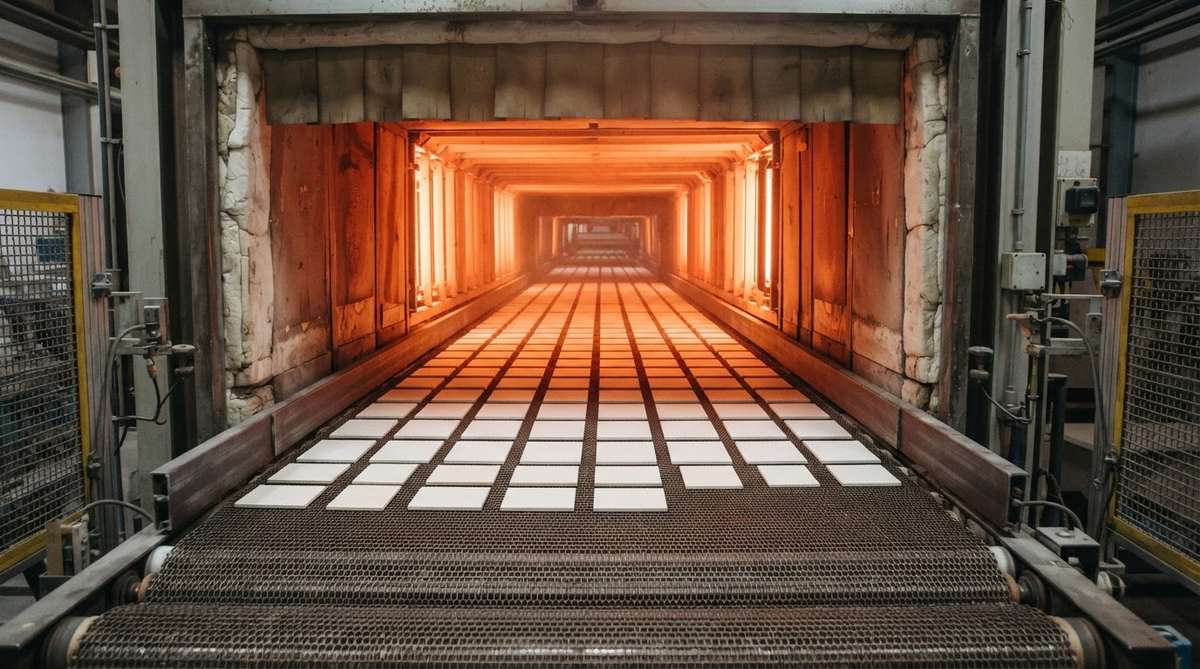
Thick-film metallization is a screen-printing process. A paste containing metal particles, a glass frit binder, and an organic vehicle is printed onto a fired ceramic substrate through a stainless-steel mesh screen. The printed substrate then passes through a belt furnace with a peak temperature of 850 °C (±10 °C) and a total cycle time of 30–60 minutes. During firing, the organic vehicle burns off, the glass frit melts and bonds to the ceramic surface, and the silver particles sinter into a continuous conductive film.
Fired film thickness is typically 8–15 µm. Line widths down to 100–125 µm are achievable with standard 325-mesh screens; finer features require higher mesh counts or supplementary photo-patterning. For context on how this fits into the broader PCB manufacturing process, thick-film printing is a purely additive step—no etching is involved.
Silver Conductor Properties After Firing
| Parameter | Value | Unit | Condition | Source |
|---|---|---|---|---|
| Bulk resistivity (Ag) | 1.59 | µΩ·cm | 20 °C, pure Ag | CRC Handbook, 97th ed. |
| Sheet resistance (fired film) | 2–3 | mΩ/sq | 10–12 µm fired thickness | DuPont 6160 / Heraeus C1076 datasheets |
| Adhesion (pull strength) | ≥ 20 | N | 2 mm × 2 mm pad on 96 % Al₂O₃, ASTM F1842 | DuPont 6160 datasheet |
| Solderability | ≥ 95 % wetting | — | SAC305, 245 °C, 5 s dwell | Heraeus C1076 datasheet |
| TCR | +50 to +150 | ppm/°C | −55 to +125 °C range | Typical for Ag thick-film conductors |
| Max continuous service temp | ≤ 300 | °C | In air, no overglaze | Heraeus application note AN-TFC |
Typical values for commercially available material, for comparison only. Confirm against the datasheet for your specific grade.
The low sheet resistance makes silver the preferred conductor for power buses, large ground fills, and RF striplines where insertion loss matters. The temperature coefficient of resistance (TCR) is higher than that of gold thick films (+10 to +50 ppm/°C), so silver is less common in precision resistor-network circuits where TCR tracking is critical.
Common Substrate Pairings
Silver paste fires well on both alumina and aluminum nitride. The glass frit formulation is adjusted for each ceramic’s surface chemistry and CTE.
- 96 % alumina (Al₂O₃) — The most common pairing. Low cost, good adhesion, CTE of 6.5–7.0 ppm/°C. Suitable for hybrid circuits, LED submounts, and sensor packages. See the full material profile for 96 % Al₂O₃ thick-film ceramic substrates.
- 99.6 % alumina — Smoother surface (Ra ≤ 0.3 µm lapped) enables finer line printing. Used in microwave hybrids and precision resistor networks. Details on 99.6 % Al₂O₃ thick-film substrates cover surface-finish options.
- Aluminum nitride (AlN) — Thermal conductivity of 170–200 W/m·K versus 24–28 W/m·K for 96 % alumina. Silver-on-AlN is used for high-power LED and laser diode submounts where heat must be extracted through the metallization and substrate together. The AlN thick-film substrate page covers firing compatibility.
Substrate thickness affects both thermal resistance and mechanical handling. The ceramic substrate thickness chart lists standard options from 0.25 mm to 1.0 mm.
Worked Example: Sheet Resistance of a Silver Power Bus
Suppose you need a 10 mm wide, 50 mm long bus carrying 5 A on a 96 % alumina substrate. The fired silver film is 12 µm thick with a measured sheet resistance of 2.5 mΩ/sq.
Number of squares: 50 mm ÷ 10 mm = 5 squares.
Total resistance: 5 × 2.5 mΩ = 12.5 mΩ.
Power dissipated: I²R = 5² × 0.0125 = 0.3125 W.
At 0.31 W over a 500 mm² footprint on alumina, the temperature rise in the conductor itself is negligible. Compare this to a gold conductor at 4–5 mΩ/sq: the same bus would dissipate roughly 0.6 W—still small, but double. For high-current LED arrays with dozens of parallel paths, the difference adds up.
Silver Migration: The Primary Reliability Risk
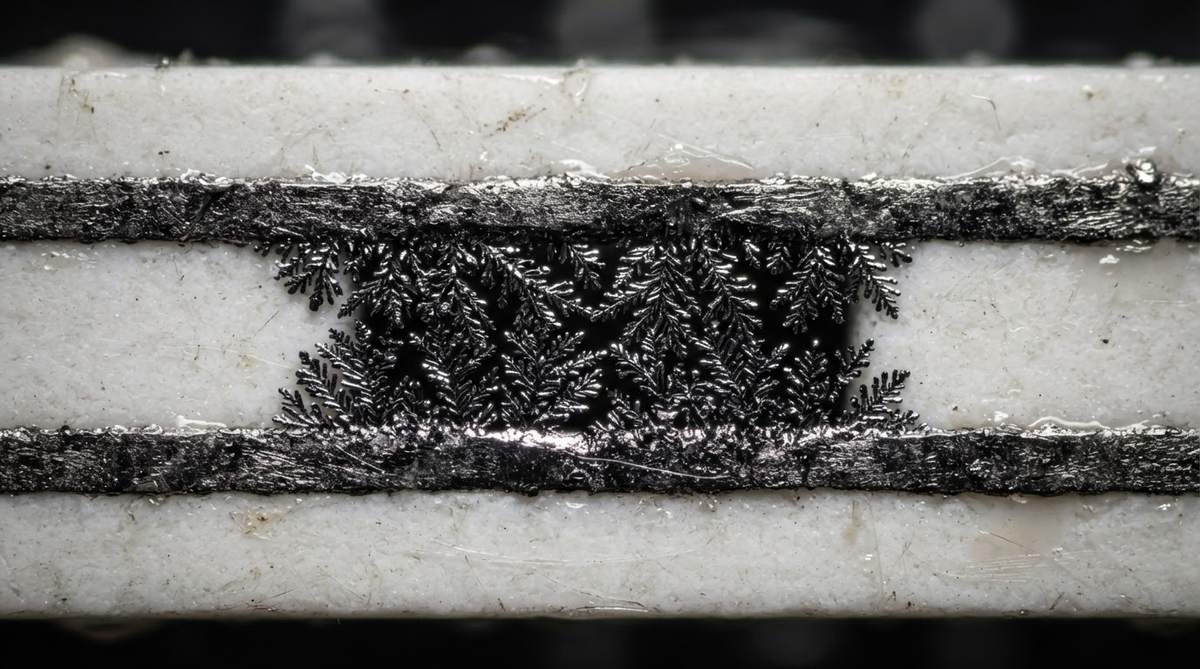
Silver is the most migration-prone of the three standard thick-film metals (Ag, Au, Cu). Under DC bias, silver ions dissolve at the anode, travel through a moisture film on the ceramic surface, and plate out at the cathode as metallic dendrites. Given enough time, these dendrites bridge adjacent conductors.
Migration rate depends on three factors: voltage, humidity, and trace spacing. At 10 V DC, 85 % RH, and 85 °C (the standard “85/85” test per IPC-TM-650 2.6.14.1), unprotected silver traces spaced 0.5 mm apart can fail in under 500 hours.
Mitigation Strategies
- Overglaze (glass passivation). A dielectric glass layer printed and fired over the silver traces seals them from moisture. This is the most common fix in hybrid microelectronics and extends 85/85 life beyond 2 000 hours.
- Conformal coating. Silicone or parylene coatings applied at the assembly level provide a moisture barrier. Less permanent than overglaze but applicable to finished modules.
- Increased spacing. Doubling trace spacing from 0.25 mm to 0.5 mm roughly quadruples time-to-failure under the same bias and humidity conditions.
- Use silver-palladium (AgPd) paste. Adding 10–30 % palladium to the silver suppresses migration significantly but raises resistivity to 5–10 mΩ/sq and increases paste cost by 2–3×.
If your application involves DC bias above 50 V in an unsealed environment with relative humidity regularly exceeding 60 %, consider gold metallized ceramic substrates instead. Gold does not migrate.
Silver vs. Gold vs. Copper: Quick Comparison
| Parameter | Ag (Silver) | Au (Gold) | Cu (Copper) |
|---|---|---|---|
| Bulk resistivity (µΩ·cm) | 1.59 | 2.44 | 1.72 |
| Sheet resistance, 10 µm film (mΩ/sq) | 2–3 | 4–5 | 2–3 (plated) |
| Relative paste cost | 1× | 5–10× | 0.5× (but needs plating) |
| Electrochemical migration risk | High | Negligible | Moderate |
| Oxidation in air | Tarnishes (Ag₂S) | None | Oxidizes readily |
| Solderability (no barrier) | Good | Good | Requires Ni/Au or OSP |
| Wire bondability (Au wire) | Fair (needs Au flash) | Excellent | Poor |
| Typical max service temp (°C) | ≤ 300 | ≤ 500 | ≤ 400 (with barrier) |
Typical values for commercially available material, for comparison only. Confirm against the datasheet for your specific grade.
When Not to Use Silver Metallization
High-humidity, high-voltage DC applications without hermetic sealing. Migration risk is too great unless you commit to overglaze and conformal coating, which add process steps and cost.
Gold wire bonding. Silver oxidizes and tarnishes, producing a poor bond interface for Au thermosonic bonding. If your assembly requires gold wire bonds, specify gold metallization or add a gold flash (0.1–0.3 µm) over the silver pads—which partially negates the cost advantage.
Sulfur-rich environments. Silver tarnishes to Ag₂S in the presence of sulfur compounds (e.g., rubber gaskets, certain adhesives, industrial atmospheres). Tarnish increases contact resistance and degrades solderability over time.
Precision thin-film resistors on the same substrate. Thick-film silver’s relatively high TCR (+50 to +150 ppm/°C) and the risk of silver diffusion into adjacent thin-film elements make gold or platinum-gold a better conductor choice for mixed thick/thin-film circuits.
Frequently Asked Questions
Can you solder directly to thick-film silver?
Yes. Fired thick-film silver wets well with both SnPb and SAC305 solders without a nickel barrier layer. Solder leaching can occur if the silver layer is thin (< 8 µm) or if multiple reflow cycles are used; specifying ≥ 10 µm fired thickness and limiting reflow to two passes mitigates this.
Does silver metallization work on aluminum nitride?
It does, but the paste formulation differs from that used on alumina. AlN-specific silver pastes use modified glass frits to achieve adhesion without degrading the AlN surface. Always confirm with the paste manufacturer that the product is rated for AlN.
How long does thick-film silver last at elevated temperature?
In dry air below 300 °C, silver metallization is stable for tens of thousands of hours. Above 300 °C, silver begins to diffuse into the glass frit and the underlying ceramic, increasing resistivity. For continuous service above 300 °C, gold or platinum-gold conductors are the standard choice.
What is the minimum trace width for screen-printed silver?
Standard 325-mesh screens resolve 100–125 µm lines and spaces reliably. Finer features (down to 50–75 µm) are possible with 400-mesh or photo-defined screens, but at higher cost and lower yield. For traces below 50 µm, thin-film sputtering or DPC processes are more appropriate.
Is silver-palladium paste a good compromise?
AgPd (typically 70/30 or 90/10 Ag/Pd) greatly reduces migration risk and improves solder-leach resistance. The penalty is higher resistivity (roughly 2–4× that of pure Ag) and higher paste cost (2–3× pure Ag). It is a reasonable middle ground for moderate-humidity applications that cannot justify gold.
Next Step
If silver metallization fits your conductivity and cost requirements, the next decision is substrate material and thickness. Review the ceramic substrate thickness chart to match your thermal and mechanical constraints, then request a quote with your Gerber files or pad layout drawing.