Choosing the right alumina 96% Al2O3 manufacturer determines the quality, cost, and lead time of the most widely used ceramic PCB substrate in the industry. 96% alumina delivers thermal conductivity of 24–28 W/m·K at 25 °C, dielectric strength above 15 kV/mm, and a CTE of 6.5–7.2 ppm/°C that closely matches many semiconductor die and leadframe alloys. It costs a fraction of higher-purity alumina or aluminum nitride, making it the default starting point for any engineer evaluating ceramic boards.
- Thermal conductivity of 96% Al2O3 is 24–28 W/m·K at 25 °C — roughly 100× higher than FR-4 (0.25–0.3 W/m·K).
- Dielectric constant is 9.0–9.5 at 1 MHz (per Kyocera A-493 datasheet), with loss tangent below 0.001.
- Flexural strength ranges from 350–380 MPa (ASTM C1161, 3-point bend), adequate for most SMT assembly stresses.
- Substrates are available from roughly 0.25 mm to 2.0 mm thick, with standard sizes up to 190 × 140 mm or larger depending on the alumina 96% Al2O3 manufacturer.
- Compatible with DPC, thick-film, thin-film, and DBC metallization — the broadest process compatibility of any ceramic grade.
What Is 96% Alumina and Why Is It the Default Ceramic PCB Material?
96% alumina is a polycrystalline ceramic body composed of approximately 96% aluminum oxide (Al2O3) by weight, with the remaining 4% made up of sintering aids — typically silica (SiO2), magnesia (MgO), and calcia (CaO). These additives lower the sintering temperature from above 1700 °C (needed for 99.6% grades) to around 1500–1600 °C, which reduces energy cost and kiln wear. The result is a substrate that is cheaper to fire, easier to machine green, and available from dozens of manufacturers worldwide.
The 4% glass phase does reduce thermal conductivity compared to 99.6% alumina substrates, which reach 30–35 W/m·K. It also slightly lowers flexural strength and increases surface roughness in the as-fired state. For the majority of power-LED, sensor, RF filter, and automotive-module applications, these differences do not matter enough to justify the price premium of higher-purity grades.
Key Material Properties From a Qualified Alumina 96% Al2O3 Manufacturer
| Parameter | Value | Unit | Condition | Source |
|---|---|---|---|---|
| Al2O3 content | 96 | % | By weight | CoorsTek ADS-96R datasheet |
| Thermal conductivity | 24–28 | W/m·K | 25 °C, ASTM E1461 | CoorsTek / Kyocera A-493 |
| CTE | 6.5–7.2 | ppm/°C | 25–300 °C | Kyocera A-493 |
| Dielectric strength | 15–17 | kV/mm | AC, 60 Hz, 1 mm thick | CoorsTek ADS-96R |
| Dielectric constant (εr) | 9.0–9.5 | — | 1 MHz, 25 °C | Kyocera A-493 |
| Loss tangent (tan δ) | < 0.001 | — | 1 MHz, 25 °C | Kyocera A-493 |
| Flexural strength | 350–380 | MPa | ASTM C1161, 3-pt bend | CoorsTek ADS-96R |
| Volume resistivity | > 1014 | Ω·cm | 25 °C | CoorsTek ADS-96R |
| Max continuous use temp. | 1600 | °C | Unmetallized body | CeramTec general alumina guide |
| Density | 3.72–3.80 | g/cm³ | — | Kyocera A-493 |
| Surface roughness (as-fired) | 0.5–1.0 | µm Ra | Typical | Maruwa HA-96 datasheet |
Typical values for commercially available material, for comparison only. Confirm against the datasheet for your specific grade.
Metallization Processes Used on 96% Alumina
One reason 96% Al2O3 dominates is its compatibility with every major ceramic metallization method. The choice of process determines your minimum feature size, copper thickness range, and cost per board. Any reputable alumina 96% Al2O3 manufacturer should clearly state which of these processes are run in-house.
Thick Film
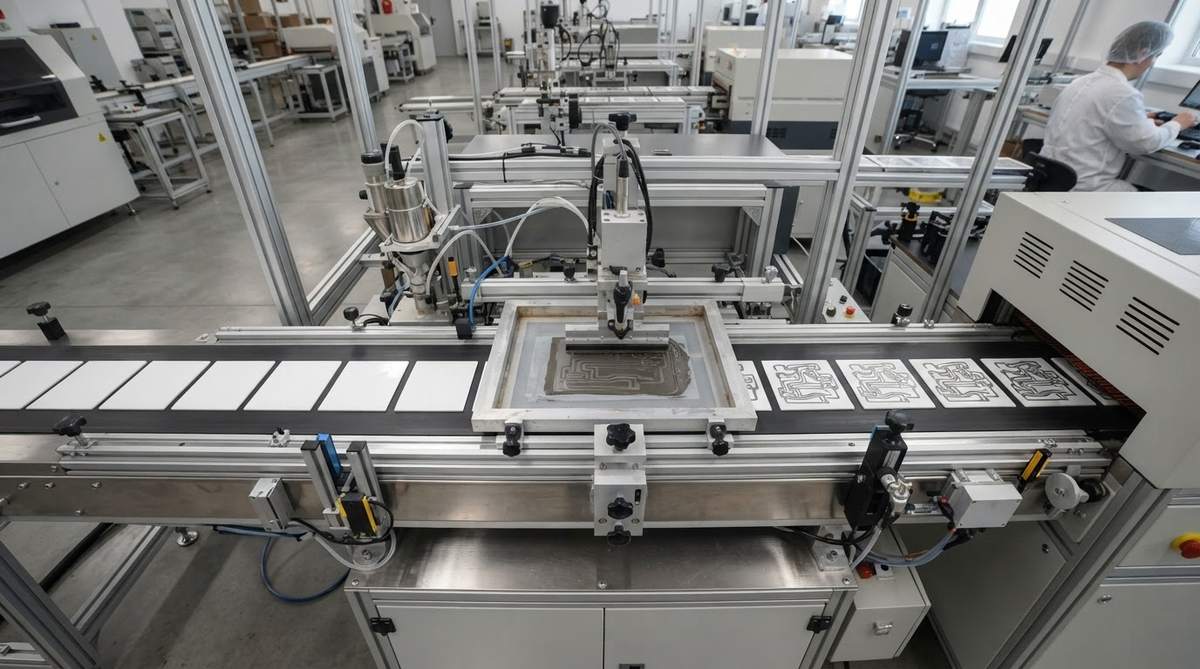
Screen-printed conductive pastes (Ag, AgPd, Au, or Cu) are fired at 850–950 °C. Line/space resolution is typically 100–150 µm. Thick film is the lowest-cost route for simple circuits, heater elements, and resistor networks. It is the most common process for 96% alumina boards in automotive and industrial sensor applications.
Thin Film (Sputtered)
Sputtered or evaporated metal layers (Ti/Pt/Au, Cr/Ni/Au, TiW/Cu) are patterned photolithographically. Line/space down to 20–30 µm is achievable. Thin film is preferred for RF circuits, precision resistors, and MEMS packaging. The substrate surface roughness matters here — if your design needs thin-film metallization, consider specifying polished or lapped 96% alumina with Ra below 0.1 µm.
DPC (Direct Plated Copper)
A sputtered seed layer followed by electrolytic copper plating. Copper thickness from 1 to 100+ µm, with line/space of 30–75 µm depending on the copper thickness. DPC is the go-to for power LED substrates and mid-power modules where you need thick copper on a ceramic base. The full sequence is described in our ceramic PCB manufacturing process overview.
DBC (Direct Bonded Copper)
Oxygen-assisted bonding of copper foil (typically 0.15–0.3 mm thick) directly to the alumina at around 1065 °C. DBC delivers the highest current-carrying capacity and lowest thermal resistance of any metallization on alumina. It is standard for IGBT modules, EV inverters, and industrial motor drives. The trade-off: minimum feature size is larger (≥ 200 µm typical) and the process is more expensive per unit area than DPC or thick film.
Worked Example: Thermal Resistance of a 96% Alumina Substrate
Suppose you have a 10 × 10 mm power die dissipating 5 W, mounted on a 0.635 mm thick 96% alumina substrate. Assume 1-D heat flow and thermal conductivity of 25 W/m·K.
Rth = t / (k × A)
Rth = 0.000635 m / (25 W/m·K × 0.0001 m²) = 0.254 °C/W
Temperature rise across the substrate: ΔT = 5 W × 0.254 °C/W = 1.27 °C
For comparison, the same geometry in FR-4 (k ≈ 0.25 W/m·K) gives Rth = 25.4 °C/W and ΔT = 127 °C — clearly unacceptable for a 5 W die. If even 1.27 °C is too much, an aluminum nitride (AlN) substrate with k ≈ 170–200 W/m·K drops the rise to under 0.2 °C, but at 3–5× the substrate cost.
Enter your own substrate dimensions, thickness, and power dissipation below to estimate thermal resistance for any ceramic grade.
How to Evaluate an Alumina 96% Al2O3 Manufacturer
Not all 96% alumina boards are equal. Here are the specification and quality factors that separate a reliable supplier from a risky one.
- Substrate source transparency. Ask whether the manufacturer fires its own substrates or buys blanks from Kyocera, Maruwa, CoorsTek, or another brand. Both models work, but you need to know which grade you are getting. The ceramic substrate supply chain is more layered than most engineers expect.
- Metallization capability. Confirm which processes are run in-house versus outsourced. A manufacturer that sputters its own seed layers and plates copper in-house has tighter control over adhesion and thickness uniformity than one that subcontracts these steps.
- Dimensional tolerances. Laser-cut or scribed substrates typically hold ±0.05–0.10 mm. If you need tighter than that, ask about post-fire grinding.
- Surface finish options. ENIG, ENEPIG, OSP, bare copper — confirm availability. For wire bonding, gold plating thickness and surface roughness are critical.
- Testing. At minimum, expect AOI, hipot (dielectric withstand), and dimensional inspection. Thermal shock cycling (per MIL-STD-883 or IEC 60068-2-14) should be available for automotive or aerospace qualifications.
Ordering: Custom vs. Wholesale
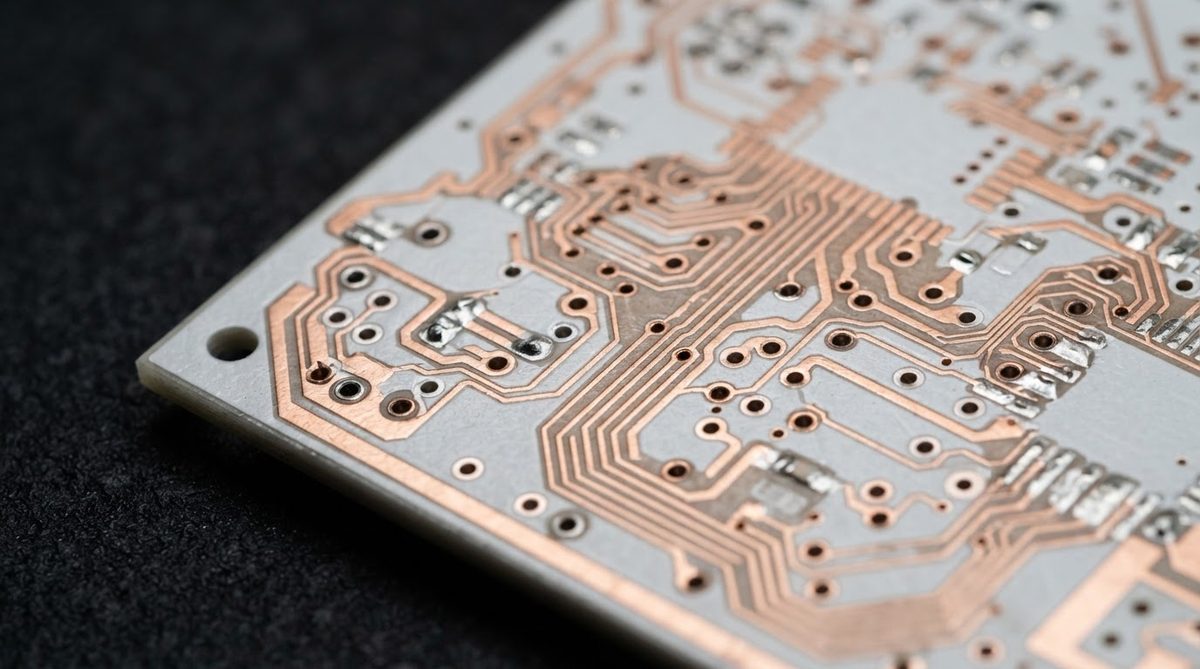
If you need metallized boards to your Gerber files, you are ordering custom-fabricated 96% alumina PCBs. Lead times for prototypes typically run 2–4 weeks depending on the metallization process and surface finish.
If you need blank substrates — unmetallized, cut to size — wholesale 96% alumina substrates are available in standard dimensions with shorter lead times and lower per-piece cost, especially at volume.
When NOT to Use 96% Alumina
Thermal conductivity above 28 W/m·K is required. If your thermal stack-up shows that 96% alumina cannot keep junction temperatures within budget, step up to 99.6% alumina (30–35 W/m·K) or AlN (170–200 W/m·K). Run the numbers before making the jump — the cost difference is significant.
Board area exceeds roughly 150 × 150 mm. Large ceramic substrates become fragile and expensive. For boards above this size, metal-core PCBs (MCPCBs) or insulated metal substrates (IMS) are usually more practical.
Cost is the primary constraint and thermal loads are modest. If your device dissipates under 0.5 W/cm² and operates below 130 °C, FR-4 or a standard MCPCB will work at a fraction of the cost. Ceramic is overkill here.
High mechanical shock or vibration. Alumina is brittle. Flexural strength of 350–380 MPa sounds high, but ceramics fail catastrophically with zero plastic deformation. For applications with repeated mechanical shock, silicon nitride (Si3N4) substrates with fracture toughness of 6–7 MPa·√m are a better fit than alumina’s 3.5–4.0 MPa·√m.
Frequently Asked Questions
Can I get 96% alumina PCBs with double-sided metallization?
Yes. Double-sided DPC and thick-film boards are standard. Through-substrate vias (filled or unfilled) connect the two sides. Via diameters typically start at 0.15–0.20 mm for laser-drilled holes.
What is the maximum operating temperature of a metallized 96% alumina board?
The ceramic body itself withstands 1600 °C, but the practical limit is set by the metallization and solder. DBC copper bonds are rated to roughly 400 °C continuous. Thick-film silver or gold conductors remain stable to about 300–400 °C. Standard Sn-based solder joints limit the assembly to around 150–200 °C. See our ceramic PCB max operating temperature guide for a deeper breakdown.
How does 96% alumina compare to aluminum nitride for LED applications?
For LEDs below about 3 W per package, 96% alumina provides sufficient thermal performance at much lower cost. Above 5–10 W per package, AlN’s 170–200 W/m·K conductivity reduces thermal resistance enough to meaningfully extend LED lifetime. The crossover depends on your thermal budget and acceptable junction temperature.
Is 96% alumina suitable for RF circuits?
It works well for frequencies up to a few GHz. The dielectric constant of 9.0–9.5 is stable and the loss tangent below 0.001 at 1 MHz is low. At millimeter-wave frequencies (above 30 GHz), the relatively high εr makes trace widths narrow and increases sensitivity to dimensional tolerances. For those frequencies, consider lower-εr substrates like quartz or specific LTCC formulations.
What minimum order quantity should I expect from an alumina 96% Al2O3 manufacturer?
MOQ varies by manufacturer and process. Prototype runs of 5–25 pieces are common for DPC. Thick-film screen printing may require higher minimums (50–100 pieces) because of screen setup costs. Wholesale blank substrates often start at 100+ pieces for standard sizes.
Next Step
If 96% alumina fits your thermal and electrical requirements, the next step is to get a quote based on your actual Gerber files and substrate specs. Upload your design files for a fast quote and DFM review.