Aluminum nitride (AlN) ceramic remains mechanically and thermally functional above 1000 °C in inert atmospheres, but the practical operating limit for a metallized AlN PCB is typically 350–500 °C. Understanding aluminum nitride AlN high temperature behavior is essential because the substrate itself is not the weak link. Metallization adhesion, solder reflow, and surface oxidation define the real ceiling in every production design.
Key Takeaways
- Bulk AlN retains >80% of its room-temperature thermal conductivity (170–200 W/mK) up to about 400 °C, per Kyocera SN-170 and Maruwa AN-170 datasheets.
- Surface oxidation of bare AlN begins near 700 °C in air, forming an alumina layer that degrades thermal and electrical performance over time.
- Thick-film metallizations (tungsten, molybdenum-manganese) survive above 500 °C; thin-film gold or copper traces are limited to roughly 300–400 °C depending on adhesion layer and atmosphere.
- Solder joints, not the ceramic, usually set the maximum continuous operating temperature at 260–350 °C for most assemblies.
- For sustained operation above 500 °C, unmetallized AlN or brazed AlN–metal assemblies are the standard approach.
Aluminum Nitride AlN High Temperature Bulk Properties
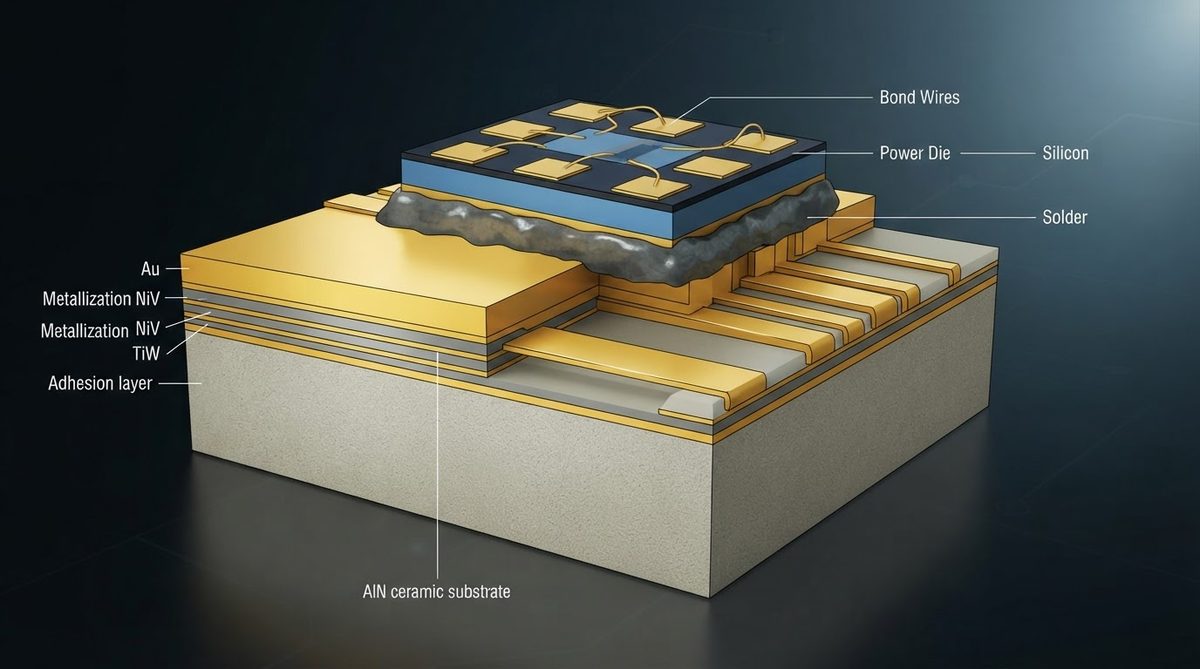
AlN is a covalently bonded ceramic with a wurtzite crystal structure. Its thermal conductivity at 25 °C ranges from 170 to 230 W/mK depending on grain size, oxygen content, and sintering aids (per CoorsTek ADS-996 and Tokuyama SH-15 datasheets). As temperature rises, phonon-phonon scattering increases and conductivity drops. At 400 °C, expect roughly 120–160 W/mK. At 800 °C, values fall to about 60–90 W/mK. Even at 800 °C, AlN still outperforms 96% alumina at room temperature.
Flexural strength stays within 10–15% of its room-temperature value (300–350 MPa per ASTM C1161) up to about 600 °C. Above 800 °C, grain-boundary softening begins in grades with yttria sintering aids. The coefficient of thermal expansion (CTE) rises from about 4.5 ppm/°C at 25 °C to approximately 5.5 ppm/°C at 800 °C, which remains a close match to silicon (2.6–4.1 ppm/°C over the same range) and GaN (3.2–5.6 ppm/°C). This CTE stability is a major reason aluminum nitride AlN high temperature substrates are chosen for high thermal conductivity PCB applications involving power semiconductors.
| Property | 25 °C | 400 °C | 800 °C | Unit | Source |
|---|---|---|---|---|---|
| Thermal conductivity | 170–230 | 120–160 | 60–90 | W/mK | Kyocera SN-170, Tokuyama SH-15 datasheets |
| Flexural strength (4-pt) | 300–350 | 280–330 | 250–300 | MPa | CoorsTek ADS-996 (ASTM C1161) |
| CTE | 4.5 | 5.0 | 5.5 | ppm/°C | Maruwa AN-170 datasheet |
| Dielectric strength | 15–17 | 12–14 | 8–10 | kV/mm | CoorsTek ADS-996 |
| Volume resistivity | >1014 | ~1011 | ~108 | Ω·cm | Kyocera SN-170 |
Typical values for commercially available material, for comparison only. Confirm against the datasheet for your specific grade.
The drop in volume resistivity above 400 °C matters for high-voltage isolation. If your design needs >1 kV isolation at sustained temperatures above 500 °C, verify the insulation resistance at operating temperature, not at 25 °C. For a deeper look at how AlN’s conductivity numbers are measured and what affects them, see our page on AlN thermal conductivity data and measurement methods.
What Actually Limits Aluminum Nitride AlN High Temperature Operation on a Metallized Board
The substrate can handle heat that the rest of the assembly cannot. Here is where each layer fails first, ranked from lowest to highest temperature ceiling:
- Solder joints (Sn-Ag-Cu): Liquidus at 217–221 °C. Maximum continuous service around 150–180 °C for standard SAC305. High-temperature solders (Au-Sn at 280 °C, Au-Ge at 356 °C) push this to roughly 250–330 °C.
- Thin-film metallization (Ti/Pt/Au, Ti/Ni/Au): Interdiffusion and adhesion degradation begin around 350–400 °C in air. In inert or vacuum environments, some Ti/Pt/Au stacks survive to 500 °C.
- Thick-film metallization (W, Mo-Mn): Stable to 500–600 °C in forming gas or nitrogen. In air, tungsten oxidizes above ~400 °C.
- Brazes (Ag-Cu-Ti active braze): Service to 500–600 °C depending on alloy. Some refractory brazes (Ti-Zr based) reach 700 °C+.
- Bare AlN substrate: Oxidation in air starts near 700 °C. In inert atmosphere or vacuum, useful to >1000 °C.
The practical rule: identify the weakest layer in your stackup and design to its limit, not the substrate’s limit. For more on how different ceramic substrates compare at extreme temperatures, see our guide to PCBs designed for 200 °C to 500 °C operation.
Worked Example: Derating AlN Thermal Resistance at 300 °C
Suppose you have a 25 × 25 mm AlN substrate, 0.635 mm thick, dissipating 80 W from a SiC MOSFET. At 25 °C, AlN thermal conductivity is 180 W/mK.
Thermal resistance through the substrate at 25 °C:
Rth = t / (k × A) = 0.000635 / (180 × 0.000625) = 0.0056 °C/W
At 300 °C, conductivity drops to approximately 140 W/mK (interpolating from the table above):
Rth,300°C = 0.000635 / (140 × 0.000625) = 0.0073 °C/W
The substrate’s thermal resistance increases by about 30%. For 80 W dissipation, that means an extra 0.14 °C of temperature rise across the substrate alone. In this geometry the substrate contribution is small, but in thicker substrates or smaller die-attach areas the derating becomes significant. Always calculate Rth at your actual operating temperature, not at 25 °C.
Enter your own substrate dimensions, thickness, and dissipated power below to estimate thermal resistance at your target operating temperature.
For a full walkthrough of thermal design on AlN, see our AlN thermal design guide.
AlN vs. Other Ceramics at High Temperature
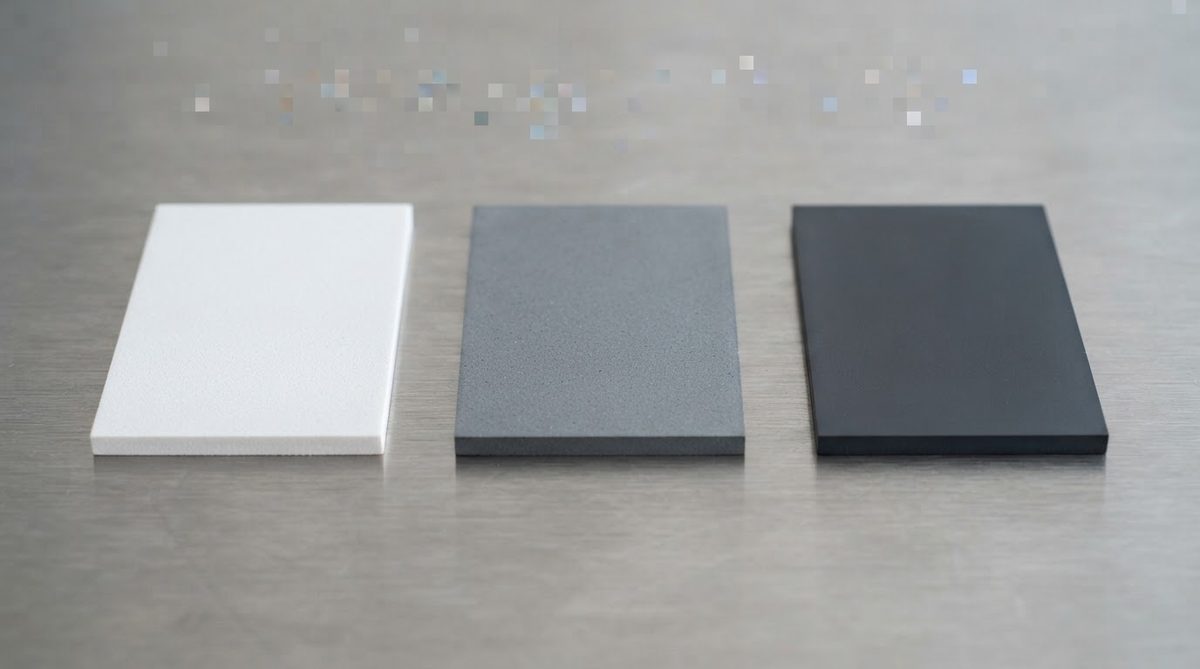
| Parameter | AlN | 96% Al₂O₃ | Si₃N₄ | Unit | Condition |
|---|---|---|---|---|---|
| Thermal conductivity | 170–230 | 24–28 | 70–90 | W/mK | 25 °C |
| Thermal conductivity | 120–160 | 14–18 | 50–65 | W/mK | 400 °C |
| Flexural strength | 300–350 | 300–380 | 600–900 | MPa | 25 °C, ASTM C1161 |
| CTE | 4.5 | 7.2 | 3.0 | ppm/°C | 25–400 °C avg |
| Max use temp (air, bare) | ~700 | >1500 | ~1000 | °C | Oxidation onset |
| Max use temp (metallized, air) | 350–500 | 350–600 | 350–500 | °C | Depends on metal system |
Typical values for commercially available material, for comparison only. Confirm against the datasheet for your specific grade.
Si₃N₄ offers superior fracture toughness and thermal-shock resistance, making it the better choice when mechanical reliability under rapid thermal cycling is the priority. For details on that material, see our page covering Si₃N₄ thermal conductivity and mechanical properties. Aluminum nitride AlN high temperature performance wins on raw thermal conductivity at every temperature point, which matters most when steady-state heat removal is the dominant requirement.
When NOT to Use AlN at High Temperature
Humid or oxidizing atmospheres above 500 °C. AlN reacts with moisture and oxygen. The resulting alumina surface layer is porous, degrades thermal contact, and can delaminate metallization. If your environment is hot, wet, and oxygen-rich, 96% alumina is more chemically stable and far cheaper.
Cost-sensitive designs under 200 °C. Below 200 °C, standard SAC solder on alumina or even metal-core PCBs may handle your thermal load for a fraction of the cost. AlN substrates typically cost 3–5× more per unit area than 96% alumina.
Severe thermal shock with thin substrates. AlN’s fracture toughness (2.5–3.5 MPa·m½) is lower than Si₃N₄ (5–7 MPa·m½). If your application involves repeated quenching or fast transients (>100 °C/s), Si₃N₄ substrates with AMB copper survive more cycles before cracking.
Very high voltage isolation at elevated temperature. AlN’s volume resistivity drops by six orders of magnitude between 25 °C and 800 °C. If you need reliable multi-kV isolation above 500 °C, alumina retains higher resistivity at those temperatures.
Frequently Asked Questions
Does AlN oxidize in air at high temperature?
Yes. Surface oxidation becomes measurable above approximately 700 °C in dry air. In humid air, degradation starts lower, around 500–600 °C. The oxide layer is porous alumina, which reduces thermal contact and can weaken metallization adhesion. For sustained aluminum nitride AlN high temperature use in air, protective coatings or inert atmospheres are necessary.
Can I solder components to AlN and run the board at 400 °C?
Not with standard solder. SAC305 melts at 217–221 °C. Au-Sn solder (melting at 280 °C) can sustain roughly 250 °C continuously. For 400 °C operation, you need active brazes, sintered silver die attach, or wire bonding instead of solder joints.
How does AlN thermal conductivity compare to copper at high temperature?
Copper conducts about 385 W/mK at 25 °C and roughly 350 W/mK at 400 °C. AlN at 400 °C is around 120–160 W/mK, so copper still wins on raw conductivity. AlN’s advantage is electrical isolation combined with a CTE close to silicon and GaN, which copper cannot provide.
Is AlN safe to handle?
Sintered AlN is safe under normal handling. Fine AlN powder can hydrolyze in contact with moisture, releasing ammonia. Machining or grinding AlN should be done with proper ventilation and dust extraction, but finished substrates pose no special hazard.
What is the thinnest AlN substrate available for high-temperature use?
Standard commercial AlN substrates are available down to 0.25 mm (250 µm) thickness. Thinner substrates (150 µm) exist but are fragile and typically used only in specific power module designs where minimal thermal resistance is critical.
Next Step
If your design involves aluminum nitride AlN high temperature operation above 300 °C, the metallization system and joining method matter more than the substrate grade. Define your operating atmosphere, peak temperature, and required cycle life, then request a review from a substrate supplier who can match the right metal stack to your conditions. You can check maximum operating temperatures across all ceramic substrate types or submit your requirements for a quote.