The ceramic PCB max operating temperature is set by the weakest thermal link in the assembly — not the substrate alone. Bare alumina (Al₂O₃ 96%) survives above 1 000 °C, and aluminum nitride (AlN) above 800 °C, but the practical ceiling for an assembled board drops to 300–500 °C once you account for metallization, solder joints, and component ratings. Every layer in the stackup has its own limit, and the lowest one governs the system.
Key Takeaways
- Al₂O₃ 96% substrates remain mechanically stable to roughly 1 600 °C; AlN to approximately 1 000 °C; Si₃N₄ to about 1 000 °C.
- Thick-film gold or platinum conductors can operate continuously above 500 °C, while copper (DBC/AMB) is limited to around 300–400 °C by oxidation.
- Standard SAC305 solder melts at 217–220 °C; high-temperature solders (AuSn, AuGe) push the joint limit to 280–360 °C.
- The real ceramic PCB max operating temperature for most assemblies is 250–500 °C, depending on metallization and interconnect choices.
- FR-4 glass transition begins at 130–180 °C, making it unsuitable above roughly 150 °C continuous — the point where ceramic substrates become necessary.
Ceramic PCB Max Operating Temperature by Substrate Material
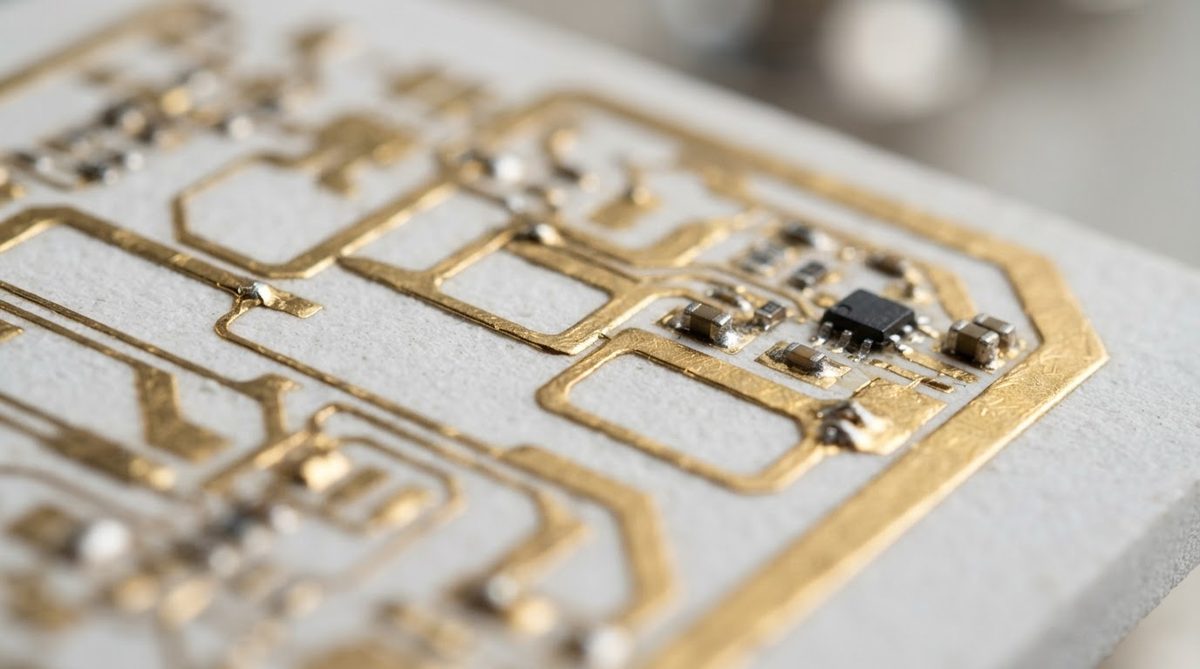
The ceramic body is almost never the first thing to fail. Still, each material has a ceiling above which mechanical properties degrade or chemical decomposition begins. The table below summarizes limits for common substrate grades.
| Material | Max Continuous Use (°C) | Failure Mode at Limit | Source |
|---|---|---|---|
| Al₂O₃ 96% | ~1 600 | Grain-boundary softening | CoorsTek ADS-996 datasheet |
| Al₂O₃ 99.6% | ~1 700 | Grain-boundary softening | Kyocera A493 datasheet |
| AlN | ~1 000 (inert); ~700 in air (oxidation onset ~700 °C) | Surface oxidation to Al₂O₃ | Maruwa AlN datasheet |
| Si₃N₄ | ~1 000 | Oxidation / creep | Kyocera SN series datasheet |
| LTCC (e.g., DuPont 951) | ~850 (post-fired body) | Glass-phase softening | DuPont 951 Green Tape datasheet |
Typical values for commercially available material, for comparison only. Confirm against the datasheet for your specific grade.
For a deeper comparison of thermal properties across these ceramics, see the ceramic substrate thermal conductivity comparison. AlN’s oxidation behavior in air deserves attention: above roughly 700 °C a surface oxide layer forms that changes both thermal and electrical behavior over time. For Si₃N₄ thermal performance details, the material’s superior fracture toughness (6–8 MPa·m^½ per ASTM C1421) gives it an edge in thermal-shock-heavy applications even if its conductivity (70–90 W/mK) is lower than AlN (170–200 W/mK).
Metallization: The Real Bottleneck
In most designs, the metallization layer fails before the ceramic. The choice of conductor and bonding method determines the effective ceramic PCB max operating temperature for the finished assembly.
Thick-Film Conductors
Thick-film pastes (fired at 850–1 000 °C during manufacturing) produce conductors that tolerate sustained temperatures well above their firing point. Gold (Au) and platinum (Pt) thick-film traces can operate above 500 °C without significant degradation. Silver (Ag) thick film begins to migrate and oxidize above 300 °C in air, limiting its practical ceiling.
Copper Metallization (DBC, AMB, DPC)
Direct Bonded Copper (DBC) and Active Metal Brazing (AMB) attach copper foil to the ceramic. Copper itself melts at 1 085 °C, but oxidation in air becomes problematic above 200–300 °C. With protective coatings or inert atmospheres, DBC assemblies can operate up to roughly 400 °C. In open-air conditions without protection, expect a practical limit of 250–300 °C. Direct Plated Copper (DPC) thin-film metallization has similar oxidation constraints.
Thin-Film Conductors
Sputtered thin-film stacks (Ti/Pt/Au, TiW/Au, NiCr/Au) handle 300–500 °C depending on the barrier and adhesion layers chosen. These are common in sensor and RF applications where fine features and high-temperature survival are both required.
| Metallization Type | Max Continuous (°C), Air | Max Continuous (°C), Inert/Vacuum | Limiting Factor |
|---|---|---|---|
| Thick-film Au | >500 | >600 | Glass-frit binder softening |
| Thick-film Pt | >500 | >700 | Paste composition dependent |
| Thick-film Ag | ~300 | ~400 | Migration, oxidation |
| DBC / AMB Cu | 250–300 | ~400 | Copper oxidation |
| Thin-film Ti/Pt/Au | 350–500 | ~500 | Interdiffusion of barrier layers |
Ranges are approximate and depend on specific paste/foil supplier and atmosphere. Confirm with your metallization supplier.
Solder and Die-Attach Limits
Even if your substrate and metallization survive 500 °C, the solder joint often sets a lower ceiling. Standard lead-free SAC305 solder has a solidus of 217 °C. For assemblies that must operate above 200 °C, you need a different interconnect strategy.
- AuSn (80/20): melts at 280 °C. Common for hermetic packages and optoelectronics.
- AuGe: melts at 356 °C. Used in aerospace and downhole applications.
- Sintered silver: no reflow; survives above 400 °C once sintered. Increasingly used in SiC power modules.
- Wire bonding (Au or Al): removes solder entirely. Au wire bonds survive above 400 °C; Al wire bonds are limited by intermetallic growth above 300 °C on Au pads.
A practical rule: identify the solder or die-attach material first, then work backward to confirm the substrate and metallization can handle at least 50 °C above that joint’s rated temperature. For boards designed to operate above 200 °C, refer to our guide on PCB design for 200–500 °C environments.
Enter your substrate material, metallization type, and target ambient temperature below to see how each layer’s limit stacks up and where your assembly’s ceiling falls.
Worked Example: Setting the Max Temperature for a SiC Gate Driver
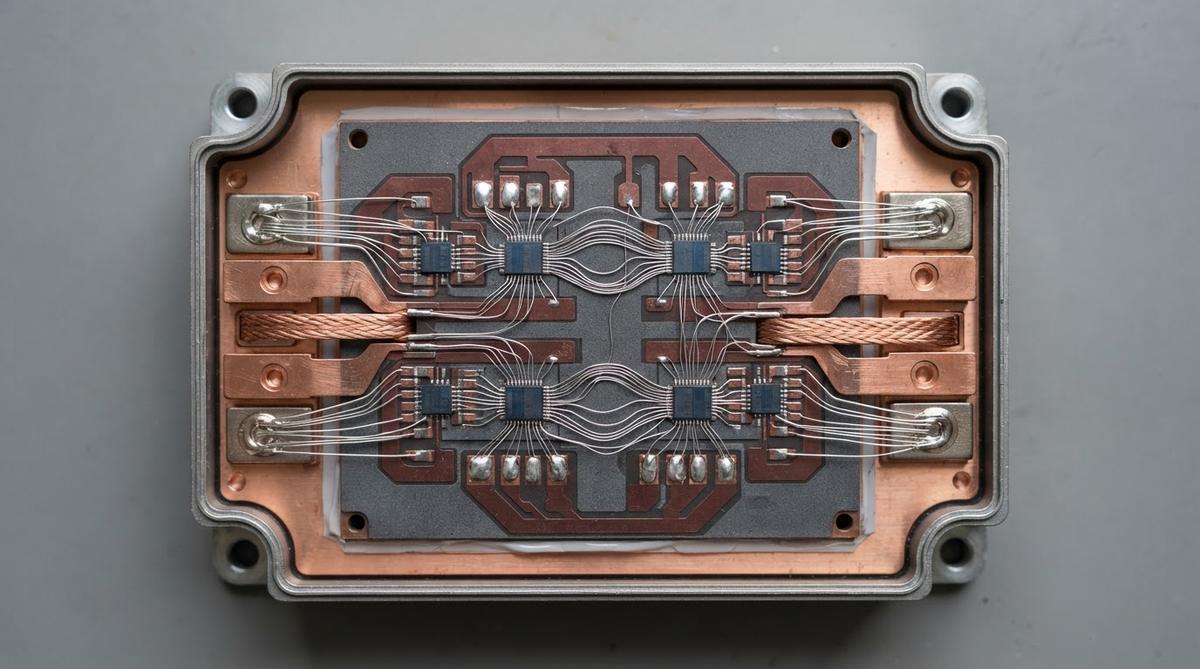
Suppose you are designing a gate-driver board for a SiC MOSFET module. The ambient inside the power module reaches 200 °C, and the board dissipates 2 W over a 25 × 25 mm area.
- Substrate: AlN, 0.635 mm thick. Thermal conductivity 170 W/mK. Continuous limit >700 °C in air — no issue.
- Metallization: DBC copper, 0.3 mm. In a partially sealed module with nitrogen backfill, good to ~350 °C.
- Die attach: AuSn solder, melting at 280 °C. Derate by 50 °C for long-term reliability → max junction at solder = 230 °C.
- Components: High-temperature gate driver IC rated to 225 °C (e.g., CISSOID CHT-HERCULES).
- Temperature rise from self-heating: Rth (substrate) ≈ t / (k × A) = 0.000635 / (170 × 0.000625) = 0.006 °C/W. At 2 W, ΔT = 0.012 °C — negligible.
The system bottleneck is the gate driver IC at 225 °C, followed closely by the AuSn solder at 230 °C (derated). The ceramic and copper are not the limiting factors. This example shows why determining the ceramic PCB max operating temperature requires evaluating every layer, not just the substrate. For a more detailed walk-through of the Rth math, see our ceramic PCB thermal resistance calculation.
When NOT to Use a Ceramic PCB for High Temperature
Ceramic substrates are the default choice above 200 °C, but they are not always necessary or optimal.
- Below 150 °C continuous: Standard high-Tg FR-4 (Tg 170 °C) or polyimide (Tg ~260 °C) will work at lower cost and with easier fabrication. Ceramic’s higher price is not justified here.
- 150–250 °C with standard components: Polyimide flex or high-Tg rigid boards may suffice if the component ratings allow it. Ceramic becomes essential only when the board itself must survive temperatures that destroy organic laminates.
- Extreme thermal shock (>400 °C/s ramp): Alumina can crack under severe thermal shock. Si₃N₄ handles shock far better, but at higher cost. If the application involves rapid flame impingement or quenching, material selection needs careful fracture-mechanics analysis beyond just the max operating temperature rating.
- Large board areas (>150 × 150 mm): Ceramic substrates are brittle and expensive at large sizes. For big boards that run warm but not extreme, metal-core PCBs (MCPCBs) with aluminum or copper bases may be more practical up to about 150 °C.
Frequently Asked Questions
Can a ceramic PCB survive 1 000 °C?
A bare alumina substrate can survive above 1 000 °C, but no standard metallization or solder joint will last at that temperature. Thick-film platinum on 99.6% alumina, wire-bonded with gold, is the closest practical assembly — rated for roughly 500–700 °C continuous in inert atmosphere.
Does AlN degrade in air at high temperature?
Yes. Aluminum nitride begins to oxidize in air above approximately 700 °C, forming an alumina surface layer that reduces thermal conductivity and changes electrical properties. In inert or vacuum environments, AlN is stable to roughly 1 000 °C.
What solder works above 300 °C?
Gold-germanium (AuGe) solder melts at 356 °C and is used in aerospace and oil-and-gas electronics. Sintered silver die attach, which has no reflow step, can survive above 400 °C. Both are significantly more expensive than SAC305.
How does ceramic compare to polyimide for high-temperature PCBs?
Polyimide laminates have a glass transition around 260 °C and begin to decompose above 350–400 °C. Ceramic substrates do not have a glass transition and remain dimensionally stable to far higher temperatures. Above 250 °C continuous, ceramic is the more reliable substrate choice. Below that, polyimide is cheaper and easier to process.
Do I need to derate the ceramic PCB max operating temperature for long-term reliability?
Yes. A common guideline is to derate the weakest link’s absolute maximum by at least 20–25% for designs intended to last 10+ years. For a SAC305 joint (liquidus 220 °C), that means designing for no more than about 165–175 °C at the joint, consistent with IPC-9701A thermal cycling guidance.
Next Step
If your application operates above 200 °C, start by identifying the weakest thermal link in your stackup — usually the solder or die-attach material. For a broader view of how ceramic substrates manage heat across an assembly, read our guide to thermal management with ceramic PCBs. When you are ready to discuss substrate and metallization options for your specific temperature range, request a quote with your thermal requirements and we will recommend a compatible stackup.