The best ceramic substrate is the one whose thermal, mechanical, and electrical properties match your application at a price you can sustain in production. There is no universal winner. Alumina (Al₂O₃) handles most general-purpose work. Aluminum nitride (AlN) dominates high-heat power electronics. Silicon nitride (Si₃N₄) wins where thermal cycling and mechanical shock would crack the others. Zirconia (ZrO₂) serves niche sensor and oxygen-probe designs. The rest of this article gives you a structured way to choose between them.
Key Takeaways
- 96% alumina costs roughly one-fifth what AlN costs per unit area and is sufficient for boards dissipating under ~10 W/cm².
- AlN substrates offer 170–230 W/mK thermal conductivity (per Kyocera SH-30 datasheet, 25 °C) but are moisture-sensitive and require hermetic packaging or passivation in humid environments.
- Si₃N₄ has the highest fracture toughness of any common ceramic substrate—6–7 MPa·√m (ASTM C1421)—making it the default for automotive power modules under severe thermal cycling.
- CTE mismatch between the substrate and the die or copper layer is the primary driver of solder-joint fatigue; keep the mismatch below 3 ppm/°C where possible.
- Material selection locks in your metallization process (DBC, AMB, DPC, thick film), so choose the substrate before you choose the circuit technology.
Material Properties Compared: Al₂O₃, AlN, Si₃N₄, ZrO₂
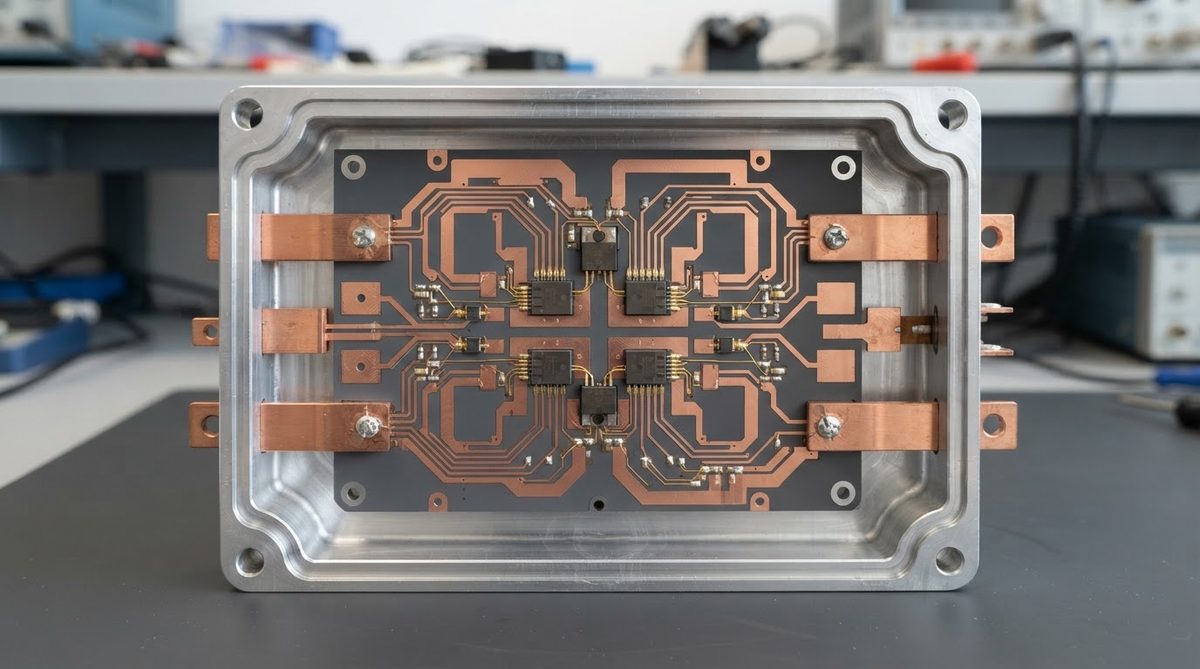
The table below collects representative values from commercially available grades. Use it for shortlisting, then confirm against the specific supplier datasheet for your chosen grade. For a broader dataset including BeO and SiC, see the full ceramic substrate properties comparison.
| Parameter | Al₂O₃ 96% | Al₂O₃ 99.6% | AlN | Si₃N₄ | ZrO₂ (3Y-TZP) | Unit | Condition / Source |
|---|---|---|---|---|---|---|---|
| Thermal conductivity | 24–28 | 28–35 | 170–230 | 60–90 | 2–3 | W/mK | 25 °C; Kyocera / CoorsTek datasheets |
| CTE | 7.2–7.4 | 7.1–7.3 | 4.5–4.7 | 2.7–3.2 | 10–10.5 | ppm/°C | 20–300 °C; CeramTec / Maruwa |
| Flexural strength | 350–380 | 400–450 | 300–350 | 600–900 | 900–1200 | MPa | ASTM C1161, 4-pt bend |
| Fracture toughness (KIC) | 3.5–4.0 | 3.8–4.2 | 2.5–3.0 | 6–7 | 7–10 | MPa·√m | ASTM C1421 |
| Dielectric constant (εr) | 9.4–9.8 | 9.8–10.0 | 8.5–9.0 | 7.5–8.5 | 25–30 | — | 1 MHz; Kyocera / CoorsTek |
| Volume resistivity | >1014 | >1014 | >1014 | >1013 | ~106 (at 300 °C) | Ω·cm | 25 °C; CeramTec |
| Max continuous use temp | 1600 | 1700 | 1000 (in air, oxidation limit) | 1200 | 1000 | °C | In air; see notes |
| Relative cost (Al₂O₃ 96% = 1×) | 1× | 1.5–2× | 3–5× | 4–6× | 2–3× | — | Typical 50 × 50 mm, 0.635 mm, 2024 market |
Typical values for commercially available material, for comparison only. Confirm against the datasheet for your specific grade.
A few things jump out. AlN’s thermal conductivity is 6–8× that of 96% alumina, but its fracture toughness is the lowest in the group. Si₃N₄ sits in between thermally (60–90 W/mK) yet offers roughly twice the toughness of alumina. ZrO₂ has exceptional mechanical strength but very poor thermal conductivity and an ionic conductivity that rises sharply above 300 °C, ruling it out for most power electronics.
Step-by-Step Substrate Selection Process
Rather than starting with the material, start with the constraints your application imposes. Work through these five questions in order.
1. What is the heat flux at the substrate surface?
Calculate the worst-case power density in W/cm². For a 50 W SiC MOSFET on a 10 × 10 mm die-attach pad, that is 50 W / 1 cm² = 50 W/cm². Below roughly 10 W/cm², 96% alumina is usually adequate. Above 30 W/cm², AlN or Si₃N₄ with a DBC or AMB copper layer becomes necessary to keep junction temperatures in check.
2. What is the CTE of your die and your heat sink?
Silicon has a CTE of about 2.6 ppm/°C; SiC is around 4.0 ppm/°C; GaN-on-SiC is similar. Copper heat sinks run 17 ppm/°C, while AlSiC composites sit near 7–8 ppm/°C. The substrate bridges these two. AlN at 4.5 ppm/°C is a close match to SiC die. Si₃N₄ at ~3 ppm/°C is closer to silicon. Alumina at 7.2 ppm/°C works well with AlSiC baseplates. A mismatch above 3 ppm/°C between die and substrate accelerates solder-joint fatigue under thermal cycling.
3. How severe is the thermal cycling?
Automotive traction inverters may see –40 to +175 °C cycles, tens of thousands of times over a vehicle’s life. Si₃N₄ AMB substrates routinely survive >3 000 cycles in –55/+250 °C accelerated tests (per Infineon AN2019-09, “Reliability of Si₃N₄ AMB Substrates”). AlN DBC substrates typically fail between 500 and 1 500 cycles under the same conditions because microcracks propagate through the lower-toughness ceramic. If your product faces fewer than a few hundred deep cycles, AlN DBC is fine. For long-life automotive or aerospace, Si₃N₄ PCB substrates are the safer bet.
4. What metallization process does the substrate require?
The substrate and the metallization process are coupled. DBC (direct bond copper) works with Al₂O₃ and AlN. AMB (active metal brazing) works with Al₂O₃, AlN, and Si₃N₄. DPC (direct plated copper) is common on Al₂O₃ and AlN for finer features. Thick-film printing suits Al₂O₃ well but is less common on AlN. Si₃N₄ almost always uses AMB because its surface chemistry resists direct bonding. Choosing Si₃N₄ therefore commits you to AMB’s higher processing cost and coarser minimum features (~300 µm trace/space vs. ~50 µm for DPC).
5. What is the per-unit budget?
A bare 96% alumina substrate (50 × 50 × 0.635 mm) might cost $1–3 in volume. The same size in AlN runs $5–15. Si₃N₄ runs $8–20. AMB processing adds another $10–30 per unit depending on copper pattern complexity. If your BOM target is $0.50 for the substrate, you are buying alumina. Period.
Worked Example: Choosing a Substrate for a 100 W SiC Half-Bridge Module
Suppose you are designing a 100 W half-bridge module with two SiC MOSFETs, each dissipating 50 W worst-case on a 5 × 5 mm die. The baseplate is AlSiC. The reliability target is 2 000 power cycles at ΔT = 150 °C.
Heat flux: 50 W / 0.25 cm² = 200 W/cm². This rules out alumina immediately.
CTE chain: SiC die ≈ 4.0 ppm/°C → substrate → AlSiC baseplate ≈ 7.5 ppm/°C. AlN at 4.5 ppm/°C is close to the die. Si₃N₄ at 3.0 ppm/°C is slightly farther from both die and baseplate.
Thermal resistance through the substrate: For a 0.32 mm thick AlN substrate under a 5 × 5 mm die: Rth = t / (k × A) = 0.00032 m / (200 W/mK × 0.000025 m²) = 0.064 °C/W. The same calculation for Si₃N₄ at 80 W/mK: 0.00032 / (80 × 0.000025) = 0.16 °C/W. That is 0.1 °C/W higher, which adds 5 °C at 50 W. Manageable, but worth accounting for.
Cycling reliability: 2 000 cycles at ΔT = 150 °C is aggressive. AlN DBC is marginal here. Si₃N₄ AMB passes comfortably.
Decision: Si₃N₄ AMB. The 5 °C thermal penalty is acceptable; the reliability margin is not negotiable. If the cycling target were only 500 cycles, AlN DBC would save 30–40% on substrate cost.
For detailed mechanical data on Si₃N₄ grades, see the Si₃N₄ material properties datasheet.
When Each Material Is the Default Choice
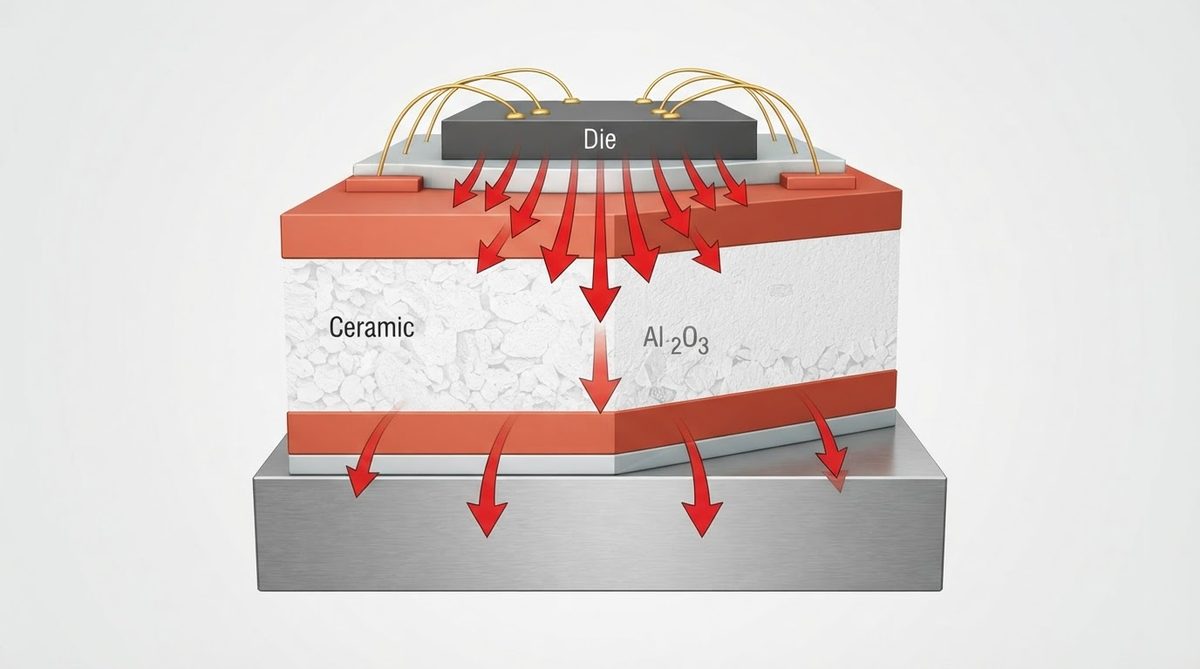
Al₂O₃ 96%: LED boards, RF packages below 10 GHz, sensor substrates, thick-film hybrid circuits, any application where cost matters more than extreme thermal performance. This is the workhorse. If you have no reason to use something else, start here.
Al₂O₃ 99.6%: Higher-purity variant for improved hermeticity and slightly better thermal conductivity. Common in military and medical hermetic packages.
AlN: High-power IGBT and MOSFET modules, laser diode submounts, RF power amplifiers, any design where thermal resistance through the substrate is the bottleneck. Check your substrate thickness options—thinner AlN substrates (0.25 mm) can cut Rth nearly in half compared to the standard 0.635 mm.
Si₃N₄: Automotive traction inverters, railway power modules, aerospace power converters—anywhere the combination of high thermal cycling, mechanical vibration, and long service life makes fracture toughness the deciding factor. Increasingly specified for SiC-based EV inverters operating at junction temperatures above 175 °C.
ZrO₂: Oxygen sensors (lambda probes), solid-oxide fuel cell components, piezoelectric actuator substrates. Rarely used for conventional PCB applications due to low thermal conductivity and ionic conductivity at elevated temperatures.
When Not to Use a Ceramic Substrate
Ceramic is not always the right answer. Use FR-4 or metal-core PCBs (MCPCBs) instead when:
- Cost per board must be under $1. Even the cheapest alumina substrate costs more than FR-4 for equivalent area.
- You need more than two or three routing layers. Multilayer ceramic PCBs exist (LTCC, HTCC), but they are expensive and limited in layer count compared to organic stackups.
- Board area exceeds roughly 150 × 150 mm. Large ceramic panels are fragile, expensive, and hard to keep flat. MCPCBs handle large-area thermal spreading at a fraction of the cost.
- Mechanical compliance is needed. Ceramic is rigid and brittle. If your enclosure flexes, a conformal MCPCB or flex-rigid board is safer.
- Operating temperature stays below 130 °C and heat flux is low. Standard FR-4 (Tg 170 °C) or high-Tg polyimide handles this fine.
Common Selection Mistakes
Specifying AlN when alumina would do. Engineers sometimes default to AlN for “thermal headroom.” If your thermal simulation shows the substrate accounts for less than 10% of total Rth (junction to ambient), upgrading the substrate material yields diminishing returns. Spend the budget on a better heat sink or thermal interface material instead.
Ignoring moisture sensitivity of AlN. Aluminum nitride hydrolyzes in humid environments. Exposed AlN surfaces degrade over months if not passivated or sealed. If your product operates in an open-air outdoor enclosure, either add a passivation layer or switch to Si₃N₄.
Choosing Si₃N₄ without confirming AMB availability. Si₃N₄ AMB is a specialty process. Lead times are longer and fewer suppliers offer it. Confirm sourcing before you commit in your design review. You can explore custom Si₃N₄ fabrication options early to lock in lead times.
Frequently Asked Questions
Can I use the same Gerber files for ceramic as for FR-4?
Yes, the file format is the same, but design rules differ. Ceramic substrates typically require wider minimum trace/space (75–100 µm for DPC, 300 µm+ for AMB) and different drill rules. Panelization also changes because ceramic panels are smaller and snapped or laser-scribed rather than routed.
Does ceramic substrate thickness affect material choice?
It does. Thinner substrates (0.25–0.38 mm) reduce thermal resistance but are more fragile. Si₃N₄ tolerates thin profiles better than AlN because of its higher fracture toughness. AlN below 0.32 mm requires careful handling during metallization and assembly. Review the ceramic PCB material options alongside your thickness requirements.
Is AlN always better than alumina for thermal performance?
Not always in practice. AlN’s 170–230 W/mK conductivity is far higher, but if the thermal bottleneck is the solder layer, the TIM, or the heat sink, upgrading only the substrate yields a small system-level improvement. Run a full thermal stack calculation before paying the AlN premium.
What surface finishes are available on ceramic substrates?
Common finishes include electroless nickel/immersion gold (ENIG), electrolytic nickel/gold, bare copper with OSP, and silver plating. The choice depends on the metallization process and the soldering or wire-bonding method used in assembly. ENIG is the most common for general soldering.
How do I get samples to test before committing to a material?
Most ceramic substrate suppliers offer sample kits with multiple materials and thicknesses. Testing a bare substrate for thermal conductivity, surface roughness, and solderability before finalizing your design is standard practice and avoids costly respins.
Are there lead-time differences between materials?
Yes. 96% alumina substrates are commodity items with lead times of 1–3 weeks. AlN typically runs 3–5 weeks. Si₃N₄ AMB substrates can take 6–10 weeks depending on copper pattern complexity and supplier backlog. Plan procurement early for AlN and Si₃N₄.