Alumina Definition
Alumina is aluminum oxide (Al₂O₃), a polycrystalline ceramic used as a substrate and insulator in electronic packaging. In PCB and hybrid-circuit work, “alumina” almost always refers to sintered Al₂O₃ substrates available in purity grades from 92% to 99.6%, with 96% being the most common for cost-sensitive designs and 99.6% chosen when lower dielectric loss or higher thermal conductivity is required.
Common Grades and Properties
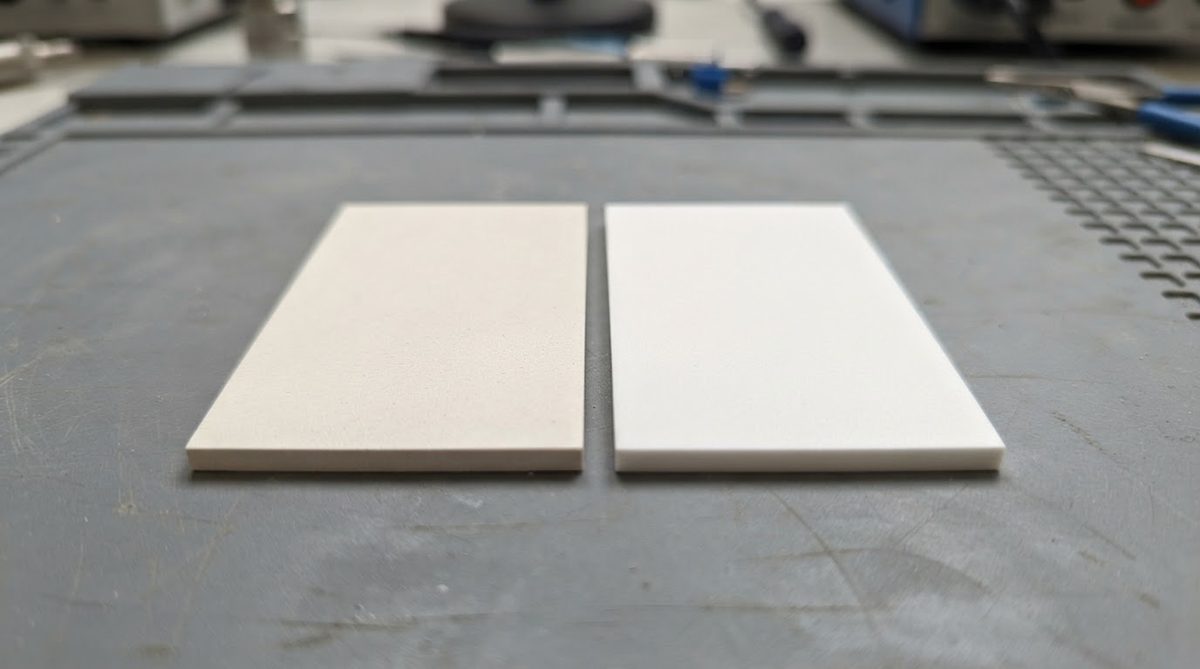
The purity percentage indicates the Al₂O₃ content by weight; the remainder is a glassy phase (typically SiO₂, MgO, and CaO) added to lower the sintering temperature. Higher purity means less glassy phase, which improves thermal conductivity and dielectric strength but raises material cost and firing temperature.
| Parameter | 96% Al₂O₃ | 99.6% Al₂O₃ | Unit | Condition |
|---|---|---|---|---|
| Thermal conductivity | 24–28 | 30–35 | W/mK | 20 °C, per CoorsTek ADS-996 / Kyocera A-493 |
| Dielectric constant (εr) | 9.0–9.5 | 9.7–10.0 | — | 1 MHz, 25 °C |
| Dielectric strength | ≥ 10 | ≥ 14 | kV/mm | AC, 60 Hz |
| Flexural strength | 350–380 | 400–450 | MPa | ASTM C1161, 4-pt bend |
| CTE | 7.2–7.4 | 7.1–7.3 | ppm/°C | 25–400 °C |
| Max continuous use temp. | ~1 600 | ~1 700 | °C | In inert atmosphere |
Typical values for commercially available material, for comparison only. Confirm against the datasheet for your specific grade.
Why Alumina Dominates Ceramic PCB Production
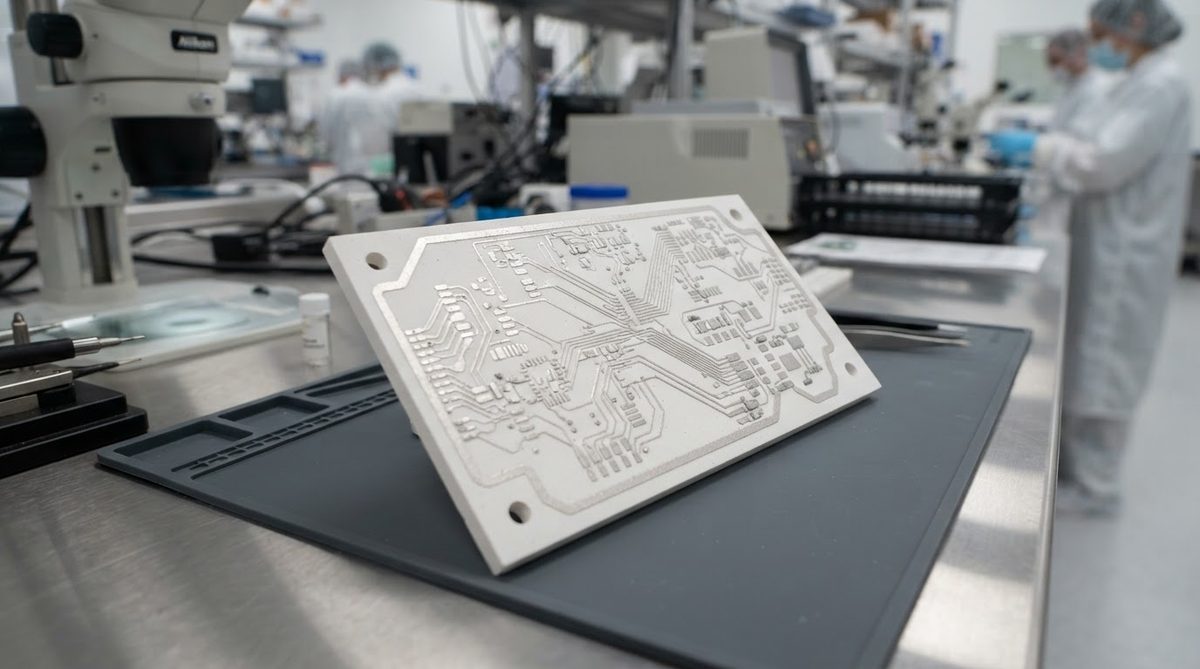
Alumina substrates account for the vast majority of ceramic PCBs because they balance cost, machinability, and electrical performance. The material is compatible with thick-film screen printing, thin-film sputtering, DPC (direct plated copper), and DBC (direct bond copper) processes. Metallised alumina substrates carry copper foil or printed conductors and serve as reliable insulators between circuit traces and a heat spreader or baseplate.
When Alumina Is Not Enough
Alumina’s 24–35 W/mK thermal conductivity falls short for high-power devices that need 170–230 W/mK (aluminum nitride) or the extreme fracture toughness of silicon nitride. Its relatively high εr (~9.5) also makes it a poor fit for millimetre-wave RF circuits, where quartz or low-εr LTCC tapes perform better. For applications below 130 °C with modest power density, standard FR-4 is cheaper and easier to source.