Heat Spreader Definition
A heat spreader is a thermally conductive plate or layer positioned between a concentrated heat source—such as a power die or LED—and a larger heat sink or ambient environment. Understanding the heat spreader definition starts with its core function: converting a small, high-flux hot spot into a broader, lower-flux thermal footprint before that energy reaches the next cooling stage.
The mechanism is lateral conduction. A bare chip might dissipate 50 W over a 5 × 5 mm footprint (2,000 kW/m²). A copper or aluminum nitride heat spreader underneath that chip conducts heat outward so the same 50 W passes through a 25 × 25 mm area (80 kW/m²) by the time it reaches the heat sink. Lower flux means a smaller temperature gradient and a cooler junction.
Why the Heat Spreader Definition Matters for Power Density
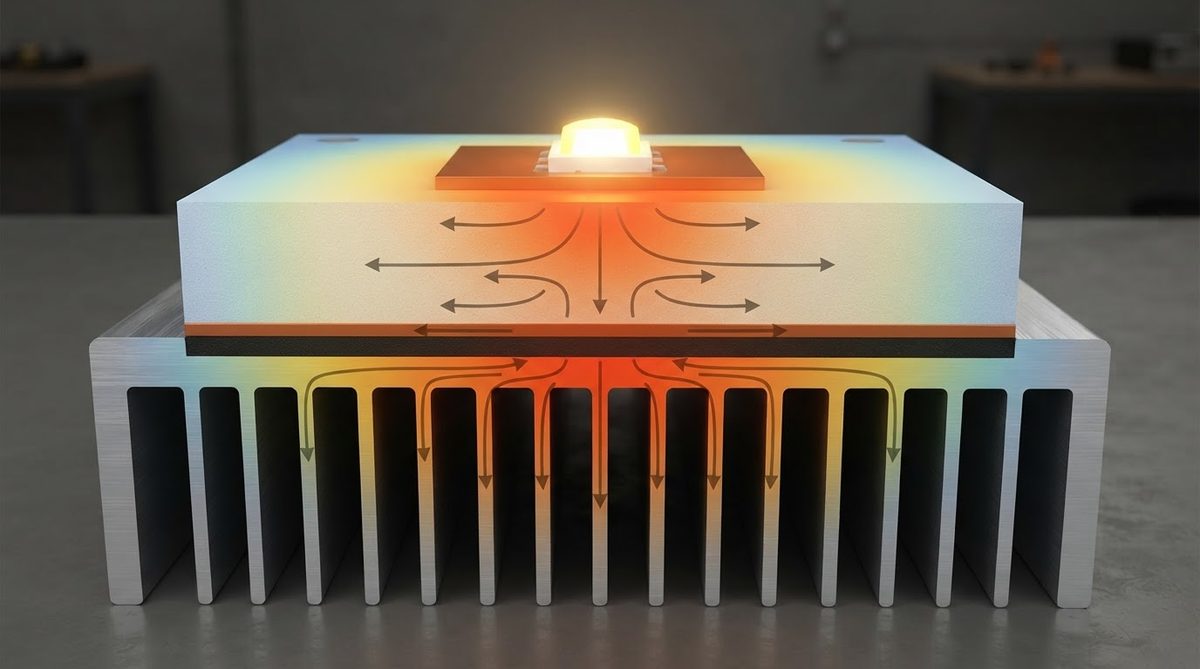
As die sizes shrink and power levels rise, the heat flux at the junction climbs steeply. Without effective spreading, the junction temperature exceeds the device’s rated maximum even when the total dissipated power is modest. A well-chosen heat spreader with high thermal conductivity buys 10–30 °C of margin at the junction, which can double semiconductor lifetime per the Arrhenius model.
Key scenarios where a heat spreader is essential:
- Localized flux exceeds roughly 50–100 kW/m², common in power converters and RF amplifiers.
- Die-to-heat-sink area ratios greater than 1:4, where direct mounting creates a severe thermal bottleneck.
- High-brightness LED arrays where junction temperature directly affects lumen output and color shift.
- SiC or GaN devices operating above 150 °C, where every degree of spreading margin extends reliability.
Common Heat Spreader Materials
| Material | Thermal Conductivity (W/m·K) | CTE (ppm/°C) | Typical Use |
|---|---|---|---|
| Copper (C101) | 385–400 | 16.5 | General power electronics |
| Aluminum (6063) | 200–218 | 23.4 | Cost-sensitive LED modules |
| AlN ceramic | 170–200 | 4.5 | High-power die attach, CTE-matched to Si/SiC |
| Cu-Mo-Cu composite | 180–250 | 6–8 | Aerospace, hermetic packages |
Typical values from published manufacturer datasheets (Maruwa, CoorsTek). Confirm against the datasheet for your specific grade.
Material choice depends on the CTE match required. Copper spreads heat well but its CTE of 16.5 ppm/°C is far from silicon’s 2.6 ppm/°C. Under thermal cycling, that mismatch stresses solder joints. Aluminum nitride, with a CTE of 4.5 ppm/°C, is a much closer match and is often used as the substrate itself in ceramic PCBs, serving double duty as both electrical carrier and heat spreader.
Enter your substrate material, thickness, and dissipated power below to see how different heat spreader choices affect estimated junction temperature rise.
Heat Spreader vs. Heat Sink
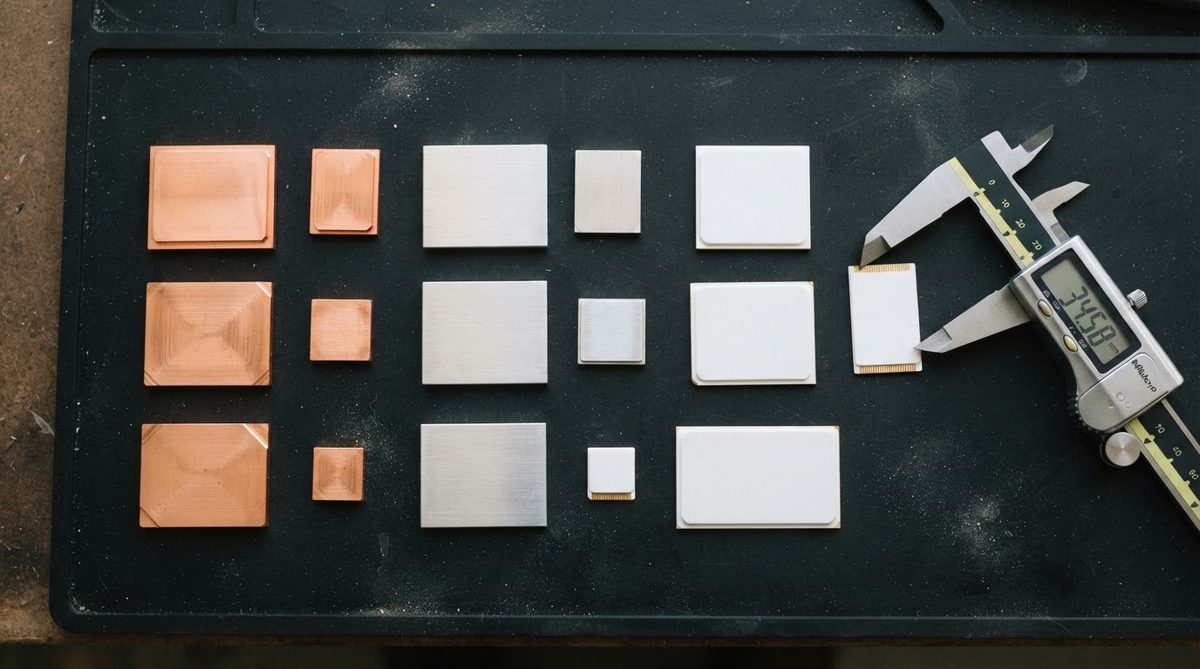
The two terms are often confused, so a clear heat spreader definition helps draw the line. A heat sink convects thermal energy into air or liquid through fins or channels. A heat spreader does no convecting; it only redistributes energy laterally so the heat sink above or below it works more efficiently. In many ceramic PCB assemblies the ceramic substrate is the heat spreader, bonded directly to a finned aluminum heat sink.
FAQ
Does every PCB need a heat spreader?
No. Low-power signal boards generate little heat and need no spreading layer. Heat spreaders become necessary when localized flux exceeds roughly 50–100 kW/m², common in power converters, RF amplifiers, and high-brightness LEDs.
Can a ceramic substrate act as a heat spreader on its own?
Yes. An AlN ceramic substrate at 170–200 W/m·K provides substantial lateral spreading while also carrying traces and die attach pads. This eliminates a separate heat spreader component and reduces total assembly thickness, which is one reason the heat spreader definition in ceramic PCB design often overlaps with the substrate itself.