The silicon nitride definition in electronics context: silicon nitride (Si₃N₄) is a non-oxide structural ceramic used as an electronics substrate material, valued for its high fracture toughness (5–7 MPa·√m per ASTM C1421) combined with moderate thermal conductivity of 60–90 W/mK at 25 °C. Among ceramic PCB substrates, Si₃N₄ is the most resistant to mechanical and thermal-shock failure. Understanding this silicon nitride definition is essential for engineers selecting substrates for high-reliability power modules.
Silicon Nitride Definition and Key Substrate Properties
To expand on the silicon nitride definition above: Si₃N₄ is a covalently bonded compound of silicon and nitrogen, sintered at high temperature into a dense polycrystalline body. Its elongated grain microstructure is what gives it crack-deflection behavior and toughness far exceeding other electronic ceramics. The table below summarizes the properties that matter most for substrate selection.
| Parameter | Value | Unit | Condition | Source |
|---|---|---|---|---|
| Thermal conductivity | 60–90 | W/mK | 25 °C | Kyocera SN series datasheet |
| Flexural strength | 600–900 | MPa | ASTM C1161, 3-pt bend | CoorsTek Si₃N₄ datasheet |
| Fracture toughness (K_IC) | 5–7 | MPa·√m | ASTM C1421 | CoorsTek Si₃N₄ datasheet |
| Dielectric strength | 15–20 | kV/mm | 25 °C, 1 mm thick | Kyocera SN series datasheet |
| CTE | 2.5–3.5 | ppm/°C | 25–400 °C | CeramTec technical data |
| Typical substrate thickness | 0.25–0.64 | mm | — | Industry standard |
Typical values for commercially available material, for comparison only. Confirm against the datasheet for your specific grade.
Why Fracture Toughness Matters
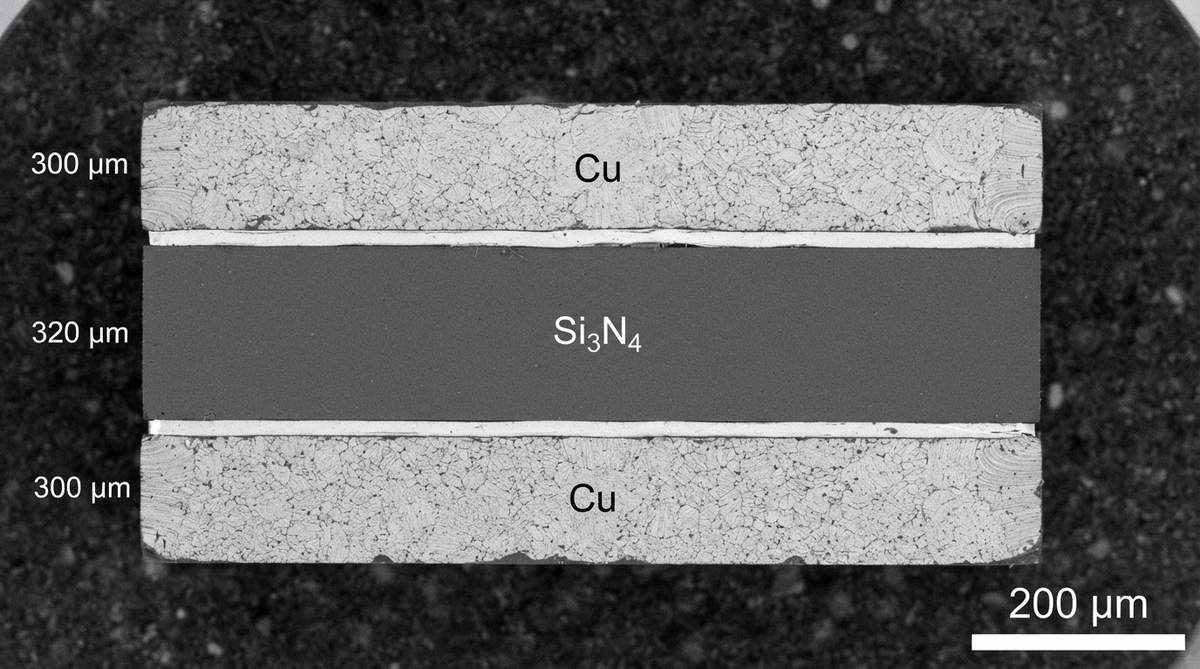
Si₃N₄ substrates tolerate thermal cycling far better than alumina or aluminum nitride. A 0.32 mm Si₃N₄ substrate in an AMB (Active Metal Brazing) power module can survive over 3 000 thermal cycles from −40 °C to +250 °C, per published Infineon reliability data, where a comparable AlN substrate may crack before 1 000 cycles. This makes Si₃N₄ the preferred choice for automotive traction inverters and railway power modules that face extreme duty cycles.
The high flexural strength also allows thinner substrates—0.25 mm is common—reducing thermal resistance through the ceramic layer without sacrificing mechanical reliability.
Where Si₃N₄ Is Used
Given the silicon nitride definition as a toughness-first ceramic, its primary application is as the insulating layer in AMB and DBC power modules for SiC and GaN devices operating above 175 °C junction temperature. Typical deployment areas include:
- EV drivetrain traction inverters requiring >3 000 thermal cycles (−40 °C to +250 °C)
- Railway power converters with 30-year service-life expectations
- Wind-turbine converter modules exposed to wide ambient temperature swings
- Aerospace power electronics where substrate cracking is a mission-critical failure mode
- Industrial SiC half-bridge modules operating at junction temperatures above 200 °C
Enter your substrate dimensions and power dissipation below to see how Si₃N₄ thermal performance changes with temperature.
Trade-offs and Limitations
No silicon nitride definition is complete without an honest look at the downsides. Si₃N₄ substrates cost roughly 5–10× more than 96% alumina per unit area and 2–4× more than AlN. Thermal conductivity peaks around 90 W/mK in the best commercial grades—well below AlN’s 170–200 W/mK. If your design is thermally limited but not mechanically stressed, AlN may be a better fit at lower cost. For low-power or cost-sensitive designs, standard alumina remains the practical default. Refer to the ceramic PCB materials overview for comparisons across all common substrate types.
FAQ
Is silicon nitride the same as aluminum nitride?
No. Silicon nitride (Si₃N₄) and aluminum nitride (AlN) are distinct ceramics. Si₃N₄ has superior fracture toughness (5–7 vs. 2–3 MPa·√m) but lower thermal conductivity (60–90 vs. 170–200 W/mK). They serve different design priorities.
Can Si₃N₄ substrates be used with DBC processing?
Yes, though AMB (Active Metal Brazing) is more common for Si₃N₄ because the brazing temperature is lower than DBC’s copper-oxide bonding temperature, reducing residual stress. DBC on Si₃N₄ exists but is less widely offered.
What is the maximum operating temperature for a Si₃N₄ substrate?
The ceramic itself is stable beyond 1 000 °C. The practical limit is set by the metallization and solder, typically 300–350 °C for AMB copper, not by the Si₃N₄.
How does the silicon nitride definition differ from silicon carbide?
Silicon nitride (Si₃N₄) is a compound of silicon and nitrogen; silicon carbide (SiC) is a compound of silicon and carbon. As a substrate, Si₃N₄ offers much higher fracture toughness (5–7 vs. ~3 MPa·√m) while SiC is more commonly used as a semiconductor die material rather than a substrate in power electronics.