A bare ceramic PCB (96% Al₂O₃, single-layer, 25 × 25 mm) typically costs $3–$8 per piece at production volumes, while an equivalent FR-4 board runs $0.20–$0.50. That 8–30× unit-price gap is the headline number most engineers see first when evaluating ceramic PCB cost vs FR4. But unit price is not total cost. Once you add thermal management hardware, assembly yield losses, warranty claims, and product lifetime into the equation, ceramic often costs less per operating hour in thermally demanding applications.
Key Takeaways
- Ceramic substrate unit cost runs 8–30× higher than FR-4, depending on material grade, metallization process, and volume.
- Eliminating an extruded aluminum heatsink and thermal interface material (TIM) can recover $1.50–$6.00 per assembly, closing 30–70% of the price gap.
- FR-4 boards in high-temperature environments (above 130 °C continuous) suffer accelerated delamination and pad lift, driving field failure rates that ceramic avoids.
- Total cost of ownership favors ceramic when dissipated power density exceeds roughly 3–5 W/cm² and the product must survive more than 20,000 operating hours.
- For low-power, room-temperature digital circuits, FR-4 wins on every cost metric. Ceramic adds no value there.
Ceramic PCB Cost vs FR4: Unit Price Breakdown
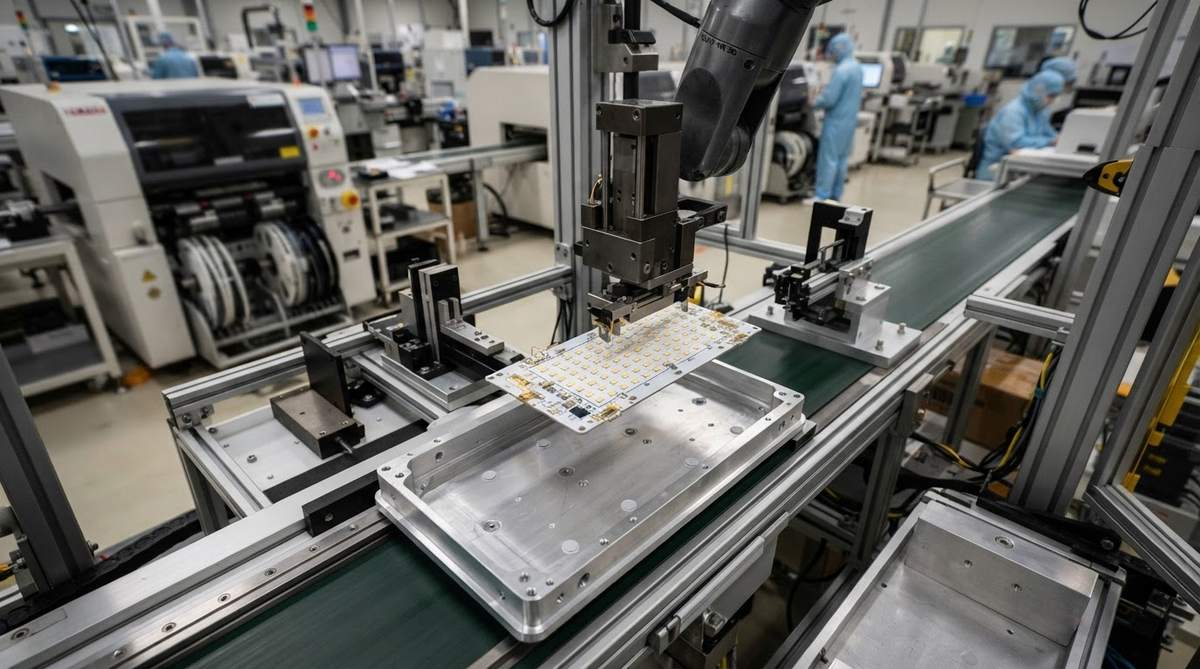
The raw substrate dominates ceramic board cost. A 96% alumina blank (0.635 mm thick, 50 × 50 mm) costs $0.80–$2.50 depending on surface finish and supplier, per CoorsTek and Maruwa published pricing. FR-4 laminate for the same footprint costs under $0.05. That gap is baked into the material: alumina is sintered at 1,500–1,600 °C in batch kilns, while FR-4 is a continuous-press laminate.
Metallization adds the next layer of cost. A silver or copper metallization process on ceramic (thick film, DPC, or DBC) requires vacuum or screen-printing equipment and firing steps that do not exist in a standard FR-4 etch line. Expect metallization to add $1.00–$4.00 per board at mid-volume (500–2,000 pcs), compared to $0.10–$0.30 for FR-4 copper etching.
Drilling and routing are also more expensive. Ceramic requires laser or diamond scribing rather than mechanical drilling. Hole costs run 3–5× higher per via. Panelization is limited by substrate brittleness, so panel utilization is lower.
| Cost Element | FR-4 (per board) | 96% Al₂O₃ Ceramic (per board) | Notes |
|---|---|---|---|
| Raw substrate | $0.03–$0.05 | $0.80–$2.50 | 25 × 25 mm, 0.635 mm thick |
| Metallization | $0.10–$0.30 | $1.00–$4.00 | Single-layer copper pattern |
| Drilling / vias | $0.02–$0.05 | $0.15–$0.50 | 4 vias assumed |
| Surface finish (ENIG) | $0.05–$0.10 | $0.10–$0.25 | Per IPC-4552 |
| Test & inspection | $0.02–$0.05 | $0.10–$0.30 | AOI + hipot for ceramic |
| Total bare board | $0.22–$0.55 | $2.15–$7.55 | At 1,000-piece volume |
Estimates based on typical contract manufacturing pricing for single-layer boards, 2024–2025. Actual quotes vary by vendor, tolerance class, and order size.
Total Cost of Ownership: Where Ceramic PCB Cost vs FR4 Flips
Unit price tells you what the purchasing department pays. Total cost of ownership (TCO) tells you what the product actually costs. The difference matters most in three areas: ceramic thermal management, field reliability, and product lifetime.
Thermal Management Hardware You Can Remove
An FR-4 board dissipating 5 W in a 10 × 10 mm footprint needs an external heatsink and TIM to keep junction temperatures safe. A typical extruded aluminum heatsink costs $0.80–$3.00. Thermal grease or a phase-change pad adds $0.30–$1.50. Mounting hardware (screws, clips, insulators) adds $0.20–$0.80. Assembly labor for heatsink attachment adds $0.40–$1.20 per board in a semi-automated line.
A 96% alumina substrate with 24–28 W/m·K thermal conductivity (per ASTM E1461, at 25 °C) conducts heat directly from the die to the chassis or ambient. In many designs, the ceramic board is the heatsink. That eliminates $1.70–$6.50 in parts and labor per assembly. On a $3–$8 ceramic board, that recovery is significant.
Worked Example: 5 W LED Module
Consider a 5 W LED module on a 20 × 20 mm substrate, 10,000-unit annual volume:
- FR-4 path: Board $0.35 + heatsink $1.20 + TIM $0.50 + mounting $0.30 + assembly labor $0.60 = $2.95/unit.
- Ceramic path (96% Al₂O₃): Board $4.50, no heatsink, no TIM, no mounting hardware, reduced assembly labor $0.20 = $4.70/unit.
- Gap: $1.75/unit favoring FR-4 on assembly cost alone.
Now add reliability. If the FR-4 assembly has a 2% annual field failure rate (common for LED modules above 120 °C junction temperature, per Nichia application note AN-1802) and each warranty replacement costs $25 fully loaded, that is $0.50/unit/year in warranty cost. Over a 5-year product life, warranty adds $2.50/unit. The ceramic assembly, running 20–30 °C cooler at the same power, drops the failure rate below 0.3%, adding only $0.38 over five years. The ceramic path now costs $5.08 lifetime versus $5.45 lifetime for FR-4. This is the point where ceramic PCB cost vs FR4 reverses for thermally stressed products.
Plug your own numbers into the calculator below to see where the crossover falls for your design. Enter board dimensions, power dissipation, production volume, and expected product life to estimate total cost of ownership for both substrate types.
[pcb_calc type=”tco”]
Field Reliability and Warranty
FR-4 has a glass transition temperature (Tg) of 130–180 °C depending on resin system, per IPC-4101. Above Tg, the resin softens, CTE spikes, and solder joints fatigue. Ceramic substrates have no Tg. Alumina operates continuously to 800 °C; aluminum nitride to over 1,000 °C. For applications where board temperature stays below 100 °C, this advantage is irrelevant. Above 130 °C, it is decisive.
Thermal cycling accelerates failure in FR-4 assemblies through CTE mismatch between the laminate (14–17 ppm/°C in-plane) and ceramic chip components (6–8 ppm/°C). Alumina’s CTE of 6.5–7.2 ppm/°C (per CoorsTek datasheet, 25–400 °C) closely matches silicon (2.6 ppm/°C) and GaN (3.2 ppm/°C), reducing solder joint stress. This matters most in power electronics and automotive underhood applications where thermal cycles exceed 1,000 over the product life.
Volume Scaling: How Ceramic PCB Cost vs FR4 Changes at 100, 1K, and 100K Pieces
FR-4 scales beautifully. At 100,000 pieces, panel utilization is optimized, and per-board cost drops below $0.15. Ceramic scales too, but the floor is higher because substrate and metallization costs dominate. At 100K pieces, a single-layer 96% alumina board on a DPC or thick-film line can reach $1.50–$3.00 per board. The ratio narrows from 30× at prototype to roughly 8–12× at high volume.
If your BOM target is $0.50 per board and the application is a consumer IoT sensor running at 50 mW, ceramic will never make financial sense. If your BOM target is $15 per board and the application is a 50 W SiC gate driver running at 175 °C ambient, the ceramic board is the cheaper path once you account for everything else on the assembly. For a full breakdown of what drives ceramic PCB cost, see the cost pillar page.
When NOT to Use Ceramic
Choose FR-4 or metal-core PCB instead of ceramic when:
- Board temperature stays below 100 °C continuously and thermal conductivity of 0.3 W/m·K (FR-4) is sufficient.
- The design requires more than 4 layers. Ceramic multilayer (HTCC/LTCC) is possible but expensive; FR-4 multilayer is mature and cheap. See the HTCC vs LTCC comparison if multilayer ceramic is on the table.
- Board area exceeds roughly 150 × 150 mm. Large ceramic panels are fragile, expensive, and yield-limited.
- The product is cost-driven consumer electronics with a 2-year expected life. Warranty savings never accumulate enough to offset the substrate premium.
- Mechanical shock and vibration are severe. Ceramic is brittle. A metal-core PCB handles mechanical abuse better.
Getting an Accurate Quote for Your Comparison
The numbers above are industry ranges. Your actual ceramic PCB cost vs FR4 depends on substrate material, metallization type, copper thickness, surface finish, tolerances, and volume. The fastest way to get a real number is to submit your design files for a quote.
Use the estimator below to get a ballpark ceramic PCB price based on your board dimensions, layer count, and quantity before submitting full Gerber files.
[pcb_calc type=”pcb-quote”]
For a deeper look at how ceramic stacks up against FR-4 on performance metrics beyond cost, see the full ceramic vs FR-4 comparison. If your thermal budget pushes you toward ceramic but you want to compare it against aluminum-backed boards, the ceramic vs MCPCB cost comparison covers that tradeoff in detail.
FAQ
Does ceramic PCB cost go down at high volume?
Yes. Ceramic PCB unit cost drops 40–60% from prototype (25–50 pcs) to production (10K+ pcs) due to better panel utilization and amortized tooling. The gap versus FR-4 narrows from roughly 30× to 8–12× but never closes entirely because the raw substrate cost has a hard floor.
Can I use a cheaper ceramic grade to reduce cost?
96% alumina is already the lowest-cost ceramic substrate grade in common use. Dropping below 96% purity degrades thermal conductivity and surface finish quality enough to cause metallization adhesion problems. Moving to aluminum nitride or silicon nitride increases cost further—2–5× over 96% alumina. See the alumina vs AlN substrate comparison for specifics.
Is ceramic PCB cost justified for a prototype run?
At prototype quantities (5–25 pcs), ceramic boards cost $15–$50 each, which is affordable for validation. The real question is whether your production volume justifies the investment in ceramic-specific design rules. If you plan to switch to FR-4 for production, the prototype data may not transfer cleanly due to different CTE and thermal behavior.
What is the biggest hidden cost of using FR-4 in a high-temperature design?
Field failures. FR-4 delamination and pad lift above Tg cause solder joint cracking that shows up months after deployment. A single field failure in an industrial or automotive product can cost $25–$200 in warranty service, dwarfing the $3–$7 saved on the substrate. The math only works if you track warranty costs back to the board level.
How do assembly costs compare between ceramic and FR-4?
SMT assembly on ceramic uses the same pick-and-place and reflow equipment as FR-4. Solder paste printing may require profile adjustments because ceramic’s higher thermal mass slows reflow ramp rates. Assembly cost per board is typically within 10–15% of FR-4 assembly cost, assuming standard component packages and no exotic attach methods.