Aluminum nitride AlN DBC direct bonded copper substrates bond a layer of oxygen-free copper directly to an AlN ceramic core at high temperature, producing a power substrate with thermal conductivity of 170–230 W/mK and copper layers thick enough to carry tens of amps. That combination makes aluminum nitride AlN DBC direct bonded copper the default choice for IGBT modules, SiC/GaN power stages, and high-flux LED arrays where heat must exit the die as fast as possible.
Key Specifications for Aluminum Nitride AlN DBC Direct Bonded Copper
| Parameter | Typical Value | Unit | Condition / Standard | Source |
|---|---|---|---|---|
| AlN thermal conductivity | 170–230 | W/mK | 20 °C, ASTM E1461 | Kyocera SH-170 / Maruwa AN-230 datasheets |
| Dielectric strength | 15–17 | kV/mm | 25 °C, IEC 60243 | CoorsTek ADS-996 datasheet |
| CTE (AlN) | 4.5–5.0 | ppm/°C | 25–400 °C | Kyocera SH-170 datasheet |
| CTE (Cu) | 17 | ppm/°C | 20 °C | Standard reference value |
| Copper thickness (per side) | 0.127–0.635 | mm | — | Industry standard DBC range |
| Flexural strength (AlN) | 300–400 | MPa | ASTM C1161 | Maruwa AN-170 datasheet |
| Volume resistivity | >1014 | Ω·cm | 25 °C | CoorsTek ADS-996 datasheet |
Typical values for commercially available material, for comparison only. Confirm against the datasheet for your specific grade.
How the Aluminum Nitride AlN DBC Direct Bonded Copper Process Works
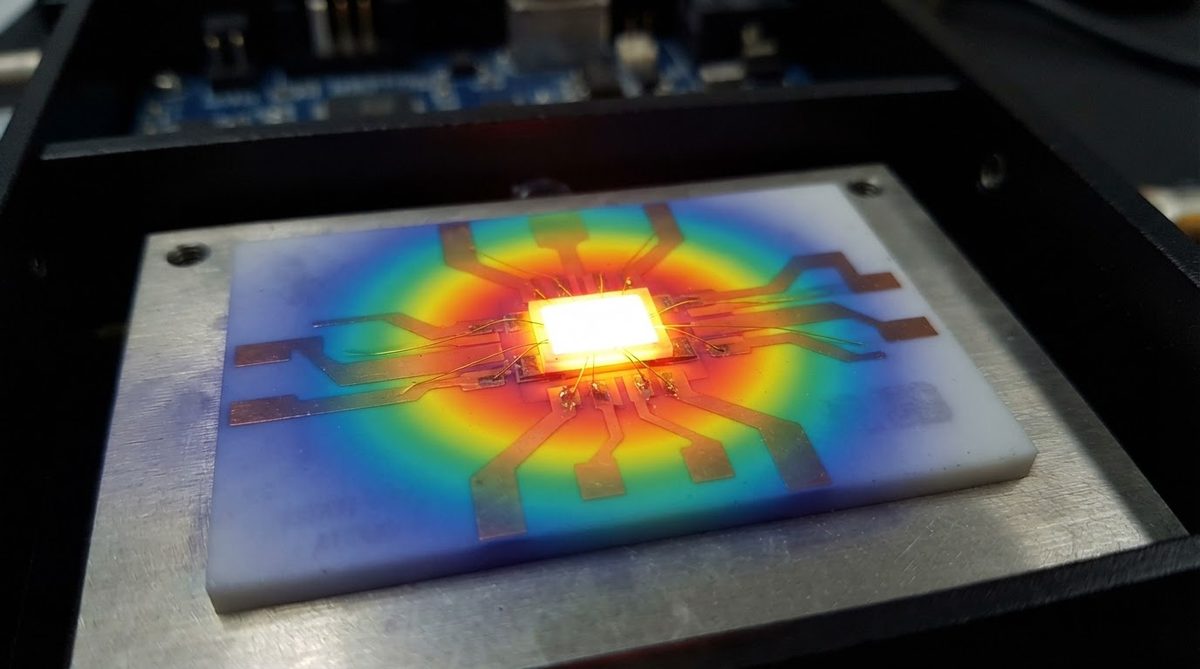
Direct bonded copper relies on a Cu–O eutectic reaction at roughly 1065 °C. A thin oxide layer on the copper surface melts and wets the ceramic, forming a chemical bond as the assembly cools. On alumina (Al₂O₃), this reaction is straightforward because the substrate already contains oxygen. On AlN, it is not.
AlN is a covalent nitride with no native oxide. Manufacturers must first pre-oxidize the AlN surface in a controlled atmosphere to grow a thin alumina interlayer (typically 1–5 µm). This interlayer participates in the Cu–O eutectic and creates the bond. The oxidation step adds cost and process sensitivity: too little oxide yields poor adhesion; too much degrades the thermal path. This is the central reason aluminum nitride AlN DBC direct bonded copper substrates cost more than Al₂O₃ DBC.
After bonding, the copper is patterned by photolithography and etching, then the substrate is cleaned and plated with a surface finish—commonly Ni/Au or Ni/Ag—to enable die attach and wire bonding. For details on copper layer options, see copper plating capabilities and tolerances.
Thermal Performance: A Worked Example
Consider a 25 mm × 25 mm AlN DBC substrate, 0.635 mm ceramic thickness, carrying a SiC MOSFET dissipating 120 W.
Thermal resistance through the ceramic alone:
Rth = t / (k × A)
Where t = 0.635 × 10⁻³ m, k = 180 W/mK, A = 625 × 10⁻⁶ m².
Rth,ceramic = 0.635 × 10⁻³ / (180 × 625 × 10⁻⁶) = 0.0056 °C/W
For the same geometry on 96% Al₂O₃ (k ≈ 25 W/mK):
Rth,ceramic = 0.635 × 10⁻³ / (25 × 625 × 10⁻⁶) = 0.041 °C/W
At 120 W, that difference is 0.67 °C versus 4.9 °C across the ceramic layer alone. In a real module with solder layers, copper planes, and a heatsink, the AlN advantage compounds through every interface because the die runs cooler and thermal margins widen.
Enter your substrate dimensions, ceramic thickness, and dissipated power below to estimate thermal resistance for your own aluminum nitride AlN DBC direct bonded copper design.
If your design uses thinner ceramic, consult the ceramic substrate thickness chart to see available AlN options down to 0.25 mm.
AlN DBC vs. AlN DPC: Which Bonding Method to Choose
Both DBC and DPC place copper on AlN, but by different mechanisms and for different use cases. Aluminum nitride AlN DBC direct bonded copper excels at high-current, thick-copper applications, while DPC targets fine-line resolution.
| Parameter | AlN DBC | AlN DPC |
|---|---|---|
| Copper thickness | 0.127–0.635 mm | Typically <0.10 mm (sputtered + plated) |
| Current capacity | High (tens of amps) | Moderate (signal and low-power) |
| Min trace / space | ~0.3 mm / 0.3 mm | ~0.050 mm / 0.050 mm |
| Bond mechanism | Cu–O eutectic at ~1065 °C | Sputter Ti/Cu seed + electroplate |
| Best for | Power modules, IGBT, SiC/GaN | RF circuits, fine-pitch LED arrays, sensors |
Choose aluminum nitride AlN DBC direct bonded copper when you need thick copper for high current or large die attach pads. Choose DPC when you need fine-line resolution below 0.15 mm. For fine-pitch AlN applications, AlN DPC substrates offer better trace definition at the cost of current-handling capacity.
Common Applications
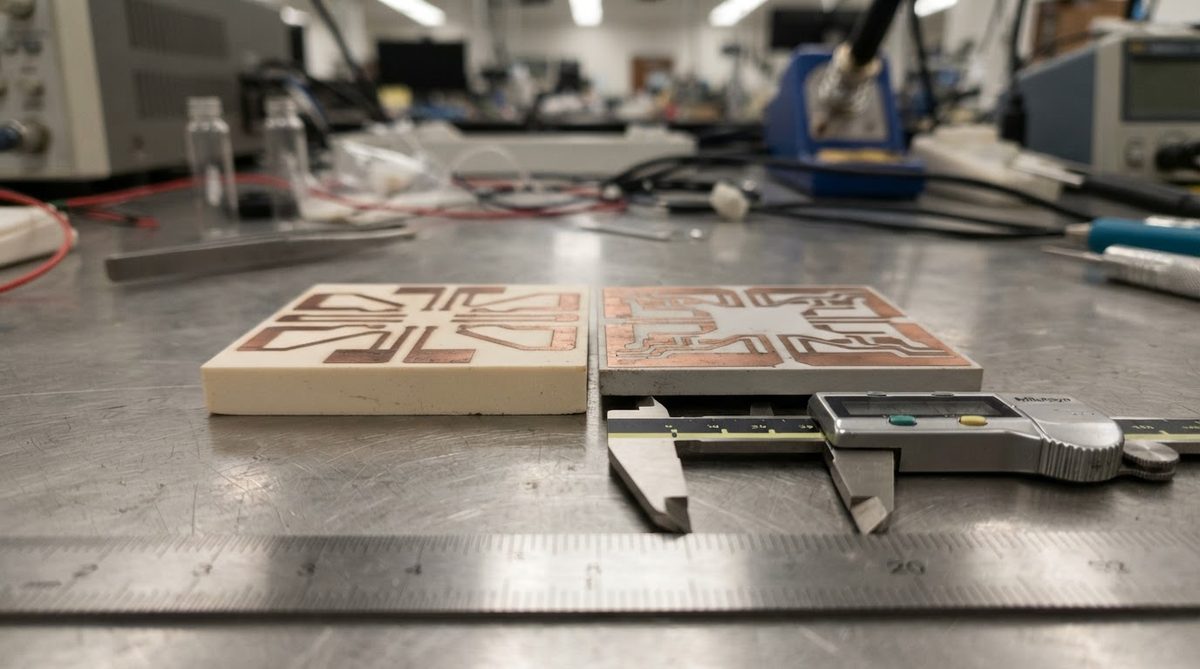
- IGBT and SiC/GaN power modules — Thick copper handles 50–200 A bus bars; AlN keeps junction temperatures within spec.
- High-power LED and UV-C arrays — AlN’s CTE (4.5–5.0 ppm/°C) closely matches GaN-on-sapphire dies (5.6 ppm/°C), reducing solder fatigue. See AlN UV-C LED starboards for a ready-made example.
- RF power amplifiers — Low dielectric loss (tan δ ≈ 3 × 10⁻⁴ at 1 MHz) and good thermal extraction suit GaN HEMT devices.
- Automotive inverters (xEV) — Thermal cycling from –40 °C to +175 °C demands strong Cu–ceramic bonds and matched CTE.
When Not to Use AlN DBC
Aluminum nitride AlN DBC direct bonded copper is not always the right substrate. Skip it if:
- Budget is the primary constraint. AlN ceramic costs 3–5× more per unit area than 96% Al₂O₃. If thermal conductivity of 24–28 W/mK is sufficient, alumina DBC will do the job at a fraction of the price.
- Extreme thermal cycling beyond 1,500 cycles at ΔT > 200 °C. The CTE mismatch between Cu (17 ppm/°C) and AlN (4.5 ppm/°C) stresses the bond under aggressive cycling. For the highest cycling reliability, Si₃N₄ DBC substrates offer roughly 3× the fracture toughness of AlN and survive many more cycles.
- Fine traces below 0.15 mm. DBC etching cannot resolve features that small. Use DPC or thin film metallization instead.
- Low power, low density. If the board dissipates under a few watts, an FR-4 or metal-core PCB is cheaper and easier to source.
Frequently Asked Questions
What is the maximum continuous operating temperature for AlN DBC?
The AlN ceramic itself is stable above 1000 °C in inert atmospheres. The practical limit is set by the copper-to-ceramic bond and the solder/die-attach materials, typically 400–500 °C for the DBC joint and 150–300 °C for common solder alloys. Most power module designs operate continuously at 150–200 °C junction temperature.
Can I solder components directly to an AlN DBC substrate?
Yes. The copper surface accepts standard solder alloys (SAC305, AuSn, high-Pb) after a suitable surface finish such as Ni/Au or Ni/Ag. Solder wetting and joint reliability are comparable to copper on any other substrate.
Does AlN DBC require special handling?
AlN ceramic is brittle (fracture toughness ~3 MPa·m½), so substrates should be stored in trays and handled at the edges. Copper adds some mechanical support, but point loads and bending must be avoided. Gloves are recommended to prevent surface contamination before bonding.
How does AlN DBC compare to AlN AMB?
Active metal brazing (AMB) uses a Ti-containing braze alloy at ~850 °C instead of the Cu–O eutectic. AMB produces a stronger bond and better thermal-cycling performance than DBC on AlN, but at higher cost and longer lead times. AMB is the preferred method for Si₃N₄ substrates, where DBC adhesion is inherently weaker.
What copper thicknesses are standard for AlN DBC?
Industry-standard copper foils for DBC range from 0.127 mm (5 mil) to 0.635 mm (25 mil). Thicker copper improves current capacity and spreading but increases CTE-induced stress. Most power module designs use 0.3 mm copper as a balance between thermal and mechanical performance.