The alumina 96% Al2O3 flexural strength falls in the range of 330–400 MPa when measured per ASTM C1161 (four-point bend, 20 °C). That range covers the vast majority of commercially available 96% alumina from major suppliers such as CoorsTek, Kyocera, and Maruwa. The exact value for a given lot depends on grain size, porosity, surface finish, and specimen geometry. Understanding this property is essential for any engineer designing ceramic PCBs that must survive mechanical loads, thermal cycling, or assembly forces.
Key Takeaways
- 96% Al2O3 flexural strength: 330–400 MPa (four-point bend, ASTM C1161, 20 °C).
- Strength decreases with increasing surface roughness and substrate thickness due to larger flaw populations.
- Weibull modulus for production-grade 96% alumina is typically 8–12, meaning scatter is moderate; design to the lower-bound value.
- At 500 °C, flexural strength drops roughly 10–15% from the room-temperature value.
- For applications demanding higher fracture resistance, zirconia-toughened alumina (ZTA) substrates offer 500–700 MPa with better crack tolerance.
How Alumina 96% Al2O3 Flexural Strength Is Measured
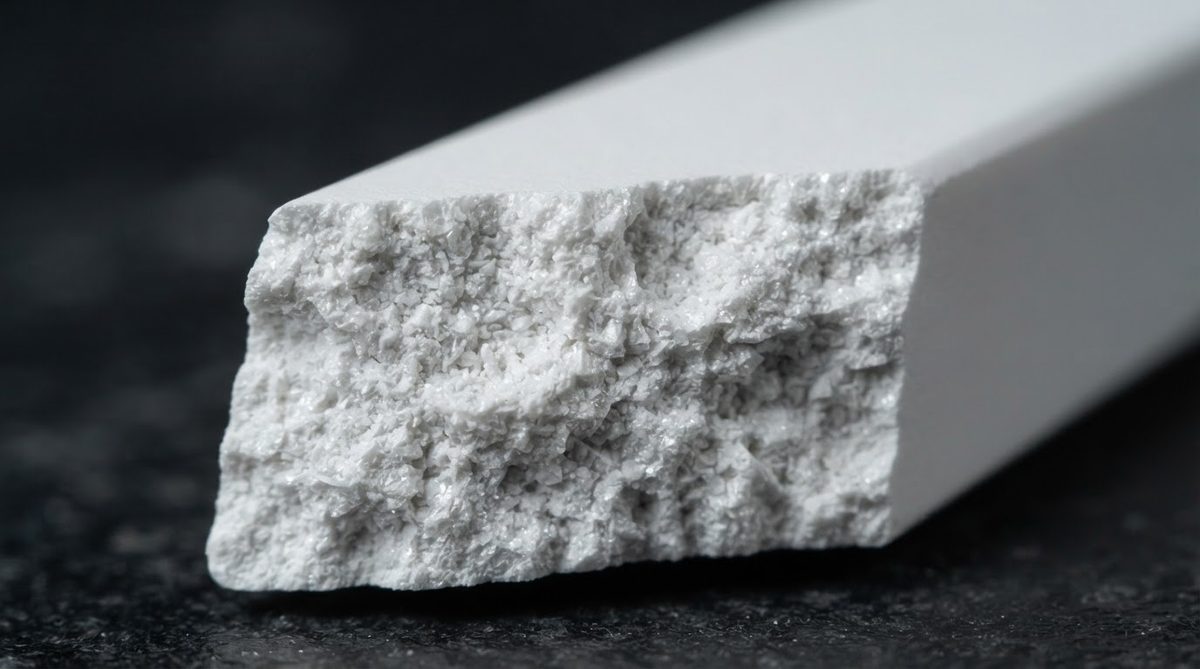
Flexural strength (also called modulus of rupture, MOR) is the maximum tensile stress a specimen sustains before fracture in bending. For thin ceramic substrates used in PCBs, two test standards dominate:
- ASTM C1161 – four-point bend on rectangular bars (Type B: 4 mm × 3 mm × 45 mm). This is the most widely reported method in substrate datasheets.
- ASTM F394 – biaxial flexure (ball-on-ring or ring-on-ring), preferred for thin discs and substrates below 1 mm thickness because it eliminates edge-flaw effects.
Values from three-point bend tests run 10–20% higher than four-point results on the same material because the maximum stress zone is smaller, reducing the probability of encountering a critical flaw. Always check which test method a datasheet references before comparing numbers across suppliers.
Typical Mechanical Property Data for 96% Al2O3
| Parameter | Value | Unit | Condition | Source |
|---|---|---|---|---|
| Flexural strength (MOR) | 330–400 | MPa | 4-pt bend, ASTM C1161, 20 °C | CoorsTek ADS-96R datasheet; Kyocera A-473 |
| Compressive strength | 2,000–2,500 | MPa | ASTM C773, 20 °C | CoorsTek ADS-96R |
| Fracture toughness (K_IC) | 3.5–4.0 | MPa·√m | SEVNB, ASTM C1421, 20 °C | CeramTec Rubalit 710 |
| Weibull modulus (m) | 8–12 | — | 4-pt bend, 20 °C | Kyocera A-473; literature surveys |
| Elastic modulus (Young’s) | 300–320 | GPa | ASTM E111, 20 °C | Maruwa HA-96 |
| Vickers hardness | 12–14 | GPa (HV1) | ASTM C1327, 20 °C | CoorsTek ADS-96R |
| Poisson’s ratio | 0.21–0.22 | — | 20 °C | CoorsTek |
Typical values for commercially available material, for comparison only. Confirm against the datasheet for your specific grade.
Enter your substrate dimensions and applied load below to see how the alumina 96% Al2O3 flexural strength limit translates into a minimum safe thickness for your specific geometry.
What Affects Flexural Strength in Practice
Surface Finish and Flaw Size
Ceramic fracture is flaw-controlled. The largest surface or edge flaw determines the stress at which a substrate breaks. A polished substrate (Ra < 0.1 µm) can test 10–15% stronger than an as-fired surface (Ra 0.4–0.8 µm) because polishing removes the largest surface pits. If your design requires tight mechanical margins, specifying a lapped or polished finish matters. More detail on roughness grades is available in the alumina 96% surface roughness reference.
Substrate Thickness
Thinner substrates are not inherently weaker in terms of material strength, but they tolerate less applied load before the tensile stress at the outer fiber reaches the fracture limit. A 0.25 mm substrate under the same point load as a 0.635 mm substrate sees roughly 6.5× higher bending stress (stress scales with 1/t² for a given load and span). Choosing the right alumina 96% thickness is therefore a structural decision, not just a thermal one.
Temperature
Alumina retains most of its room-temperature strength up to about 400 °C. Between 400 °C and 800 °C, the alumina 96% Al2O3 flexural strength drops gradually—roughly 10–15% at 500 °C and 20–25% at 800 °C, per CoorsTek published data for ADS-96R. Above 1,000 °C, grain-boundary glassy phases in 96% alumina soften and strength falls sharply. If your operating temperature exceeds 600 °C continuously, 99.6% alumina (with less glassy phase) holds its strength better.
Metallization and Thermal Cycling
Thick-film metallization (fired at 850 °C) and DBC copper bonding (bonded at ~1,065 °C) introduce residual stresses from CTE mismatch between copper (~17 ppm/°C) and alumina (~7.1 ppm/°C at 20–400 °C). These residual stresses reduce the effective fracture load of the assembly by 15–30% compared to a bare substrate, depending on copper thickness and pattern geometry. Always qualify the assembly, not just the bare ceramic.
Worked Example: Minimum Thickness for a Given Load
Suppose a 96% alumina substrate spans 10 mm between two supports in a power module, and a spring clip applies 5 N of force at the center. What is the minimum safe thickness, given the published alumina 96% Al2O3 flexural strength range?
- Calculate peak bending stress (three-point approx.): σ = 3FL / (2bh²), where F = 5 N, L = 10 mm span, b = substrate width (assume 10 mm).
- Apply a safety factor. With a Weibull modulus of 10, a common practice is to design to 1/3 of the minimum published MOR. Use 330 MPa / 3 = 110 MPa allowable stress.
- Solve for h: h² = 3 × 5 × 10 / (2 × 10 × 110) = 150 / 2,200 = 0.068 mm². h = 0.26 mm.
- Select next standard thickness: 0.38 mm (0.015″) gives a comfortable margin. A 0.25 mm substrate would be marginal.
This is a simplified static case. Add thermal cycling fatigue, metallization residual stress, and vibration loads before finalizing.
How 96% Alumina Flexural Strength Compares to Other Ceramics
| Material | Flexural Strength (MPa) | K_IC (MPa·√m) | Condition | Source |
|---|---|---|---|---|
| Al2O3 96% | 330–400 | 3.5–4.0 | 4-pt bend, ASTM C1161, 20 °C | CoorsTek, Kyocera |
| Al2O3 99.6% | 350–450 | 3.8–4.5 | 4-pt bend, ASTM C1161, 20 °C | CoorsTek, Kyocera |
| AlN | 300–350 | 2.5–3.0 | 4-pt bend, ASTM C1161, 20 °C | Kyocera, Maruwa |
| Si3N4 (AMB grade) | 650–800 | 6.0–7.0 | 4-pt bend, ASTM C1161, 20 °C | Kyocera SN-733 |
| ZTA (10% ZrO2) | 500–700 | 5.0–6.5 | 4-pt bend, ASTM C1161, 20 °C | CeramTec |
Typical values for commercially available material, for comparison only. Confirm against the datasheet for your specific grade.
AlN is mechanically weaker and more brittle than 96% alumina. Details on aluminum nitride flexural strength are covered separately. Si3N4 is the strongest option but costs 5–10× more per substrate and is typically reserved for high-reliability power modules subjected to aggressive thermal cycling.
When 96% Alumina Is Not Strong Enough
Choose a different substrate if any of these apply:
- Severe thermal cycling (>10,000 power cycles, ΔT > 150 °C): Si3N4 AMB substrates resist crack propagation far better (K_IC 6–7 MPa·√m vs. 3.5–4 MPa·√m).
- High mechanical shock or vibration (automotive underhood, downhole tools): ZTA provides 50–75% higher flexural strength with similar thermal conductivity to 96% alumina.
- Substrates thinner than 0.2 mm under bending loads: Handling breakage during assembly becomes a yield problem. Consider a metal-core PCB or a thicker ceramic.
- Cost-driven consumer products with no thermal or dielectric need: FR-4 at 1/10th the cost is the obvious choice.
Frequently Asked Questions
Does laser scribing weaken a 96% alumina substrate?
Yes. Laser-scribed snap lines introduce controlled surface flaws that reduce local flexural strength by 30–50% along the scribe. The substrate is designed to break cleanly at the scribe, so the rest of the panel retains full strength. Keep scribe lines at least 1 mm from any high-stress mounting point.
Can I use flexural strength to predict drop-test survival?
Only roughly. Drop-test failure depends on impact energy, substrate mass, support geometry, and dynamic stress concentration—none of which static MOR captures directly. For drop-sensitive products, run actual drop tests per JEDEC JESD22-B111 rather than relying on material MOR alone.
Is 99.6% alumina significantly stronger than 96%?
Marginally. The 99.6% grade offers about 5–15% higher flexural strength (350–450 MPa vs. 330–400 MPa) and better high-temperature strength retention because it has less glassy grain-boundary phase. Full 99.6% alumina material properties are available for comparison.
What Weibull modulus should I use for design?
For production-grade 96% alumina, use a Weibull modulus of 8–10 unless your supplier provides lot-specific data. A modulus of 10 means 1 in 1,000 parts will fail below about 60% of the characteristic strength. Most power-electronics designers apply a safety factor of 2.5–3× on the minimum published MOR.
Does metallization affect the substrate’s mechanical strength?
Yes. CTE mismatch between copper and alumina creates residual tensile stress in the ceramic after bonding or firing. This can reduce effective fracture load by 15–30%. The effect is larger with thicker copper (e.g., 300 µm DBC) and smaller with thin-film metallization (<5 µm). Always test metallized assemblies, not bare substrates, for your reliability qualification.
Next Step
If you are comparing full 96% alumina properties against your mechanical and thermal requirements, the datasheet page provides thermal conductivity, CTE, dielectric, and dimensional data in one place. For substrates matched to your specific thickness and strength needs, request a quote through the project form.