An alumina 99.6% Al2O3 DPC direct plated copper substrate is a high-purity ceramic base metallized with copper through vacuum sputtering and electroplating rather than high-temperature bonding. This combination delivers thermal conductivity of 30–35 W/mK (at 20 °C, per Kyocera A-493 datasheet), dielectric strength above 15 kV/mm, and copper trace resolution down to 10 µm line/space. That makes alumina 99.6% Al2O3 DPC direct plated copper the go-to ceramic substrate for power electronics and sensor packaging that demand finer features than DBC can achieve.
Key Takeaways
- 99.6% alumina provides 30–35 W/mK thermal conductivity at 20 °C, roughly 25–40% higher than 96% alumina (24–28 W/mK), per CoorsTek ADS-996 data.
- The DPC process achieves copper trace/space as fine as 10 µm, versus 150–200 µm minimum for DBC.
- Copper thickness in DPC typically ranges from 10 µm to 100 µm; thicker copper for high-current paths requires DBC or AMB instead.
- The CTE of 99.6% alumina is 7.2–7.9 ppm/°C (20–300 °C, per Kyocera), close enough to GaAs and SiC die to reduce solder-joint fatigue in thermal cycling.
- Surface roughness of polished 99.6% alumina reaches Ra ≤ 0.1 µm, critical for thin-film and DPC seed-layer adhesion.
What Is the Alumina 99.6% Al2O3 DPC Direct Plated Copper Process?
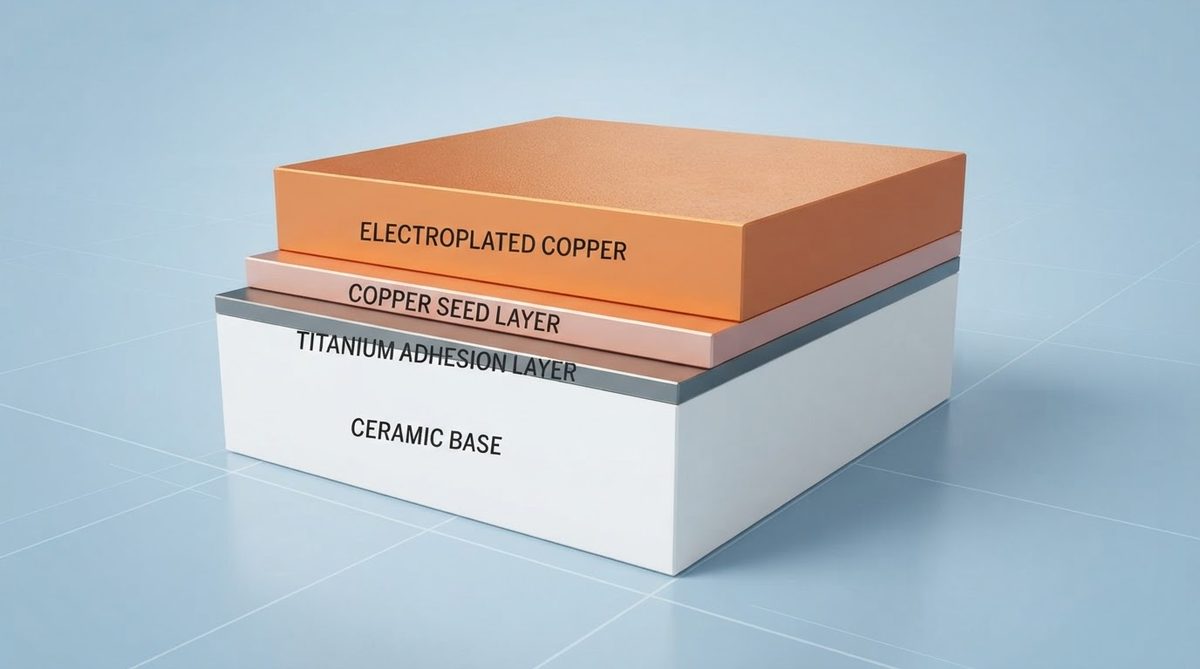
Direct plated copper is a metallization method that deposits copper onto a ceramic substrate without the oxide-eutectic bonding step used in DBC. The typical sequence is: clean and roughen the substrate surface → sputter a Ti or TiW adhesion layer (50–200 nm) → sputter a Cu seed layer (200–500 nm) → pattern with photolithography → electroplate copper to the target thickness → strip resist and etch the seed layer.
Because patterning happens via photolithography, DPC resolves features an order of magnitude finer than DBC etching. That precision matters for RF matching networks, laser-diode sub-mounts, and MEMS sensor carriers where 50 µm pitch or tighter is a baseline requirement. The trade-off is current-carrying capacity: DPC copper layers top out around 100 µm, while DBC and AMB can bond 300 µm copper foil or thicker.
Why Choose 99.6% Alumina Over 96% for DPC?
The extra 3.6% purity is not cosmetic. Removing glassy-phase sintering aids raises thermal conductivity from the 24–28 W/mK range to 30–35 W/mK and improves volume resistivity from ~1014 Ω·cm to >1014 Ω·cm (per CoorsTek ADS-996 vs. ADS-96R datasheets). Surface finish after lapping and polishing is also smoother — Ra ≤ 0.1 µm is standard for 99.6%, versus Ra 0.3–0.6 µm for 96% — which directly improves seed-layer adhesion in the DPC sputtering step.
For context, 96% Al2O3 DPC substrates cost less and work well for many power LED and general thermal-management applications. Move to 99.6% when your design needs tighter trace geometry, lower dielectric loss at high frequency, or the extra thermal headroom that alumina 99.6% Al2O3 DPC direct plated copper provides.
Material Properties: 99.6% Al2O3 DPC Substrate
| Parameter | Value | Unit | Condition | Source |
|---|---|---|---|---|
| Thermal conductivity | 30–35 | W/mK | 20 °C | Kyocera A-493 / CoorsTek ADS-996 |
| Dielectric strength | 15–20 | kV/mm | AC, 1 mm thick | CoorsTek ADS-996 |
| Dielectric constant (εr) | 9.7–9.9 | — | 1 MHz, 25 °C | Kyocera A-493 |
| Loss tangent (tan δ) | 0.0001–0.0003 | — | 1 MHz, 25 °C | Kyocera A-493 |
| CTE | 7.2–7.9 | ppm/°C | 20–300 °C | Kyocera A-493 |
| Flexural strength | 380–450 | MPa | 3-point bend, ASTM C1161 | CoorsTek ADS-996 |
| Surface roughness (polished) | ≤ 0.1 | µm Ra | — | Manufacturer spec |
| DPC copper thickness | 10–100 | µm | Electroplated | Process spec |
| Min trace/space (DPC) | 10 | µm | Photolithography | Process spec |
Typical values for commercially available material, for comparison only. Confirm against the datasheet for your specific grade.
Worked Example: Thermal Resistance of an Alumina 99.6% Al2O3 DPC Direct Plated Copper Substrate
Suppose you have a 10 mm × 10 mm die dissipating 20 W, mounted on a 0.635 mm thick 99.6% alumina DPC substrate. Ignoring spreading resistance for simplicity:
Rth = t / (k × A) = 0.000635 m / (32 W/mK × 0.0001 m²) = 0.198 °C/W
Temperature rise across the substrate alone: ΔT = 20 W × 0.198 °C/W ≈ 4.0 °C. Using 96% alumina (26 W/mK) the same calculation gives 0.244 °C/W and ΔT ≈ 4.9 °C. The difference — roughly 0.9 °C — is modest for a single die but compounds in multi-die arrays or stacked modules where every fraction of a degree matters.
Enter your own substrate dimensions, thickness, and power dissipation below to estimate junction temperature rise for your alumina 99.6% Al2O3 DPC direct plated copper layout.
Typical Applications for Alumina 99.6% Al2O3 DPC Direct Plated Copper
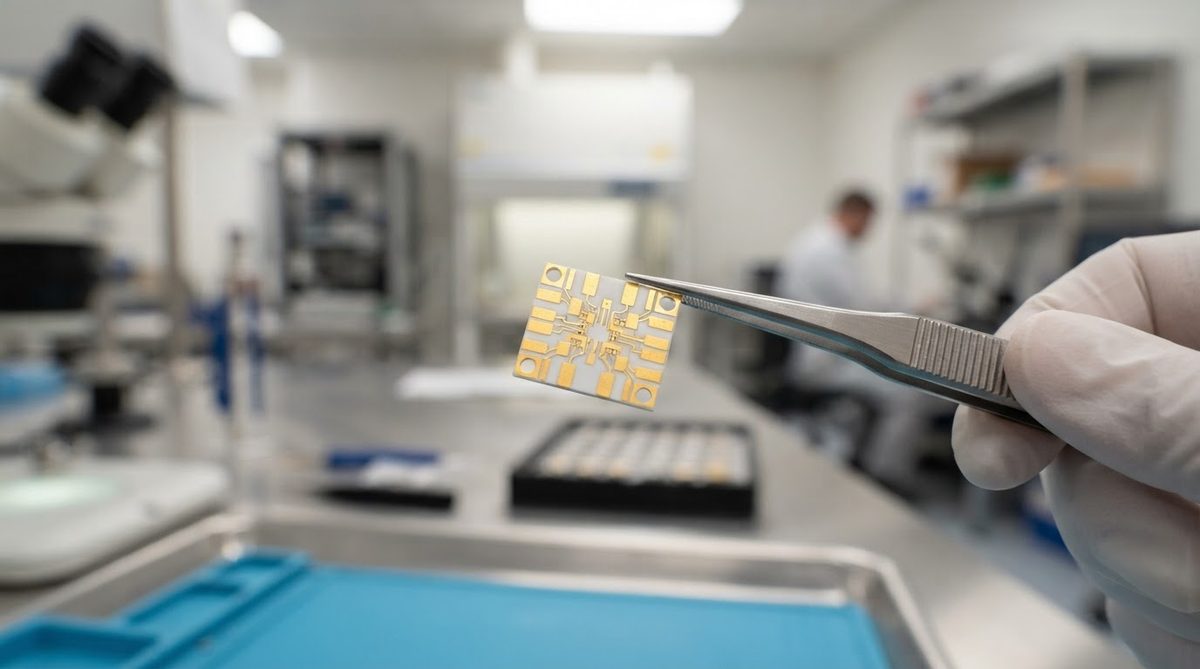
99.6% alumina DPC substrates appear most often in designs where fine copper patterning and moderate thermal conductivity must coexist:
- Laser-diode and photodetector sub-mounts — 25–50 µm trace features, tight CTE match to GaAs.
- MEMS sensor carriers — low surface roughness for die-attach planarity.
- RF and microwave hybrid circuits — low loss tangent, fine impedance-controlled lines. For even finer features, consider 99.6% Al2O3 thin film substrates.
- Power-module redistribution layers — where DBC trace resolution is insufficient.
When thermal conductivity above 35 W/mK is the primary driver, aluminum nitride DPC substrates offer 170–200 W/mK at higher cost. For current loads above 30 A requiring 300 µm+ copper, AlN DBC substrates are the better fit.
When Not to Use 99.6% Al2O3 DPC
High current density (>30 A per trace): DPC copper tops out around 100 µm. DBC or AMB processes bond 300 µm copper foil and carry far more current per unit width.
Cost-sensitive, high-volume LED boards: 96% alumina DPC costs 20–40% less per substrate and is sufficient when trace/space requirements are above 50 µm.
Thermal loads above ~50 W/cm²: At these densities, 30–35 W/mK is not enough. AlN (170–200 W/mK) or Si₃N₄ with AMB metallization are stronger choices. See Si₃N₄ AMB substrates for high-reliability power cycling applications.
Large panel sizes: 99.6% alumina is harder to sinter flat at large dimensions. Check standard ceramic substrate sizes before committing to a layout.
FAQ
Can you solder components directly to a DPC copper surface?
Yes. DPC copper accepts standard solder alloys (SAC305, AuSn) and common surface finishes such as ENIG and ENEPIG. Solder wetting is comparable to copper on FR-4, and the ceramic’s CTE reduces thermal-cycling stress on joints compared to organic boards.
What surface finishes are available on 99.6% alumina DPC?
Typical finishes include electroless nickel / immersion gold (ENIG), electroless nickel / electroless palladium / immersion gold (ENEPIG), and bare copper with OSP. Gold plating thickness is usually 0.05–0.1 µm for ENIG and 0.03–0.08 µm Pd for ENEPIG.
How does DPC adhesion strength compare to DBC on alumina?
DPC peel strength is typically 6–10 N/mm on 99.6% alumina, versus 10–15 N/mm for DBC, both measured per IPC-TM-650 2.4.8. DPC adhesion is adequate for most die-attach and wire-bond applications, but DBC is preferred where the copper layer must survive aggressive thermal cycling beyond 1 000 cycles (–55 °C to +150 °C).
Is 99.6% alumina DPC suitable for wire bonding?
Yes. The smooth copper surface and tight thickness tolerance of DPC make it compatible with both gold and aluminum wedge bonding. Bond-pad planarity benefits from the low Ra of the underlying 99.6% substrate.
What is the maximum operating temperature for a 99.6% alumina DPC substrate?
The alumina ceramic itself is stable well above 1 000 °C. The practical limit is the copper metallization and solder joints — typically 350–400 °C for the Ti/Cu adhesion layer and around 260–300 °C for standard lead-free solder. Design to the weakest link in your stack.
Next Step
If your design calls for trace/space below 50 µm on a thermally conductive ceramic, alumina 99.6% Al2O3 DPC direct plated copper is a strong baseline. Compare it against thin-film metallization for sub-10 µm features, or against AlN DPC when thermal conductivity is the binding constraint. To get a quote on your specific layout, submit your files through the instant quote tool.