The alumina 96% Al2O3 thick film ceramic substrate is the most widely used ceramic substrate in electronics. It pairs a low-cost, well-characterized base material (thermal conductivity 24–28 W/mK at 25 °C, dielectric strength ~15 kV/mm per ASTM D149) with screen-printed conductor, resistor, and dielectric layers that can be produced in high volume. If your project needs better thermal performance than FR-4 but does not justify the cost of aluminum nitride, an alumina 96% Al2O3 thick film ceramic board is usually the starting point.
Key Takeaways
- 96% Al2O3 thick film substrates offer thermal conductivity of 24–28 W/mK—roughly 100× that of FR-4 (0.25–0.3 W/mK)—at the lowest cost of any ceramic substrate option.
- Thick film metallization uses screen-printed pastes (typically Au, Ag, Ag/Pd, or Ag/Pt) fired at 850–1000 °C, achieving conductor resistivities of 2–5 mΩ/sq for gold-based pastes.
- Minimum line/space for thick film printing is typically 100–125 µm, wider than thin film (≤25 µm) or DPC processes.
- The substrate is rated for continuous operation up to roughly 300 °C in air, limited by metallization oxidation rather than the ceramic itself (melting point ~1800 °C).
- Flexural strength of 96% alumina is 300–380 MPa (per ASTM C1161, 3-point bend), adequate for most SMD and hybrid circuit applications but brittle under point loads or mechanical shock.
What Is an Alumina 96% Al2O3 Thick Film Ceramic Substrate?
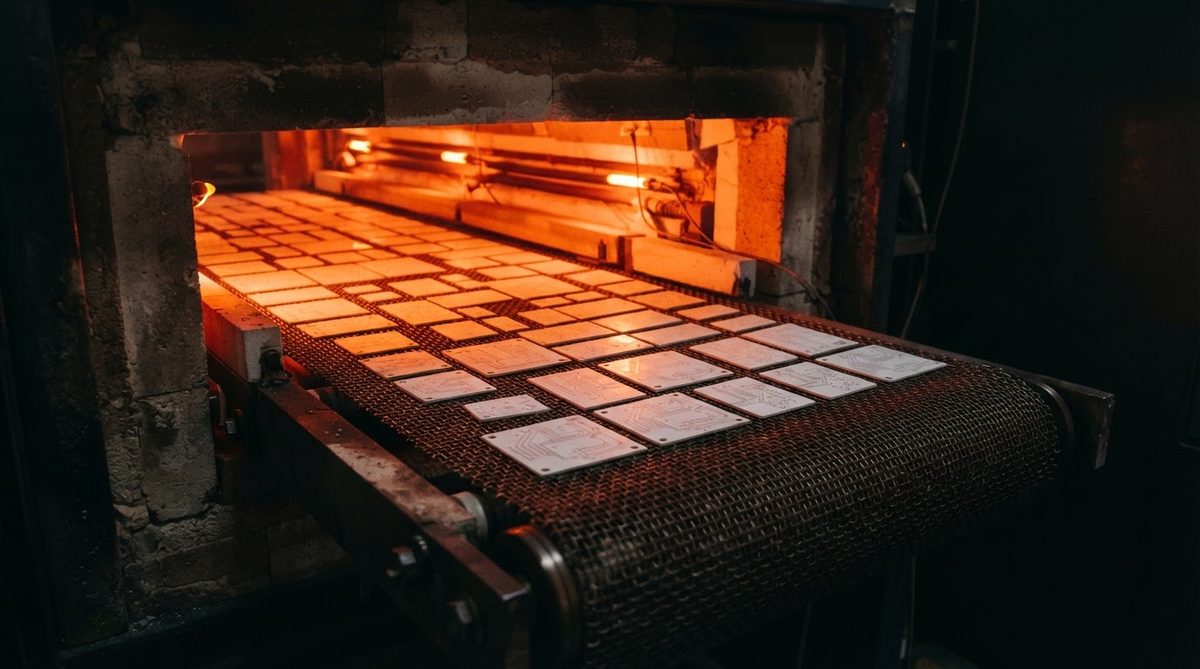
A 96% alumina thick film substrate consists of a fired ceramic base (96 wt% Al2O3, balance SiO2 + CaO + MgO glass phase) onto which conductive, resistive, or dielectric layers are deposited by screen printing and furnace firing. The “96%” designation distinguishes it from higher-purity grades such as 99.6% alumina, which has better thermal and dielectric performance but costs 2–4× more per unit area.
The glass phase in 96% alumina lowers the sintering temperature and improves thick film paste adhesion. This is a genuine engineering advantage: the glass promotes chemical bonding between the printed conductor and the substrate during firing, producing peel strengths of 3–6 N/mm (per IPC-TM-650 2.4.21). Higher-purity alumina grades have less glass phase, which can make thick film adhesion more difficult without modified paste formulations.
Material Properties of 96% Al2O3
| Parameter | Value | Unit | Condition | Source |
|---|---|---|---|---|
| Thermal conductivity | 24–28 | W/mK | 25 °C | CoorsTek ADS-96R datasheet |
| Dielectric constant (εr) | 9.0–9.5 | — | 1 MHz, 25 °C | Kyocera A-493 datasheet |
| Dielectric strength | ~15 | kV/mm | ASTM D149 | CoorsTek ADS-96R datasheet |
| Flexural strength | 300–380 | MPa | ASTM C1161, 3-pt bend | CeramTec Rubalit 710 |
| CTE | 7.1–7.4 | ppm/°C | 25–300 °C | Kyocera A-493 datasheet |
| Volume resistivity | >10¹⁴ | Ω·cm | 25 °C | CoorsTek ADS-96R datasheet |
| Surface roughness (as-fired) | 0.5–1.0 | µm Ra | Typical | Maruwa HA-96 datasheet |
| Max use temperature (ceramic) | ~1600 | °C | In air, unloaded | CoorsTek general data |
Typical values for commercially available material, for comparison only. Confirm against the datasheet for your specific grade.
Thick Film Process on Alumina 96% Al2O3 Ceramic
Thick film metallization follows a well-established sequence: print, dry, fire. A stainless-steel mesh screen (typically 200–400 mesh) transfers paste onto the substrate in the desired pattern. The printed layer is dried at 100–150 °C to remove solvents, then fired in a belt furnace at 850–1000 °C in air. Peak firing time is 8–12 minutes.
Conductors are usually gold (Au), silver (Ag), silver-palladium (Ag/Pd), or silver-platinum (Ag/Pt) pastes. Gold is preferred for wire-bondable pads and corrosion-critical circuits. Silver is the lowest-cost option and has the highest conductivity (~3 mΩ/sq sheet resistance) but is susceptible to electromigration in humid environments. Ag/Pd blends trade off some conductivity for migration resistance.
Resistors are printed from ruthenium oxide (RuO2) based pastes, trimmed by laser to tolerances of ±1% or better. Dielectric layers (glass-based pastes) enable multilayer crossovers. A typical hybrid circuit may require 3–6 print-and-fire cycles.
If your design needs finer features below 100 µm line/space, consider a thin film process on 96% alumina instead, which uses sputtered and etched metal layers to achieve traces as narrow as 10–25 µm.
Worked Example: Thermal Resistance of an Alumina 96% Al2O3 Thick Film Ceramic Power Resistor
Suppose you are mounting a thick film power resistor dissipating 5 W on a 96% alumina substrate, 25.4 mm × 25.4 mm × 0.635 mm thick, heat-sunk on the bottom face.
Conduction thermal resistance through the substrate:
R_th = t / (k × A) = 0.000635 m / (26 W/mK × 0.000645 m²) = 0.038 °C/W
Temperature rise across the ceramic at 5 W: ΔT = 5 × 0.038 = 0.19 °C. In practice, spreading resistance and interface resistance dominate. The ceramic itself contributes negligibly at this thickness. This is why 96% alumina is adequate for many power circuits: you only need AlN’s 170–200 W/mK conductivity when the substrate is thicker, the heat flux density is very high, or the total thermal budget is extremely tight.
Enter your own substrate area, thickness, and dissipated power below to estimate junction temperature rise for your alumina 96% Al2O3 thick film ceramic layout.
When to Choose 99.6% Alumina or AlN Instead
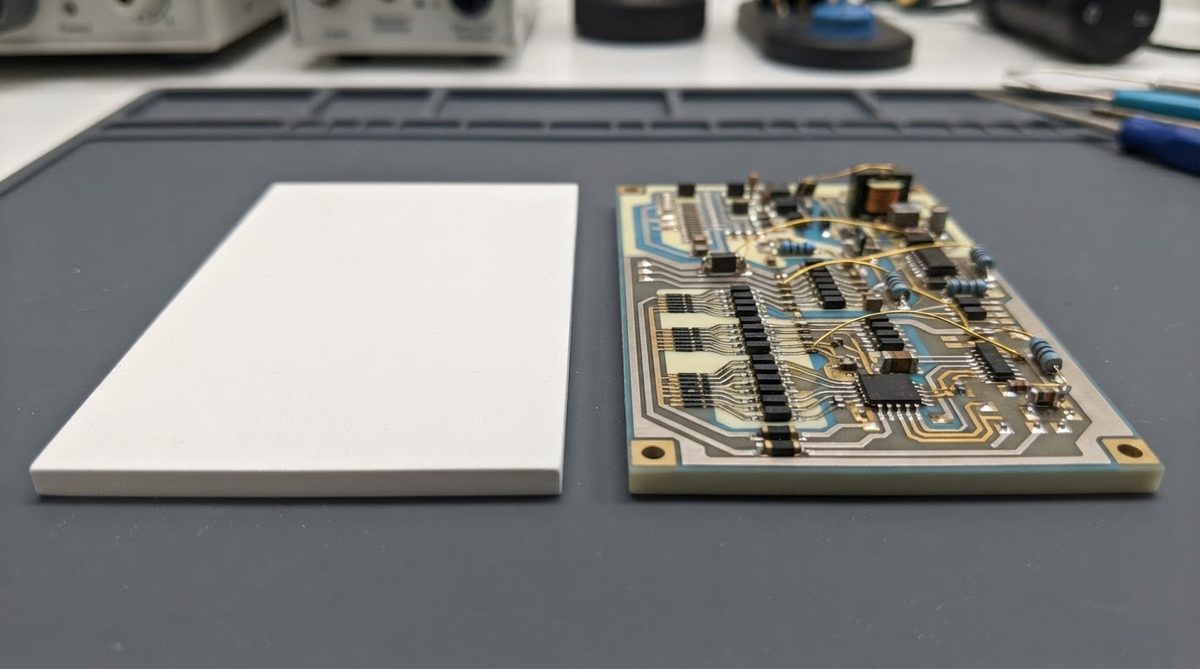
The 96% grade falls short in two areas. First, its higher glass content lowers hermeticity and dielectric performance compared to 99.6% alumina thick film substrates, which offer εr of 9.8–10.0 and tighter dielectric loss (tan δ < 0.0002 at 1 MHz). For RF circuits above a few GHz, the glass phase in 96% alumina increases loss tangent and signal attenuation.
Second, if your thermal budget demands more than 28 W/mK, aluminum nitride (AlN) thick film substrates provide 170–200 W/mK. AlN costs 3–5× more per unit area but may eliminate the need for a separate heat spreader, offsetting some of that cost at the system level.
When Not to Use a Ceramic Substrate at All
If your board runs below 1 W total dissipation, operates at room temperature, and has no special dielectric or hermeticity requirements, FR-4 at $0.01–0.03/cm² will outperform ceramic on cost by 10–50×. Metal-core PCBs (MCPCBs) fill the gap between FR-4 and ceramic for LED and moderate-power applications at roughly 1–3 W/mK through the dielectric layer. An alumina 96% Al2O3 thick film ceramic substrate makes economic sense when you need high thermal conductivity, high-temperature operation, precise thick or thin film resistors, or long-term reliability in harsh environments.
For projects requiring standard panel sizes, check the available ceramic substrate dimensions early in layout to avoid costly custom sizing.
Typical Applications for Alumina 96% Al2O3 Thick Film Ceramic
96% alumina thick film substrates are the default for hybrid microelectronics, automotive sensor modules (exhaust gas sensors, pressure sensors), LED packages, power resistor networks, and medical implant electronics. The CTE of 7.1–7.4 ppm/°C closely matches that of silicon (2.6 ppm/°C) and GaAs (5.7 ppm/°C) well enough for many die-attach applications, though for bare die with very tight CTE matching requirements, AlN (4.5 ppm/°C) is a better fit.
FAQ
Can you laser-trim thick film resistors on 96% alumina?
Yes. Laser trimming of RuO2-based thick film resistors on 96% alumina is standard practice. Nd:YAG lasers at 1064 nm are most common. Achievable tolerance after trimming is ±0.1% to ±1%, depending on resistor geometry and trim strategy (L-cut vs. plunge cut).
Is 96% alumina suitable for wire bonding?
It is, provided the metallization is appropriate. Gold thick film pads support thermosonic gold wire bonding directly. For aluminum wedge bonding, a thin film top layer (sputtered Al or TiW/Au) over thick film is sometimes used for more reliable bonds.
What surface finishes are available on thick film conductors?
Gold thick film pads are typically used as-fired for wire bonding. Silver or Ag/Pd conductors can be plated with nickel/gold (electroless or electrolytic) for soldering. ENIG and ENEPIG are also applied to thick film pads when needed for BGA or flip-chip attach.
How does 96% alumina compare to 96% alumina LTCC?
They are different products. A 96% alumina thick film substrate is a pre-fired, fully dense ceramic onto which conductors are printed. LTCC uses a lower-purity alumina/glass tape system co-fired with embedded conductors at 850–900 °C. LTCC enables true multilayer embedded passives but has lower thermal conductivity (2–4 W/mK) than dense 96% alumina (24–28 W/mK).
What is the shelf life of an unmetallized 96% alumina substrate?
Indefinite, if stored in a clean, dry environment. The ceramic is chemically inert. Contamination from handling oils or dust is the practical concern; substrates should be cleaned (ultrasonic in isopropanol or acetone) before metallization if stored for extended periods.
Next Step
If alumina 96% Al2O3 thick film ceramic fits your requirements, request a quote with your substrate dimensions, metallization pattern, and quantity. For designs needing finer traces or tighter tolerances, compare the 99.6% alumina thin film substrate option as well.