Aluminum nitride AlN flexural strength typically falls between 300 and 400 MPa (three-point bend, per ASTM C1161 or JIS R1601), depending on grain size, sintering additives, and substrate thickness. That is roughly 10–15× stronger than FR-4 in bending, yet AlN remains a brittle ceramic with a fracture toughness of only 2.5–3.5 MPa·√m. Designing around that brittleness matters more than the raw strength number.
Key Takeaways
- Aluminum nitride AlN flexural strength: 300–400 MPa (three-point bend, 20 °C), per Kyocera and Maruwa datasheets.
- Fracture toughness (KIC) is 2.5–3.5 MPa·√m—about one-third that of silicon nitride.
- Thermal cycling and metallization stress, not static load, cause most field failures in AlN substrates.
- Si3N4 (600–900 MPa, KIC 6–7 MPa·√m) is the better choice when mechanical shock or deep thermal cycling dominates the reliability requirement.
What Determines Aluminum Nitride AlN Flexural Strength?
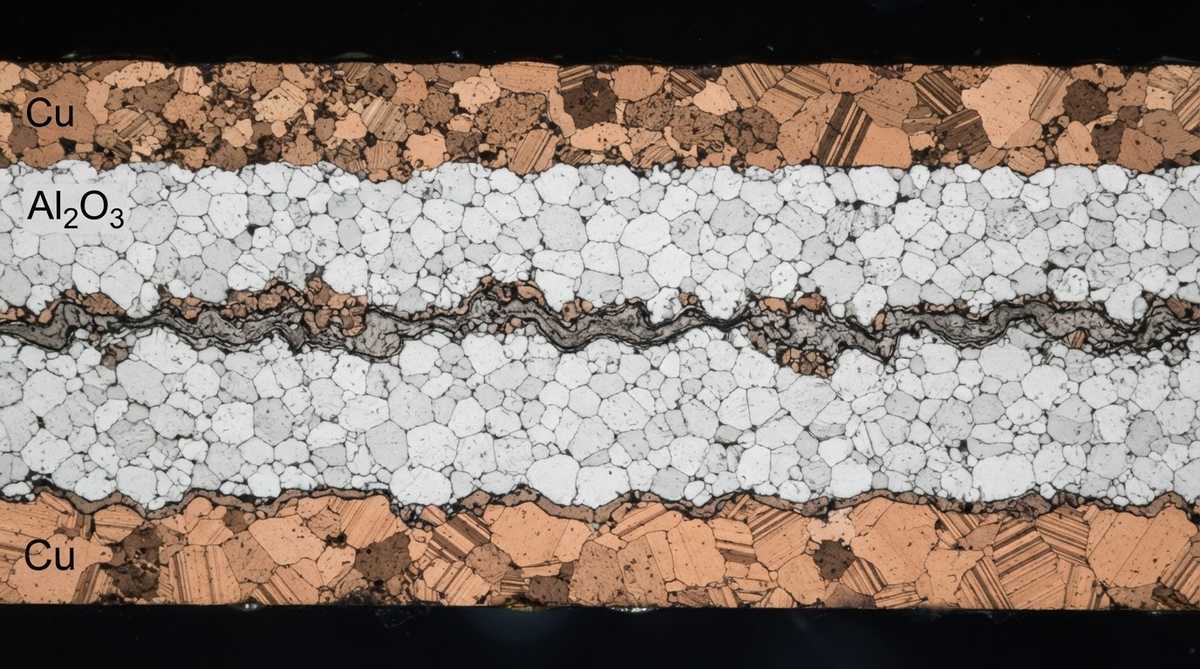
Flexural strength in AlN is governed by microstructure. Finer grain sizes (1–3 µm) push strength toward 400 MPa. Coarser grains and residual porosity from incomplete sintering drop it toward 300 MPa or below. Most commercial AlN substrates use yttria (Y2O3) as a sintering aid; the resulting yttrium aluminate grain-boundary phase improves densification but can also introduce weak interfaces if the sintering profile is not tightly controlled.
Surface condition also matters. As-fired AlN surfaces carry micro-pits and grain pull-outs that act as stress concentrators. Lapping or polishing removes the worst of these defects and can raise effective aluminum nitride AlN flexural strength by 10–20%. If your design pushes mechanical limits, specifying a tighter AlN surface roughness (Ra ≤ 0.3 µm) is a practical way to buy margin.
Substrate thickness plays a direct role as well. Thinner substrates (0.25 mm) are more vulnerable to handling damage and thermal-cycling stress. Thicker substrates (0.635–1.0 mm) tolerate more abuse but add thermal resistance. The trade-off between mechanical margin and thermal performance must be evaluated for each design. AlN thickness and tolerance options let you tune this balance.
AlN Mechanical Properties Compared to Other Ceramic Substrates
| Parameter | AlN | Al₂O₃ 96% | Si₃N₄ | Unit | Condition | Source |
|---|---|---|---|---|---|---|
| Flexural strength | 300–400 | 330–380 | 600–900 | MPa | 3-pt bend, 20 °C, ASTM C1161 | Kyocera, Maruwa, CeramTec datasheets |
| Fracture toughness (KIC) | 2.5–3.5 | 3.5–4.0 | 6–7 | MPa·√m | SEVNB, 20 °C | CoorsTek, Kyocera datasheets |
| Elastic modulus | 310–320 | 340–370 | 290–310 | GPa | 20 °C | Maruwa, CeramTec datasheets |
| CTE | 4.4–4.6 | 7.0–7.4 | 2.7–3.2 | ppm/°C | 20–400 °C | Kyocera, Maruwa datasheets |
| Thermal conductivity | 170–200 | 24–28 | 70–90 | W/mK | 20 °C | Kyocera, Maruwa datasheets |
Typical values for commercially available material, for comparison only. Confirm against the datasheet for your specific grade.
The table highlights the central trade-off: AlN gives you the best thermal conductivity of any non-beryllia oxide ceramic, but its fracture toughness is the lowest in the group. Silicon nitride properties show roughly double the aluminum nitride AlN flexural strength and double the fracture toughness, at the cost of lower thermal conductivity (70–90 W/mK vs. 170–200 W/mK).
How Thermal Cycling Degrades AlN Substrates
Static flexural strength is rarely the failure mode in service. The real threat is thermo-mechanical fatigue. In a DBC or AMB power module, the copper layer and the AlN substrate have different CTEs (Cu ≈ 17 ppm/°C vs. AlN ≈ 4.5 ppm/°C). Each power cycle imposes shear and peel stresses at the copper-ceramic interface and tensile stress in the ceramic.
After thousands of cycles (typically –40 °C to +150 °C or wider), micro-cracks nucleate at grain boundaries near the interface edge. Because AlN’s fracture toughness is low, those cracks propagate quickly once they reach a critical length. Published data from Infineon and Semikron application notes show that AlN DBC substrates survive roughly 15,000–30,000 power cycles at ΔT = 100 K, while Si3N4 AMB substrates survive 100,000+ cycles under the same profile.
Enter your substrate material, copper thickness, and cycling range below to estimate the derating effect on service life.
Worked Example: Stress Estimate in a DBC Substrate
Consider a 0.635 mm AlN substrate with 0.3 mm copper on each side, cooled from solder reflow (260 °C) to room temperature (25 °C). The CTE mismatch stress in the ceramic can be approximated by:
σ ≈ EAlN × ΔT × (CTECu − CTEAlN)
σ ≈ 315 GPa × 235 K × (17.0 − 4.5) × 10−6 = ~925 MPa (unconstrained estimate).
In practice, copper yielding and creep absorb most of this stress, bringing the actual ceramic tensile stress down to roughly 80–150 MPa—well below the 300–400 MPa aluminum nitride AlN flexural strength. The danger is not a single cycle but the accumulation of fatigue damage at stress concentrators over thousands of cycles. Edge defects, via holes, and metallization pattern corners are the usual crack initiation sites.
Design Strategies to Improve AlN Reliability
Radius all copper pattern corners. Sharp interior corners in etched copper patterns create local stress concentrations in the ceramic underneath. A minimum 0.3 mm fillet radius reduces peak stress by 30–50%, per Infineon AN2019-09.
Keep copper away from substrate edges. A 0.5–1.0 mm clearance between the copper pattern edge and the ceramic edge prevents the highest-stress zone from coinciding with edge chips or micro-cracks introduced during scribing.
Match copper thickness top and bottom. Asymmetric metallization causes substrate bowing during reflow, adding bending stress. If one side must be thinner, keep the ratio within 2:1.
Control CTE matching at every interface. Baseplate material (Cu, AlSiC, CuMo) and solder joint compliance all affect the stress seen by the ceramic. A compliant solder (e.g., SAC305 vs. sintered silver) trades thermal resistance for longer ceramic life.
When NOT to Use AlN for Mechanical Reasons
AlN is the wrong substrate when:
- Deep thermal cycling (ΔT > 150 K) with long service life (> 20 years). Automotive traction inverters and railway converters increasingly specify Si₃N₄ PCB substrates for exactly this reason.
- High mechanical shock or vibration. Defense and aerospace modules subject to 500 g shock events need the higher fracture toughness of Si₃N₄.
- Thin substrates (< 0.32 mm) under significant thermal load. The combination of low fracture toughness and reduced cross-section makes handling and assembly yields poor.
- Applications where cost is the primary driver and thermal conductivity above 25 W/mK is unnecessary. Al₂O₃ 96% is 3–5× cheaper per unit area and has comparable flexural strength.
FAQ
Does aluminum nitride AlN flexural strength change at high temperature?
AlN retains 85–95% of its room-temperature flexural strength up to 600 °C, per Kyocera technical data. Strength drops more noticeably above 800 °C as grain-boundary phases soften, but few PCB applications reach that range.
Can I improve AlN fracture toughness with additives?
Some research grades use SiC whisker or ZrO₂ particle reinforcement to push KIC above 4 MPa·√m, but these are not widely available as commercial PCB substrates. For production power modules, switching to Si₃N₄ is the standard path to higher toughness.
Is AlN weaker than alumina?
Not in flexural strength—both sit in the 300–400 MPa range. AlN is weaker in fracture toughness (2.5–3.5 vs. 3.5–4.0 MPa·√m for 96% Al₂O₃). This means AlN is more sensitive to surface flaws and edge damage, even though its bending strength is similar.
How do I test AlN flexural strength on incoming substrates?
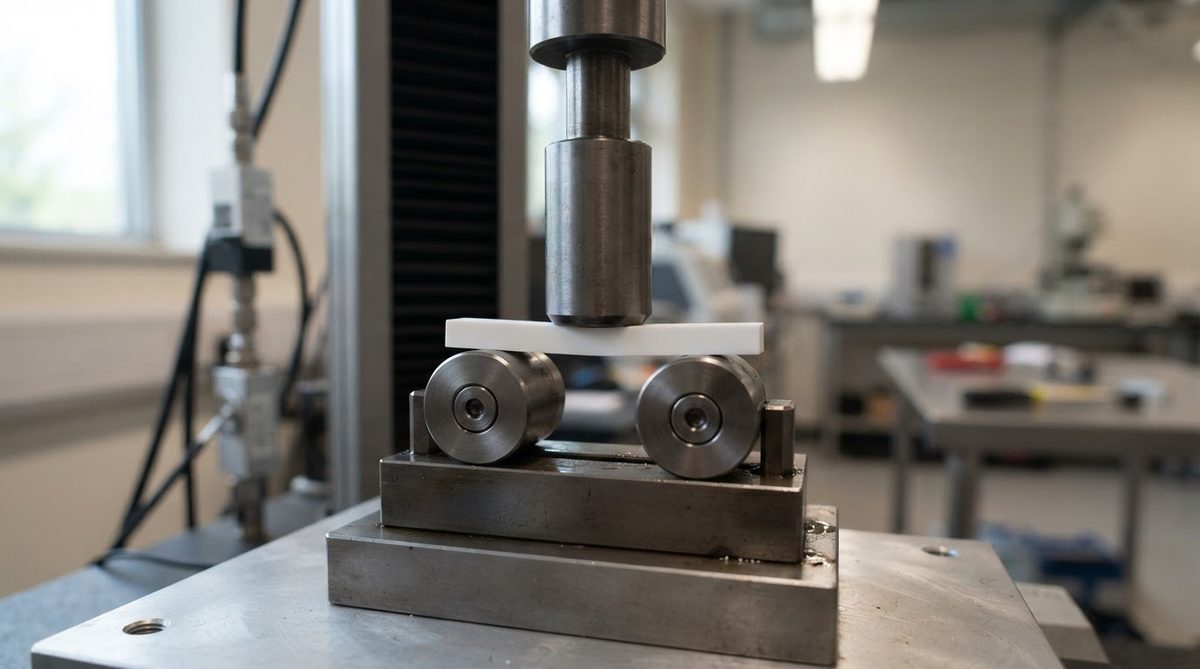
The standard method is ASTM C1161 (three-point or four-point bend on rectangular bars). For production screening, most manufacturers rely on lot-level destructive sampling rather than 100% testing. Requesting a certificate of analysis (CoA) with aluminum nitride AlN flexural strength data per lot is standard practice for power-module substrates.
Does metallization weaken the AlN substrate?
Metallization itself does not reduce bulk strength, but the process can. DBC bonding above 1,060 °C introduces residual thermal stress; poorly controlled AMB brazing can leave voids that act as crack initiators. Inspect metallized substrates with C-SAM (scanning acoustic microscopy) to catch delamination before assembly.