An IGBT substrate AlN PCB reduces junction temperatures by 15–30 °C compared with a 96 % alumina substrate of the same geometry, primarily because AlN conducts heat at 170–200 W/mK versus alumina’s 24–28 W/mK. That thermal margin translates directly into higher safe operating current, longer device life, or a smaller heatsink—whichever your design needs most. For power modules rated above 600 V, the IGBT substrate AlN PCB is the dominant ceramic platform in both industrial and automotive applications.
Key Takeaways
- AlN thermal conductivity (170–200 W/mK at 25 °C, per Maruwa and Kyocera datasheets) is 6–8× higher than 96 % Al₂O₃.
- AlN’s CTE of 4.4–4.7 ppm/°C closely matches silicon die (2.6–4.2 ppm/°C), reducing solder-joint fatigue during thermal cycling.
- Direct Bond Copper (DBC) on AlN supports copper layers of 0.127–0.635 mm, handling currents above 100 A per trace in power modules.
- AlN substrates cost roughly 3–5× more per unit area than 96 % alumina; the premium is justified only when the thermal budget demands it.
- For IGBT modules operating above 175 °C junction temperature, AlN is the mainstream ceramic choice; Si₃N₄ is preferred where mechanical shock or deep thermal cycling dominates.
Why IGBT Modules Need an AlN PCB Substrate
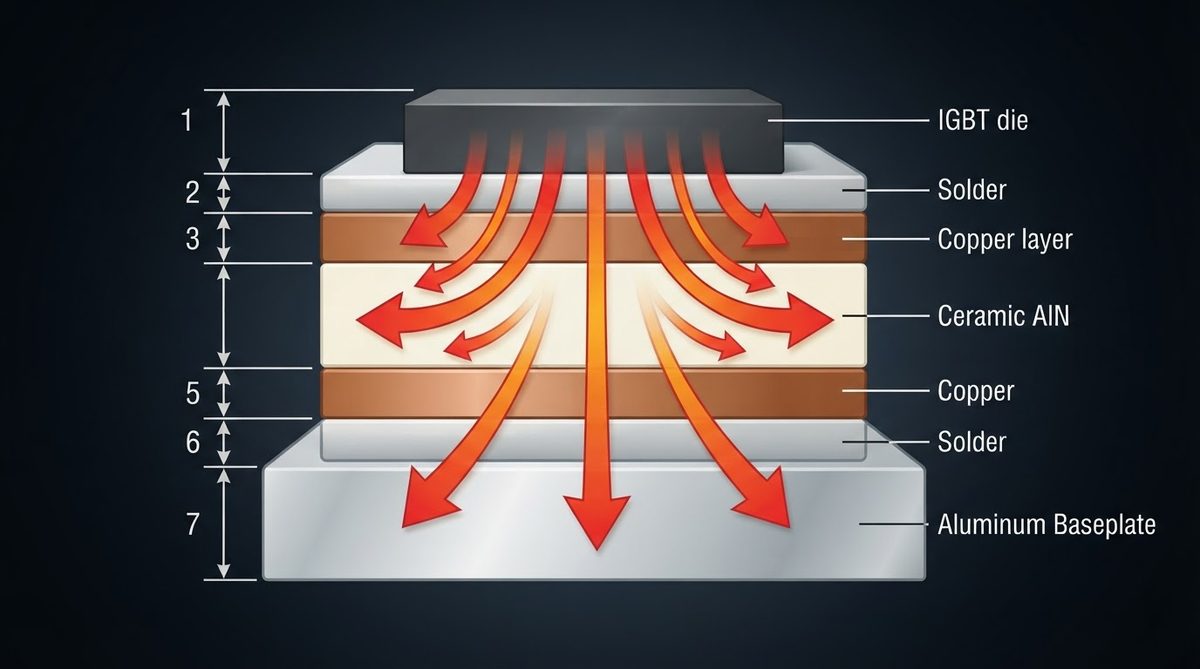
An IGBT die can dissipate 100–300 W/cm² during switching transients. The substrate directly beneath the die must spread that heat laterally and conduct it to the baseplate before the junction temperature exceeds the rated maximum—typically 150–175 °C for standard silicon IGBTs. Every degree of thermal resistance between die and heatsink matters.
AlN’s thermal conductivity of 170–200 W/mK (measured per ASTM E1461 laser-flash method at 25 °C) gives it the lowest substrate-level thermal resistance of any oxide or nitride ceramic in common production. This is the primary reason the IGBT substrate AlN PCB dominates in half-bridge and full-bridge modules rated above 600 V. Its CTE match to silicon is the secondary reason: a CTE mismatch below 1.5 ppm/°C at the die-attach interface keeps solder-joint strain within the fatigue budget for automotive-grade power cycling (≥ 20 000 cycles, ΔTj = 100 K).
IGBT Substrate AlN PCB Properties Compared
| Parameter | AlN | Al₂O₃ 96 % | Si₃N₄ | Unit | Condition | Source |
|---|---|---|---|---|---|---|
| Thermal conductivity | 170–200 | 24–28 | 70–90 | W/mK | 25 °C, ASTM E1461 | Maruwa / Kyocera datasheets |
| CTE | 4.4–4.7 | 7.0–7.4 | 2.7–3.2 | ppm/°C | 25–400 °C | CoorsTek / Kyocera |
| Flexural strength | 300–400 | 300–380 | 600–900 | MPa | ASTM C1161, 3-pt bend | CeramTec / Kyocera |
| Dielectric strength | 14–17 | 10–15 | 12–18 | kV/mm | DC, 25 °C | Maruwa |
| Dielectric constant (εr) | 8.6–8.9 | 9.4–9.8 | 7.9–8.5 | — | 1 MHz | Kyocera |
| Max continuous use temp. | 1 000 | 1 600 | 1 000 | °C | In inert/N₂ atmosphere | CoorsTek |
Typical values for commercially available material, for comparison only. Confirm against the datasheet for your specific grade.
A few things stand out. AlN’s flexural strength is adequate but not exceptional; Si₃N₄ is roughly 2× stronger. If your module must survive extreme mechanical shock or very deep thermal cycles (ΔTj > 150 K, > 50 000 cycles), silicon nitride thin substrates may be a better fit despite their lower thermal conductivity. For most industrial and automotive IGBT applications, the AlN PCB’s thermal performance wins the trade-off.
Worked Example: Thermal Resistance Through an AlN DBC Substrate
Consider a 1200 V / 150 A half-bridge IGBT module. Each die dissipates 120 W at rated load. The DBC substrate is AlN, 0.635 mm thick, with 0.3 mm copper on both sides. Die footprint: 13 × 13 mm.
Step-by-Step Calculation
- Thermal resistance of the AlN layer: Rth,AlN = t / (k × A) = 0.000635 m / (180 W/mK × 0.000169 m²) = 0.021 °C/W.
- Thermal resistance of one copper layer (0.3 mm): Rth,Cu = 0.0003 / (390 × 0.000169) = 0.0046 °C/W.
- Total substrate stack (Cu–AlN–Cu): Rth,sub ≈ 0.0046 + 0.021 + 0.0046 = 0.030 °C/W.
- Temperature drop across the substrate at 120 W: ΔT = 120 × 0.030 = 3.6 °C.
Repeat the same geometry with 96 % alumina (k = 26 W/mK): Rth,Al₂O₃ = 0.000635 / (26 × 0.000169) = 0.144 °C/W. Total stack ≈ 0.153 °C/W. ΔT = 120 × 0.153 = 18.4 °C. The IGBT substrate AlN PCB saves roughly 15 °C at the substrate level alone—before accounting for spreading effects, which further favour the higher-conductivity material.
Enter your own substrate dimensions, copper thickness, and dissipated power below to estimate the temperature drop across your specific AlN DBC stack.
DBC vs. AMB on AlN: Which Bonding Process for Your IGBT Substrate?
Most IGBT modules use Direct Bond Copper (DBC) on AlN. The process bonds copper foil to the ceramic at ~1 065 °C using a controlled Cu–O eutectic layer. DBC on AlN is well-characterised and widely available.
Active Metal Brazing (AMB) uses a Ti-containing braze alloy (typically Ag-Cu-Ti) at ~850 °C. AMB produces a stronger copper-ceramic bond and survives deeper thermal cycles, making it the choice for SiC-based modules that push junction temperatures toward 200 °C. For silicon IGBTs operating at Tj ≤ 175 °C, DBC is usually sufficient and less expensive. If your roadmap includes a migration from Si IGBT to SiC power modules on AlN, designing for AMB now avoids a substrate requalification later.
Design Considerations for an IGBT Substrate AlN PCB
Moisture Sensitivity
Unprotected AlN hydrolyses slowly in humid air, forming aluminum hydroxide on the surface. This degrades solder wettability and can increase thermal resistance at the interface. Store substrates in nitrogen-purged dry packs. Specify a metallisation (Ni/Au or Ag plating on DBC copper) that seals the ceramic surface and protects it during assembly.
Via and Routing Limits
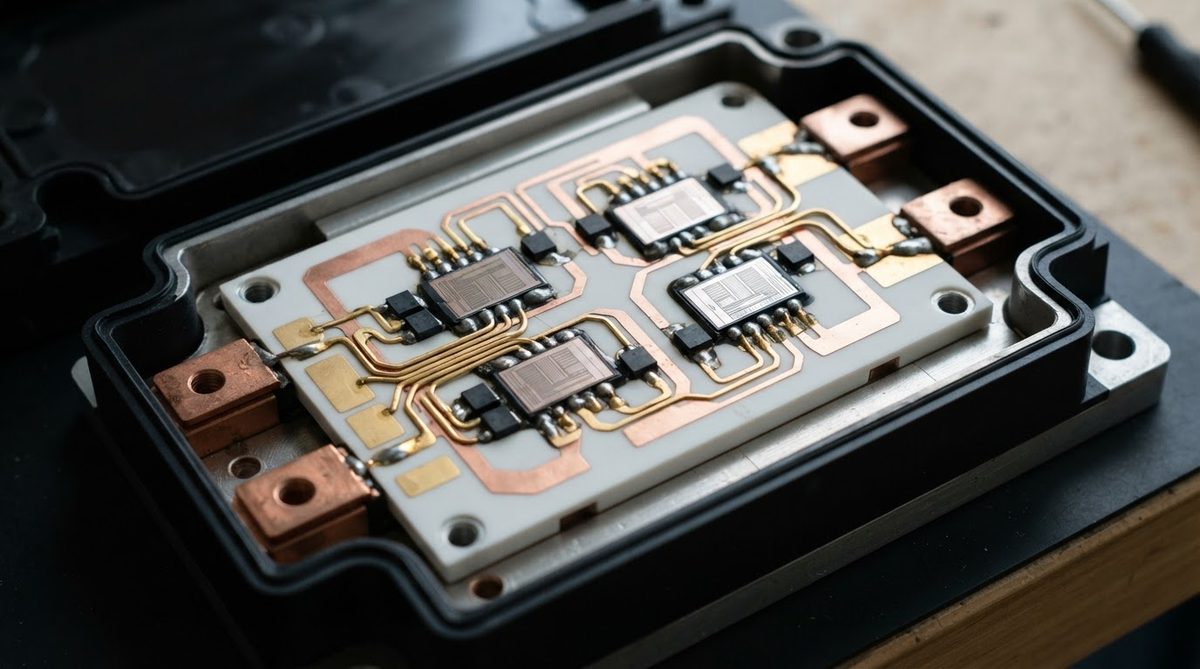
AlN DBC substrates are typically single- or double-sided without through-vias. If your IGBT module needs vertical interconnects, laser-drilled and metallised vias are possible but add cost and reduce yield. Keep the layout planar where you can. For complex multi-layer routing, consider an AlN custom fabrication approach with the manufacturer early in the design phase.
Substrate Thickness Selection
Common AlN DBC thicknesses for IGBT modules are 0.38 mm and 0.635 mm ceramic, with 0.127–0.3 mm copper per side. Thinner ceramic lowers thermal resistance but reduces dielectric withstand voltage. For 1200 V-class IGBTs, 0.635 mm AlN provides ≥ 8.9 kV DC isolation margin (14 kV/mm × 0.635 mm), well above the 4.5–6.0 kV typical hipot test requirement per IEC 60664-1.
When Not to Use an AlN PCB for IGBT Substrates
AlN is not always the right answer. Choose a different substrate if:
- Thermal budget is relaxed. For low-power IGBTs (≤ 50 W per die) or modules with generous heatsinking, 96 % alumina DBC at one-third the substrate cost may keep Tj within limits.
- Extreme thermal cycling dominates. Traction inverters with ΔTj > 150 K and > 50 000 power cycles benefit from Si₃N₄ AMB substrates, which resist copper-delamination crack propagation better than AlN DBC.
- Cost is the primary constraint. High-volume consumer appliance drives (air conditioners, washing machines) often use alumina DBC or even Al₂O₃ thick-film substrates to hit aggressive price targets.
- You need a metal-core PCB. For discrete IGBT packages soldered to a larger board, an aluminum MCPCB may handle the heat at a fraction of the cost. Ceramic substrates make sense inside the module, not necessarily as the system board.
Frequently Asked Questions
What is the maximum operating temperature of an AlN substrate?
AlN ceramic itself can withstand continuous temperatures above 1 000 °C in an inert atmosphere. In practice, the copper bond layer (DBC or AMB) and the solder joints limit the assembly to roughly 300–400 °C for short excursions, or a sustained 200–250 °C for AMB-bonded substrates. Silicon IGBTs rarely push beyond 175 °C junction temperature, so the substrate is not the limiting factor.
Can I use AlN DBC for both Si IGBTs and SiC MOSFETs?
Yes, the same AlN DBC substrate geometry can carry either die type. SiC devices run hotter (Tj up to 200 °C), so verify that your solder alloy and bond process can handle the higher temperature. Many designers moving to SiC switch from DBC to AMB for improved thermal-cycle reliability at the higher ΔTj.
How does AlN compare to Si₃N₄ for IGBT modules?
AlN offers roughly 2× the thermal conductivity of Si₃N₄ (170–200 vs. 70–90 W/mK), giving it a clear advantage in steady-state heat spreading. Si₃N₄ has roughly 2× the flexural strength (600–900 vs. 300–400 MPa), making it more resistant to crack propagation under deep thermal cycling. For most industrial IGBT applications, the AlN PCB wins on thermal performance; for automotive traction inverters with extreme cycling demands, Si₃N₄ is increasingly specified.
Does AlN require special handling during SMT assembly?
AlN is brittle and sensitive to moisture. Handle substrates with vacuum wands, not tweezers. Bake out absorbed moisture (125 °C, 4 hours minimum) before soldering if packages have been exposed to ambient humidity for more than 24 hours. Use a nitrogen reflow atmosphere to prevent copper oxidation on DBC pads.
What surface finishes work on AlN DBC for IGBT die attach?
Electroless Ni/Au (ENIG) is the most common finish for AlN DBC pads in IGBT modules, providing solderability and wire-bondability. Ag plating is used when sintered-silver die attach is specified for higher-temperature operation. Bare copper with an OSP coating is acceptable for immediate processing but has a short shelf life.
Next Step
If you are evaluating an IGBT substrate AlN PCB for your next power module, start by choosing the right ceramic substrate for your thermal and mechanical requirements. When you are ready to discuss specific dimensions, copper thickness, and metallisation, request a quote with your module drawing attached.