Why Source from an Aluminum Nitride ALN China Manufacturer?
China produces the majority of the world’s aluminum nitride ceramic substrates. Choosing the right aluminum nitride ALN China manufacturer gives hardware teams access to a vertically integrated supply chain—from AlN powder synthesis through sintering, metallization, and circuit patterning—concentrated in Guangdong, Jiangsu, and Hunan provinces. For sourcing managers, this means shorter lead times and lower per-unit costs compared to Japanese or European alternatives, typically 30–50% less for equivalent grades. The trade-off is that quality varies widely between factories, so qualification audits matter more than price sheets.
AlN’s appeal is straightforward: thermal conductivity of 170–200 W/mK (per Maruwa and Kyocera datasheets, measured at 25 °C per ASTM E1461) paired with a coefficient of thermal expansion (CTE) of 4.5–4.7 ppm/°C, which closely matches silicon (2.6 ppm/°C) and SiC (4.0 ppm/°C). That CTE match reduces solder-joint fatigue in power semiconductor die attach. If your device dissipates more than about 50 W/cm² and reliability under thermal cycling is critical, AlN is the right substrate.
Key Properties of Aluminum Nitride Substrates
| Parameter | Value | Unit | Condition | Source |
|---|---|---|---|---|
| Thermal conductivity | 170–200 | W/mK | 25 °C, ASTM E1461 | Maruwa / Kyocera datasheets |
| CTE | 4.5–4.7 | ppm/°C | 20–400 °C | CoorsTek technical data |
| Dielectric strength | 15–17 | kV/mm | 25 °C, IEC 60672 | Kyocera datasheet |
| Flexural strength | 300–400 | MPa | 3-pt bend, ASTM C1161 | CoorsTek / Maruwa |
| Volume resistivity | >10¹⁴ | Ω·cm | 25 °C | Kyocera datasheet |
| Density | 3.26 | g/cm³ | — | CoorsTek |
Typical values for commercially available material, for comparison only. Confirm against the datasheet for your specific grade.
Thermal conductivity is the spec most sensitive to manufacturing quality. AlN substrates from top-tier aluminum nitride ALN China manufacturer facilities routinely hit 170 W/mK; reaching 190+ W/mK requires tighter control of oxygen content in the AlN powder (below 1 wt%) and sintering atmosphere purity. Ask any prospective supplier for lot-level thermal conductivity test reports, not just a catalogue number.
Metallization Processes from an Aluminum Nitride ALN China Manufacturer
Chinese AlN PCB manufacturers commonly offer three metallization routes. Each suits a different circuit density and power level.
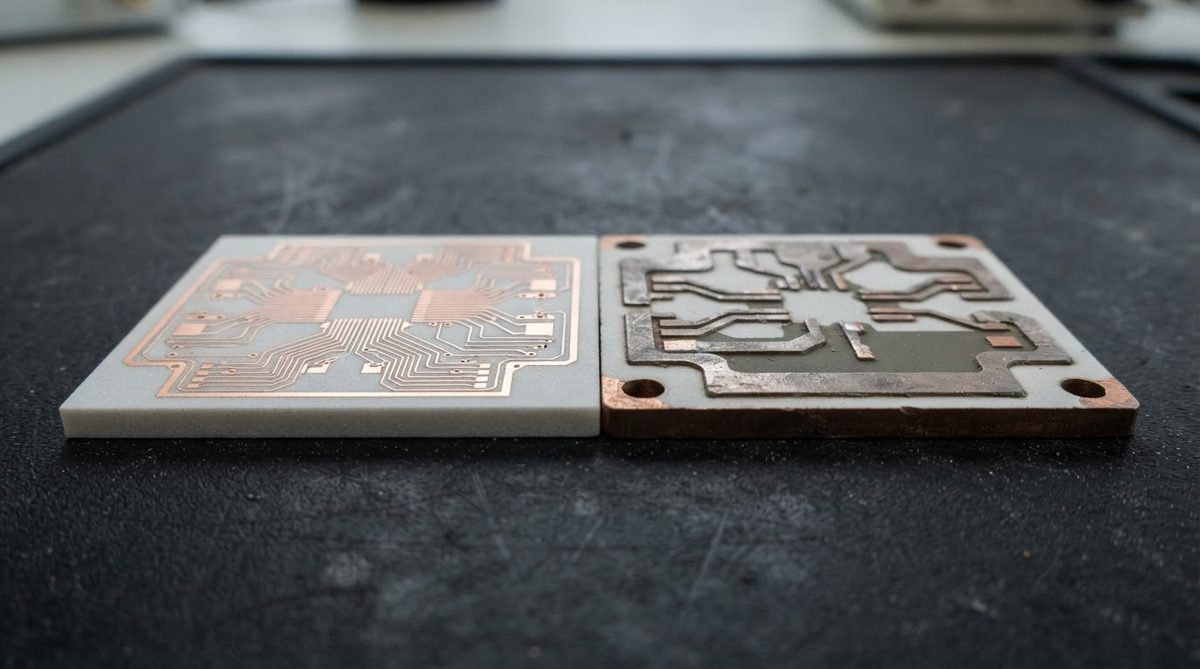
- DPC (Direct Plated Copper): Sputtered seed layer followed by electroplated copper, 1–100 µm thick. Achieves fine line/space down to 30–50 µm. Best for high-density LED arrays and RF substrates. Most Chinese ceramic PCB factories run DPC in-house.
- DBC (Direct Bonded Copper): Pre-oxidized copper foil bonded at ~1065 °C via a Cu-O eutectic. Copper thickness typically 127–500 µm. Suited to power modules above 100 A. Fewer Chinese factories run DBC on AlN than on Al₂O₃ because AlN requires a pre-oxidation step to form the bonding interface.
- AMB (Active Metal Brazing): A Ti-containing braze alloy (e.g., Ag-Cu-Ti) bonds copper foil to AlN at 800–900 °C under vacuum. Produces the strongest Cu-ceramic bond and handles thermal cycling better than DBC on AlN. AMB is increasingly available from Chinese suppliers, though the vacuum furnace investment limits it to larger factories.
If you need custom AlN PCB fabrication with tight trace geometries, DPC is the default. For high-current power modules, AMB is the safer long-term choice on AlN because DBC’s oxide interlayer on AlN is inherently weaker than on alumina.
What to Verify Before Placing an Order
Quality gaps between aluminum nitride ALN China manufacturer operations are real. Here is a practical qualification checklist:
- Powder source and oxygen content. Request the AlN powder supplier name and incoming QC spec for oxygen. Below 1.0 wt% O₂ is acceptable; below 0.8 wt% is preferred for ≥180 W/mK substrates.
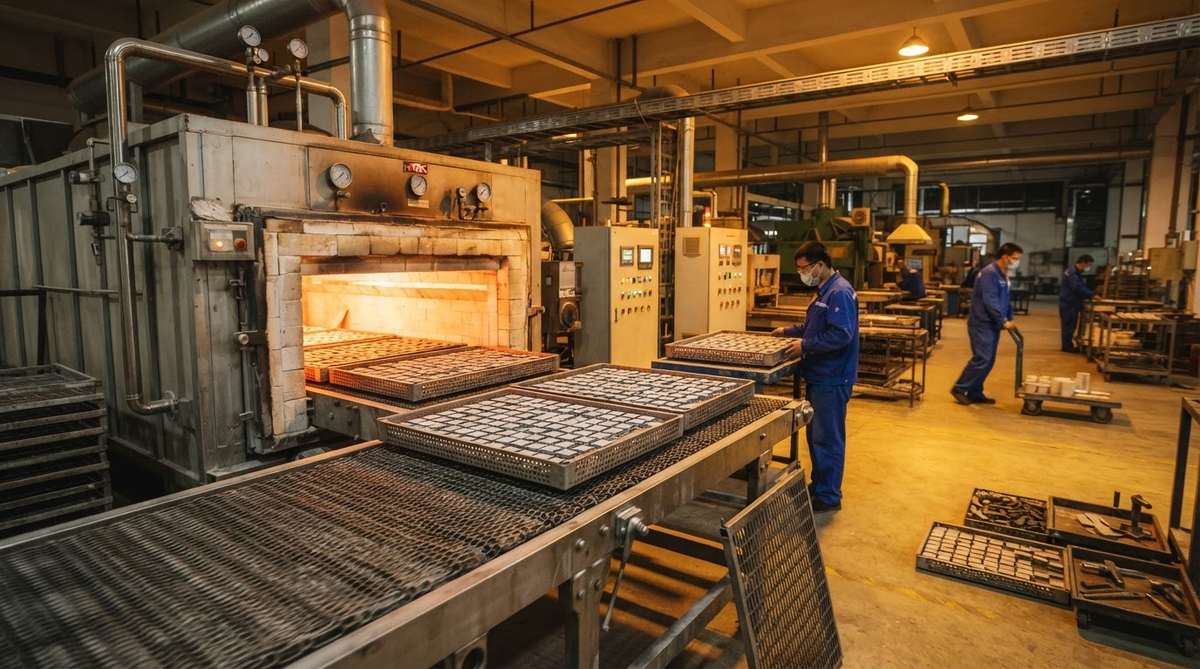
- Sintering atmosphere. AlN must be sintered under nitrogen at 1750–1850 °C. Ask whether the factory runs batch or continuous kilns, and whether they monitor dew point in the furnace.
- Thermal conductivity testing. Insist on laser flash (ASTM E1461) results per lot, not per batch. Some factories test only one sample per 500-piece batch.
- Metallization adhesion. Peel strength should exceed 6 N/mm for DBC/AMB and 4 N/mm for DPC, tested per IPC-TM-650 2.4.8.
- Dimensional tolerance. ±0.1 mm is standard for substrate outline after laser scribing; ±0.05 mm is achievable from better-equipped factories. Verify with first-article inspection.
Understanding the broader ceramic substrate supply chain helps you identify which factories actually sinter their own AlN versus those that buy blanks and only metallize.
AlN vs. Alternatives: When to Choose Something Else
| Parameter | AlN | Al₂O₃ 96% | Si₃N₄ | Metal-core PCB |
|---|---|---|---|---|
| Thermal conductivity (W/mK) | 170–200 | 24–28 | 70–90 | 1–4 (dielectric layer) |
| CTE (ppm/°C) | 4.5–4.7 | 7.0–8.0 | 2.5–3.5 | ~17 (aluminum) |
| Flexural strength (MPa) | 300–400 | 300–380 | 600–900 | N/A |
| Relative substrate cost | 3–5× | 1× (baseline) | 5–8× | 0.3–0.5× |
Typical values for commercially available material, for comparison only. Confirm against the datasheet for your specific grade.
When NOT to use AlN
If your heat flux is below ~20 W/cm², 96% alumina at one-third the cost will likely do the job. If your primary concern is mechanical shock or vibration rather than thermal performance, Si₃N₄ substrates from China offer roughly double the fracture toughness of AlN (6–7 MPa·m^½ vs. 2.5–3.5 MPa·m^½). And if your board is larger than about 50 × 50 mm with complex routing, a metal-core PCB or insulated metal substrate may be more practical and far cheaper.
AlN is also sensitive to moisture. Prolonged exposure to humid environments without passivation can cause surface hydrolysis, degrading both thermal and electrical performance. If your application involves outdoor exposure without hermetic packaging, factor in a protective coating or consider alumina instead.
Tariffs and Import Considerations
Ceramic PCBs from China are subject to U.S. tariffs under HTS codes that vary depending on whether the substrate is classified as a finished circuit board or a blank ceramic part. The effective duty rate can range from 0% to 25% depending on classification and any active Section 301 tariffs. Review the specifics in our guide on tariffs and country of origin for ceramic PCBs before finalizing landed-cost calculations.
Worked Example: Thermal Resistance of an AlN Substrate
Suppose you have a 10 × 10 mm AlN substrate, 0.635 mm thick, with thermal conductivity of 180 W/mK. The conductive thermal resistance through the substrate is:
Rth = t / (k × A) = 0.000635 / (180 × 0.0001) = 0.035 °C/W
For comparison, the same geometry in 96% alumina (k = 26 W/mK) gives 0.244 °C/W—about 7× higher. At 100 W dissipation, that difference is 0.035 × 100 = 3.5 °C across the AlN substrate versus 24.4 °C across alumina. For high-power die attach, that 21 °C margin directly extends device lifetime.
Enter your own substrate dimensions, thickness, and dissipated power below to estimate junction temperature rise for AlN or alumina.
FAQ
Can I get AlN substrates with through-holes or vias?
Yes. Laser drilling is the standard method for vias in AlN, typically down to 100–150 µm diameter. The vias are then filled with conductive paste (usually tungsten or copper) and co-fired or plated. Expect a cost premium of 20–40% over solid substrates.
What surface finishes are available on AlN PCBs from China?
Common finishes include ENIG, ENEPIG, electroplated Au, and bare Cu with OSP. ENIG is the most widely offered for wire-bondable pads. Confirm gold thickness (typically 0.05–0.15 µm for ENIG) against your bonding requirements.
How does AlN handle repeated thermal cycling?
AlN substrates themselves withstand thermal cycling well, but the metallization bond is the weak link. AMB joints on AlN typically survive 2,000–3,000 cycles from −40 to +150 °C (per JEDEC JESD22-A104). DBC on AlN tends to delaminate earlier due to the weaker oxide interlayer. Specify AMB for applications requiring extended cycling life.
What is the minimum order quantity from a typical aluminum nitride ALN China manufacturer?
MOQs vary. For standard sizes (e.g., 114 × 114 mm blanks), some suppliers sell as few as 10–25 pieces. For AlN wholesale quantities, pricing drops significantly above 500–1,000 pieces. Custom metallized circuits usually require 25–50 piece minimums for prototyping.
Does AlN require special handling during assembly?
AlN is brittle (fracture toughness ~2.5–3.5 MPa·m^½), so standard board-handling fixtures used for FR-4 can crack it. Use vacuum pick-and-place tooling and avoid clamping edges. Soldering profiles are compatible with standard SAC305 reflow, but ramp rates above 3 °C/s can cause thermal shock fractures in substrates thicker than 1 mm.
Next Step
If you are evaluating AlN for a specific power module or LED application, start by defining your thermal resistance budget and required copper thickness. Then request a quote from an AlN ceramic PCB manufacturer with lot-level thermal conductivity data and metallization peel-strength reports included in the quotation package.