When engineers compare ceramic PCB weight vs FR4, the answer is counter-intuitive: ceramic is about twice as dense, yet a finished ceramic board is often lighter. 96% alumina has a density of roughly 3.7–3.9 g/cm³, while standard FR-4 laminate sits at about 1.8–1.85 g/cm³ (per IPC-4101 Class /FR-4 datasheets). That is a 2:1 density ratio. But density alone does not determine the mass of a finished board—thickness does, and ceramic substrates are almost always thinner than their FR-4 equivalents.
Key Takeaways
- 96% alumina (Al₂O₃) density is 3.7–3.9 g/cm³; FR-4 is 1.8–1.85 g/cm³—about half.
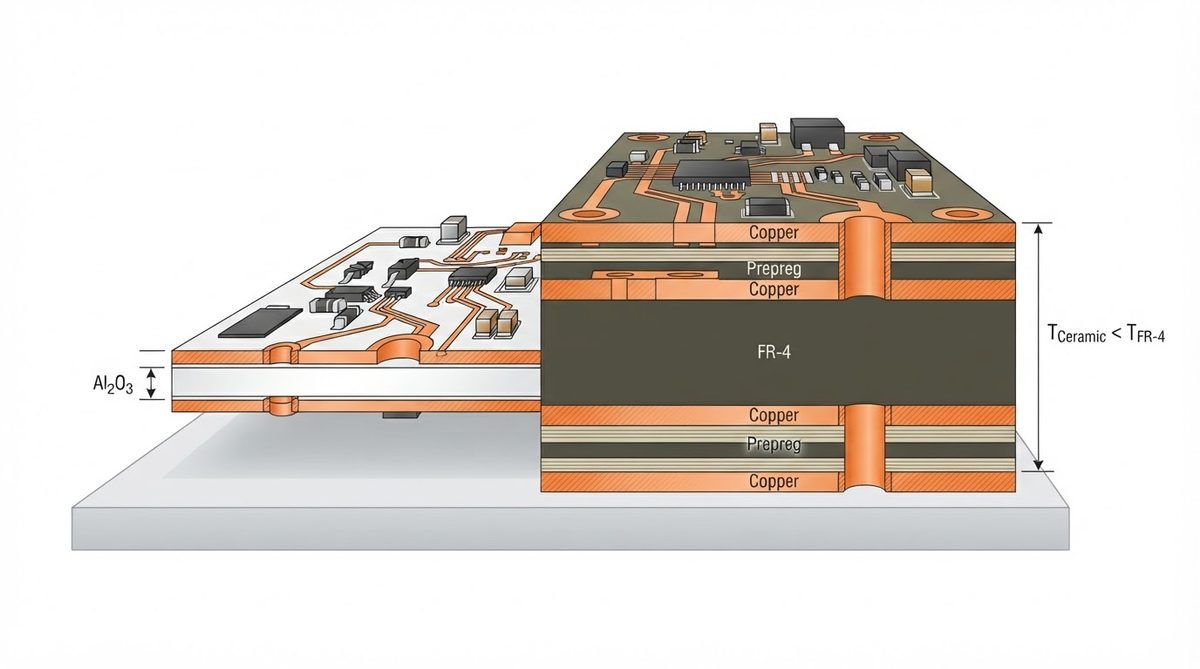
- A typical ceramic substrate is 0.25–0.635 mm thick, while a standard 4-layer FR-4 board is 1.6 mm thick, so the ceramic board’s mass per unit area can be comparable or even lower.
- Aluminum nitride (AlN) is slightly lighter at 3.25–3.30 g/cm³ but still denser than FR-4.
- For weight-critical aerospace or wearable designs, a thin ceramic board may weigh less than the multi-layer FR-4 it replaces.
- Copper layers, solder, and components dominate total assembly weight in most real designs.
Ceramic PCB Weight vs FR4: Density and Thickness Data
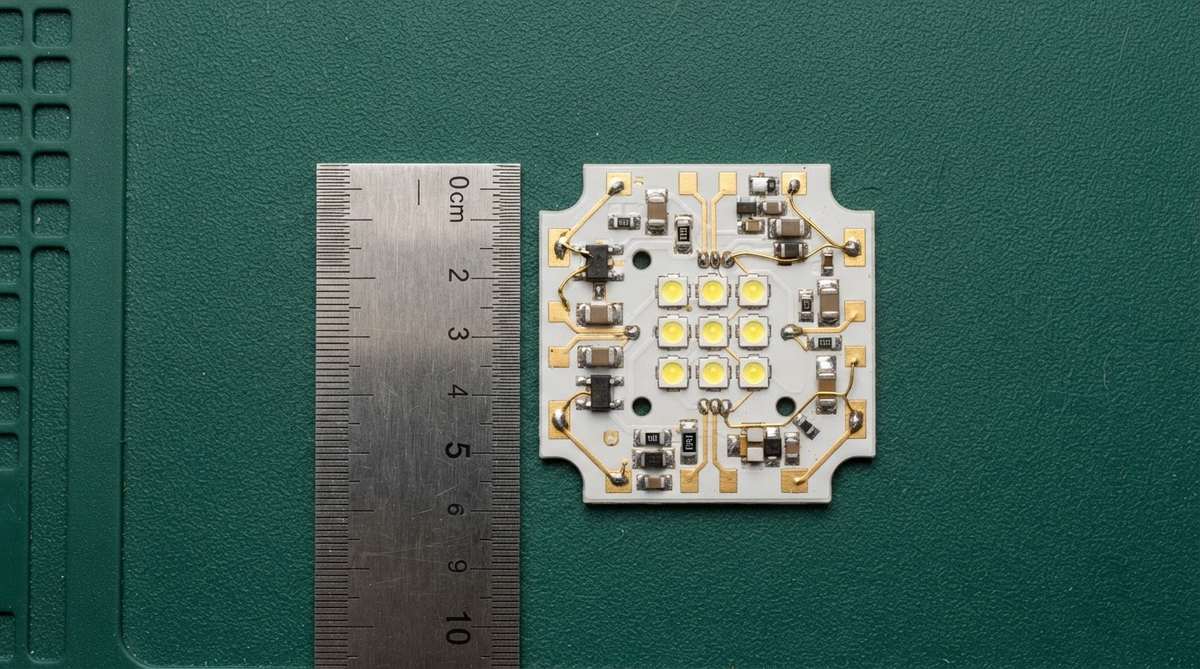
| Material | Density (g/cm³) | Common Thickness (mm) | Mass per cm² at That Thickness (g) | Source |
|---|---|---|---|---|
| FR-4 (glass/epoxy) | 1.80–1.85 | 1.6 | 0.288–0.296 | IPC-4101, Isola 370HR datasheet |
| Al₂O₃ 96% | 3.70–3.90 | 0.635 | 0.235–0.248 | CoorsTek ADS-996 datasheet |
| Al₂O₃ 96% | 3.70–3.90 | 0.381 | 0.141–0.149 | CoorsTek ADS-996 datasheet |
| AlN | 3.25–3.30 | 0.635 | 0.206–0.210 | Kyocera SH-30 datasheet |
| Si₃N₄ | 3.20–3.30 | 0.32 | 0.102–0.106 | Kyocera SN-100 datasheet |
Typical values for commercially available material, for comparison only. Confirm against the datasheet for your specific grade.
The table reveals the key insight in the ceramic PCB weight vs FR4 discussion: a 0.635 mm alumina board weighs less per square centimetre than a 1.6 mm FR-4 board, despite being twice as dense. At 0.381 mm—a common ceramic PCB thickness—the alumina board is roughly half the areal mass of the FR-4.
Worked Example: 25 × 25 mm Board Mass
Consider a 25 mm × 25 mm board (6.25 cm² area) with no copper or components—just bare substrate. This example makes the ceramic PCB weight vs FR4 trade-off concrete.
FR-4 at 1.6 mm
Volume = 6.25 cm² × 0.16 cm = 1.0 cm³. Mass = 1.0 × 1.82 = 1.82 g.
96% Alumina at 0.635 mm
Volume = 6.25 cm² × 0.0635 cm = 0.397 cm³. Mass = 0.397 × 3.80 = 1.51 g.
96% Alumina at 0.381 mm
Volume = 6.25 cm² × 0.0381 cm = 0.238 cm³. Mass = 0.238 × 3.80 = 0.90 g.
The thinner alumina board is about half the weight of the FR-4. Even the thicker alumina option is 17% lighter. The density disadvantage is more than offset by the thickness reduction.
Use the tool below to model different substrate thicknesses and layer counts for your own board dimensions.
[pcb_calc type=”stackup-thickness”]
Why Ceramic Boards Are Thinner
FR-4 boards achieve structural rigidity through multi-layer lamination. A standard 4-layer FR-4 stackup is 1.6 mm thick partly because the resin-and-glass weave needs bulk to remain stiff. Ceramic substrates are inherently rigid: 96% alumina has a flexural strength of 350–380 MPa (per ASTM C1161), roughly 10× that of FR-4. A 0.38 mm alumina sheet is stiff enough to handle and assemble without flex damage.
This structural strength means ceramic circuit boards do not need the same thickness to survive handling, reflow soldering, or vibration. In many thermal-management applications, the ceramic substrate replaces both the PCB and the heat spreader, removing a layer from the assembly and further reducing total weight.
When Copper and Components Dominate
On a populated assembly, the substrate is often a minority contributor to total mass. A single QFN-48 package weighs about 0.1 g; a bank of decoupling capacitors, connectors, and a heatsink can easily outweigh the bare board by 3–5×. Solder paste adds another 0.5–2 g depending on pad count.
If your design has significant copper pours—say 70 µm copper on both sides—that adds roughly 1.3 g per cm² of copper area. At that point, the substrate material’s density difference between ceramic and FR-4 becomes a rounding error in the system-level mass budget.
For designs where the board itself is the dominant mass contributor (sensor tags, implantable medical devices, small LED modules), the ceramic PCB weight vs FR4 question matters. For a power converter with a large heatsink, it usually does not.
Weight Comparison for Common Applications
| Application | Typical Board Size | FR-4 Board Mass (1.6 mm) | Alumina Board Mass (0.38 mm) | Weight Difference |
|---|---|---|---|---|
| LED module | 20 × 20 mm | 1.17 g | 0.58 g | Ceramic 50% lighter |
| RF sensor | 10 × 15 mm | 0.44 g | 0.22 g | Ceramic 50% lighter |
| Power module (DBC) | 40 × 50 mm | 5.82 g | 2.89 g | Ceramic 50% lighter |
| Large control board | 100 × 160 mm | 46.6 g | 23.1 g | Ceramic 50% lighter |
Bare substrate mass only; no copper, solder, or components. FR-4 density assumed 1.82 g/cm³; alumina 96% at 3.80 g/cm³.
When NOT to Choose Ceramic for Weight Reasons
If your only motivation for considering ceramic is weight reduction, there are cheaper paths. Thin-core FR-4 (0.4 mm, 2-layer) weighs less than standard 1.6 mm FR-4 and costs a fraction of a ceramic board. Flex circuits (polyimide, ~1.4 g/cm³) are lighter still. Metal-core PCBs using aluminium (2.7 g/cm³) are lighter than ceramic for the same thickness, though they lack ceramic’s dielectric strength and high-temperature capability.
Ceramic substrates earn their place when you need the combination of thermal conductivity, electrical isolation, CTE matching, or extreme operating temperatures—and the weight happens to be acceptable or even beneficial. Choosing ceramic purely for mass savings over FR4 is rarely cost-effective.
FAQ
How much does a typical ceramic PCB weigh?
A 25 × 25 mm, 0.635 mm-thick alumina substrate weighs about 1.5 g bare. Thinner substrates (0.25–0.38 mm) weigh proportionally less. Add copper metallisation and solder to get the true assembly mass.
Is aluminum nitride lighter than alumina?
AlN is slightly less dense—3.25–3.30 g/cm³ versus 3.70–3.90 g/cm³ for 96% alumina. On a 25 × 25 mm, 0.635 mm board, that saves about 0.2 g. The difference is small; AlN is chosen for its thermal conductivity (170–200 W/mK), not its weight.
Does copper thickness change the weight comparison?
Significantly. Copper has a density of 8.96 g/cm³. A 35 µm copper layer on both sides of a 25 × 25 mm board adds about 0.39 g. On a DBC substrate with 300 µm copper, the copper alone can outweigh the ceramic.
Can I reduce ceramic PCB weight by using thinner substrates?
Yes. Alumina substrates are commercially available from 0.25 mm to over 2 mm. Going from 0.635 mm to 0.25 mm cuts substrate mass by 60%. The trade-off is reduced mechanical strength and higher breakage risk during handling; consult ceramic board handling guidelines before specifying ultra-thin substrates.
Does ceramic PCB weight matter for vibration resistance?
A lighter board has a higher natural frequency for a given stiffness, which can push resonance above the excitation band. Ceramic’s high Young’s modulus (300–370 GPa for alumina vs ~20 GPa for FR-4) also raises natural frequency. In vibration-sensitive applications like aerospace avionics, these properties can be more important than raw mass.
Next Step
If you are evaluating ceramic PCB weight vs FR4 for a specific board outline, request a quote with your dimensions and thickness preference. We can return both the bare substrate mass and a budgetary price so you can evaluate the trade-off directly. Visit the AluminaPCB ceramic PCB overview for material options, or browse the full ceramic PCB question library for related topics.