Ceramic substrates for EV and traction power modules typically cost $15–$80 per unit in production volumes of 1,000–10,000 pieces, depending on material grade, metallization process, and substrate dimensions. Understanding EV power module PCB cost matters because that is 8–30× the price of an equivalent FR-4 board, yet the system-level savings in thermal management hardware and reliability often justify the premium.
Key Takeaways
- An Al₂O₃ 96% DBC substrate for a 50 kW inverter half-bridge runs roughly $15–$25 per piece at 5,000-unit volumes; an AlN AMB version of the same layout costs $45–$80.
- Material choice (Al₂O₃ vs. AlN vs. Si₃N₄) accounts for 40–60% of the substrate unit cost.
- Moving from DBC to AMB metallization adds 30–50% to the per-unit price but is required for Si₃N₄ and increasingly preferred for SiC die-attach reliability.
- Panel utilization is the single fastest lever to reduce EV power module PCB cost—fitting four substrates per panel instead of two can cut piece price by 25–35%.
Why EV Power Modules Use Ceramic Substrates
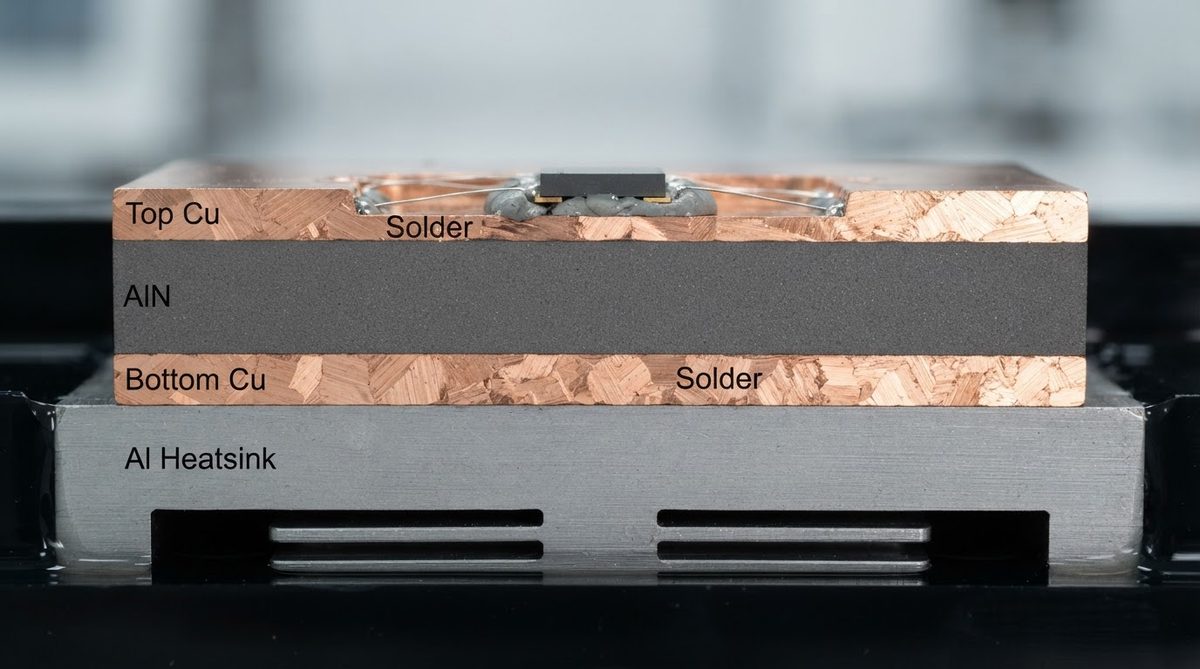
Silicon carbide (SiC) and silicon IGBT dies in traction inverters dissipate 100–300 W per switch position at junction temperatures of 150–200 °C. The substrate must conduct that heat into a baseplate or cooler while electrically isolating the die from the heatsink. FR-4 (thermal conductivity ~0.3 W/mK) cannot do this. Metal-core PCBs top out around 2–4 W/mK with a dielectric layer that limits voltage isolation.
Ceramic substrates solve both problems. Al₂O₃ 96% offers 24–28 W/mK (per CoorsTek ADS-96R datasheet, ASTM E1461), AlN reaches 170–200 W/mK (Kyocera AN-200), and Si₃N₄ delivers 80–90 W/mK with roughly 3× the flexural strength of AlN—critical for substrates that must survive thermal cycling between −40 °C and +175 °C over 15-year vehicle lifetimes. For a deeper look at SiC power module substrate costs, see our dedicated breakdown.
EV Power Module PCB Cost Drivers
1. Substrate Material
Material is the dominant input in any EV power module PCB cost estimate. AlN raw ceramic costs 5–8× more than Al₂O₃ 96% per cm², and Si₃N₄ sits between the two at roughly 3–5× Al₂O₃ pricing. Most 400 V battery-platform inverters still use Al₂O₃ DBC. 800 V SiC platforms increasingly specify AlN or Si₃N₄ because higher switching frequencies and junction temperatures demand lower thermal resistance and better thermal-cycling endurance.
2. Metallization Method (DBC vs. AMB)
Direct Bond Copper (DBC) fuses a copper foil to the ceramic at ~1,065 °C in a controlled oxygen atmosphere. Active Metal Brazing (AMB) uses a TiAgCu or TiCuSn braze alloy at 800–900 °C. AMB produces a stronger copper-ceramic bond and is the only reliable method for Si₃N₄. The braze alloy and vacuum furnace cycle add 30–50% to the metallization cost compared with DBC. For modules with IGBT die, the cost trade-offs shift because lower junction temperatures relax the material requirement.
3. Copper Thickness
EV inverter substrates commonly use 0.3 mm copper on both sides for current-carrying capacity. Some designs call for 0.5 mm or even 0.8 mm copper to handle 200–600 A bus currents. Thicker copper increases raw material cost and etching time, and it raises the risk of ceramic cracking during thermal cycling, which drives up scrap rates.
4. Panel Size and Utilization
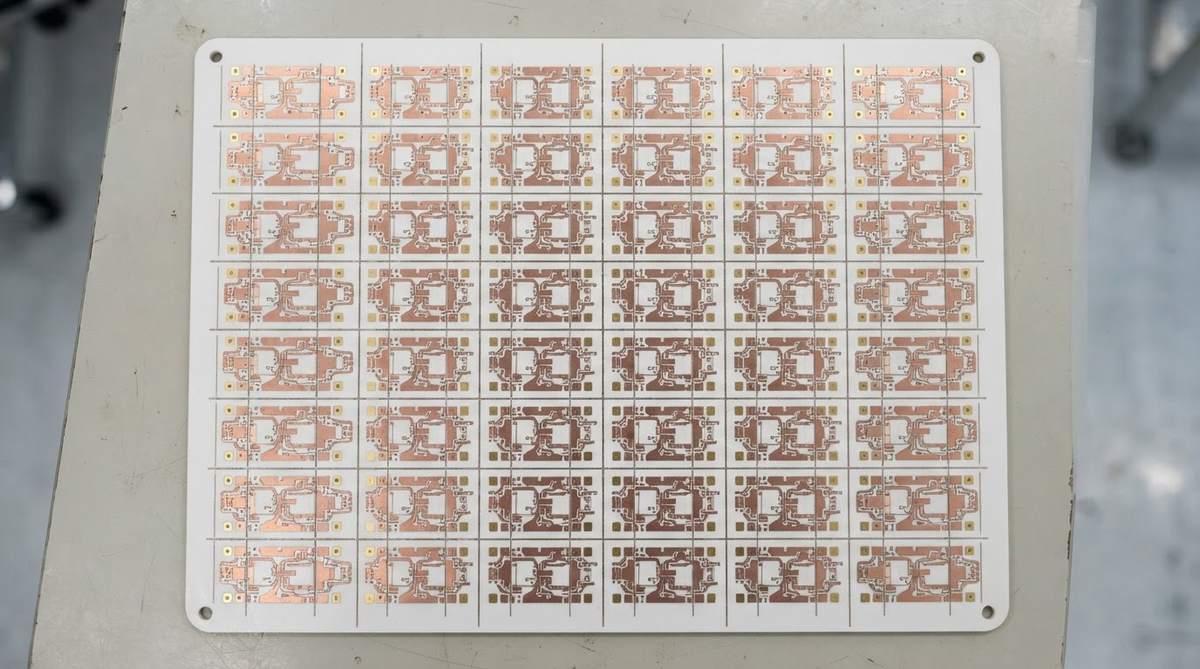
Ceramic panels are typically 114 × 114 mm or 138 × 190 mm. A half-bridge substrate measuring 36 × 52 mm fits six-up on a 138 × 190 mm panel with routing margins. If your layout is 70 × 52 mm, only three fit. That nearly doubles the per-piece cost from the same panel. Design the substrate outline with panel utilization in mind before locking the power module footprint.
5. NRE and Tooling
Laser scribing patterns, etching artwork, and brazing fixtures carry a one-time NRE charge, often $800–$3,000 per design. For EV programs that will produce thousands of modules, NRE is negligible per piece. For prototype runs of 10–50 units, it can dominate the per-unit cost. A full overview of ceramic PCB cost factors covers NRE amortization in more detail.
Worked Cost Example: 100 kW SiC Inverter Substrate
Assume a six-in-one SiC inverter module. Each phase leg uses one substrate, so the module needs three substrates. Substrate dimensions: 38 × 56 mm, AlN, AMB, 0.3 mm Cu both sides, Ni/Au plating, quantity 3,000 sets (9,000 substrates). This example illustrates how EV power module PCB cost accumulates across each production step.
| Cost Element | Per Substrate | Notes |
|---|---|---|
| AlN ceramic blank (0.635 mm) | $12–$18 | 138 × 190 mm panel, 6-up |
| AMB metallization (0.3 mm Cu, both sides) | $18–$28 | Vacuum furnace, TiAgCu braze |
| Circuit etching | $3–$5 | Photolithographic etch, min 0.3 mm trace/space |
| Ni/Au surface finish | $2–$4 | Electroless Ni 3–6 µm, immersion Au 0.05–0.1 µm |
| Electrical and visual inspection | $1–$2 | Hipot, AOI, dimensional check |
| Total per substrate | $36–$57 | |
| Total per 3-substrate module set | $108–$171 | Excludes NRE ($1,500–$2,500 one-time) |
Typical values for commercially available material, for comparison only. Confirm against the datasheet for your specific grade.
Switching to Al₂O₃ 96% DBC with 0.3 mm Cu would bring the per-substrate cost down to roughly $15–$25, but thermal resistance from junction to coolant rises, which may force a larger heatsink or lower power density—costs that show up elsewhere in the bill of materials.
Material Comparison for EV Substrates
| Parameter | Al₂O₃ 96% | AlN | Si₃N₄ | Unit | Source |
|---|---|---|---|---|---|
| Thermal conductivity (20 °C) | 24–28 | 170–200 | 80–90 | W/mK | CoorsTek, Kyocera, Toshiba datasheets |
| Flexural strength | 300–380 | 300–400 | 700–900 | MPa | ASTM C1161 |
| CTE (20–300 °C) | 7.2–7.8 | 4.5–5.0 | 2.5–3.5 | ppm/°C | Manufacturer datasheets |
| Dielectric strength | 10–15 | 15–17 | 12–15 | kV/mm | IEC 60672 |
| Relative substrate cost (index) | 1× | 5–8× | 3–5× | — | Industry pricing, 2024 |
| Compatible metallization | DBC, AMB | DBC, AMB | AMB only | — | — |
Typical values for commercially available material, for comparison only. Confirm against the datasheet for your specific grade.
How to Reduce EV Power Module PCB Cost
- Maximize panel utilization. Adjust substrate outline by even 1–2 mm to gain an extra piece per panel.
- Use Al₂O₃ where thermal budget allows. Many 400 V IGBT platforms perform well on alumina DBC at a fraction of AlN cost.
- Standardize thickness. 0.32 mm and 0.635 mm ceramic, 0.3 mm Cu are high-volume standards. Non-standard thicknesses require custom ceramic runs.
- Consolidate NRE. If you have three substrate variants, design them to share a common panel layout and etching fixture.
- Order qualification and production volumes together. Splitting a 5,000-piece need into a 200-piece qual run and a 4,800-piece production run often costs more than a single 5,000-piece order.
If you are budgeting stencil costs for module assembly, enter your dimensions below to estimate SMT stencil pricing for your EV substrate layout.
[pcb_calc type=”stencil-cost”]
When a Ceramic Substrate Is Not the Right Choice
If your power module operates below 5 kW with junction temperatures under 125 °C, an insulated metal substrate (IMS/MCPCB) at $1–$3 per piece may handle the thermal load adequately. For low-voltage, low-current gate-driver boards within the same module, standard FR-4 or polyimide flex is cheaper and easier to route. Ceramic substrates earn their EV power module PCB cost premium only where thermal conductivity above ~3 W/mK, high-voltage isolation, and extreme thermal cycling are genuine requirements—conditions that describe most traction inverters and DC-DC converters above 20 kW.
For cost considerations in industrial power supply modules or high-power LED assemblies, the trade-offs shift because duty cycles and ambient temperatures differ significantly from automotive traction duty.
Frequently Asked Questions
Does Si₃N₄ always cost more than AlN for EV substrates?
Si₃N₄ raw ceramic is typically 3–5× the price of Al₂O₃ 96%, which is less than AlN at 5–8×. However, Si₃N₄ requires AMB metallization, and the total substrate cost often lands between Al₂O₃ DBC and AlN AMB. The long-term reliability advantage of Si₃N₄ under aggressive thermal cycling can reduce warranty cost enough to offset the higher substrate price.
How many thermal cycles can an EV ceramic substrate survive?
Al₂O₃ DBC substrates typically withstand 3,000–10,000 cycles from −40 °C to +150 °C before copper delamination, depending on copper thickness and edge geometry. Si₃N₄ AMB substrates routinely exceed 30,000 cycles under the same profile, per published data from Toshiba Materials and Rogers/Curamik. Cycle life directly affects warranty cost and therefore total cost of ownership.
Can I prototype an EV power module substrate in small quantities?
Yes. Most ceramic substrate suppliers offer prototype runs of 5–50 pieces with lead times of 2–4 weeks. Expect NRE of $800–$2,500 and per-piece pricing 2–4× higher than production volumes because panel utilization and furnace batch efficiency are lower.
Is gold plating necessary on EV substrates?
Gold plating (typically electroless Ni/Au) is standard for die-attach and wire-bond pads because it prevents copper oxidation and provides a reliable solder or sinter interface. If your module uses only solder attach and no wire bonds, a Ni-only finish or OSP may suffice, saving $1–$3 per substrate. Confirm compatibility with your die-attach process before specifying a lower-cost finish.
What is the typical lead time for production volumes of EV substrates?
Production orders of 1,000–10,000 substrates typically ship in 4–8 weeks from order confirmation, assuming approved artwork and no custom ceramic thickness. AlN and Si₃N₄ substrates may take 1–2 weeks longer than Al₂O₃ because raw ceramic availability is more constrained.
Next Step
If you have a substrate outline and copper layout, request a project-specific quote to compare Al₂O₃ DBC, AlN DBC, and Si₃N₄ AMB pricing side by side. Upload your Gerber or DXF files for a detailed EV power module PCB cost breakdown within two business days.