A ceramic PCB for a high-power LED typically costs 3–8× more than an equivalent metal-core PCB (MCPCB), with single-unit high power LED PCB cost ranging from roughly $8–$45 for a 20 × 20 mm board depending on substrate material, metallization process, and copper thickness. The premium buys you 5–10× better thermal conductivity path to the heat sink, longer phosphor life from reduced junction temperature, and stable dielectric performance above 300 °C—advantages that often pay for themselves in fewer field failures and tighter chromaticity binning.
What Drives High Power LED PCB Cost
Five variables account for roughly 85% of the price difference between one ceramic LED board and another. Understanding each one lets you trade off cost against performance with precision.
Substrate material. 96% alumina (Al₂O₃) is the workhorse: $0.02–$0.06 per cm² in volume. 99.6% alumina adds 30–50% for tighter grain structure and higher thermal conductivity (28–30 W/mK vs. 24–26 W/mK at 25 °C, per CoorsTek datasheet). Aluminum nitride (AlN) jumps to $0.15–$0.40 per cm² but delivers 170–200 W/mK—essential when junction-to-board thermal resistance must stay below 1 °C/W on a COB array.
Metallization process. Direct Plated Copper (DPC) and Direct Bond Copper (DBC) are the two main routes. DPC offers finer traces (line/space down to 50 µm) and thinner copper (1–50 µm), keeping the high power LED PCB cost lower for single-die packages. DBC bonds thicker copper foil (150–500 µm) for higher current, but tooling and processing add 20–40% to unit cost. Thick-film silver or gold paste is cheapest for simple single-pad layouts, though its thermal resistance is higher than bulk copper.
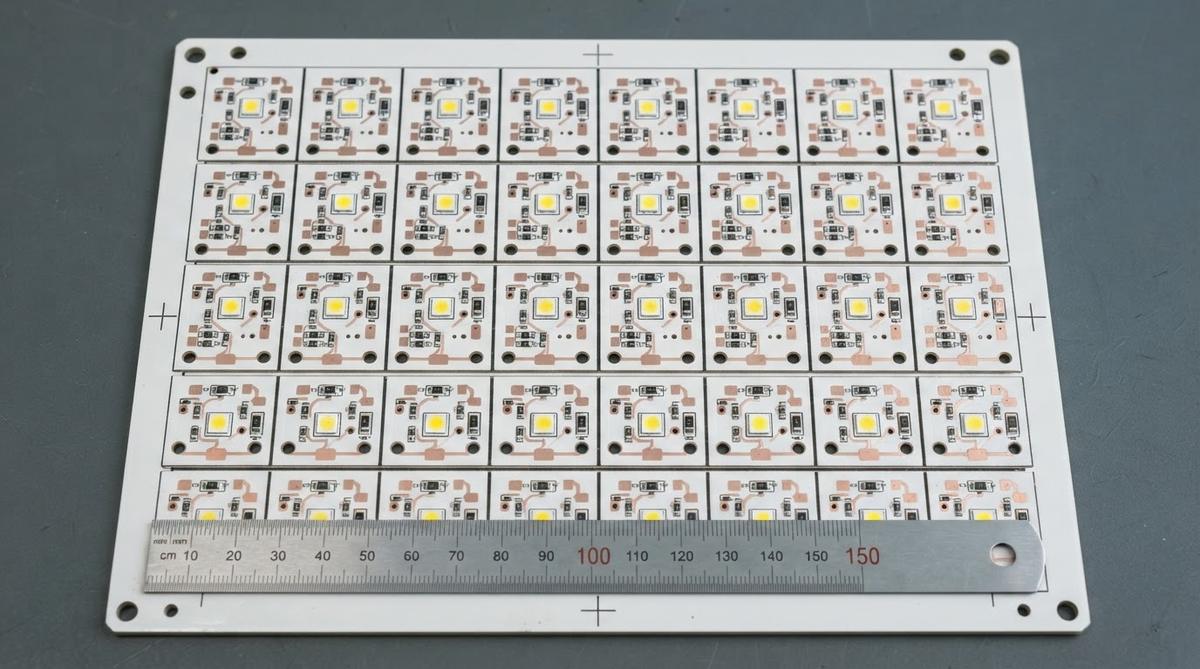
Board size and panelization. Ceramic substrates are processed on fixed panel sizes. A 20 × 20 mm LED board that tiles efficiently onto a 114 × 114 mm panel wastes less material than a 25 × 25 mm board that leaves unusable strips. Ask your fabricator for the panel layout before you freeze the outline—moving 2 mm can drop cost 10–15%.
Surface finish. ENIG is standard for LED soldering. Silver plating costs slightly less but tarnishes. Gold flash over nickel adds $0.005–$0.01 per pad but improves wire-bond pull strength for COB LEDs. Reflective finishes (silver mirror on alumina) for white-light applications add a separate plating step and 15–25% to cost.
Volume. High power LED PCB cost follows a steep volume curve. A 100-piece order may run $15–$25 per unit; at 10,000 pieces the same board drops to $3–$7. Tooling amortization and panel utilization both improve with quantity.
Substrate Cost Comparison for LED Applications
| Parameter | Al₂O₃ 96% | Al₂O₃ 99.6% | AlN | MCPCB (Al-base) |
|---|---|---|---|---|
| Thermal conductivity (W/mK, 25 °C) | 24–26 | 28–30 | 170–200 | 1–3 (dielectric layer) |
| Max continuous temp (°C) | 1 600 | 1 700 | 1 000 | 130–150 |
| CTE (ppm/°C, 25–300 °C) | 7.2–7.5 | 7.0–7.3 | 4.5–5.0 | 22–24 (aluminum) |
| Typical unit cost (20 × 20 mm, qty 1 000) | $3–$6 | $5–$9 | $12–$25 | $0.50–$1.50 |
| Dielectric strength (kV/mm) | 10–15 | 12–18 | 14–17 | 3–5 |
Typical values for commercially available material, for comparison only. Confirm against the datasheet for your specific grade. Thermal conductivity per CoorsTek and Maruwa published datasheets; MCPCB dielectric values per Bergquist/Henkel HT series.
Worked Example: Cost per Lumen-Hour
Consider a 50 W COB LED module on a 25 × 25 mm substrate. The LED die operates at 150 lm/W when junction temperature stays below 85 °C. This example shows how high power LED PCB cost translates into total cost of ownership.
On MCPCB: The 2 W/mK dielectric layer creates roughly 4.8 °C/W junction-to-board thermal resistance (calculated as t / (k × A) = 0.075 mm / (2 W/mK × 625 mm²) ≈ 0.06 °C·m²/W, but the effective spreading resistance raises this). Junction temperature reaches ~105 °C at 50 W, dropping efficacy to ~130 lm/W per the LED manufacturer’s derating curve. Lumen output: 6,500 lm. Board cost: $1.00. L70 lifetime at 105 °C: ~25,000 h (per Cree/Wolfspeed LM-80 extrapolation).
On 96% alumina (DPC): Thermal resistance through the substrate drops to roughly 0.48 °C/W. Junction temperature stays at ~78 °C. Efficacy holds at 148 lm/W. Lumen output: 7,400 lm. Board cost: $5.00. L70 lifetime at 78 °C: ~50,000 h.
Cost per million lumen-hours: MCPCB = $1.00 / (6.5 klm × 25 kh) = $0.0062. Alumina = $5.00 / (7.4 klm × 50 kh) = $0.0135 on board cost alone—but the doubled lifetime means half the replacement labor and half the module cost over the fixture’s life. For commercial and industrial luminaires, the ceramic board often wins on total cost of ownership.
How to Reduce High Power LED PCB Cost
Most savings come from design choices made before the Gerber files are sent out. A few practical moves can trim 20–40% without changing the thermal performance that justified ceramic in the first place. Detailed strategies are covered in our guide to reducing ceramic PCB cost.
- Use 96% alumina unless thermal math demands AlN. For single-die LEDs under 10 W, alumina handles the heat and costs a quarter of AlN.
- Optimize outline to panel size. Round corners add a laser-cutting step. Square corners with standard radii (R 0.3–0.5 mm) scribe-and-snap cleanly.
- Combine orders. If you run a UV LED product and a white-light product on the same substrate material and thickness, panelize both on one run.
- Specify only the copper thickness you need. 10–20 µm DPC handles most LED pad requirements. Going to 100 µm for current capacity you don’t need doubles metallization cost.
Enter your board dimensions, material, and quantity below to see an estimated price range for your LED substrate.
[pcb_calc type=”pcb-quote”]
When NOT to Use a Ceramic PCB for LEDs
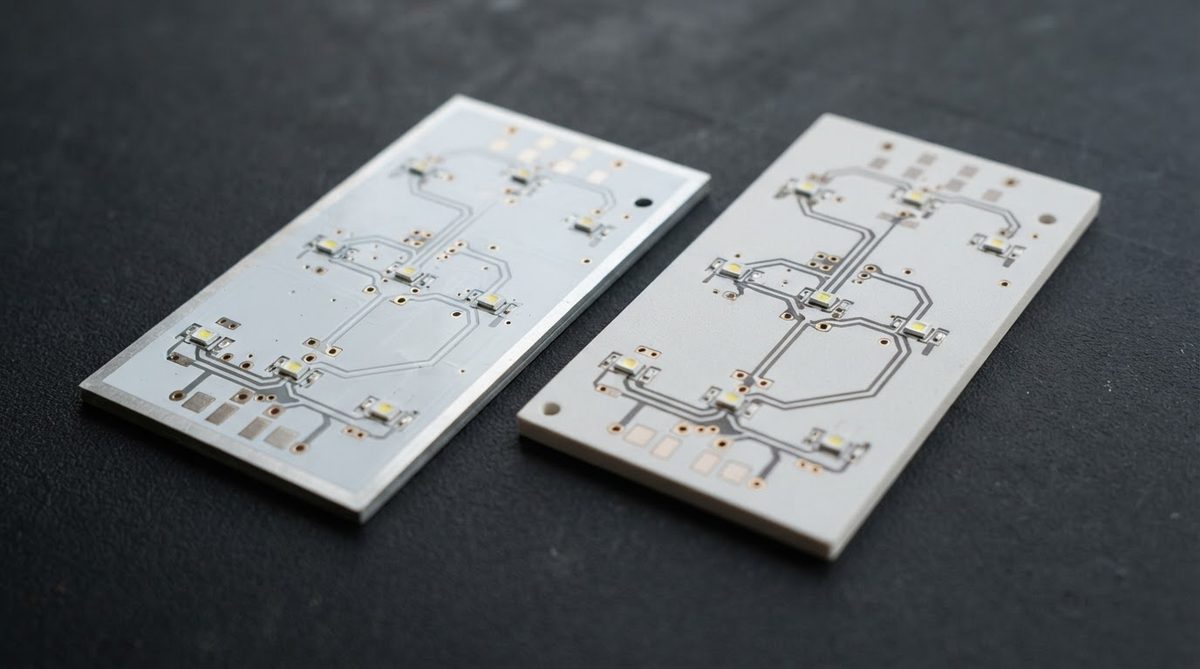
Ceramic is overkill—and a waste of budget—in several common LED scenarios. If your LED array dissipates less than 3 W/cm² and operates below 120 °C ambient, a standard aluminum MCPCB with a 1.5–2.0 W/mK dielectric layer will manage junction temperature adequately at one-fifth the high power LED PCB cost. Mid-power LEDs (0.2–0.5 W per package) on standard FR-4 with thermal vias work fine for indicator and backlighting applications. And for flexible LED strips, polyimide flex PCBs are the only practical choice—ceramic is rigid and brittle by nature.
If you are evaluating whether the ceramic premium makes sense for your specific thermal and reliability targets, the analysis in is a ceramic PCB worth the extra cost walks through the decision framework.
How UV and Specialty LED Costs Differ
UV-A and UV-C LEDs impose additional cost factors beyond standard white-light high-power LEDs. The substrate must resist UV degradation (ruling out most organic dielectrics), and reflective silver finishes degrade under short-wavelength exposure. AlN becomes more common in UV-C applications because its CTE closely matches GaN die, reducing solder joint fatigue. For a detailed breakdown, see UV LED ceramic PCB cost factors.
Frequently Asked Questions
How much does a ceramic PCB for a 10 W LED cost?
A 10 × 10 mm 96% alumina DPC board for a single 10 W LED die typically costs $4–$8 each at quantities of 100, dropping to $1.50–$3.50 at 5,000 pieces. AlN substrates for the same footprint run roughly 3–4× higher.
Can I solder standard LED packages to a ceramic PCB?
Yes. Ceramic PCBs with ENIG or silver finish accept standard SAC305 reflow soldering. Peak reflow temperatures of 260 °C are well within the substrate’s capability. Wire bonding for COB LEDs also works directly on gold-plated ceramic pads.
Does ceramic PCB thickness affect LED cost significantly?
Thinner substrates (0.25–0.38 mm) use less raw material but are harder to handle, increasing breakage rates during processing. The sweet spot for cost and mechanical robustness in LED applications is 0.38–0.635 mm. Going thicker than 1.0 mm adds material cost without meaningful thermal benefit because lateral spreading dominates at that point.
Is DBC or DPC cheaper for LED boards?
DPC is generally cheaper for LED substrates because LED pads rarely need copper thicker than 50 µm. DBC becomes cost-competitive only when you need 150 µm or thicker copper for high-current arrays above 20 A. For most COB and SMD LED layouts, DPC is the more economical process.
What minimum order quantity should I expect?
Most ceramic PCB fabricators accept prototype orders of 5–25 pieces, though per-unit cost at these volumes is high. Production MOQs typically start at 100–500 panels. Request a ceramic PCB instant quote to see pricing at your specific quantity.
Do ceramic LED PCBs need conformal coating?
Ceramic substrates are inherently moisture-resistant and do not absorb water like FR-4. Conformal coating is usually unnecessary for the substrate itself, though it may still be applied over solder joints and wire bonds for salt-spray or outdoor environments. Skipping conformal coating on the bare ceramic saves a processing step and $0.10–$0.30 per board.
For cost analysis on other ceramic PCB applications—from laser diode submount pricing to sensor and MEMS substrate costs—browse our application cost guides or request a quote with your specific requirements.