A ceramic PCB prototype typically costs $50–$600 per piece at quantities of 5–25 units, with 96% alumina (Al₂O₃) boards at the low end and aluminum nitride (AlN) or complex multi-layer LTCC at the high end. The exact price depends on substrate material, metallization method, board dimensions, layer count, and the tooling charges that get amortized across your small order.
Key Takeaways
- A simple single-layer 96% Al₂O₃ prototype (25 × 25 mm, thick-film metallization) runs roughly $50–$120 per piece at qty 10.
- AlN substrates cost 3–5× more than 96% alumina for the same board outline, driven by raw material and processing difficulty.
- NRE (non-recurring engineering) charges of $200–$1,500 per design are the largest hidden cost in prototype runs and do not scale with quantity.
- Moving from 5 pieces to 100 pieces can cut per-unit cost by 40–60%, mostly through NRE amortization and panel utilization.
- DPC (direct plated copper) prototypes cost more than thick-film silver but offer finer traces and better thermal performance.
What Drives Ceramic PCB Prototype Cost
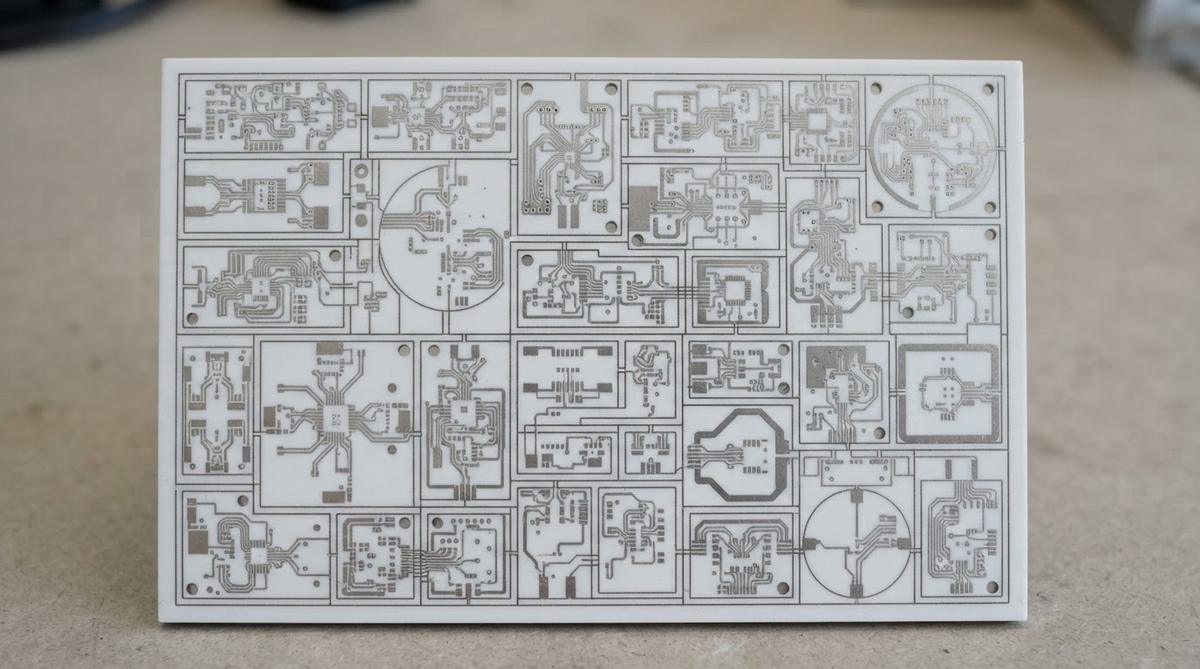
Prototype pricing breaks into four buckets: substrate material, metallization process, NRE/tooling, and finishing. Each one can swing the total by 2–5×. Understanding the split lets you make trade-offs before you commit to a quote.
Substrate Material
The ceramic blank is often the single largest line item. A 50 × 50 mm, 0.635 mm thick panel of 96% Al₂O₃ costs roughly $2–$5 per piece in small volume. The same footprint in AlN jumps to $15–$40 per piece because AlN powder is more expensive and sintering requires a nitrogen atmosphere above 1,700 °C. Si₃N₄ sits even higher, at $25–$60 per piece, due to the long sintering cycle and tighter process control needed for its high flexural strength (700–900 MPa per CoorsTek datasheet). For a deeper look at material-level pricing, see the ceramic PCB cost breakdown.
Metallization Process
Thick-film screen printing (silver or gold paste, fired at 850 °C) is the cheapest route for prototypes. Expect $30–$80 per board for a single-layer pattern at qty 10. DPC (direct plated copper) costs more because it involves sputtering a seed layer and electroplating copper, but it delivers trace/space down to 50 µm or finer and copper thickness up to 100+ µm. DPC prototypes typically run $80–$250 per board. DBC (direct bonded copper) is a panel-level process best suited to power modules; its tooling cost is high, so prototype pricing can reach $150–$400 per board even for simple patterns.
NRE and Tooling
NRE covers artwork generation, screen or mask fabrication, and first-article inspection. For thick-film, a new screen costs $100–$400. For DPC, photomask sets run $200–$800 depending on the number of layers. DBC requires custom graphite molds or etching masks at $300–$1,500. At qty 5, a $600 NRE charge adds $120 per board. At qty 50, the same charge adds only $12. This is the single biggest reason prototype unit costs look so different from production pricing.
Finishing and Testing
Surface finishes add $5–$30 per board. ENIG (electroless nickel immersion gold) is common for wire-bondable pads and costs more than bare copper or tin plating. If your prototype needs laser scribing, via filling, or electrical testing (hipot, continuity), add another $10–$50 per board depending on complexity.
Prototype Cost Comparison Table
| Parameter | 96% Al₂O₃ Thick-Film | 96% Al₂O₃ DPC | AlN DPC | Unit | Condition |
|---|---|---|---|---|---|
| Substrate cost (50 × 50 mm) | 2–5 | 2–5 | 15–40 | $/pc | 0.635 mm, qty 10 |
| Metallization cost | 30–80 | 80–200 | 100–250 | $/pc | Single layer, qty 10 |
| NRE (amortized at qty 10) | 10–40 | 20–80 | 20–80 | $/pc | Single design |
| Surface finish (ENIG) | 8–15 | 8–15 | 10–20 | $/pc | 3–5 µm Ni / 0.05 µm Au |
| Total per piece | 50–140 | 110–300 | 145–390 | $/pc | qty 10, 50 × 50 mm |
Typical ranges for commercially available materials and standard processes, for comparison only. Confirm against quotes for your specific design.
Worked Example: Budgeting a 10-Piece Prototype Run
Suppose you need 10 pieces of a 25 × 25 mm, single-layer DPC board on 96% Al₂O₃ with ENIG finish for a high-power LED evaluation.
- Substrate: 25 × 25 mm blank at $1.50/pc × 10 = $15
- DPC metallization: $100/pc × 10 = $1,000 (includes sputtering, plating, etching)
- NRE (photomask set): $400 one-time
- ENIG finish: $10/pc × 10 = $100
- Electrical test: $5/pc × 10 = $50
Total order: $1,565. Per-unit cost: $156.50.
If you increase the order to 50 pieces, the NRE amortizes to $8/pc instead of $40/pc, and metallization drops to roughly $70/pc due to panel efficiency. The per-unit cost falls to about $90—a 42% reduction.
Prototype vs. Production: How Cost Scales with Volume
The gap between prototype and production pricing is larger for ceramic than for FR-4 because ceramic processes have higher fixed setup costs and lower panel utilization at small volumes. A board that costs $150 at qty 10 might cost $18 at qty 1,000 and $8 at qty 10,000. The steepest price drop happens between qty 10 and qty 100, where NRE amortization and panel nesting both improve sharply.
Enter your board details below to see how unit cost changes across order quantities for your specific design.
[pcb_calc type=”proto-vs-production”]
For application-specific volume pricing, see guides on SiC power module substrate costs or sensor ceramic substrate pricing.
How to Reduce Ceramic PCB Prototype Cost
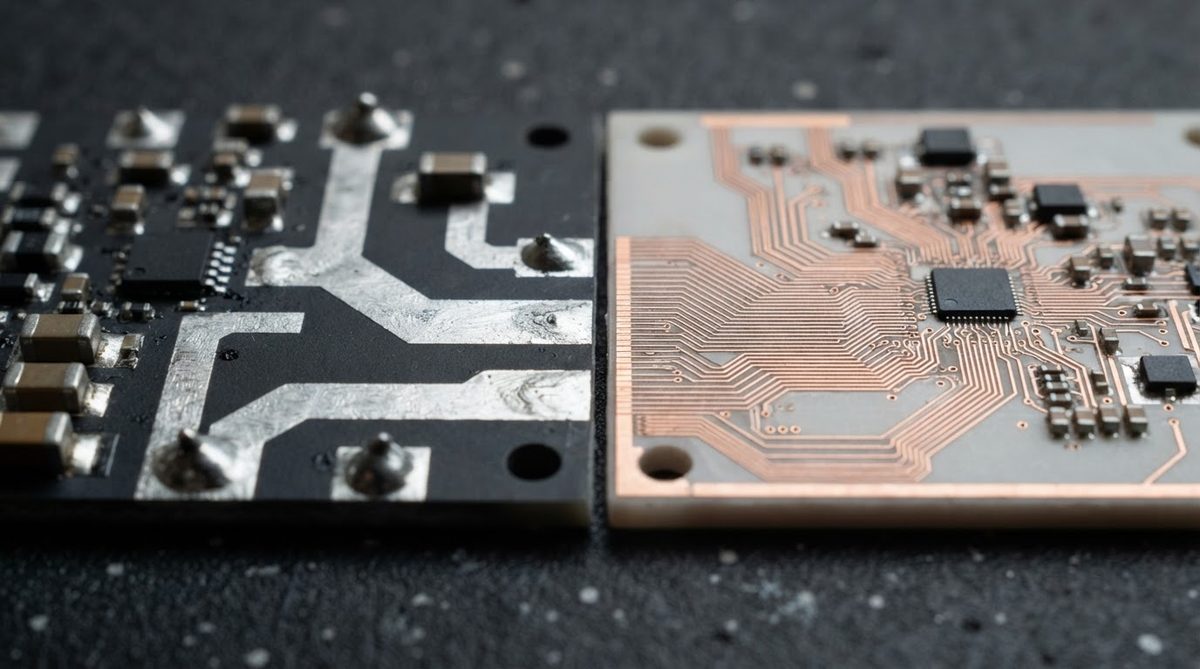
Use standard substrate sizes. Ordering a custom blank size means extra laser cutting or scribing. If your design fits on a standard 50.8 × 50.8 mm or 114.3 × 114.3 mm panel, you avoid that charge.
Choose 96% Al₂O₃ unless your thermal load demands otherwise. Alumina is the default ceramic substrate for good reason: it is widely stocked, easy to metallize, and 3–5× cheaper than AlN. Reserve AlN for designs that genuinely need 170+ W/m·K thermal conductivity.
Consolidate designs on one panel. If you have two or three small board variants, ask your supplier to nest them on a single panel with a shared NRE charge. This can cut tooling cost by 30–50%.
Relax tolerances where possible. Thick-film trace/space of 150 µm is much cheaper than DPC at 50 µm. If your circuit does not require fine lines, thick-film saves money and lead time.
Skip unnecessary finishes. If the prototype is for thermal or electrical validation only, bare copper or immersion tin may be sufficient. Gold wire-bond pads add cost that is wasted if you are only soldering test leads.
When a Ceramic Prototype Is Not Worth the Cost
If your operating temperature stays below 130 °C and thermal dissipation is under 5 W/cm², a metal-core PCB (MCPCB) prototype at $5–$20 per piece will validate your layout at a fraction of the cost. Switch to ceramic only when MCPCB testing reveals thermal or dielectric limits you cannot solve with aluminum-backed FR-4.
For RF prototypes below 6 GHz, Rogers RO4003C or similar PTFE-based laminates prototype faster and cheaper than ceramic. Ceramic becomes the right call above 10 GHz or when you need hermetic packaging. See the RF ceramic PCB cost considerations for a direct comparison.
If you only need one or two pieces for a bench test, ask whether a bare ceramic substrate with hand-soldered components on copper tape is sufficient. Paying $1,500 in NRE for two boards that may change after the first test is poor use of budget.
Frequently Asked Questions
How long does a ceramic PCB prototype take?
Most ceramic PCB prototypes ship in 7–15 business days after design approval. Thick-film boards are faster (7–10 days) because screen printing and firing are single-step. DPC and DBC require more process steps and typically take 10–15 days.
Is there a minimum order quantity for ceramic prototypes?
Many suppliers accept orders as low as 1–5 pieces for prototypes. However, the per-unit cost at qty 1 can be 5–10× higher than at qty 25 because NRE is not amortized. Ordering 10–25 pieces usually hits the best balance between unit cost and budget risk.
Can I reuse NRE tooling for a second prototype run?
Yes, if the design has not changed. Screens and photomasks are stored by most suppliers for 6–12 months. A repeat order of the same design skips the NRE charge entirely, dropping per-unit cost significantly.
Does board thickness affect prototype price?
Standard thicknesses (0.25 mm, 0.38 mm, 0.635 mm, 1.0 mm) are stocked and cost the same. Non-standard thicknesses require custom lapping or grinding, which adds $5–$20 per piece and 2–5 days of lead time.
Are multi-layer ceramic prototypes much more expensive?
Yes. Each additional layer adds a metallization and lamination step. A 3-layer LTCC prototype can cost 2–3× more than a single-layer board of the same size, and NRE roughly doubles because each layer needs its own screen or mask set.
Next Step
Gather your board dimensions, material preference, layer count, and target quantity. Upload your Gerber files or DXF to the ceramic PCB cost estimator for a budgetary quote within 24 hours. If you are still deciding between materials, start with the cost breakdown guide linked above to narrow your options before requesting formal pricing.