Seven ceramic PCB cost drivers account for roughly 90% of the unit-price difference between one project and another: substrate material, metallisation process, board dimensions, copper thickness, surface finish, order quantity, and testing requirements. Understanding which lever you are pulling—and by how much—lets you make informed trade-offs before you commit to a design.
Key Takeaways
- Switching from AlN to 96% Al₂O₃ can cut substrate cost by 3–5× for the same board outline.
- DBC (direct bond copper) typically costs 1.5–2.5× more than DPC (direct plated copper) for the same circuit pattern, but handles thicker copper natively.
- Doubling the substrate area roughly doubles the raw material cost, but amortises tooling, so the per-unit increase is less than 2×.
- Moving from 10 pcs to 100 pcs usually drops the unit price 40–60%; moving from 100 to 1,000 drops it another 20–35%.
- A full HALT or burn-in test protocol can add 15–30% to the finished-board price.
1. Substrate Material — The Largest of All Ceramic PCB Cost Drivers
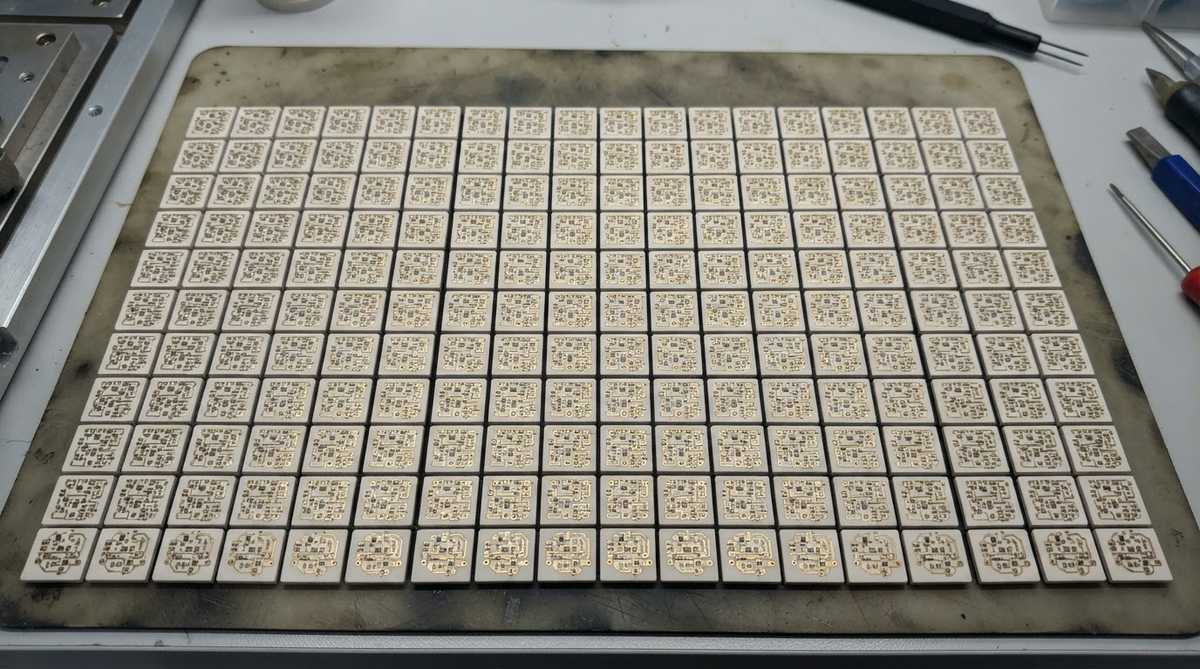
Material is the single largest cost driver. The ceramic blank itself can represent 30–50% of the finished board price, and grades vary enormously. A 96% alumina (Al₂O₃) substrate is the industry baseline. Stepping up to 99.6% alumina for better hermeticity or lower surface roughness adds roughly 30–60%. Choosing aluminium nitride (AlN, 170–200 W/mK at 25 °C per Maruwa and CoorsTek datasheets) for its thermal performance multiplies the substrate cost by 3–5× compared with 96% alumina (24–28 W/mK). Silicon nitride (Si₃N₄) sits even higher—4–7× the alumina price—because sintering Si₃N₄ requires higher temperatures and longer dwell times.
The practical question is whether your thermal budget actually demands the premium grade. For a full breakdown of how material choice cascades through the total bill, see the complete ceramic PCB cost overview.
| Material | Thermal conductivity (W/mK) | Relative substrate cost (Al₂O₃ 96% = 1×) | Source |
|---|---|---|---|
| Al₂O₃ 96% | 24–28 at 25 °C | 1× | CoorsTek ADS-996 datasheet |
| Al₂O₃ 99.6% | 28–35 at 25 °C | 1.3–1.6× | Kyocera A-493 datasheet |
| AlN | 170–200 at 25 °C | 3–5× | Maruwa AN-230 datasheet |
| Si₃N₄ | 60–90 at 25 °C | 4–7× | Kyocera SN-282 datasheet |
Typical values for commercially available material, for comparison only. Confirm against the datasheet for your specific grade.
2. Metallisation Process
How copper (or other metal) gets onto the ceramic is the second-biggest of the ceramic PCB cost drivers. Three processes dominate:
- DPC (Direct Plated Copper): Sputtered seed layer followed by electroplating. Best for fine lines (≤ 50 µm trace/space). Lower per-unit cost at moderate copper thicknesses (≤ 100 µm).
- DBC (Direct Bond Copper): A copper foil is bonded to the ceramic through a controlled oxidation layer at ~1,065 °C. Handles 150–500 µm copper natively. Higher tooling and energy cost—expect a 1.5–2.5× premium over DPC for the same outline.
- AMB (Active Metal Brazing): Uses a TiAgCu or similar braze to bond copper to non-oxide ceramics like AlN or Si₃N₄. Required when DBC’s oxide bond won’t form. Adds another 1.3–1.8× over DBC.
If your design needs ≥ 300 µm copper for high-current handling, DBC or AMB is effectively mandatory, and the cost premium is a design constraint, not a sourcing one. For projects that need only signal-level traces, DPC keeps costs closer to the alumina baseline. Power-module designers working with SiC devices will find a more detailed process-cost comparison on the SiC power module ceramic PCB cost page.
3. Board Dimensions and Panelisation
Ceramic substrates are cut from standard blanks—commonly 114.3 × 114.3 mm (4.5″ × 4.5″) or 139.7 × 190.5 mm, depending on the supplier. Your board outline determines how many units fit per blank. Poor nesting wastes material, and ceramic scrap has almost no recovery value. Among all ceramic PCB cost drivers, this one is the easiest to address at the layout stage.
Worked example. A 25 × 25 mm board nests 16-up on a 114.3 × 114.3 mm blank (allowing 1.5 mm saw streets). A 30 × 30 mm board of similar complexity nests only 9-up on the same blank. That 44% drop in yield-per-blank raises the per-unit substrate cost by roughly 1.7×—even though the board area increased by only 44%.
If your outline can shrink by even 2–3 mm on one axis, re-run the panelisation. The savings compound through every downstream step because metallisation, finishing, and testing are also done at the panel level.
4. Copper Thickness
Standard copper thickness for DPC boards is 20–70 µm. Each step up increases plating time and material consumption. Going from 35 µm to 100 µm roughly doubles the metallisation cost for that layer. For DBC, the foil itself is sold in standard gauges (127 µm, 254 µm, 381 µm, 508 µm). Thicker foil costs more, but the bonding step cost is nearly the same, so the premium per-unit is lower in percentage terms—typically 10–20% per gauge step.
Designers specifying copper for thermal spreading rather than current carrying should check whether a thinner copper layer on a higher-conductivity substrate (e.g., 127 µm Cu on AlN vs. 381 µm Cu on Al₂O₃) yields a lower total cost at the same thermal resistance. Often it does not, but the exercise takes five minutes and occasionally saves 20–30% on the board.
5. Surface Finish
Surface finish adds 5–20% to the board cost depending on the chemistry. ENIG (electroless nickel / immersion gold) is the most common for ceramic boards and sits at the lower end of that range. Thicker gold for wire-bonding pads—0.5–1.5 µm Au vs. the standard 0.05–0.1 µm flash—can triple the finish cost. Silver (Ag) finishes are cheaper but tarnish without passivation, adding a storage-life constraint.
For high-power LED applications where the finish must survive reflow at ≥ 260 °C and maintain reflectance, the finish specification is tightly linked to the application. The high-power LED ceramic PCB cost guide covers finish selection in that context.
6. Order Quantity and NRE Amortisation
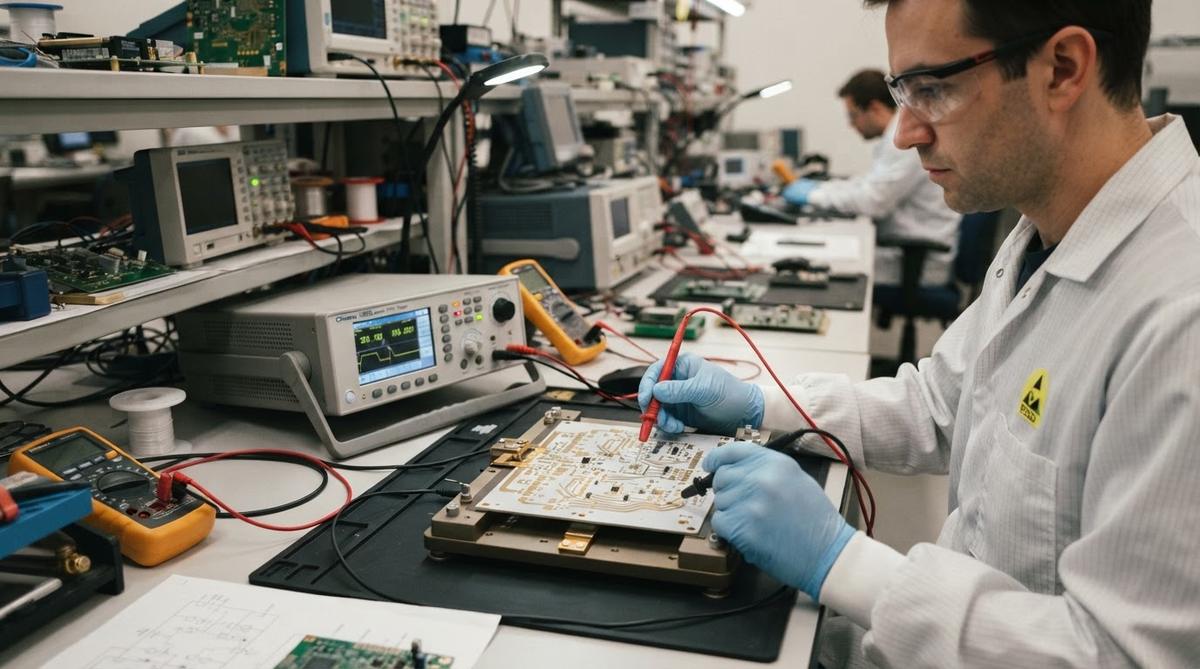
Ceramic PCB pricing is front-loaded with NRE: artwork generation, laser or CNC programming, screen or stencil fabrication, and first-article inspection. These fixed costs get amortised across the order. Of all the ceramic PCB cost drivers, quantity scaling is the most predictable. Typical scaling:
| Quantity | Approximate unit-price index (10 pcs = 100) |
|---|---|
| 10 pcs | 100 |
| 50 pcs | 55–65 |
| 100 pcs | 40–50 |
| 500 pcs | 25–35 |
| 1,000 pcs | 18–28 |
Index values are representative for a single-layer 96% Al₂O₃ DPC board with ENIG finish. Actual pricing depends on all seven drivers discussed here.
Prototype runs are inherently expensive per piece. For guidance on keeping prototype spend reasonable, see the ceramic PCB prototype cost guide.
7. Testing and Quality Requirements
Standard visual inspection and dimensional check add minimal cost. But many ceramic PCB applications—IGBT modules, medical implants, aerospace—require extended testing: hi-pot (dielectric withstand), thermal cycling (e.g., –55 °C to +150 °C, 500–1,000 cycles per MIL-STD-883), X-ray inspection for void percentage under DBC bonds, or 100% AOI. Each test layer adds cost:
- Hi-pot testing: 2–5% of board cost for batch sampling, 8–12% for 100% testing.
- Thermal cycling (500 cycles): 10–20% of board cost, driven by chamber time.
- X-ray void analysis: 5–10% for sampling, 15–25% for 100%.
Specify only the tests your end application actually requires. Over-testing a commercial LED board to aerospace standards is a common source of unnecessary spend.
Estimating Stencil and Assembly-Related Costs
If your ceramic boards go through SMT assembly, stencil cost is an often-overlooked line item—especially for step stencils required by mixed-component heights on ceramic substrates. Enter your stencil dimensions and type below to get a ballpark figure before requesting a formal quote.
[pcb_calc type=”stencil-cost”]
When a Ceramic PCB Is Not Worth the Cost
If your operating temperature stays below 130 °C, your power dissipation is under 2 W/cm², and you have no high-frequency or hermeticity requirement, FR-4 or a metal-core PCB (MCPCB) will do the job at 5–15× lower board cost. Ceramic substrates earn their price in environments where organic laminates fail: sustained temperatures above 200 °C, dielectric strengths above 15 kV/mm, or thermal conductivities above 20 W/mK through the substrate itself. If none of those conditions apply, spend the budget elsewhere. For strategies on trimming cost when ceramic is the right call, the guide to reducing ceramic PCB cost is a practical starting point.
Frequently Asked Questions
Which of the ceramic PCB cost drivers has the biggest impact on price?
Substrate material grade typically has the largest single impact, accounting for 30–50% of the finished board price. Switching from AlN to 96% Al₂O₃—where thermal performance allows—can reduce total board cost by 50–70%.
Does double-sided metallisation double the cost?
No. Adding a second metallised side increases cost by roughly 40–70%, not 100%, because substrate preparation, cutting, and finishing are shared between both sides. The exact premium depends on the metallisation process and pattern complexity.
How much can I save by relaxing trace-and-space tolerances?
Moving from 50 µm trace/space to 100 µm trace/space can reduce metallisation cost by 15–25% for DPC boards, because wider features have higher first-pass yield and allow faster plating parameters. For DBC boards, the effect is smaller since the pattern is defined by etching rather than additive plating.
Is gold plating always necessary on ceramic PCBs?
No. Gold is required for wire-bonding pads and some high-reliability soldering specs, but many designs perform well with OSP (organic solderability preservative) or immersion silver at lower cost. Choose the finish based on your interconnect method and storage-life requirements, not convention.
Do ceramic PCB prices drop significantly at high volumes?
Yes. Unit price at 1,000 pcs is typically 70–80% lower than at 10 pcs, driven mainly by NRE amortisation and panel-level efficiency. Beyond 5,000 pcs the curve flattens, and further savings come mainly from material purchasing leverage.
Can I get a quick price estimate before sending Gerber files?
Yes. Most manufacturers can give a budgetary estimate from a basic spec sheet: material, dimensions, copper thickness, finish, and quantity. For a faster path, Request a project quotation with your preliminary specs.