Beryllium oxide (BeO), also called beryllia, is a ceramic with thermal conductivity of 250–330 W/mK at 25 °C — roughly 10× higher than 96% alumina and comparable to aluminum nitride — while retaining high electrical resistivity (>1014 Ω·cm) and low dielectric loss typical of oxide ceramics. Understanding beryllia BeO properties is essential before specifying this material, because BeO dust is a confirmed human carcinogen that causes chronic beryllium disease (CBD), and this hazard dominates every sourcing and handling decision. That combination of extreme thermal performance and extreme toxicity makes BeO unique among ceramic substrate materials. Read the full beryllium oxide safety and handling guide before specifying BeO for any project.
Key Takeaways
- BeO thermal conductivity ranges from 250–330 W/mK at 25 °C (per Materion and Brush Ceramics datasheets), dropping to roughly 100–130 W/mK at 300 °C.
- Dielectric constant is 6.5–6.8 at 1 MHz (ASTM D150), lower than alumina’s 9.0–9.8, giving BeO an advantage in RF substrate design.
- Flexural strength is 230–280 MPa (ASTM C1161, 4-point bend), adequate but lower than Si₃N₄ (600–900 MPa).
- BeO dust is classified as a Group 1 carcinogen by IARC; machining, grinding, or breakage requires OSHA-regulated controls (29 CFR 1910.1024).
- Viable non-toxic alternatives now exist for many applications: aluminum nitride (AlN) for thermal performance and Si₃N₄ for mechanical reliability.
What Is Beryllium Oxide and Why Do Its Beryllia BeO Properties Matter?
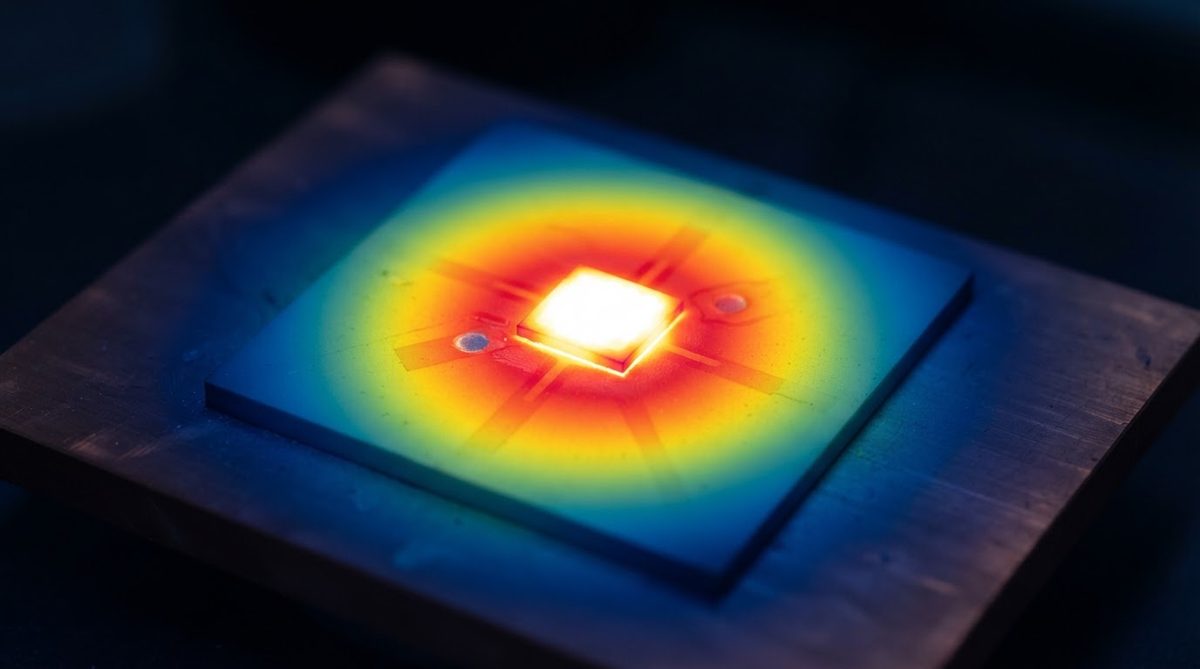
Beryllium oxide is a white, polycrystalline ceramic formed by sintering beryllia powder at 1500–1800 °C. It crystallizes in the wurtzite structure — the same crystal type as AlN — which gives it unusually high phonon velocity for an oxide. That phonon velocity is the reason BeO conducts heat far better than alumina or zirconia despite being an electrical insulator.
BeO substrates have been manufactured commercially since the 1960s, primarily by Materion (formerly Brush Ceramics) and National Beryllia. They are used in traveling-wave tubes, high-power RF transistor packages, and certain military radar modules where no other ceramic matched the thermal requirements at the time of design. Engineers evaluating beryllia BeO properties today are typically deciding whether to continue with a legacy BeO design or transition to AlN.
Complete Beryllia BeO Properties Table
| Parameter | Value | Unit | Condition | Source |
|---|---|---|---|---|
| Density | 2.85–3.01 | g/cm³ | Sintered, >99% purity | Materion datasheet |
| Thermal conductivity | 250–330 | W/mK | 25 °C, >99.5% BeO | Materion / Brush Ceramics |
| Thermal conductivity | 100–130 | W/mK | 300 °C | Materion |
| CTE | 7.5–9.0 | ppm/°C | 25–300 °C | Materion |
| Dielectric constant (εr) | 6.5–6.8 | — | 1 MHz, 25 °C, ASTM D150 | Materion |
| Loss tangent (tan δ) | 0.0003–0.0005 | — | 10 GHz, 25 °C | Materion |
| Volume resistivity | >1014 | Ω·cm | 25 °C | Materion |
| Dielectric strength | 10–14 | kV/mm | ASTM D149 | Materion |
| Flexural strength | 230–280 | MPa | 4-point bend, ASTM C1161 | Materion |
| Elastic modulus | 310–345 | GPa | 25 °C | Materion |
| Max continuous use temp | 1800 | °C | Inert atmosphere | Materion |
| Hardness | 9 | Mohs | — | CRC Handbook |
Typical values for commercially available material, for comparison only. Confirm against the datasheet for your specific grade.
Thermal Conductivity: The Standout Among Beryllia BeO Properties
BeO’s 250–330 W/mK at room temperature is 8–12× that of 96% alumina (24–28 W/mK) and sits in the same range as aluminum nitride (170–230 W/mK for commercial grades). The key difference: BeO’s thermal conductivity drops more steeply with temperature than AlN’s. At 300 °C, BeO falls to about 100–130 W/mK, while high-purity AlN retains roughly 100–140 W/mK. This means BeO’s thermal advantage over AlN narrows significantly at elevated operating temperatures.
BeO’s conductivity is also strongly purity-dependent. At 99.5% purity, values reach 310–330 W/mK. At 95% purity, conductivity may fall to 200–220 W/mK because glassy grain-boundary phases scatter phonons. This purity sensitivity is something BeO shares with AlN and alumina — see how purity affects ceramic substrate performance for the underlying mechanism.
Worked Example: Thermal Resistance Through a BeO Substrate
Suppose you have a 25 × 25 mm BeO substrate, 0.635 mm thick, dissipating 50 W from a transistor die.
Thermal resistance through the substrate (one-dimensional approximation):
Rth = t / (k × A) = 0.000635 m / (280 W/mK × 0.000625 m²) = 0.0036 °C/W
Temperature rise across the substrate: ΔT = 50 W × 0.0036 °C/W = 0.18 °C.
For comparison, the same geometry in 96% alumina (k = 26 W/mK): Rth = 0.039 °C/W, ΔT = 1.95 °C. The substrate itself is rarely the thermal bottleneck in either case, but the beryllia BeO properties advantage compounds when you reduce substrate area or increase power density, as in multi-die RF pallets.
Enter your substrate dimensions, material, and dissipated power below to estimate junction temperature rise for BeO or any alternative ceramic.
Dielectric and RF Properties
BeO’s dielectric constant of 6.5–6.8 at 1 MHz is notably lower than alumina’s 9.0–9.8. In microstrip and stripline designs, a lower εr means wider traces for a given impedance, which reduces conductor loss. The loss tangent of 0.0003–0.0005 at 10 GHz is also lower than standard alumina (0.0002–0.001 depending on purity and frequency), making BeO attractive for low-loss microwave circuits up to 40 GHz.
These RF-relevant beryllia BeO properties, combined with the thermal conductivity, are the primary reason BeO persists in legacy military and aerospace RF modules. For new designs, however, engineers increasingly use AlN (εr ≈ 8.5–8.9) or specialized low-loss alumina grades, accepting the higher εr in exchange for eliminating the toxicity risk.
CTE and Die-Attach Compatibility
BeO’s CTE of 7.5–9.0 ppm/°C (25–300 °C) sits between silicon (2.6 ppm/°C) and copper (17 ppm/°C). This is higher than AlN’s 4.5–5.0 ppm/°C, which means BeO has a larger CTE mismatch with silicon and SiC die than AlN does. For large die (>10 mm edge), this mismatch can drive solder-joint fatigue under thermal cycling. AuSn or AuSi hard solders are commonly used for BeO die attach because they tolerate the stress better than soft solders at elevated temperatures.
BeO vs. AlN vs. Si₃N₄: How Beryllia BeO Properties Compare
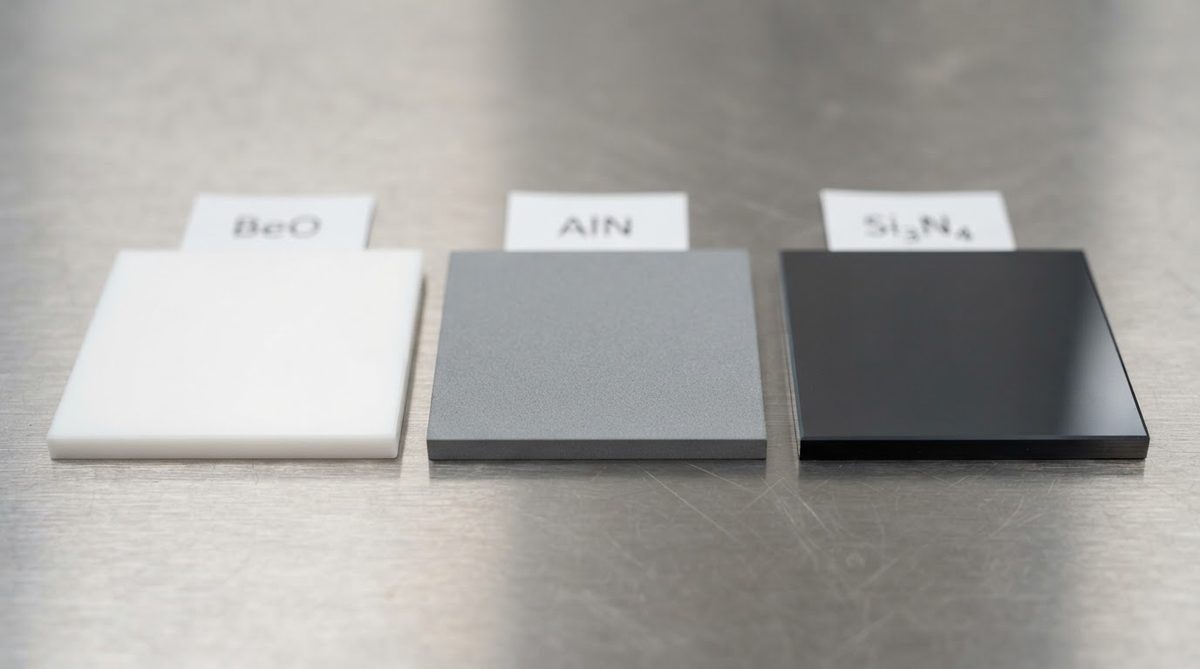
| Parameter | BeO (99.5%) | AlN | Si₃N₄ | Unit |
|---|---|---|---|---|
| Thermal conductivity (25 °C) | 250–330 | 170–230 | 60–90 | W/mK |
| Dielectric constant (1 MHz) | 6.5–6.8 | 8.5–8.9 | 8.0–8.5 | — |
| Loss tangent (10 GHz) | 0.0003–0.0005 | 0.0005–0.002 | 0.001–0.003 | — |
| Flexural strength | 230–280 | 300–400 | 600–900 | MPa |
| CTE (25–300 °C) | 7.5–9.0 | 4.5–5.0 | 2.5–3.5 | ppm/°C |
| Fracture toughness | 2.5–3.5 | 2.5–3.5 | 6.0–8.0 | MPa·m½ |
| Toxicity hazard | Carcinogenic dust | None | None | — |
Typical values for commercially available material, for comparison only. Confirm against the datasheet for your specific grade. AlN values per Kyocera and Maruwa datasheets; Si₃N₄ per Kyocera SN series.
If mechanical reliability under thermal shock is the priority, silicon nitride Si₃N₄ substrates offer the strongest option. For guidance on selecting between all ceramic substrate types, see how to choose the right ceramic substrate.
Safety: The Defining Constraint of Beryllia BeO Properties in Practice
Beryllium oxide dust is a confirmed human carcinogen (IARC Group 1) and the cause of chronic beryllium disease, an incurable lung condition. Intact, fired BeO substrates are safe to handle with standard gloves. The hazard arises during machining, grinding, laser cutting, breakage, or any process that generates airborne particulate.
OSHA’s beryllium standard (29 CFR 1910.1024) sets a permissible exposure limit (PEL) of 0.2 µg/m³ as an 8-hour TWA and a short-term exposure limit (STEL) of 2.0 µg/m³ over 15 minutes. Any facility processing BeO must implement engineering controls, exposure monitoring, medical surveillance, and regulated areas. The European REACH regulation (ECHA) also classifies beryllium compounds as substances of very high concern (SVHC).
These regulatory requirements add significant cost and liability. Many contract manufacturers refuse to handle BeO. End-of-life disposal is also regulated as hazardous waste in most jurisdictions. For the full handling protocol, read the BeO safety and handling guide.
When NOT to Use BeO
For most new designs, BeO is not the right choice. Specify something else when:
- AlN meets your thermal requirements. If your power density allows a substrate with 170–230 W/mK, AlN eliminates all toxicity and regulatory burden. This covers the majority of ceramic thermal management applications.
- Mechanical robustness matters. BeO’s fracture toughness (2.5–3.5 MPa·m½) is no better than AlN and far below Si₃N₄ (6–8 MPa·m½). For power modules that undergo aggressive thermal cycling, Si₃N₄ substrates last longer.
- Your supply chain cannot handle beryllium. If any downstream assembler, rework technician, or end-of-life recycler lacks beryllium-rated facilities, the entire program carries regulatory risk.
- Cost is a constraint. BeO substrates cost 3–8× more than equivalent AlN substrates due to raw material cost, restricted sourcing, and handling overhead.
BeO remains justified in legacy programs where qualification costs of switching exceed the ongoing handling costs, and in niche RF applications above 20 GHz where the low εr and low tan δ together provide a measurable link-budget advantage over AlN. Even in those cases, evaluate whether a redesign on AlN or a low-loss alumina grade could close the gap.
Frequently Asked Questions
Is it safe to touch a BeO substrate?
Yes, intact and fired BeO substrates are safe to handle with standard nitrile gloves. The carcinogenic hazard comes from dust generated by machining, grinding, or breakage. Do not sand, saw, or snap a BeO substrate without proper engineering controls and respiratory protection per OSHA 29 CFR 1910.1024.
Can BeO substrates be soldered like other ceramics?
Yes. BeO substrates are commonly metallized with thin-film (TiW/Au, Cr/Au) or thick-film (Mo-Mn) processes and soldered using AuSn, AuSi, or SnAgCu. Standard reflow and die-attach processes work, but any rework that risks cracking the substrate must be done in a beryllium-controlled facility.
Why is BeO being replaced by AlN in new designs?
AlN offers 170–230 W/mK thermal conductivity with zero toxicity risk, simpler supply chains, and lower cost. While beryllia BeO properties include higher room-temperature conductivity, the gap narrows at operating temperatures above 200 °C. The regulatory and liability costs of BeO increasingly outweigh the performance margin for most applications.
What purity grade of BeO is used for substrates?
Most electronic-grade BeO substrates are 99.5% purity. This grade achieves thermal conductivity of 310–330 W/mK at 25 °C. Lower-purity grades (95–97%) exist for structural applications but sacrifice significant thermal performance due to grain-boundary scattering.
Does BeO degrade at high temperatures?
BeO is stable to approximately 1800 °C in inert or reducing atmospheres. In humid air above 1000 °C, it can form volatile beryllium hydroxide, which is both a material loss mechanism and an additional inhalation hazard. For most electronic applications operating below 300 °C, thermal degradation is not a concern.
Next Step
If you are evaluating whether to continue with BeO or transition to a non-toxic alternative, compare your thermal and RF requirements against AlN and Si₃N₄ datasheets side by side. Our engineers can review your thermal stack and recommend a substrate that meets your performance spec without the beryllium handling burden. Request a quote or design review.
Last reviewed: 2025-06