Ceramic substrate purity is the single largest lever controlling thermal conductivity, dielectric loss, and mechanical strength of a finished board. Moving from 96% alumina (Al₂O₃) to 99.6% alumina raises thermal conductivity from roughly 24–28 W/mK to 28–35 W/mK, cuts dielectric loss tangent nearly in half, and increases flexural strength—but it also raises raw substrate cost by 2–4× and narrows the supplier base. Choosing the right purity grade means matching these gains to the actual requirements of your circuit, not defaulting to the highest number available.
Key Takeaways
- 96% Al₂O₃ is adequate for most power and LED substrates where thermal conductivity of 24–28 W/mK suffices and cost matters.
- 99.6% Al₂O₃ delivers 28–35 W/mK thermal conductivity and a loss tangent of ~0.0001 at 1 MHz, making it the standard choice for RF, microwave, and high-reliability circuits.
- Aluminum nitride (AlN) at ≥99% purity reaches 170–200 W/mK but costs 5–10× more than 96% alumina per unit area.
- Impurities—primarily SiO₂, CaO, and MgO in alumina—form glassy grain-boundary phases that scatter phonons, lower breakdown voltage, and reduce mechanical integrity above 300 °C.
- Purity selection should be driven by a specific thermal, electrical, or reliability requirement, not by a general preference for “better” material.
What “Purity” Actually Means in a Ceramic Substrate
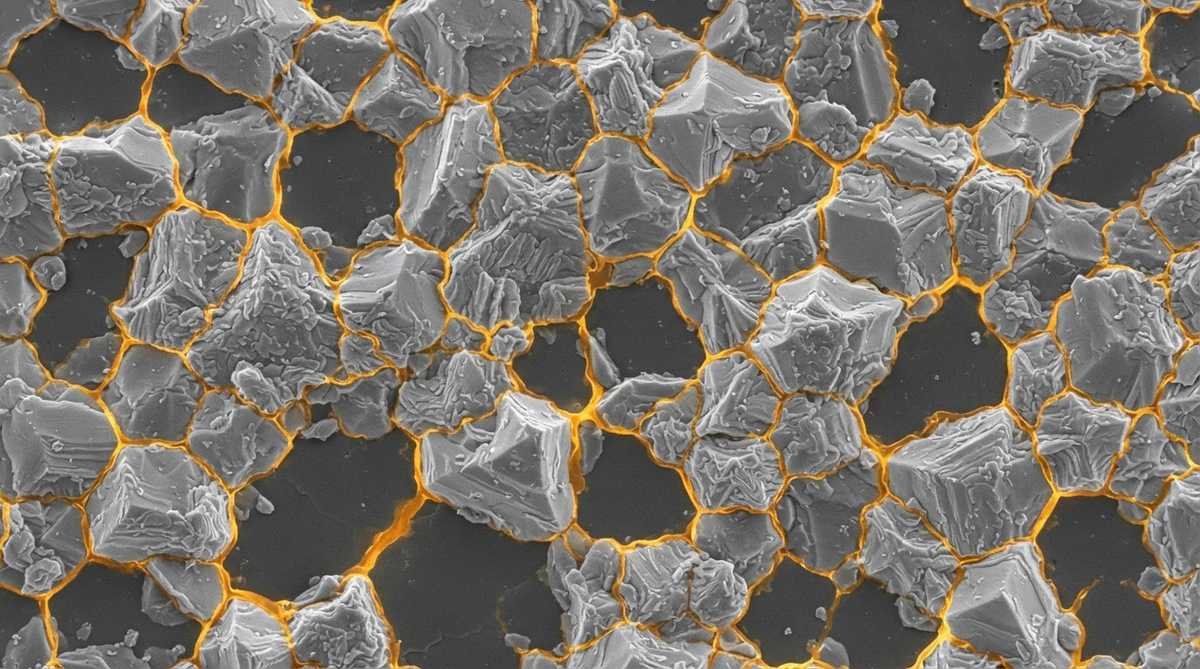
Purity refers to the weight percentage of the primary oxide phase. A 96% alumina body contains roughly 4% sintering aids and residual oxides—typically SiO₂, MgO, and CaO—that lower the sintering temperature and promote densification. These additives form an amorphous or partially crystalline grain-boundary phase. That glassy phase is the root cause of most performance differences between grades.
At 99.6% purity the grain-boundary phase shrinks to a thin film a few nanometers wide. Phonon transport across grain boundaries improves, ionic mobility under DC bias drops, and the material becomes more chemically inert. The trade-off is that higher-purity powders require higher sintering temperatures (1,600–1,700 °C vs. 1,500–1,550 °C for 96%), which increases energy cost and limits the number of qualified furnace lines worldwide. For a broader comparison of substrate chemistries, see our guide to types of ceramic substrates.
How Purity Changes Thermal Conductivity
Thermal conductivity is the property most sensitive to ceramic substrate purity. In polycrystalline alumina, heat travels as lattice vibrations (phonons). Every grain boundary and every glassy inclusion scatters phonons. Reducing impurity content from 4% to 0.4% shrinks the scattering cross-section and raises bulk conductivity by 20–40%.
The effect is even more dramatic in aluminum nitride. Oxygen dissolved in the AlN lattice substitutes for nitrogen and creates aluminum vacancies, both of which scatter phonons. Commercial AlN at 95% purity may measure only 80–120 W/mK, while 99%+ AlN with controlled oxygen content reaches 170–200 W/mK (per Kyocera SH-30 and Maruwa AN-230 datasheets, measured per ASTM E1461 laser flash at 25 °C).
Worked Example: Junction Temperature Difference
Consider a 10 × 10 mm die dissipating 20 W, mounted on a 1.0 mm thick ceramic substrate. The conductive thermal resistance through the substrate is Rth = t / (k × A).
- 96% Al₂O₃ (k = 25 W/mK): Rth = 0.001 / (25 × 0.0001) = 0.40 °C/W → ΔT = 8.0 °C
- 99.6% Al₂O₃ (k = 32 W/mK): Rth = 0.001 / (32 × 0.0001) = 0.31 °C/W → ΔT = 6.3 °C
- AlN 99% (k = 180 W/mK): Rth = 0.001 / (180 × 0.0001) = 0.056 °C/W → ΔT = 1.1 °C
The jump from 96% to 99.6% alumina saves only 1.7 °C—meaningful in some designs, irrelevant in others. The jump to AlN saves nearly 7 °C. If your thermal budget is tight by less than 2 °C, upgrading alumina purity is cheaper than switching to AlN. If you need a 5 °C or larger improvement, AlN is the only ceramic path. For help selecting between these options, see how to choose the right ceramic substrate.
Purity and Electrical Performance
Grain-boundary glass is slightly conductive at elevated temperatures and absorbs RF energy. Higher purity reduces both effects.
| Parameter | 96% Al₂O₃ | 99.6% Al₂O₃ | AlN ≥99% | Condition | Source |
|---|---|---|---|---|---|
| Dielectric constant (εr) | 9.4–9.8 | 9.7–10.0 | 8.5–9.0 | 1 MHz, 25 °C | CoorsTek ADS-96, AD-995; Maruwa AN-230 |
| Loss tangent (tan δ) | 0.0002–0.0004 | 0.0001–0.0002 | 0.0002–0.0005 | 1 MHz, 25 °C | CoorsTek datasheets |
| Dielectric strength | 10–15 kV/mm | 15–20 kV/mm | 14–17 kV/mm | AC, 60 Hz, 25 °C | CeramTec Rubalit 710, 710HP |
| Volume resistivity | ≥10¹⁴ Ω·cm | ≥10¹⁴ Ω·cm | ≥10¹³ Ω·cm | 25 °C | Manufacturer datasheets |
Typical values for commercially available material, for comparison only. Confirm against the datasheet for your specific grade.
For RF circuits above 1 GHz, the halved loss tangent of 99.6% alumina versus 96% translates directly into lower insertion loss per unit length of transmission line. Below 100 MHz, the difference is negligible for most power-conversion layouts.
Mechanical and Reliability Implications
Flexural strength of alumina increases with purity: 96% grades typically measure 350–380 MPa, while 99.6% grades reach 400–450 MPa (per ASTM C1161, four-point bend, 25 °C, CoorsTek data). The glassy grain-boundary phase is the weak link; removing it tightens the strength distribution and improves Weibull modulus, which matters more than average strength for reliability engineers running worst-case analysis.
Where extreme mechanical toughness is needed alongside thermal performance, silicon nitride (Si₃N₄) substrates offer fracture toughness of 6–7 MPa·m¹/² versus 3.5–4.0 for high-purity alumina, though at substantially higher cost.
Cost Impact of Purity Grades
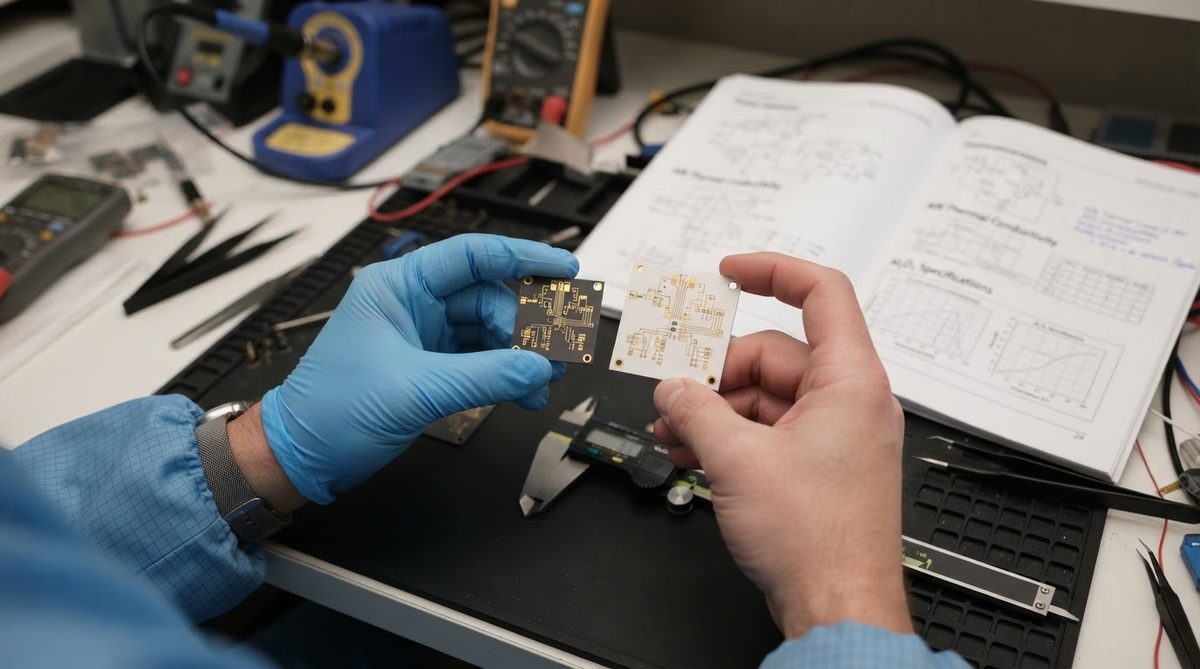
Raw powder cost, sintering energy, and yield loss all rise with purity. Approximate relative pricing for a 50.8 × 50.8 × 0.635 mm substrate, unmetallized:
| Grade | Relative Cost (96% = 1.0×) | Typical Lead Time |
|---|---|---|
| Al₂O₃ 96% | 1.0× | Stock / 1–2 weeks |
| Al₂O₃ 99.6% | 2.0–4.0× | 2–4 weeks |
| AlN ≥99% | 5–10× | 3–6 weeks |
If your design can meet its thermal and electrical specs on 96% alumina, there is no engineering reason to pay more. Purity upgrades should be justified by a quantified gap—degrees Celsius, dB of insertion loss, or a reliability test failure—not by a general desire for margin. Substrate thickness also affects cost and thermal resistance; consult the ceramic substrate thickness chart for standard options.
When NOT to Upgrade Purity
Higher purity is the wrong move in several common scenarios:
- Low-frequency power circuits below 50 W: 96% alumina handles 24–28 W/mK comfortably. The 1–2 °C gain from 99.6% rarely justifies doubling the substrate cost.
- Cost-sensitive LED assemblies: Standard 96% alumina or even metal-core PCBs (MCPCBs) at 1–3 W/mK are sufficient for many mid-power LED arrays.
- Prototyping and design validation: Prove the circuit on 96% first. Upgrade purity only if thermal or electrical test data shows a shortfall.
- Large-area boards (>100 × 100 mm): The cost multiplier of high-purity substrates at large panel sizes can make the BOM uncompetitive. Consider segmenting the thermal path instead.
Frequently Asked Questions
Does 99.6% alumina sinter differently than 96%?
Yes. 99.6% alumina requires sintering at 1,600–1,700 °C compared to 1,500–1,550 °C for 96%, because it contains fewer flux agents. This higher temperature demands more expensive furnace time and tighter atmosphere control, which is a primary driver of the cost premium.
Can I mix purity grades on the same assembly?
You can, provided the CTE values are compatible. Both 96% and 99.6% alumina share a CTE of roughly 7.0–7.4 ppm/°C (20–300 °C), so co-firing or mechanical assembly is straightforward. Mixing alumina with AlN (CTE ~4.5 ppm/°C) requires careful solder-joint design to manage CTE mismatch stress.
Is 99% alumina a real commercial grade?
It exists but is far less common than 96% or 99.6%. Most substrate manufacturers skip from 96% to 99.5% or 99.6%. If a supplier quotes “99% alumina,” ask for the full chemical analysis—it may be a marketing rounding of a 99.5% or 99.6% body.
How does purity affect laser scribing and machining?
Higher-purity alumina is harder (Vickers hardness ~1,500–1,700 HV for 99.6% vs. ~1,300–1,500 HV for 96%) and more abrasive to diamond tooling. Laser scribing is less affected by purity than by grain size and porosity, but 99.6% substrates tend to produce cleaner scribe lines due to their more uniform microstructure.
Does AlN purity matter as much as alumina purity?
More so. Oxygen contamination in AlN has a disproportionate effect on thermal conductivity. A 1% increase in oxygen content can reduce conductivity by 30–50 W/mK. Always request a certificate of analysis specifying oxygen content (target <1.0 wt%) when sourcing AlN substrates, per guidance in Kyocera and Maruwa technical notes.
Next Step
If you have identified the purity grade your design requires, request a quote with your specific material, thickness, and metallization needs. For projects where the right grade is still unclear, our applications engineers can review your thermal and electrical requirements and recommend the most cost-effective option. Start with substrate selection guidance or go directly to our instant quote page.