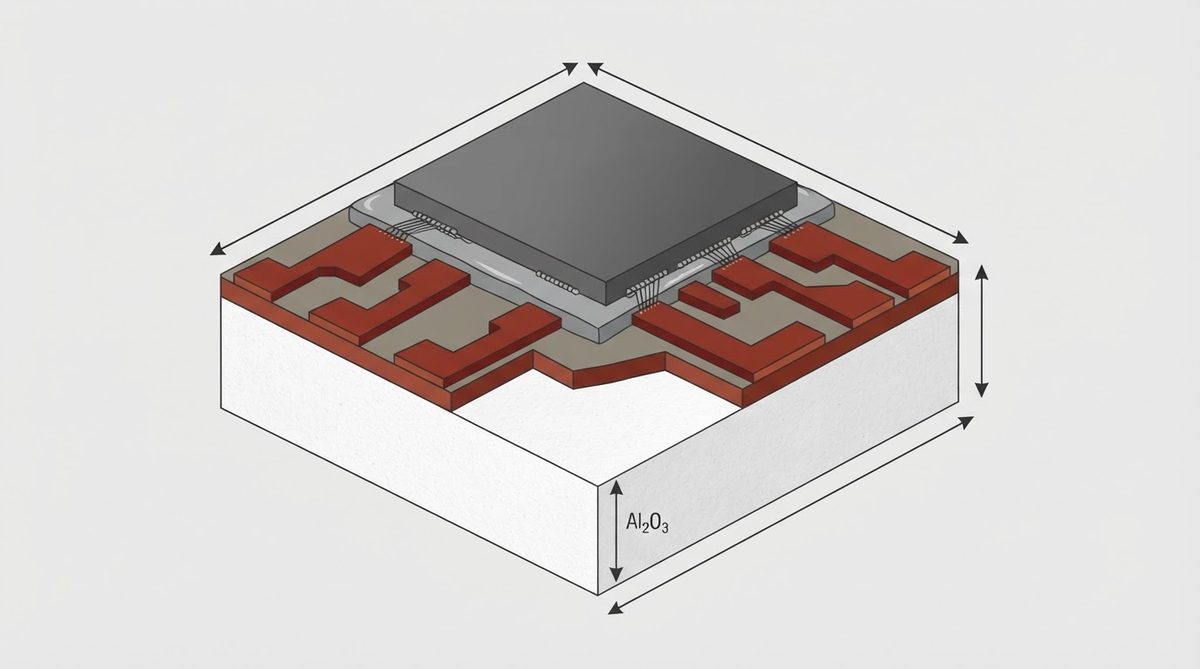
The alumina 96% Al2O3 datasheet below consolidates the mechanical, thermal, electrical, and physical properties you need to evaluate this substrate for your next design. Typical 96% alumina delivers 24–28 W/m·K thermal conductivity (at 25 °C), a dielectric strength above 15 kV/mm, and flexural strength of 330–380 MPa — making it the default ceramic PCB substrate for designs that outgrow FR-4 but do not justify the cost of AlN or 99.6% alumina.
Key Takeaways
- 96% alumina thermal conductivity ranges from 24–28 W/m·K at 25 °C, roughly 100× higher than FR-4 (0.25 W/m·K).
- Dielectric strength exceeds 15 kV/mm (per ASTM D149), suitable for high-voltage isolation up to several kilovolts.
- CTE of 6.5–7.2 ppm/°C (25–300 °C) is a close match to silicon (2.6 ppm/°C) and GaN-on-SiC (4.5 ppm/°C), reducing solder-joint fatigue in die-attach applications.
- Material cost is typically 3–5× lower than 99.6% alumina and 5–8× lower than aluminum nitride, making it the most cost-effective ceramic substrate grade.
- The remaining 4% is a glassy phase (primarily SiO₂, MgO, CaO) that lowers sintering temperature but slightly reduces thermal and mechanical performance versus higher-purity grades.
96% Alumina (Al2O3) Property Table
| Parameter | Value | Unit | Condition / Standard | Source |
|---|---|---|---|---|
| Al₂O₃ purity | 96 ± 0.5 | % | Weight % | CoorsTek ADS-96R datasheet |
| Density | 3.72–3.78 | g/cm³ | ASTM C373 | CoorsTek ADS-96R |
| Flexural strength | 330–380 | MPa | ASTM C1161, 4-pt bend | Kyocera A-476 datasheet |
| Vickers hardness | 12–13 | GPa | ASTM E384 | CeramTec Rubalit 710 |
| Young’s modulus | 300–320 | GPa | ASTM C1259 | Kyocera A-476 |
| Thermal conductivity | 24–28 | W/m·K | 25 °C, ASTM E1461 | CoorsTek ADS-96R |
| CTE | 6.5–7.2 | ppm/°C | 25–300 °C, ASTM E228 | Kyocera A-476 |
| Max use temperature | 1600 | °C | In air, no load | CoorsTek ADS-96R |
| Specific heat | 880 | J/kg·K | 25 °C | Kyocera A-476 |
| Dielectric strength | 15–20 | kV/mm | ASTM D149, 60 Hz, 25 °C | CeramTec Rubalit 710 |
| Dielectric constant (εr) | 9.0–9.5 | — | 1 MHz, 25 °C, ASTM D150 | Kyocera A-476 |
| Loss tangent (tan δ) | 0.0002–0.0010 | — | 1 MHz, 25 °C | CeramTec Rubalit 710 |
| Volume resistivity | >10¹⁴ | Ω·cm | 25 °C, ASTM D257 | CoorsTek ADS-96R |
| Water absorption | 0.0 | % | ASTM C373 | CoorsTek ADS-96R |
| Surface roughness (Ra, as-fired) | 0.4–0.8 | µm | Profilometer | Maruwa HA-96 |
Typical values for commercially available material, for comparison only. Confirm against the datasheet for your specific grade.
How to Read the Glassy-Phase Composition
The “96%” figure refers to alumina content by weight. The balance — roughly 4% — is a sintering-aid glass phase composed of SiO₂, MgO, and CaO. This glass phase melts at a lower temperature than pure alumina, which allows sintering at 1500–1600 °C instead of the 1700+ °C required for 99.6% grades. The trade-off: the glass phase sits at grain boundaries and reduces both thermal conductivity and mechanical strength compared to 99.6% alumina substrates.
Different manufacturers tune the glass composition to optimize for specific properties. Some formulations emphasize lower dielectric loss for RF applications; others prioritize higher flexural strength. This is why nominally identical “96% alumina” substrates from two vendors can differ by 10–15% on a given parameter. Always request the vendor-specific datasheet, not a generic one. For a deeper comparison of how these formulations differ, see our guide to alumina 96% grades and purity levels.
96% Alumina vs. 99.6% Alumina vs. AlN — Quick Comparison
| Parameter | 96% Al₂O₃ | 99.6% Al₂O₃ | AlN | Unit |
|---|---|---|---|---|
| Thermal conductivity (25 °C) | 24–28 | 28–35 | 170–200 | W/m·K |
| CTE (25–300 °C) | 6.5–7.2 | 6.7–7.4 | 4.4–4.7 | ppm/°C |
| Flexural strength (4-pt) | 330–380 | 350–400 | 300–350 | MPa |
| Dielectric constant (1 MHz) | 9.0–9.5 | 9.7–10.0 | 8.5–9.0 | — |
| Relative substrate cost | 1× | 3–5× | 5–8× | — |
Sources: CoorsTek ADS-96R, Kyocera A-479, Maruwa AN-200 datasheets. Confirm against your specific grade.
If your thermal budget requires more than 28 W/m·K, step up to 99.6% alumina or review the aluminum nitride (AlN) datasheet for high-power designs. For most LED, sensor, and mid-power IGBT applications, 96% alumina handles the heat at a fraction of the cost.
Worked Example: Thermal Resistance Through a 96% Alumina Substrate
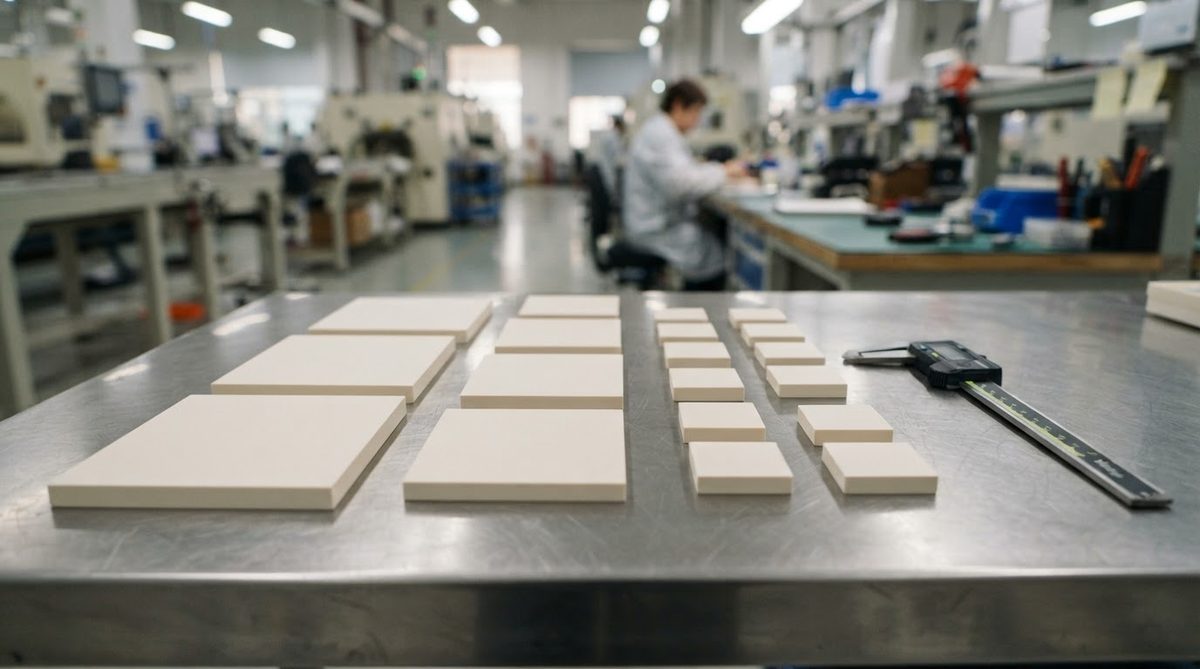
Suppose you need to estimate the conduction thermal resistance through a 0.635 mm thick, 25 × 25 mm 96% alumina substrate dissipating 10 W uniformly.
Rth = t / (k × A)
Where t = 0.635 × 10⁻³ m, k = 26 W/m·K (mid-range), A = 0.025 × 0.025 = 6.25 × 10⁻⁴ m².
Rth = 0.000635 / (26 × 0.000625) = 0.039 °C/W
At 10 W, the temperature drop across the substrate alone is 0.39 °C — negligible. The dominant thermal resistances in your stack will be the die-attach layer and the interface to the heatsink, not the alumina itself. This is why 96% alumina works for most mid-power designs: even at “only” 26 W/m·K, a thin substrate adds very little to total Rth.
For available substrate dimensions and tolerances, see our page on alumina 96% thickness and tolerance options.
When NOT to Use 96% Alumina
Thermal loads above ~50 W/cm²: At very high heat flux densities, the 24–28 W/m·K conductivity creates a meaningful temperature gradient. Switch to AlN (170–200 W/m·K) or Si₃N₄ with DBC/AMB metallization.
Frequencies above ~20 GHz: The loss tangent of 96% alumina (0.0002–0.0010 at 1 MHz) rises with frequency. At millimeter-wave frequencies, lower-loss substrates such as 99.6% alumina (tan δ ≈ 0.0001 at 10 GHz) or quartz may be necessary.
Severe thermal cycling with large CTE-mismatched components: If your die is GaN-on-SiC (CTE ~4.5 ppm/°C) and the assembly undergoes thousands of deep thermal cycles, the CTE gap to 96% alumina (~7 ppm/°C) can cause solder-joint fatigue. AlN (4.4–4.7 ppm/°C) is a better CTE match.
Applications where FR-4 already works: If your board runs below 130 °C, dissipates under a few watts, and does not need high-voltage isolation, FR-4 at 1/10th the cost is the right call.
FAQ
Can I get 96% alumina substrates polished to sub-micron roughness?
Yes. As-fired 96% alumina typically has Ra of 0.4–0.8 µm. Lapping and polishing can bring this below 0.1 µm Ra, which is often required for thin-film metallization (sputtering or evaporation). Polishing adds cost and lead time, so specify it only if your process demands it.
Does 96% alumina meet UL 94 flammability requirements?
Alumina is an inorganic ceramic with zero organic content. It does not burn and is inherently non-flammable. It does not carry a UL 94 rating because the standard applies to plastics. For regulatory purposes, ceramic substrates are classified as non-combustible per ASTM E136.
What metallization methods work on 96% alumina?
96% alumina is compatible with thick-film screen printing (Ag, Au, Ag/Pd pastes), thin-film sputtering (Ti/Cu, Cr/Au, TaN), DPC (direct plated copper), and DBC (direct bonded copper). HTCC and LTCC use different alumina formulations co-fired with metallization, so they are separate processes rather than post-fire options on a standard 96% substrate.
Is 96% alumina RoHS compliant?
Pure alumina ceramic contains none of the six substances restricted by RoHS 2 (Directive 2011/65/EU). The glassy sintering aids (SiO₂, MgO, CaO) are also exempt. However, the metallization and solder used on the finished PCB must be independently verified for RoHS compliance.
How does moisture affect 96% alumina electrically?
96% alumina has zero water absorption (ASTM C373). Surface moisture in humid environments can create a conductive film that lowers surface resistivity, but the bulk volume resistivity (>10¹⁴ Ω·cm) is unaffected. For high-impedance circuits in humid environments, a conformal coating or hermetic package is recommended.
Next Step
Download the full 96% Al₂O₃ substrate PDF from our datasheets page, or request a quote with your specific dimensions, thickness, and metallization requirements. If you need tighter tolerances or higher thermal performance, compare the 99.6% alumina and AlN datasheets linked above to find the right grade for your thermal budget.