Aluminum nitride AlN thermal conductivity falls in the range of 170–230 W/mK at 25 °C for commercially available substrate grades, roughly 6–8× higher than 96% alumina (24–28 W/mK). The exact value depends on grain size, oxygen content, sintering additives, and the specific manufacturer. That range is wide enough to matter in a thermal design: picking “AlN” without specifying a grade can introduce a 25% error in your thermal resistance calculation.
Key Takeaways
- Standard AlN substrates (≥ 95% purity) measure 170–180 W/mK at 25 °C; high-purity grades (≥ 99%) reach 200–230 W/mK (per Maruwa and Kyocera datasheets).
- Aluminum nitride AlN thermal conductivity drops with temperature: expect roughly 80–100 W/mK at 300 °C for a 170 W/mK room-temperature grade.
- Oxygen dissolved in the AlN lattice is the single largest conductivity killer; every 1 wt% increase in oxygen can reduce k by 20–30 W/mK.
- AlN costs 3–5× more per unit area than 96% alumina, so it is justified only when the thermal budget actually demands it.
- For a full side-by-side of ceramic substrate thermal properties, see the ceramic thermal conductivity comparison table.
What Determines Aluminum Nitride AlN Thermal Conductivity?
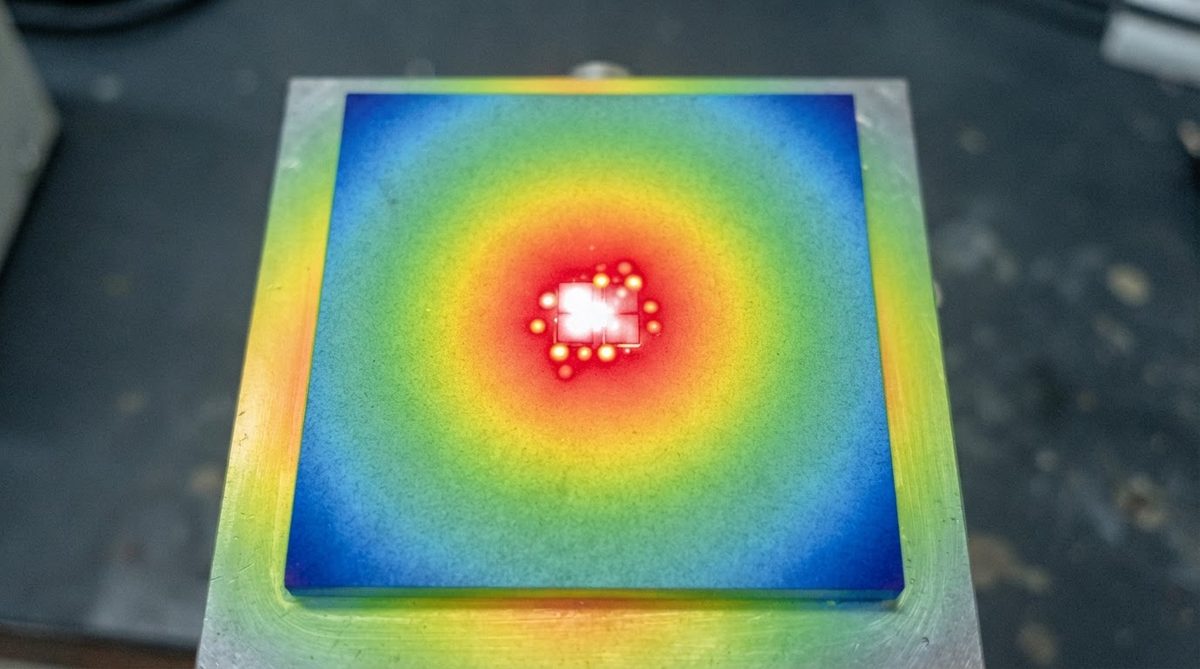
Aluminum nitride is a covalently bonded ceramic with a wurtzite crystal structure. In a theoretically perfect single crystal, thermal conductivity approaches 320 W/mK at room temperature (Slack, 1973, J. Phys. Chem. Solids 34:321). Commercial polycrystalline substrates fall well below that because of grain boundaries, dissolved oxygen, and sintering-aid phases at the grain junctions.
Oxygen content. During sintering, oxygen substitutes for nitrogen in the AlN lattice, creating aluminum vacancies that scatter phonons. High-purity AlN powder with < 0.5 wt% oxygen can yield substrates above 200 W/mK. Standard-grade powder at 1–2 wt% oxygen typically lands at 170–180 W/mK. This is the dominant variable controlling aluminum nitride AlN thermal conductivity in practice.
Sintering additives. Most AlN substrates use yttria (Y₂O₃) at 3–5 wt% to promote densification and to getter oxygen into yttrium aluminate grain-boundary phases. The type and amount of additive affects the grain-boundary thermal resistance. CaO-based systems can achieve similar density but often yield lower conductivity.
Grain size. Larger grains mean fewer grain boundaries per unit length and higher conductivity, all else being equal. However, large-grain microstructures reduce flexural strength. Substrate manufacturers balance this trade-off differently depending on the target application.
AlN Thermal Conductivity by Grade — Datasheet Values
| Grade / Supplier | Purity | k (W/mK) | Temp (°C) | Flexural Strength (MPa) | Source |
|---|---|---|---|---|---|
| Maruwa HA-200 | ≥ 99% | 200 | 25 | 300 | Maruwa datasheet, 2023 |
| Kyocera SH-50 | ≥ 95% | 170 | 25 | 350 | Kyocera technical catalog |
| CoorsTek AlN-170 | ≥ 95% | 170 | 25 | 320 | CoorsTek product data |
| CeramTec Alunit | ≥ 98% | 180 | 25 | 330 | CeramTec datasheet |
| Tokuyama SH-30 | ≥ 99% | 230 | 25 | 280 | Tokuyama technical note |
Typical values for commercially available material, for comparison only. Confirm against the datasheet for your specific grade.
The spread from 170 to 230 W/mK is real and significant. In a power module where the substrate sits between a die and a heat sink, moving from 170 to 230 W/mK can reduce junction-to-case thermal resistance by 15–20%. Specifying aluminum nitride AlN thermal conductivity by grade name or minimum k value eliminates costly ambiguity in your bill of materials.
How Aluminum Nitride AlN Thermal Conductivity Changes with Temperature
AlN thermal conductivity is dominated by phonon transport, so it decreases as temperature rises and phonon-phonon scattering increases. The relationship is approximately k ∝ 1/T above the Debye temperature (~950 K for AlN).
For practical design, use these approximate derating factors (referenced to 25 °C value):
| Temperature (°C) | Derating Factor | Effective k for 170 W/mK grade | Effective k for 200 W/mK grade |
|---|---|---|---|
| 25 | 1.00 | 170 W/mK | 200 W/mK |
| 100 | ~0.80 | 136 W/mK | 160 W/mK |
| 200 | ~0.62 | 105 W/mK | 124 W/mK |
| 300 | ~0.50 | 85 W/mK | 100 W/mK |
Derating factors derived from published Maruwa and Kyocera temperature-dependent data. Actual values vary by grade.
If your device operates at 200 °C junction temperature, using the room-temperature k value overestimates thermal performance by roughly 40%. Always derate. For more on how temperature limits interact with substrate choice, see ceramic PCB maximum operating temperature.
Enter your substrate grade, thickness, and operating temperature below to see the derated aluminum nitride AlN thermal conductivity and estimated temperature rise for your specific case.
Worked Example: AlN Substrate Thermal Resistance
Consider a GaN HEMT die (3 mm × 3 mm) dissipating 50 W, mounted on a 0.635 mm thick AlN substrate (k = 170 W/mK at operating temperature after derating).
The one-dimensional conduction resistance through the substrate directly under the die is:
Rth = t / (k × A) = 0.000635 m / (170 W/mK × 9 × 10⁻⁶ m²) = 0.41 °C/W
Temperature rise through the substrate alone: ΔT = 50 W × 0.41 °C/W = 20.7 °C.
If you used 96% alumina (k ≈ 26 W/mK at the same operating temperature) instead:
Rth = 0.000635 / (26 × 9 × 10⁻⁶) = 2.71 °C/W, giving ΔT = 135 °C.
That 115 °C difference is why AlN exists as a substrate material. For a deeper walkthrough of this math, including spreading resistance and interface layers, see how to calculate ceramic PCB thermal resistance.
AlN vs. Other Ceramic Substrates
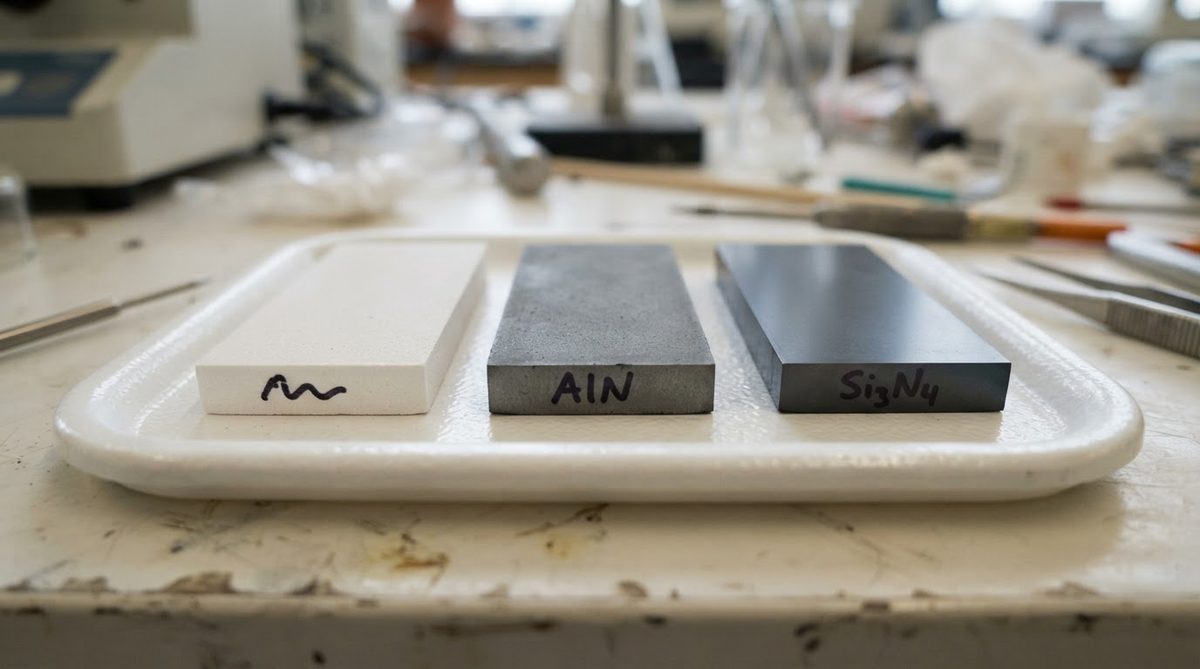
| Parameter | AlN | 96% Al₂O₃ | Si₃N₄ | Unit | Condition |
|---|---|---|---|---|---|
| Thermal conductivity | 170–230 | 24–28 | 60–90 | W/mK | 25 °C |
| CTE | 4.5–4.8 | 6.5–7.2 | 2.7–3.2 | ppm/°C | 25–400 °C |
| Flexural strength | 280–400 | 300–380 | 600–900 | MPa | ASTM C1161 |
| Fracture toughness | 2.5–3.5 | 3.5–4.0 | 6–8 | MPa·m½ | ASTM C1421 |
| Dielectric constant | 8.5–9.0 | 9.0–9.5 | 7.5–8.5 | — | 1 MHz |
| Relative cost (per cm²) | 3–5× | 1× (baseline) | 4–6× | — | 0.635 mm thick |
Typical values for commercially available material, for comparison only. Confirm against the datasheet for your specific grade.
AlN wins on raw thermal conductivity. Silicon nitride thermal performance is lower (60–90 W/mK) but its fracture toughness is roughly double, making it the better choice for power modules subjected to severe thermal cycling. The decision is rarely about conductivity alone.
When NOT to Use AlN
Your thermal budget is comfortable with alumina. If the substrate contributes less than 10–15 °C to the total junction-to-ambient rise, the 3–5× cost premium of AlN is hard to justify. Run the numbers first.
You need mechanical robustness under cycling. AlN’s fracture toughness (2.5–3.5 MPa·m½) is the lowest of the three common ceramics. In automotive power modules with –40 °C to +175 °C cycling, Si₃N₄ substrates survive significantly more cycles before copper-delamination or substrate cracking. See designing thermally with AlN substrates for guidance on mitigating this.
You are building an RF circuit above 10 GHz. AlN’s dielectric constant of 8.5–9.0 is manageable but higher than alumina or quartz. Dielectric loss tangent (~0.001 at 1 MHz) is acceptable for most power applications but may matter at millimeter-wave frequencies.
Volume is very high and die size is small. For LED packages under 1 W, a metal-core PCB or even FR-4 with well-designed thermal vias can handle the heat at a fraction of the cost.
Practical Tips for Specifying AlN Substrates
- Always request the lot-level thermal conductivity certificate. Reputable suppliers measure k by laser flash (ASTM E1461) on witness coupons from each sintering batch.
- Specify the grade by name or by minimum k, not just “AlN.” Asking for “AlN, k ≥ 180 W/mK at 25 °C per ASTM E1461” eliminates ambiguity.
- Account for metallization layers. A 10–20 µm thick-film conductor adds negligible thermal resistance, but a poorly bonded interface can add 0.1–0.5 °C/W per cm² — often more than the substrate itself.
- For thermal management on ceramic boards, consider the full stack: die attach, substrate, solder or thermal interface, and heat sink. Optimizing only the substrate k is a common mistake.
Frequently Asked Questions
Is aluminum nitride AlN thermal conductivity really 170 or 230 W/mK?
Both values are correct for different grades. Standard-purity AlN (≥ 95%) typically measures 170–180 W/mK at 25 °C. High-purity grades (≥ 99%, low oxygen) reach 200–230 W/mK. Always check the specific grade’s datasheet rather than using a generic “AlN” number.
Does AlN lose thermal conductivity at high temperature?
Yes. Aluminum nitride AlN thermal conductivity drops roughly 50% between 25 °C and 300 °C due to increased phonon scattering. A substrate rated at 170 W/mK at room temperature will conduct at approximately 85 W/mK at 300 °C. Designs that ignore this derating underestimate junction temperature.
Can I solder directly to an AlN substrate?
Not to bare AlN. The surface must first be metallized, typically with a DBC (direct bond copper) layer, an AMB (active metal brazing) layer, or a thin-film Ti/Pt/Au stack. Standard Sn-Ag-Cu solder then wets the metallization normally.
How does AlN compare to BeO for thermal conductivity?
Beryllium oxide reaches 250–300 W/mK at 25 °C, exceeding even high-purity AlN. However, BeO dust is a confirmed human carcinogen that causes chronic beryllium disease. Regulatory restrictions (OSHA PEL: 0.2 µg/m³) and disposal requirements make BeO impractical for most new designs. AlN is the standard replacement. For safety details, refer to beryllia safety guidance.
What thickness should I specify for an AlN substrate?
0.635 mm (25 mil) is the most common standard thickness, balancing thermal resistance, mechanical handling strength, and cost. Thinner substrates (0.25–0.38 mm) reduce thermal resistance further but are more fragile and more expensive to process. Choose based on your calculated Rth budget and assembly yield requirements.
Next Step
If your thermal model shows that alumina cannot meet your junction temperature target, AlN is likely the right substrate. Start by confirming the grade and thickness against your Rth budget, then request a quote with your specific thermal conductivity requirement.