An alumina 96% Al2O3 AMB active metal brazing substrate is a ceramic circuit board where copper foil is bonded to a 96%-purity alumina base using an Ag-Cu-Ti braze alloy—typically fired at 800–900 °C in vacuum. This alumina 96% Al2O3 AMB active metal brazing process delivers copper adhesion strengths above 20 MPa on a substrate with 24–28 W/mK thermal conductivity (at 20 °C, per CoorsTek ADS-96R datasheet), at roughly 40–60% of the cost of an equivalent aluminum nitride AMB part.
What Is Alumina 96% Al2O3 AMB Active Metal Brazing?
Active metal brazing (AMB) uses a thin foil or paste of a silver-copper alloy containing a small percentage of titanium (commonly Ag-72.5 / Cu-27 / Ti-1.5 wt%). The titanium reacts with the alumina surface during a vacuum furnace cycle, forming a TiO₂-rich reaction layer that wets the ceramic. Copper foil—typically 0.2 mm to 0.8 mm thick—bonds directly to this reaction layer without the oxide interlayer required by DBC.
Because the braze temperature (800–900 °C) is well below the alumina sintering temperature (~1600 °C), the substrate retains its as-fired mechanical and dielectric properties. The result is a metallised ceramic with high peel strength, good thermal cycling reliability, and the ability to carry thick copper traces for high-current power electronics. This makes alumina 96% Al2O3 AMB active metal brazing a practical choice for IGBT modules, SiC half-bridges, and industrial drives where cost matters as much as performance.
Key Properties of 96% Alumina AMB Substrates
| Parameter | Value | Unit | Condition | Source |
|---|---|---|---|---|
| Thermal conductivity (substrate) | 24–28 | W/mK | 20 °C | CoorsTek ADS-96R datasheet |
| Dielectric strength | 14–17 | kV/mm | AC, 60 Hz, 25 °C | Kyocera A-476 datasheet |
| Flexural strength | 350–400 | MPa | 3-pt bend, ASTM C1161 | CoorsTek ADS-96R |
| CTE | 7.2–7.8 | ppm/°C | 25–400 °C | CeramTec Rubalit 708S |
| Copper thickness (AMB) | 0.2–0.8 | mm | — | Typical industry range |
| Cu peel strength (AMB bond) | ≥ 20 | MPa | 90° peel, as-brazed | Heraeus braze alloy technical note |
| Max continuous use temp | ~600 | °C | Substrate only, no Cu | CoorsTek ADS-96R |
Typical values for commercially available material, for comparison only. Confirm against the datasheet for your specific grade.
AMB vs DBC on 96% Alumina: Which Bond Method?
DBC (direct bonded copper) uses a Cu₂O eutectic reaction at ~1065 °C to bond copper to alumina. AMB fires 150–250 °C lower, which reduces residual thermal stress in the finished part. That stress difference matters during thermal cycling: AMB joints on alumina typically survive 3,000+ cycles from −40 °C to +150 °C (per JEDEC JESD22-A104), while DBC on alumina may begin delaminating at 1,500–2,500 cycles depending on copper thickness and substrate geometry.
AMB also permits thicker copper (up to 0.8 mm is routine; DBC on alumina is usually limited to ≤ 0.3 mm) and finer circuit patterning after etching. The trade-off is cost: the Ag-Cu-Ti braze alloy is expensive, and vacuum furnace cycles are slower than the continuous-belt furnaces used for DBC. For high-reliability power modules that must survive aggressive thermal cycling, the alumina 96% Al2O3 AMB active metal brazing approach is the stronger choice. For cost-sensitive, moderate-cycling applications, DBC may be sufficient.
Why Choose 96% Alumina Over AlN for Active Metal Brazing?
Aluminum nitride AMB substrates offer 170–200 W/mK thermal conductivity—roughly 7× higher than 96% alumina. If your die dissipates more than about 100 W/cm² and junction temperature is the binding constraint, AlN AMB substrates are the correct material. But AlN costs 3–5× more per unit area than 96% alumina, and its flexural strength is lower (300–350 MPa vs 350–400 MPa).
For IGBT modules, SiC half-bridges, and rectifier assemblies where dissipation per unit area is moderate (20–60 W/cm²) and the baseplate provides additional heat spreading, 96% alumina AMB handles the thermal load at a fraction of the price. A quick thermal resistance estimate illustrates the point.
Worked Example: Thermal Resistance Through the Substrate
For a 25 mm × 25 mm substrate, 0.38 mm thick, conducting 40 W:
Rth = t / (k × A) = 0.00038 m / (26 W/mK × 0.000625 m²) = 0.023 °C/W
That adds only ~0.9 °C to the total junction-to-case temperature rise. Even doubling the power to 80 W gives 1.9 °C—often well within budget when the dominant thermal resistance is the die-attach or heatsink interface. The substrate material matters most when area is small or power density is very high.
Enter your substrate area, thickness, and dissipated power below to estimate junction temperature rise for your own design.
Typical Applications for Alumina 96% Al2O3 AMB Active Metal Brazing
- IGBT and SiC power modules – 600 V to 1700 V class, where thick copper (0.3–0.8 mm) carries tens of amps and the substrate must survive −40 °C to +150 °C cycling.
- EV traction inverters – cost pressure favours alumina over AlN where thermal margins allow.
- Industrial motor drives – long service life requires high thermal-cycle reliability.
- Railway power converters – vibration and wide temperature swings demand strong Cu-ceramic bonds.
Comparing Alumina AMB to Other 96% Alumina Metallisation Methods
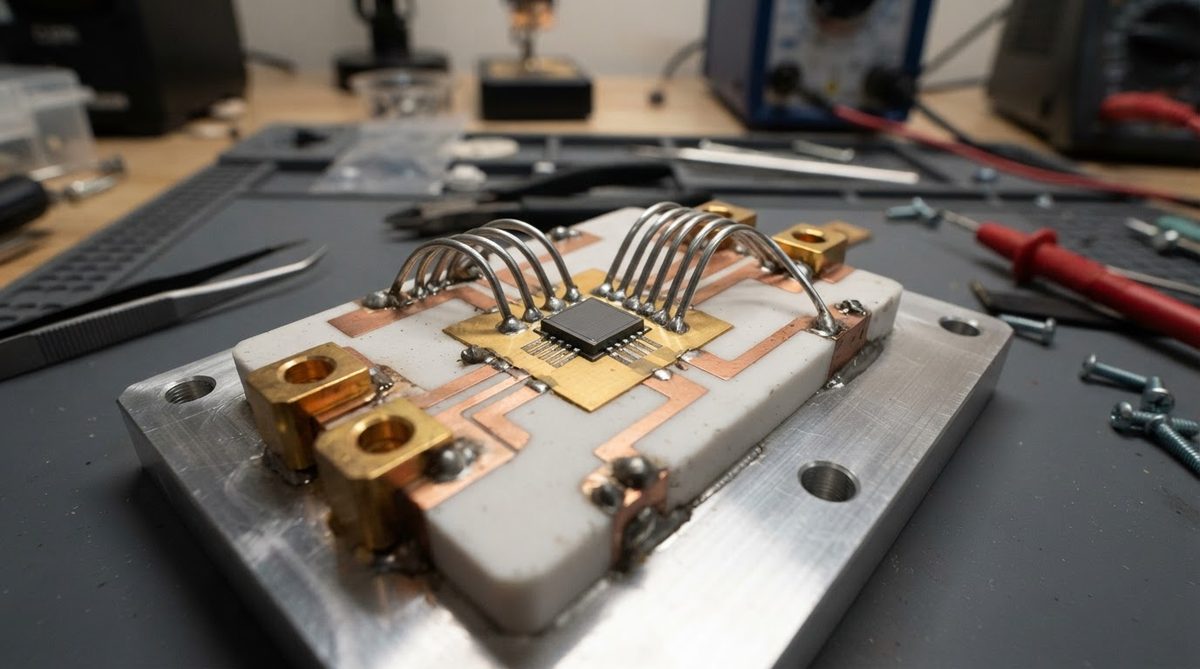
AMB is one of several ways to put copper on a 96% alumina substrate. If your design needs fine traces below 75 µm line/space, alumina 96% DPC substrates use sputtering and plating to achieve much finer resolution—but with thinner copper (typically ≤ 50 µm), limiting current capacity. Alumina 96% thick film substrates print conductors from metal pastes and fire at 850 °C; they suit sensor circuits and resistor networks but cannot match AMB’s copper thickness or thermal cycling performance.
Choose the metallisation method based on your current requirement, trace resolution, and reliability target—not on a general preference.
When NOT to Use Alumina 96% AMB
High power density above ~100 W/cm²: Switch to AlN AMB. The 7× thermal conductivity advantage becomes decisive once the substrate itself is the bottleneck.
Fine-pitch circuits below 100 µm line/space: AMB copper is patterned by etching thick foil. Resolution is limited to roughly 100–150 µm minimum trace/space. Use DPC or thin film instead.
Cost-driven, low-cycle applications: If your product sees fewer than 1,000 thermal cycles over its lifetime and copper thickness ≤ 0.3 mm is adequate, DBC on alumina costs less than AMB and performs well enough.
Extreme mechanical shock: Alumina is brittle. If your assembly faces repeated high-g impacts, consider Si₃N₄ AMB, which has roughly 2–3× the fracture toughness.
Substrate Dimensions and Ordering
Alumina 96% AMB substrates are available in a range of panel sizes and thicknesses. Check the standard ceramic substrate sizes page for common formats, or review the ceramic substrate thickness chart for available alumina thicknesses from 0.25 mm to 1.0 mm.
Frequently Asked Questions
Can alumina 96% AMB substrates be used with lead-free solder?
Yes. The AMB copper surface accepts standard Ni/Au or Ni/Ag plating, which is fully compatible with SAC305 and other lead-free solders. Reflow temperatures of 240–260 °C are far below the braze joint’s service limit.
What is the maximum copper thickness for AMB on 96% alumina?
Most AMB suppliers offer copper from 0.2 mm to 0.8 mm on 96% alumina. Thicker copper increases residual stress and raises delamination risk during thermal cycling, so 0.3–0.5 mm is the most common range for power modules.
Does the Ag-Cu-Ti braze alloy affect electrical isolation?
The braze layer is metallic and conductive, but it is confined to the copper-ceramic interface. Isolation voltage is determined by the ceramic bulk. A 0.38 mm alumina substrate still provides ≥ 5 kV AC isolation (per IEC 60664-1 clearance requirements), provided the braze does not extend beyond the copper footprint.
How does CTE mismatch affect reliability with Si and SiC die?
Silicon has a CTE of ~2.6 ppm/°C and SiC ~4.0 ppm/°C, while 96% alumina is 7.2–7.8 ppm/°C. This mismatch is managed by die-attach materials (sintered silver, solder) that absorb strain. For large die (> 10 mm × 10 mm), finite-element analysis of the die-attach joint is recommended before committing to alumina over AlN (CTE ~4.5 ppm/°C), which matches SiC more closely.
Is AMB on alumina suitable for hermetic packaging?
AMB substrates can form part of a hermetic package when combined with a brazed or seam-welded metal frame. The alumina itself is gas-tight; hermeticity depends on the quality of the frame-to-substrate seal, not the AMB copper bond.