A ceramic spacer washer is a non-conductive mechanical component—typically alumina, aluminum nitride, or zirconia—used to electrically isolate, thermally manage, or physically separate parts in an assembly. Ceramic spacers handle continuous temperatures from 1000 °C to over 1700 °C depending on material, maintain dielectric strength above 8 kV/mm, and resist creep under sustained compressive loads that would deform plastic alternatives.
Key Takeaways
- 96% alumina spacers withstand continuous use to roughly 1500 °C and offer dielectric strength of 8–10 kV/mm per ASTM D149.
- Aluminum nitride washers conduct heat at 170–200 W/mK while still providing full electrical isolation—useful when a spacer must also serve as a thermal path.
- Zirconia (ZrO₂, 3Y-TZP) delivers the highest fracture toughness among common ceramics at 8–10 MPa·m^½, making it the best choice where impact or point loading is a concern.
- Ceramic spacers cost 5–20× more per piece than nylon or PTFE equivalents but eliminate replacement cycles in high-temperature or high-voltage environments.
Why Use a Ceramic Spacer Instead of Plastic or Metal?
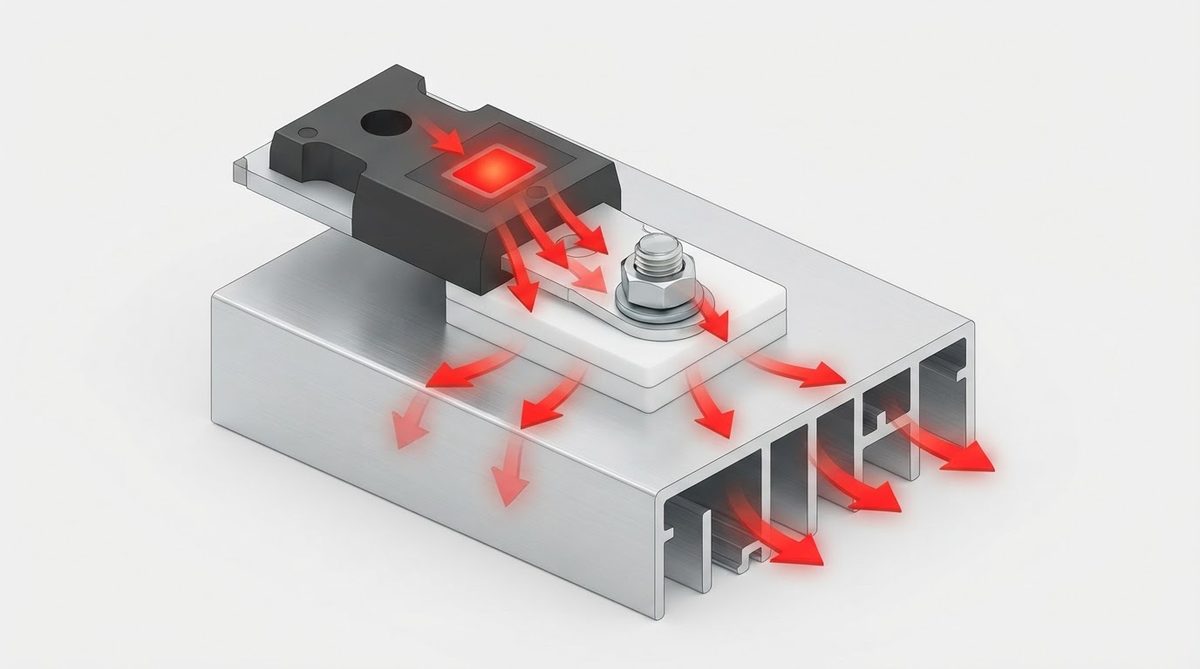
Plastic washers (nylon, PEEK, PTFE) are cheap and easy to machine but top out at 260 °C for PTFE and roughly 250 °C for PEEK under continuous load. Above those temperatures they soften, outgas, or decompose. Metal spacers conduct electricity, which rules them out wherever galvanic isolation between a bolt and a chassis, a heatsink and a power device, or stacked PCBs matters.
Ceramic fills the gap: it insulates electrically, survives extreme heat, and resists chemical attack from acids, solvents, and process gases. The trade-off is brittleness. Ceramics do not yield—they fracture. Torque control during fastener assembly is critical, and designs should avoid point contact or cantilever loading on a ceramic washer.
Common Materials for Ceramic Spacers and Washers
| Parameter | Al₂O₃ 96% | Al₂O₃ 99.6% | AlN | ZrO₂ (3Y-TZP) |
|---|---|---|---|---|
| Thermal conductivity (W/mK, 20 °C) | 24–28 | 30–35 | 170–200 | 2–3 |
| Dielectric strength (kV/mm, ASTM D149) | 8–10 | 10–15 | 14–17 | 10–12 |
| Max continuous temp (°C, in air) | ~1500 | ~1700 | ~1000 (oxidation limit) | ~1200 |
| Flexural strength (MPa, ASTM C1161) | 300–350 | 350–400 | 300–350 | 900–1200 |
| Fracture toughness (MPa·m^½) | 3.5–4 | 3.5–4.5 | 2.5–3 | 8–10 |
| CTE (ppm/°C, 20–300 °C) | 7.2–7.5 | 7.5–8.0 | 4.5–5.0 | 10–10.5 |
| Relative cost | 1× | 1.5–2× | 3–5× | 2–3× |
Typical values for commercially available material, for comparison only. Confirm against the datasheet for your specific grade. Sources: CoorsTek Advanced Ceramics datasheets; Kyocera Fine Ceramics product catalog; Maruwa AlN substrate data.
For most isolation applications, 96% alumina substrates offer the best balance of cost and performance. When thermal conductivity through the spacer matters—such as isolating a power MOSFET from a grounded heatsink while still pulling heat through—aluminum nitride thick film substrates are the practical choice.
Typical Shapes and Dimensions
Ceramic spacers and washers are produced in several standard forms:
- Flat washers: OD 3–50 mm, ID 1.5–25 mm, thickness 0.25–5 mm. The most common shape for bolt isolation.
- Shoulder washers (bushings): A cylindrical sleeve with an integral flange, isolating both the bolt shank and the bearing surface in one piece.
- Tubular spacers: Simple cylinders, often used between stacked boards or as standoffs inside vacuum chambers.
- Custom profiles: Laser-cut or CNC-ground to net shape from blanks. Tolerances of ±0.05 mm are achievable on ground surfaces; as-fired tolerances are typically ±1% of the nominal dimension.
If you need to confirm which standard ceramic substrate sizes are available as starting blanks for custom washers, check the catalog before requesting a quote—starting from a stock panel size reduces lead time and tooling cost.
Worked Example: Selecting a Washer for Power Module Isolation
Suppose you need to isolate a TO-247 power device (mounting hole M3, bolt circle OD 8 mm) from a grounded aluminum heatsink. The device dissipates 40 W continuously, and the system operates at 150 °C ambient.
Option A: 96% Alumina Washer
Washer dimensions: OD 8 mm, ID 3.2 mm, thickness 1 mm. Thermal resistance through the washer:
Rth = t / (k × A) = 0.001 m / (26 W/mK × 38.2 × 10⁻⁶ m²) ≈ 1.01 °C/W
Temperature rise across the washer at 40 W: ΔT ≈ 40.4 °C. Junction temperature contribution from the washer alone is significant. If thermal budget is tight, consider Option B.
Option B: AlN Washer
Same dimensions. Rth = 0.001 / (180 × 38.2 × 10⁻⁶) ≈ 0.145 °C/W. ΔT ≈ 5.8 °C. The AlN washer cuts the thermal penalty by roughly 85%, but costs 3–5× more per piece. For a 40 W device with a tight thermal budget, the extra cost is justified. For a 5 W device, alumina is fine.
Dielectric and Voltage Ratings
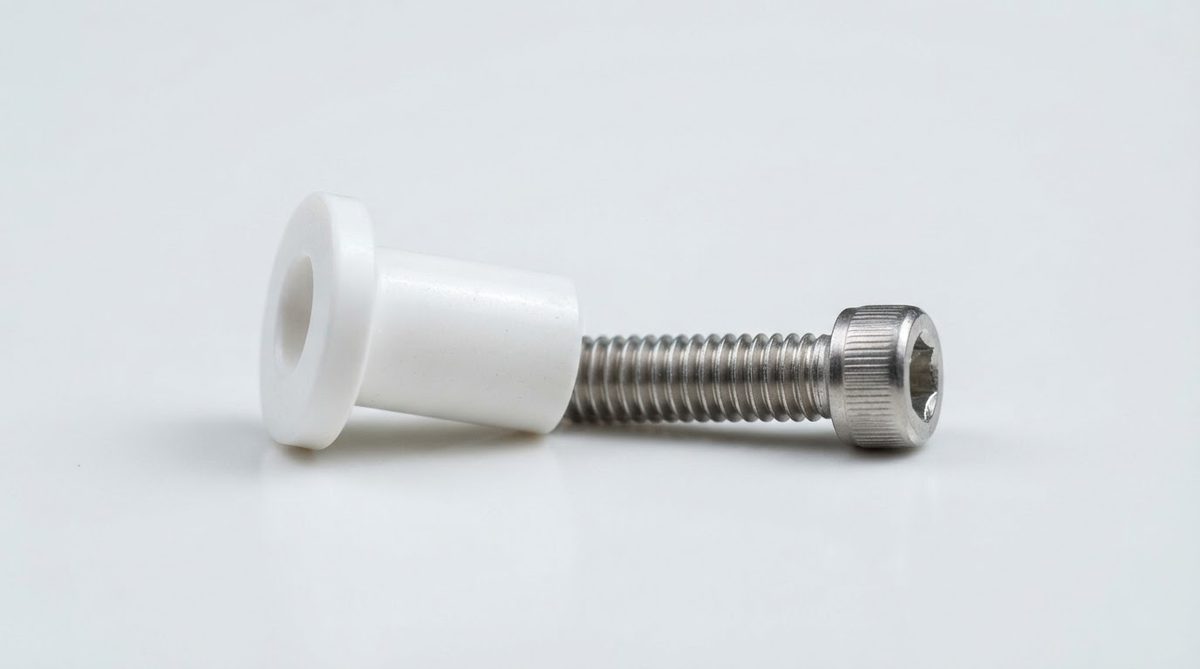
A 1 mm thick 96% alumina washer withstands 8–10 kV before breakdown. In practice, the working voltage is derated to one-third to one-half of the breakdown value, giving a working isolation of roughly 3–5 kV for a 1 mm part. For higher isolation, increase thickness or select 99.6% alumina, which offers 10–15 kV/mm dielectric strength. Surface flashover—not bulk breakdown—is usually the limiting factor in humid or contaminated environments. Keeping surfaces clean and using conformal coating or potting around the washer edge extends reliable isolation.
For assemblies where the ceramic washer also carries a metallized trace or bond pad, gold-metallized ceramic substrates can serve double duty as both an insulating spacer and a circuit element.
When NOT to Use a Ceramic Spacer
Low temperature, low voltage: If the operating environment stays below 200 °C and isolation requirements are under 500 V, nylon or PEEK washers cost a fraction of ceramic and are far more forgiving of over-torque.
High impact or vibration with unconstrained loading: Ceramics fracture without warning. In applications with repeated mechanical shock (handheld tools, automotive suspension-mounted electronics), a compressible insulating washer (silicone rubber, mica + silicone composite) absorbs energy that would crack a ceramic part.
Large, thin, unsupported spans: A ceramic washer with an OD-to-thickness ratio above 20:1 is fragile in handling and assembly. Redesign the stack to use a thicker washer or a different isolation strategy.
Cost-sensitive high-volume consumer products: At volumes above 100k, the per-piece cost of ceramic spacers adds up. Evaluate whether a Kapton film or anodized aluminum washer meets the electrical and thermal requirements at lower cost.
Sourcing and Quality Considerations
Specify the material grade (not just “alumina”), surface finish (as-fired vs. lapped vs. polished), and critical tolerances on ID, OD, thickness, and flatness. Flatness matters for thermal interface performance—a washer that rocks on a heatsink traps air gaps and defeats the purpose of using a high-conductivity ceramic.
Request a ceramic substrate sample kit to verify fit and finish before committing to production quantities. Incoming inspection should include a dimensional check with a micrometer and a dielectric withstand test per IEC 60243-1 on a sample basis.
FAQ
Can I drill or machine a ceramic washer after firing?
Yes, but only with diamond tooling. Alumina and AlN are too hard for carbide or HSS. Laser cutting is preferred for thin washers (under 1 mm); diamond grinding handles thicker parts. Expect to add 20–40% to the piece cost for post-fire machining versus ordering net-shape parts.
What torque can I apply to a bolt through a ceramic washer?
Ceramic washers do not have a published torque rating because failure depends on contact geometry, surface finish, and load distribution. Use a metal washer on top of the ceramic to spread the bolt head load, and torque to the lower end of the fastener spec. A flat, lapped ceramic surface and a controlled clamp area prevent point-load fractures.
Do ceramic spacers need thermal grease?
For thermal applications, yes. Even a lapped ceramic surface has micro-roughness that traps air. A thin layer of thermal grease or a phase-change pad fills those gaps and can reduce interface resistance by 30–50%. For purely mechanical or electrical isolation with no thermal path requirement, grease is unnecessary.
Are ceramic washers compatible with vacuum environments?
Alumina and AlN are excellent vacuum materials. They have near-zero outgassing rates and are routinely used in semiconductor fab equipment, electron-beam systems, and space hardware. Avoid glazed or polymer-sealed ceramics in vacuum—the coating outgasses.
What is the minimum order for custom ceramic washers?
Minimums vary by manufacturer and process. Laser-cut washers from stock blanks can often be ordered in quantities as low as 10–50 pieces for prototyping. Pressed or injection-molded washers with custom tooling typically require 500–5000 pieces to amortize die costs.