Silicon nitride (Si3N4) substrates offer a rare combination of high flexural strength (600–900 MPa per ASTM C1161) and moderate-to-good thermal conductivity (28–90 W/mK at 25 °C, grade-dependent), making them the default ceramic for power modules that face severe thermal cycling. This silicon nitride Si3N4 datasheet consolidates the properties you need for material selection, thermal simulation, and supplier qualification — all with units, test conditions, and sources.
Silicon Nitride Si3N4 Datasheet — Full Property Table
| Parameter | Typical Value | Unit | Condition / Standard | Source |
|---|---|---|---|---|
| Thermal conductivity | 28–90 | W/mK | 25 °C; varies by grain-boundary engineering | Kyocera SN series datasheet; Toshiba HTCC Si3N4 |
| Flexural strength | 600–900 | MPa | 3-point bend, ASTM C1161 | CoorsTek Si3N4 datasheet |
| Fracture toughness (KIC) | 6–8 | MPa·m½ | SEVNB, ASTM C1421 | CoorsTek; Kyocera |
| CTE | 2.5–3.4 | ppm/°C | 25–400 °C | Kyocera SN282/SN287 datasheet |
| Density | 3.20–3.26 | g/cm³ | Archimedes method | CoorsTek |
| Dielectric constant (εr) | 7.9–8.5 | — | 1 MHz, 25 °C | Kyocera SN series |
| Dielectric strength | 15–18 | kV/mm | AC, IEC 60672 | Maruwa Si3N4 datasheet |
| Volume resistivity | >1013 | Ω·cm | 25 °C | Kyocera |
| Young’s modulus | 290–320 | GPa | Resonance method, ASTM E1876 | CoorsTek |
| Poisson’s ratio | 0.27–0.28 | — | — | CoorsTek |
| Max continuous use temperature | 1,000–1,200 | °C | In air, no load | Kyocera; Toshiba |
| Typical substrate thickness | 0.25–1.0 | mm | As-fired or lapped | Industry standard |
Typical values for commercially available material, for comparison only. Confirm against the datasheet for your specific grade.
The wide thermal-conductivity range (28–90 W/mK) in this silicon nitride Si3N4 datasheet reflects real grade differences. Standard Si3N4 sits near 28–30 W/mK. High-thermal grades from Toshiba and Kyocera reach 70–90 W/mK through controlled β-Si3N4 grain alignment and reduced grain-boundary oxygen. Specify the exact grade, not just “Si3N4,” in your thermal model.
Enter your substrate dimensions, thickness, and thermal conductivity grade to estimate junction-to-case thermal resistance for your specific layout.
How Si3N4 Compares to AlN and Al₂O₃
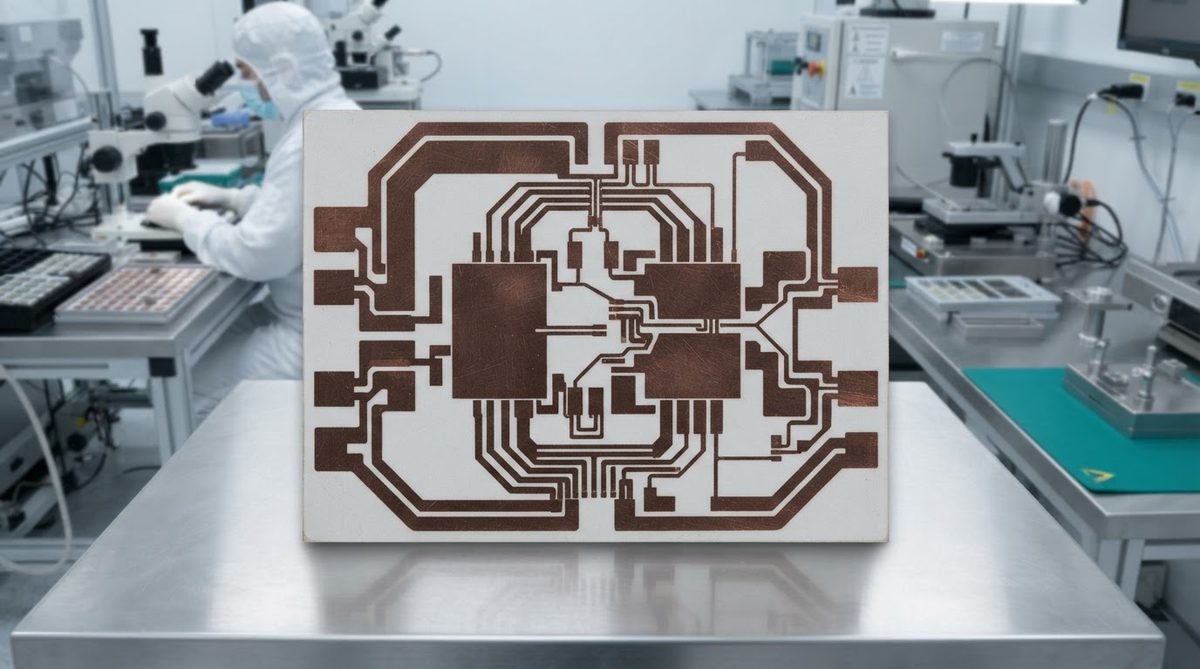
Engineers often shortlist Si3N4 alongside aluminum nitride (AlN) and 96 % alumina. The table below puts the three side by side on the parameters that usually decide the trade-off. Use this alongside the silicon nitride Si3N4 datasheet above to determine whether the mechanical advantage justifies the cost premium.
| Parameter | Si3N4 (high-TC grade) | AlN | Al₂O₃ 96 % | Unit |
|---|---|---|---|---|
| Thermal conductivity (25 °C) | 70–90 | 170–200 | 24–28 | W/mK |
| Flexural strength | 600–900 | 300–400 | 300–380 | MPa |
| Fracture toughness | 6–8 | 2.5–3.5 | 3.5–4.0 | MPa·m½ |
| CTE | 2.5–3.4 | 4.5–5.0 | 6.5–7.2 | ppm/°C |
| Relative substrate cost | 3–5× | 2–4× | 1× (baseline) | — |
Sources: Kyocera SN287 datasheet, CoorsTek AlN datasheet, Maruwa Al₂O₃ 96 % datasheet. Values at 25 °C unless noted.
Si3N4’s defining advantage is mechanical toughness. Its fracture toughness is roughly 2× that of AlN, which means it survives thousands more thermal-shock cycles before cracking — the reason automotive SiC inverter modules have largely standardized on Si3N4 AMB substrates. For a deeper comparison of Si3N4 thermal conductivity across grades, see our dedicated page.
Which Metallization Processes Work with Si3N4?
Si3N4 is a covalently bonded ceramic that resists wetting by molten copper. Two metallization routes dominate:
- Active Metal Brazing (AMB): A titanium-containing braze (e.g., Ag-Cu-Ti) reacts with the Si3N4 surface to form a TiN bonding layer. AMB is the standard for Si3N4 AMB power substrates in EV traction inverters. Copper thickness up to 0.8 mm is common.
- Direct Bonded Copper (DBC): Possible on Si3N4 but less common than on AlN because the oxide-interlayer bond is weaker on nitride ceramics. Si3N4 DBC substrates still serve applications where thinner copper (0.2–0.3 mm) suffices.
HTCC and LTCC are not used with Si3N4. The material is sintered at 1,700–1,900 °C under nitrogen pressure (gas-pressure sintering or HIP), not co-fired with metallization pastes. If your design requires embedded vias or co-fired passives, alumina LTCC or HTCC is the correct path. Any silicon nitride Si3N4 datasheet that lists LTCC compatibility should be treated with suspicion.
Worked Example: Thermal Resistance Through a Si3N4 Substrate
Assume a 40 mm × 40 mm Si3N4 substrate, 0.32 mm thick, high-TC grade at 80 W/mK. The conductive thermal resistance through the ceramic alone is:
Rth = t / (k × A) = 0.00032 m / (80 W/mK × 0.0016 m²) = 0.0025 K/W
For the same geometry in AlN at 180 W/mK, Rth = 0.0011 K/W. The difference is 1.4 mK/W — often negligible once solder layers and heat-sink interfaces are included. This is why Si3N4’s mechanical reliability often outweighs AlN’s raw thermal edge in designs that must survive >3,000 thermal cycles (–40 to +150 °C). Cross-reference these numbers against the silicon nitride Si3N4 datasheet table above to verify the grade you are modeling.
When Si3N4 Is Not the Right Choice
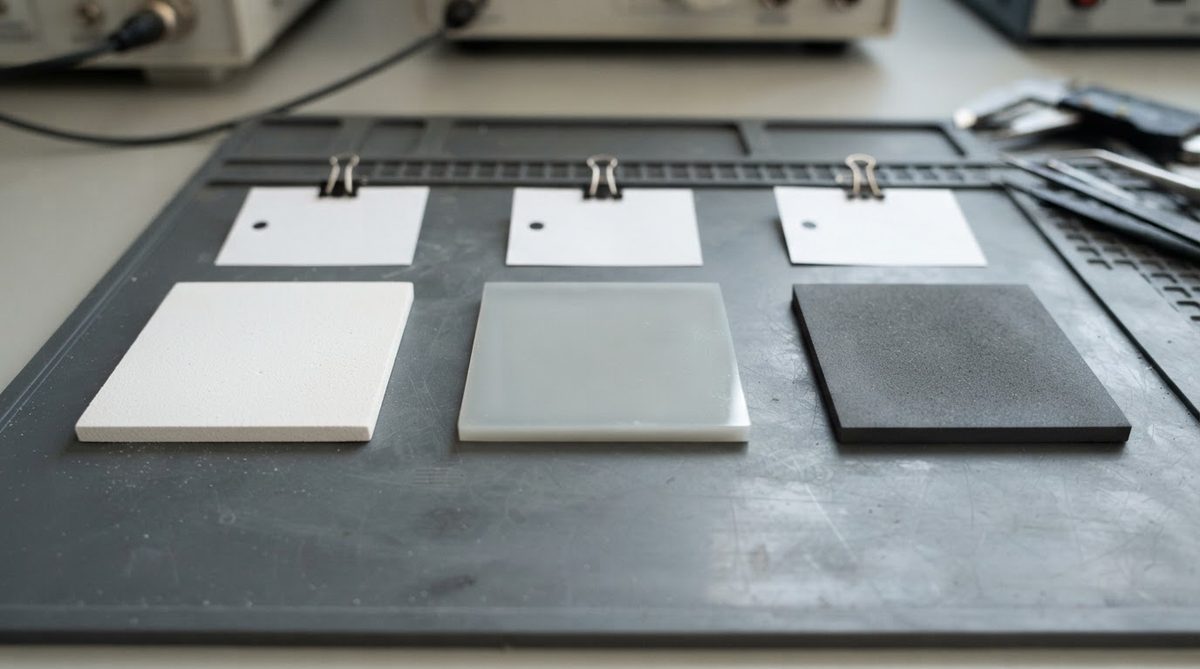
Si3N4 is expensive — typically 3–5× the cost of 96 % alumina on a per-piece basis. If your application does not face aggressive thermal cycling or mechanical shock, alumina or AlN will perform adequately at lower cost. For RF or microwave circuits requiring low εr and low loss tangent, alumina or quartz substrates are better suited. And for prototyping where lead time matters more than reliability qualification, standard alumina is available faster and from more suppliers.
Frequently Asked Questions
Can I get Si3N4 substrates thinner than 0.3 mm?
Yes. Substrates down to 0.20 mm are commercially available, and some suppliers offer 0.15 mm on request. Thinner substrates reduce thermal resistance but are more fragile during handling. See our page on ultra-thin Si3N4 ceramic substrates for handling guidelines.
Is Si3N4 compatible with lead-free soldering?
Yes. AMB- and DBC-metallized Si3N4 substrates are routinely soldered with SAC305 and other lead-free alloys at peak reflow temperatures of 245–260 °C. The ceramic itself is unaffected at these temperatures.
What is the typical lot-to-lot variation in thermal conductivity?
For high-TC grades (nominally 90 W/mK), expect ±10 % lot-to-lot variation — meaning actual values between roughly 80 and 95 W/mK. Always request a Certificate of Analysis with measured k-values per lot if your thermal budget is tight.
Does Si3N4 degrade in humid environments?
Si3N4 is highly resistant to moisture and most acids at room temperature. Oxidation becomes significant only above 800–900 °C in air. For power-module applications sealed in silicone gel, humidity is not a practical concern.
How do I specify surface finish on a bare Si3N4 substrate?
As-fired Si3N4 has a surface roughness (Ra) of roughly 0.4–0.8 µm. Lapping brings Ra below 0.2 µm, and polishing can reach Ra < 0.05 µm. Smoother surfaces improve braze-layer uniformity in AMB. Specify Ra on your drawing along with the measurement method (stylus profilometry per ISO 4287).
Next Step
If you are modeling a power-module substrate and need exact property values for a specific Si3N4 grade, request a grade-specific silicon nitride Si3N4 datasheet and quote through our Si3N4 wholesale inquiry page. Include your target substrate size, thickness, and metallization type so we can match the right grade to your thermal and mechanical requirements.