An automotive electronics AlN PCB uses aluminum nitride ceramic as its dielectric layer, delivering 170–200 W/mK thermal conductivity at 25 °C (per Kyocera SH-30 and Maruwa AN series datasheets) alongside a close CTE match to silicon and SiC die (4.5–4.7 ppm/°C vs. 2.6–4.0 ppm/°C) and volume resistivity above 10¹⁴ Ω·cm. These properties make the automotive electronics AlN PCB the substrate of choice for traction inverters, on-board chargers, LiDAR drivers, and high-current sensor interfaces in vehicles rated to AEC-Q200 environments.
- AlN thermal conductivity (170–200 W/mK at 25 °C) is 6–8× that of 96% alumina (24–28 W/mK).
- CTE of 4.5–4.7 ppm/°C reduces solder-joint fatigue during –40 °C to +150 °C thermal cycling per AEC-Q100.
- Dielectric strength of 15–17 kV/mm (per ASTM D149) supports isolation in 800 V EV bus architectures.
- AlN substrates cost 3–5× more per unit area than 96% alumina, so they are justified only when the thermal budget demands them.
Why Automotive Electronics Need AlN PCB Substrates
Modern vehicles pack increasing power density into shrinking volumes. A SiC MOSFET half-bridge in a traction inverter can dissipate 50–120 W per die at switching frequencies above 20 kHz. Under-hood ambient temperatures reach 125–150 °C, and the substrate must survive 1,000+ thermal cycles between –40 °C and +150 °C without cracking or delaminating copper traces. FR-4 (Tg 130–180 °C, thermal conductivity ~0.3 W/mK) fails on both counts. Standard alumina (96% Al₂O₃) handles the temperature but its 24–28 W/mK conductivity forces larger heat-sink footprints. An automotive electronics AlN PCB closes that gap.
The CTE match matters as much as raw conductivity. A bare SiC die bonded to an AlN substrate with Ag sinter paste sees a CTE mismatch of roughly 0.5–2.1 ppm/°C. The same die on a copper MCPCB (CTE ~17 ppm/°C) faces a mismatch above 13 ppm/°C, which drives crack initiation at the solder interface within hundreds of power cycles. For EV traction power modules on AlN, this reliability margin is the primary design driver, not just thermal performance.
Key Automotive Applications for AlN PCBs
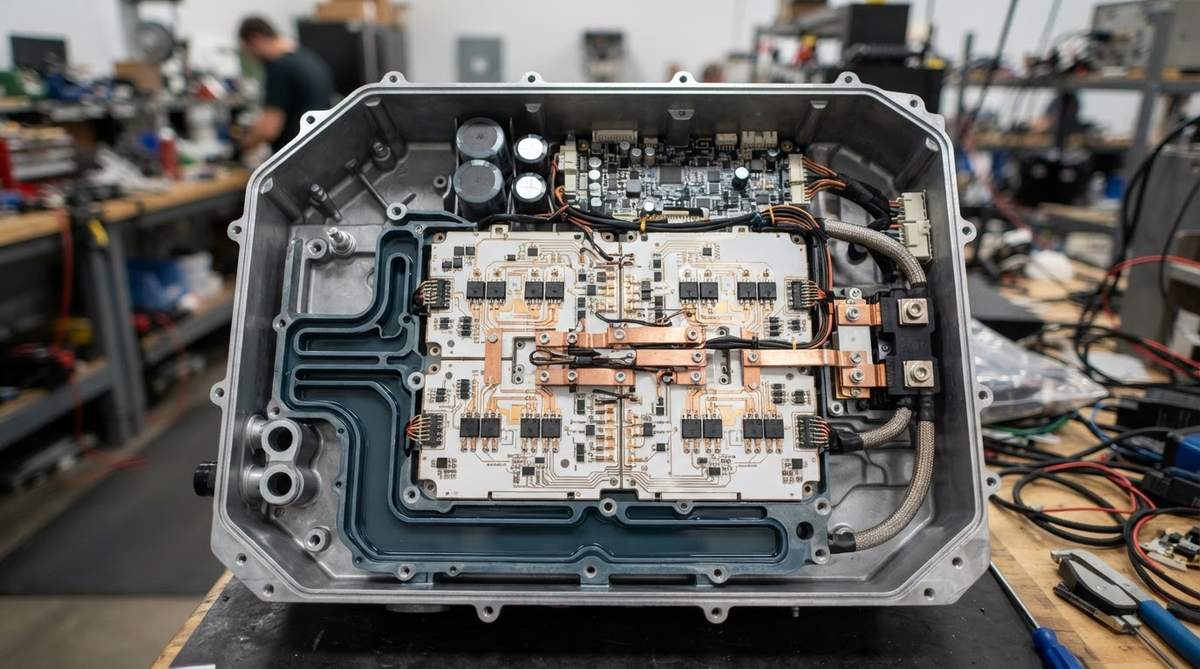
Traction Inverters and DC-DC Converters
SiC and GaN power stages in 400 V and 800 V drivetrains generate heat flux densities of 100–250 W/cm² at the die attach. AlN DBC (direct bond copper) or AMB (active metal brazed) substrates carry this heat to the baseplate while maintaining 2.5–5 kV isolation. Infineon’s HybridPACK Drive and similar modules use AlN or Si₃N₄ substrates for exactly this reason.
On-Board Chargers (OBC)
11 kW and 22 kW OBCs use GaN HEMTs switching at 100–500 kHz. The small die size concentrates heat. An automotive electronics AlN PCB keeps junction-to-case thermal resistance (Rth,jc) low enough to avoid derating at 105 °C coolant temperatures common in liquid-cooled OBC designs.
LiDAR and Radar Driver Boards
Pulsed laser drivers for LiDAR push 20–75 A peak currents through small GaN transistors. AlN’s combination of high thermal conductivity and low dielectric constant (Dk 8.5–9.0 at 1 MHz, per Maruwa AN-230 datasheet) supports both thermal and signal-integrity requirements. For broader sensor-substrate considerations, see AlN PCBs for sensors and MEMS.
High-Temperature Sensors
Exhaust-gas, turbo-inlet, and battery-pack temperature sensors may operate continuously above 200 °C. AlN substrates remain mechanically and electrically stable at these temperatures, unlike polyimide flex or even high-Tg FR-4.
AlN vs. Alumina vs. Si₃N₄ for Automotive Electronics
| Parameter | AlN | 96% Al₂O₃ | Si₃N₄ | Unit | Condition |
|---|---|---|---|---|---|
| Thermal conductivity | 170–200 | 24–28 | 70–90 | W/mK | 25 °C |
| CTE | 4.5–4.7 | 7.0–7.4 | 2.7–3.2 | ppm/°C | 20–300 °C |
| Flexural strength | 300–350 | 300–380 | 650–800 | MPa | ASTM C1161, 3-pt bend |
| Dielectric strength | 15–17 | 10–15 | 12–18 | kV/mm | ASTM D149 |
| Fracture toughness (K_IC) | 2.5–3.0 | 3.5–4.0 | 6.0–7.0 | MPa·√m | ASTM C1421 |
| Relative cost (per cm²) | 3–5× | 1× (baseline) | 4–8× | — | Volume pricing |
Typical values for commercially available material, for comparison only. Confirm against the datasheet for your specific grade.
AlN wins on thermal conductivity. Si₃N₄ wins on mechanical toughness, which matters for substrates under bolt-down mechanical stress or wide-temperature cycling. If your design sees sustained vibration and thermal cycling beyond 2,000 cycles (–40/+175 °C), Si₃N₄ AMB may outlast AlN DBC despite lower conductivity. For cost-sensitive modules where heat flux is moderate (below ~50 W/cm²), 96% alumina is usually sufficient.
Worked Example: Thermal Resistance Through an Automotive Electronics AlN PCB
Consider a SiC MOSFET die (6 mm × 6 mm) mounted on a 0.635 mm thick AlN DBC substrate. The one-dimensional thermal resistance through the ceramic layer is:
Rth = t / (k × A)
Where t = 0.635 × 10⁻³ m, k = 180 W/mK (mid-range AlN), A = 36 × 10⁻⁶ m².
Rth = 0.000635 / (180 × 0.000036) = 0.098 °C/W
The same geometry in 96% alumina (k = 26 W/mK) yields Rth = 0.68 °C/W. At 80 W dissipation, that is a 7.8 °C vs. 54.4 °C temperature rise across the substrate alone. In an under-hood environment where every degree of margin counts toward AEC-Q100 Grade 0 (–40 to +150 °C ambient), 46 °C of headroom is decisive.
Enter your own substrate dimensions and power dissipation below to estimate the temperature rise for your specific automotive AlN PCB stack-up.
Design Considerations for Automotive AlN PCBs
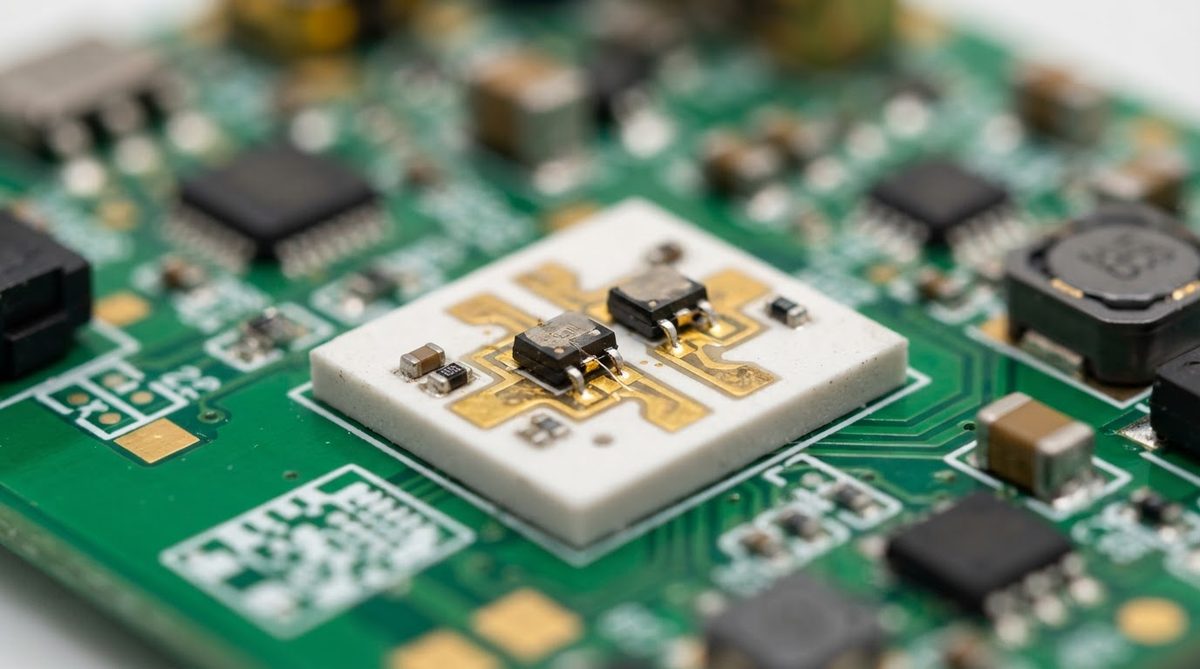
Metallization. DBC bonds 0.3 mm copper foils directly to AlN at ~1065 °C. AMB uses an active braze alloy (typically Ag-Cu-Ti) at ~850 °C and yields higher peel strength (above 8 N/mm vs. ~4–6 N/mm for DBC), which improves reliability under automotive thermal-cycle requirements. AMB is increasingly preferred for AlN in automotive power modules.
Moisture sensitivity. Bare AlN hydrolyzes slowly in humid environments, forming aluminum hydroxide on the surface. Automotive modules must seal or passivate exposed AlN edges. Common approaches include glass passivation or silicone encapsulation per IPC-SM-785 guidelines.
Surface finish. Ni/Au plating (3–5 µm Ni, 0.05–0.5 µm Au) is standard for wire-bondable pads. For solder-attach pads, Ni/Ag or bare Cu with OSP may be used depending on the solder alloy. Polished AlN substrates offer improved surface roughness (Ra < 0.1 µm) for thin-film metallization in sensor applications.
Qualification. Automotive-grade AlN substrates must pass AEC-Q200 passive component stress tests, including 1,000-cycle thermal shock (–55/+150 °C) and 1,000-hour high-temperature storage at 150 °C. The substrate supplier should provide lot-traceable data to support PPAP submissions.
When NOT to Use an AlN PCB in Automotive Electronics
AlN is not always the right answer. Skip it when:
- Heat flux is below ~30 W/cm² and ambient stays under 125 °C. Standard 96% alumina DBC or even aluminum MCPCB handles this at a fraction of the cost.
- Mechanical shock and vibration dominate the failure mode. AlN’s fracture toughness (2.5–3.0 MPa·√m) is roughly half that of Si₃N₄. For substrates bolted to a vibrating engine block, Si₃N₄ AMB may be more reliable.
- Large board area with low component density. An ECU motherboard running a microcontroller at 2 W does not need a ceramic substrate. FR-4 or polyimide flex is appropriate.
- Budget constraints on high-volume consumer-tier parts. At 3–5× the cost of alumina, AlN only makes economic sense where the thermal or reliability requirement cannot be met otherwise.
For modules where thermal demands are moderate but isolation voltage is high, AlN substrates for IGBT modules discusses the trade-off between AlN and alumina in a power-module context.
FAQ
Can automotive electronics AlN PCB assemblies survive –40 °C to +150 °C thermal cycling?
Yes. AlN DBC and AMB substrates routinely pass 1,000+ thermal cycles between –55 °C and +150 °C per JEDEC JESD22-A104. The low CTE mismatch with SiC and Si die is the main reason they survive where organic substrates fail.
Is AlN approved for use under AEC-Q standards?
AlN itself is a material, not a component, so it is not “AEC-Q approved” as such. However, passive substrates and modules built on AlN are qualified to AEC-Q200 or AEC-Q100 by the module manufacturer. The substrate supplier provides material-level test data to support that qualification.
Does AlN degrade in humid underhood environments?
Bare AlN slowly hydrolyzes in the presence of moisture, forming a surface layer of aluminum hydroxide. In sealed power modules with silicone gel or epoxy encapsulation, this is not a practical concern. Exposed AlN edges in unsealed assemblies should be passivated with glass or a conformal coating.
How does AlN compare to Si₃N₄ for EV inverters?
AlN offers roughly 2× the thermal conductivity of Si₃N₄ (170–200 vs. 70–90 W/mK), but Si₃N₄ has roughly 2× the fracture toughness (6–7 vs. 2.5–3.0 MPa·√m). For maximum thermal performance, choose AlN. For maximum mechanical reliability under extreme cycling, choose Si₃N₄. Many Tier 1 suppliers are migrating to Si₃N₄ AMB for next-generation 800 V inverters where cycle life above 3,000 cycles is required.
What is the maximum continuous operating temperature for an AlN substrate?
The ceramic itself is stable above 1,000 °C. The practical limit is set by the metallization and solder or sinter attach. DBC copper on AlN is rated for continuous use up to roughly 300 °C; silver sinter joints can operate to 250–300 °C. Standard SAC305 solder limits the assembly to about 125–150 °C continuous.
Next Step
If your automotive power module or sensor assembly requires AlN substrates, start with material selection and a thermal stack-up review. For volume pricing on AlN blanks or metallized substrates, request a wholesale AlN quote with your panel size, thickness, and annual quantity.