Ceramic PCBs cost roughly 3–10× more per unit than MCPCBs at comparable board sizes, but the gap narrows sharply once you factor in heatsink elimination, longer field life, and higher thermal conductivity. A 25 × 25 mm single-layer MCPCB runs about $0.80–$2.50 in volumes of 1,000; the same footprint on 96% alumina (Al₂O₃) via DPC costs $4–$12, and on aluminum nitride (AlN) $15–$40. Whether that premium pays for itself depends on your thermal budget, reliability target, and production volume.
Key Takeaways
- MCPCB unit prices are 3–10× lower than ceramic for the same board outline, driven mainly by cheaper aluminum-core material and simpler processing.
- Ceramic substrates (24–170 W/mK) outperform standard MCPCBs (1–4 W/mK through the dielectric layer) in thermal resistance, often eliminating a separate heatsink.
- Total cost of ownership can favor ceramic in high-reliability or high-power-density applications where field failures, heatsink hardware, or thermal interface materials dominate system cost.
- Below roughly 5 W/cm² heat flux, MCPCB is almost always the cheaper and adequate choice.
- Prototype quantities amplify the ceramic cost premium because tooling and setup costs are amortized over fewer boards.
What Drives the Price Difference Between Ceramic and MCPCB?
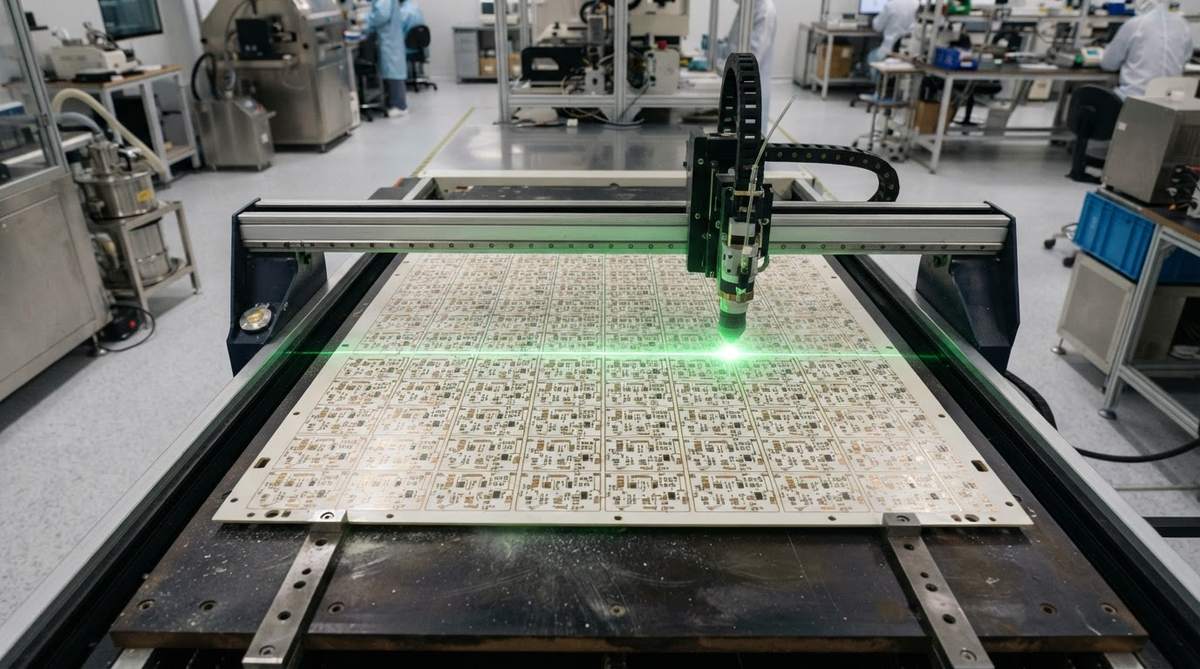
The cost gap has three main sources: raw substrate material, metallization process, and yield loss.
Substrate material. A 1.6 mm aluminum-core panel costs a fraction of an equivalent-area 0.635 mm Al₂O₃ 96% blank. AlN blanks cost another 4–8× above alumina. The ceramic raw material is sintered at 1,600–1,900 °C in controlled atmospheres; aluminum sheet is rolled at commodity scale. That energy and process difference sets the floor price.
Metallization. MCPCBs use standard FR-4-style copper lamination on a dielectric-coated aluminum base. Ceramic boards require specialized processes—DBC vs DPC being the most common trade-off. DBC (direct bond copper) involves high-temperature oxidation bonding; DPC (direct plated copper) uses sputtering and electroplating. Both demand equipment and expertise that a standard PCB shop does not have, adding cost per layer.
Yield. Ceramics are brittle. Handling breakage during singulation, printing, and soldering pushes scrap rates higher than for MCPCBs, especially on thin substrates (≤ 0.38 mm) or complex outlines. Yield losses of 5–15% are typical for ceramic versus 1–3% for MCPCB.
Unit-Cost Ranges: Ceramic PCB Cost vs MCPCB
| Parameter | MCPCB (1-layer, Al core) | Ceramic – Al₂O₃ 96% DPC | Ceramic – AlN DBC |
|---|---|---|---|
| Substrate cost (25 × 25 mm) | $0.05–$0.15 | $0.50–$1.50 | $2.00–$6.00 |
| Metallization + patterning | $0.30–$0.80 | $2.00–$6.00 | $5.00–$15.00 |
| Surface finish (ENIG) | $0.10–$0.30 | $0.30–$0.80 | $0.50–$1.20 |
| Singulation | $0.05–$0.10 | $0.20–$0.60 | $0.30–$0.80 |
| Test + inspection | $0.05–$0.10 | $0.20–$0.50 | $0.30–$0.80 |
| Total per unit (qty 1,000) | $0.80–$2.50 | $4.00–$12.00 | $15.00–$40.00 |
Estimates for single-layer, 25 × 25 mm boards at 1,000-piece volumes. Actual prices vary by supplier, copper thickness, and feature complexity. Request a quote for your specific design.
Thermal Performance Per Dollar: A Worked Example
Consider a 10 W LED module on a 20 × 20 mm substrate. The critical number is thermal resistance from the die-attach pad through the board to the heat-spreading surface (Rth,board).
MCPCB path: 35 µm copper → 75 µm dielectric (typical k ≈ 2–3 W/mK) → 1.5 mm aluminum base. The dielectric layer dominates: Rth = t / (k × A) = 0.000075 / (2.5 × 0.0004) = 0.075 °C/W. With 10 W dissipated, ΔT across the dielectric alone is 0.75 °C. Add spreading resistance and TIM to a heatsink, and total Rth,junction-to-ambient might reach 8–12 °C/W.
Ceramic path (Al₂O₃ 96%, k ≈ 26 W/mK, 0.635 mm thick): Rth = 0.000635 / (26 × 0.0004) = 0.061 °C/W through the substrate. No polymer dielectric layer exists. If the ceramic board is soldered directly to a heat spreader, you skip the TIM entirely, dropping total Rth,junction-to-ambient to 4–7 °C/W.
That 4–5 °C/W improvement lets you either run the LED harder at the same junction temperature or eliminate a finned heatsink. A stamped aluminum heatsink with mounting hardware costs $0.40–$1.50 per unit, plus the thermal grease or pad at $0.10–$0.30. Over 10,000 units, that is $5,000–$18,000 in heatsink cost alone—enough to close or erase the ceramic premium.
Where Volume Changes the Math
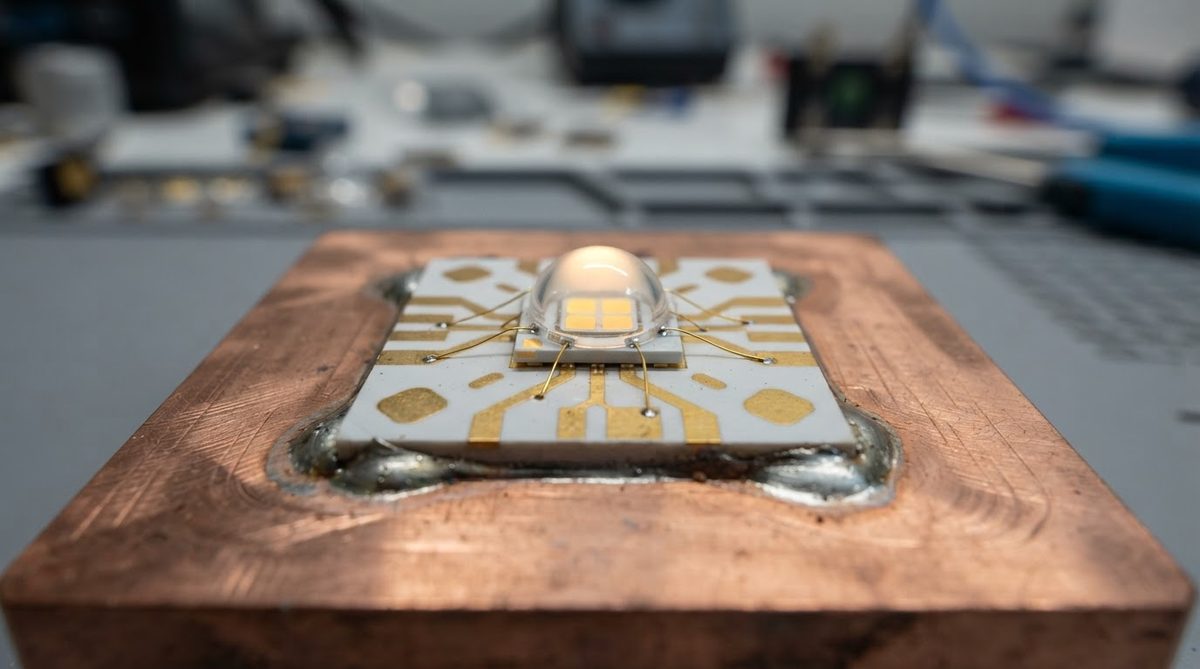
At prototype quantities (5–50 pieces), ceramic NRE and setup charges dominate. Expect $300–$800 in tooling for a ceramic run versus $50–$150 for MCPCB. Per-unit ceramic cost at qty 10 can be 15–20× MCPCB.
At production volumes (10,000+), ceramic per-unit cost drops 40–60% from prototype pricing as tooling amortizes and panel utilization improves. MCPCB pricing also falls, but it starts from a lower baseline, so the ratio compresses to roughly 3–5×. The decision then shifts to total system cost, not bare-board cost.
If you are deciding between a prototype run and a production run, factor in that ceramic prototype lines often use the same process as production, so your prototype validates the final design more faithfully than an MCPCB stand-in would.
Use the estimator below to model lead time and turnaround for your specific board parameters before committing to a substrate type.
[pcb_calc type=”lead-time”]
Total Cost of Ownership: Beyond the Unit Price
Unit price is the number purchasing sees. Total cost of ownership (TCO) is the number the program manager should see. Ceramic TCO advantages appear in three places:
1. Heatsink and TIM elimination. As shown above, this can offset $0.50–$1.80 per unit.
2. Field reliability. Ceramic substrates withstand higher operating temperatures (continuous 300–350 °C for Al₂O₃ vs. 130–150 °C for MCPCB dielectric per IPC-4101 ratings). In automotive under-hood or industrial power applications, fewer thermal-cycling failures mean lower warranty cost. Even a 0.5% annual failure rate reduction on a $200 module saves $1.00 per unit per year in warranty reserves.
3. Assembly density. Ceramic’s dimensional stability and fine-line capability (DPC and thin-film processes achieve 30–50 µm lines) can shrink the board footprint, reducing enclosure size and weight. This matters in aerospace and medical devices where grams and cubic millimeters carry cost.
For LED star boards specifically, the ceramic vs MCPCB trade-off is well documented. If your application is a star board for high-power LEDs, the thermal and optical gains of ceramic often justify the price in lumens-per-dollar terms.
When NOT to Use Ceramic
Ceramic is overkill—and wastefully expensive—in several common scenarios:
- Heat flux below 5 W/cm². Standard MCPCB handles this comfortably. Most single-die indicator LEDs, low-power sensor boards, and general lighting fall here.
- Large board area (> 100 × 100 mm). Ceramic substrate blanks are limited in size, and cost scales roughly with area squared due to yield. A large single-layer MCPCB is far cheaper.
- Cost-driven consumer products. If the BOM target is under $0.50 for the bare board, ceramic cannot compete.
- Mechanical shock and vibration. Ceramics are brittle (flexural strength 300–400 MPa for Al₂O₃ per ASTM C1161, but zero plastic deformation). If the board will see repeated bending or impact, an MCPCB or even standard FR-4 with a metal stiffener is more forgiving.
For a broader substrate comparison including FR-4 and glass options, the ceramic PCB comparison hub covers all major substrate families side by side.
FAQ
Can I prototype on MCPCB and switch to ceramic for production?
You can, but the thermal and electrical behavior will differ enough to require re-validation. The MCPCB dielectric layer (75–150 µm polymer, k ≈ 1–3 W/mK) has different parasitic capacitance and thermal impedance than a 0.635 mm alumina substrate (k ≈ 24–28 W/mK). Prototype on the final substrate if your thermal margin is tight.
Does ceramic PCB cost drop significantly at higher volumes?
Yes. Expect a 40–60% per-unit reduction from qty 50 to qty 10,000 as tooling, setup, and panel utilization amortize. The steepest drop is between 50 and 500 units; above 5,000 the curve flattens.
Is AlN always worth the extra cost over alumina?
No. AlN (170–200 W/mK) costs 4–8× more than 96% alumina (24–28 W/mK). It pays off only when the heat flux exceeds roughly 20 W/cm² or when CTE matching to SiC or GaN die is critical. For most LED and mid-power applications, alumina is sufficient. See the AlN vs Si₃N₄ substrate comparison for a deeper material trade-off.
Are there hidden costs in ceramic PCB assembly?
The main hidden cost is solder-paste printing setup. Ceramic substrates are thinner and more fragile than MCPCB, so they need dedicated stencil fixtures and slower pick-and-place profiles. Budget an extra 10–20% on assembly cost per board for the first run; this drops with operator experience.
What surface finishes are available on ceramic vs MCPCB?
Both support ENIG, ENEPIG, and bare copper (OSP). Ceramic boards also support gold thick-film pads and silver thick-film, which are uncommon on MCPCB. Finish choice affects solderability and wire-bondability but adds only $0.10–$0.50 per unit in either case.