Silicon nitride (Si3N4) is the strongest commercially available ceramic substrate for IGBT modules, with flexural strength of 650–800 MPa and fracture toughness of 6–7 MPa·√m — roughly three to four times tougher than alumina or aluminum nitride. For engineers selecting a silicon nitride Si3N4 PCB IGBT substrate, that mechanical advantage translates directly into longer power-cycling life, which is the primary failure mode in traction inverters, wind converters, and rail drives.
Key Takeaways
- Si3N4 substrates reach thermal conductivities of 70–90 W/mK, lower than AlN (170–200 W/mK) but far above 96% alumina (24–28 W/mK).
- Fracture toughness of 6–7 MPa·√m allows Si3N4 AMB substrates to survive >100,000 active power cycles at ΔTj = 100 K, per Kyocera SN-283 datasheet testing.
- CTE of 2.5–3.3 ppm/K closely matches silicon (2.6 ppm/K), reducing solder-joint fatigue under thermal cycling.
- Si3N4 substrates are typically bonded with copper via Active Metal Brazing (AMB), not DBC, because DBC bond strength is limited on Si3N4.
- Cost is 5–10× higher than Al2O3 DBC substrates, so a silicon nitride Si3N4 PCB IGBT substrate is justified only when reliability requirements exceed what alumina or AlN can deliver.
Why Silicon Nitride Si3N4 PCB IGBT Substrate Designs Outperform Alumina
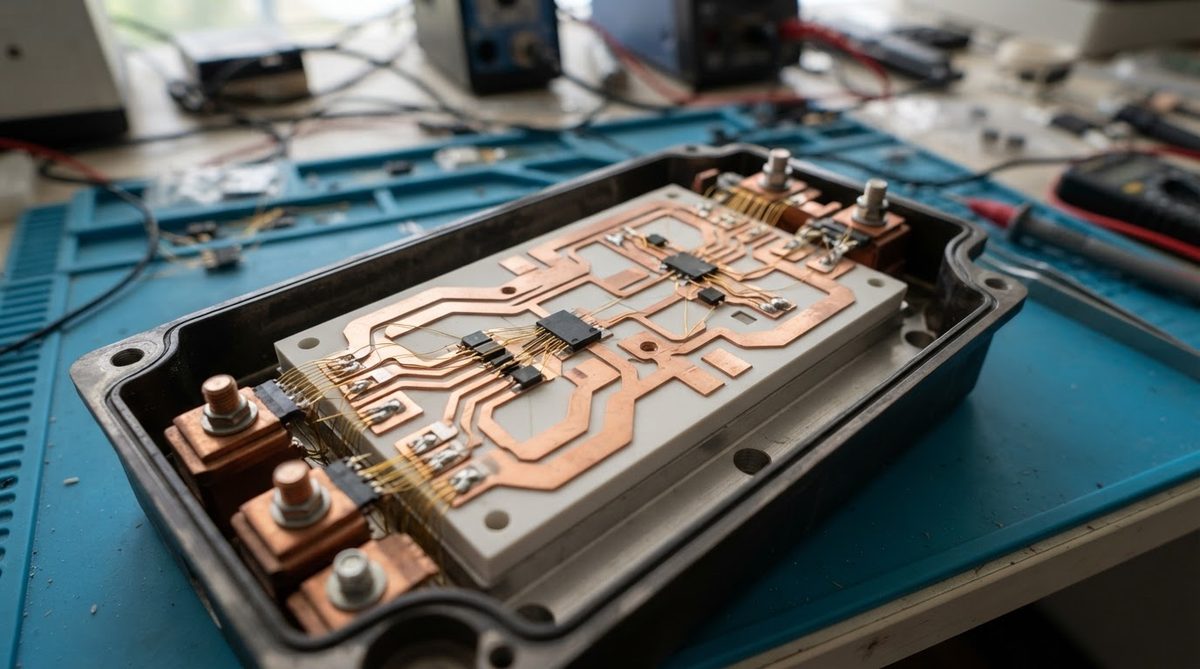
IGBT modules in automotive traction inverters and industrial drives experience rapid, repeated junction temperature swings — often ΔTj of 80–125 K every few seconds. Each swing stresses the bond between copper and ceramic. In alumina (Al2O3) DBC substrates, cracks nucleate at the ceramic surface after 20,000–40,000 cycles at ΔTj = 100 K. AlN DBC performs somewhat better but remains brittle at 3–4 MPa·√m fracture toughness.
Si3N4’s high fracture toughness arrests crack propagation. Published data from CeramTec and Kyocera show Si3N4 AMB substrates exceeding 100,000 power cycles at the same ΔTj without substrate cracking. For automotive-grade ceramic PCBs, this is the difference between a 15-year warranty and a 5-year one.
Si3N4 Material Properties Compared to AlN and Al2O3
| Parameter | Si3N4 | AlN | Al2O3 96% | Unit | Condition | Source |
|---|---|---|---|---|---|---|
| Thermal conductivity | 70–90 | 170–200 | 24–28 | W/mK | 20 °C | Kyocera SN-283 / CoorsTek datasheets |
| Flexural strength | 650–800 | 300–400 | 300–380 | MPa | ASTM C1161, 3-pt bend | Kyocera / CeramTec |
| Fracture toughness (KIC) | 6–7 | 2.5–3.5 | 3–4 | MPa·√m | ASTM C1421 | CeramTec / Maruwa |
| CTE | 2.5–3.3 | 4.5–5.0 | 7.0–8.0 | ppm/K | 20–400 °C | Kyocera / CoorsTek |
| Dielectric strength | 15–18 | 15–17 | 10–15 | kV/mm | AC, 1 mm thick | Manufacturer datasheets |
| Typical substrate thickness | 0.25–0.64 | 0.38–1.0 | 0.38–1.0 | mm | — | Industry standard |
Typical values for commercially available material, for comparison only. Confirm against the datasheet for your specific grade.
The lower thermal conductivity of a silicon nitride Si3N4 PCB IGBT substrate compared to AlN is a real trade-off. However, because Si3N4 substrates can be made thinner — commonly 0.32 mm versus 0.63 mm for AlN — the total thermal resistance through the ceramic layer is comparable. A 0.32 mm Si3N4 substrate at 80 W/mK gives a thermal resistance per unit area of 0.004 K·m²/W. A 0.63 mm AlN substrate at 180 W/mK gives 0.0035 K·m²/W. The difference is under 15%.
Worked Example: Thermal Resistance Through the Substrate
For a single IGBT die footprint of 13 mm × 13 mm (169 mm²) dissipating 150 W:
- Si3N4 (0.32 mm, 80 W/mK): Rth,ceramic = t / (k × A) = 0.00032 / (80 × 0.000169) = 0.024 K/W
- AlN (0.63 mm, 180 W/mK): Rth,ceramic = 0.00063 / (180 × 0.000169) = 0.021 K/W
- Temperature rise through ceramic only: Si3N4 = 150 × 0.024 = 3.5 K. AlN = 150 × 0.021 = 3.1 K.
The 0.4 K difference is negligible in a system where total Rth,j-c is typically 0.15–0.25 K/W. The mechanical reliability gain of a silicon nitride Si3N4 PCB IGBT substrate far outweighs this thermal penalty.
Enter your substrate dimensions, material, and dissipated power below to estimate the thermal resistance for your own IGBT layout.
AMB vs. DBC: Why Bonding Method Matters for Si3N4
Direct Bond Copper (DBC) works by forming a copper-oxide eutectic at the ceramic surface. This process bonds well to Al2O3 and AlN but poorly to Si3N4 because silicon nitride does not form a stable oxide interlayer under standard DBC conditions. The result is weak adhesion and early delamination.
Active Metal Brazing (AMB) uses a titanium-containing brazing alloy (typically AgCuTi) that chemically reacts with the Si3N4 surface, forming a strong TiN reaction layer. AMB bonds on Si3N4 achieve peel strengths above 8 N/mm, compared to 2–4 N/mm for DBC attempts. For IGBT substrate assemblies, AMB on Si3N4 is the standard process used by Infineon, Semikron, and other tier-1 module makers.
AMB also allows thicker copper — 0.3 mm to 0.8 mm is common — which improves current carrying capacity and heat spreading. This is especially relevant for SiC power module substrates, where junction temperatures reach 175–200 °C and thermal stress is even more severe than in silicon IGBT designs.
Where Si3N4 IGBT Substrates Are Used
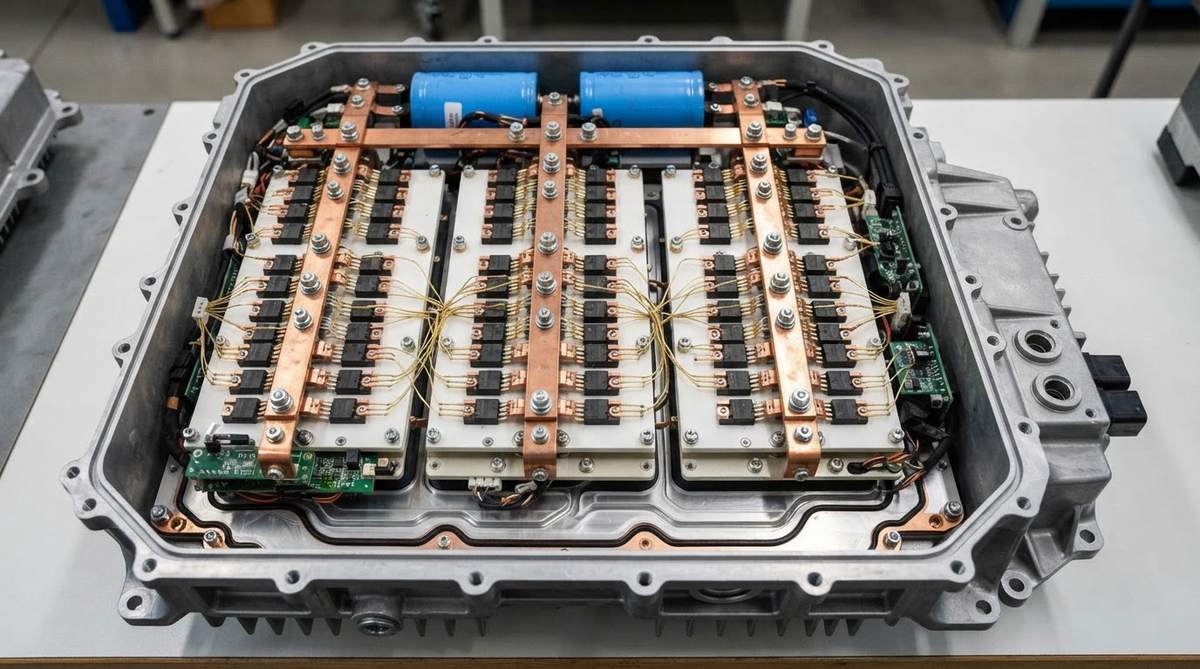
The cost premium of a silicon nitride Si3N4 PCB IGBT substrate limits adoption to applications where failure cost is high or power-cycling demands are extreme:
- EV traction inverters: 1,000,000+ power cycles over vehicle life, ΔTj = 80–125 K.
- Rail traction converters: 30-year service life, vibration, and wide ambient temperature range.
- Wind turbine converters: Remote locations make module replacement extremely expensive.
- Industrial servo drives: High-frequency start/stop cycling in robotic applications.
For designs where thin Si3N4 substrates are needed to minimize package height, 0.25 mm material is available from Kyocera (SN-283) and Toshiba Materials.
When Not to Use Si3N4
Si3N4 is overkill — and overpriced — for many IGBT applications. Choose a different substrate when:
- Power-cycling requirement is under 30,000 cycles at ΔTj ≤ 80 K: Al2O3 DBC handles this reliably at a fraction of the cost.
- Thermal conductivity is the primary constraint: If the module is thermally limited and mechanically fine, AlN DBC at 170–200 W/mK is the better choice.
- Budget is fixed and volume is high: Consumer or low-cost industrial drives rarely justify Si3N4. Standard Al2O3 DBC substrates cost roughly $2–5 per piece versus $15–40+ for Si3N4 AMB of comparable size.
- Operating temperature stays below 125 °C continuously: The CTE-mismatch advantage of Si3N4 matters most at high temperature swings. Mild conditions reduce the reliability gap between ceramics.
Si3N4 for Next-Generation SiC and GaN Modules
SiC MOSFETs and GaN HEMTs push junction temperatures beyond what silicon IGBTs see — up to 200 °C or higher. At these temperatures, the CTE mismatch between copper and ceramic generates much larger thermomechanical stress. Si3N4’s combination of low CTE (close to Si and SiC), high toughness, and adequate thermal conductivity makes the silicon nitride Si3N4 PCB IGBT substrate platform the default choice for next-generation wide-bandgap power modules. Infineon’s HybridPACK Drive and several Bosch traction inverter platforms already use Si3N4 AMB substrates in production vehicles. For more on Si3N4-based SiC power modules, see our dedicated application page.
Frequently Asked Questions
Can Si3N4 substrates handle lead-free solder reflow?
Yes. Si3N4 withstands peak reflow temperatures of 260 °C and above without damage. Its low CTE also reduces warpage during reflow compared to Al2O3 substrates, improving solder joint coplanarity on large modules.
Is Si3N4 available with silver sintering instead of solder attach?
Yes. Silver sintering (pressureless or pressure-assisted) bonds directly to the AMB copper surface. This is increasingly common in SiC modules where solder fatigue is a concern at 175–200 °C junction temperatures. The Si3N4 substrate itself is unaffected by the sintering process temperatures (around 250–300 °C).
What thickness of Si3N4 should I specify for an IGBT substrate?
0.32 mm is the most common choice for automotive IGBT and SiC modules. It balances isolation voltage (typically >5 kV AC for 0.32 mm), thermal resistance, and mechanical strength. For higher isolation requirements, 0.50 mm and 0.64 mm are available.
Does Si3N4 meet automotive AEC-Q qualification?
AEC-Q200 covers passive components, not bare substrates. However, Si3N4 AMB substrates are qualified as part of power modules that pass AQG 324 (ECPE guideline for automotive power modules), which includes power cycling, thermal shock (−40 to +150 °C, 1,000 cycles), and humidity testing. The substrate must be qualified within the module, not standalone.
How does Si3N4 compare to ZTA (zirconia-toughened alumina)?
ZTA offers improved toughness over standard Al2O3 (fracture toughness around 4.5–5.5 MPa·√m) at a lower cost than Si3N4. However, ZTA’s thermal conductivity is only 24–28 W/mK, and its CTE (~8 ppm/K) is much higher than silicon. For IGBT modules with severe power cycling, a silicon nitride Si3N4 PCB IGBT substrate remains the stronger choice.
Next Step
If your IGBT or SiC module design requires Si3N4 AMB substrates, send your layout files and power-cycling specification for a substrate quotation. AluminaPCB supplies Si3N4 substrates with AMB copper metallization in prototype and production volumes.