A bare, unmetallized ceramic substrate has no meaningful shelf life limit — alumina, aluminum nitride, and silicon nitride are chemically inert and do not degrade in storage. The practical shelf life of a metallized ceramic PCB is set by its surface finish, not the ceramic itself. An ENIG-finished board stored in a sealed moisture-barrier bag at <30 °C and <60% RH will remain solderable for 12 months. Exceed those conditions and you risk pad oxidation, intermetallic growth, or moisture absorption into thick-film layers that causes solder defects at reflow.
Why Ceramic Substrates Themselves Don’t Expire
Ceramics such as 96% alumina (Al₂O₃) and aluminum nitride (AlN) are oxide or nitride compounds already in a thermodynamically stable state. They do not absorb moisture into the bulk, do not outgas, and do not support fungal growth. A crate of bare alumina substrates stored in a warehouse for ten years will measure the same dielectric constant and flexural strength as the day they were fired.
This is fundamentally different from FR-4, where the epoxy-glass laminate absorbs moisture at 0.10–0.20% by weight and must be baked before lead-free reflow if stored beyond its moisture sensitivity level (MSL) window per IPC/JEDEC J-STD-033.
What Actually Limits Ceramic PCB Shelf Life
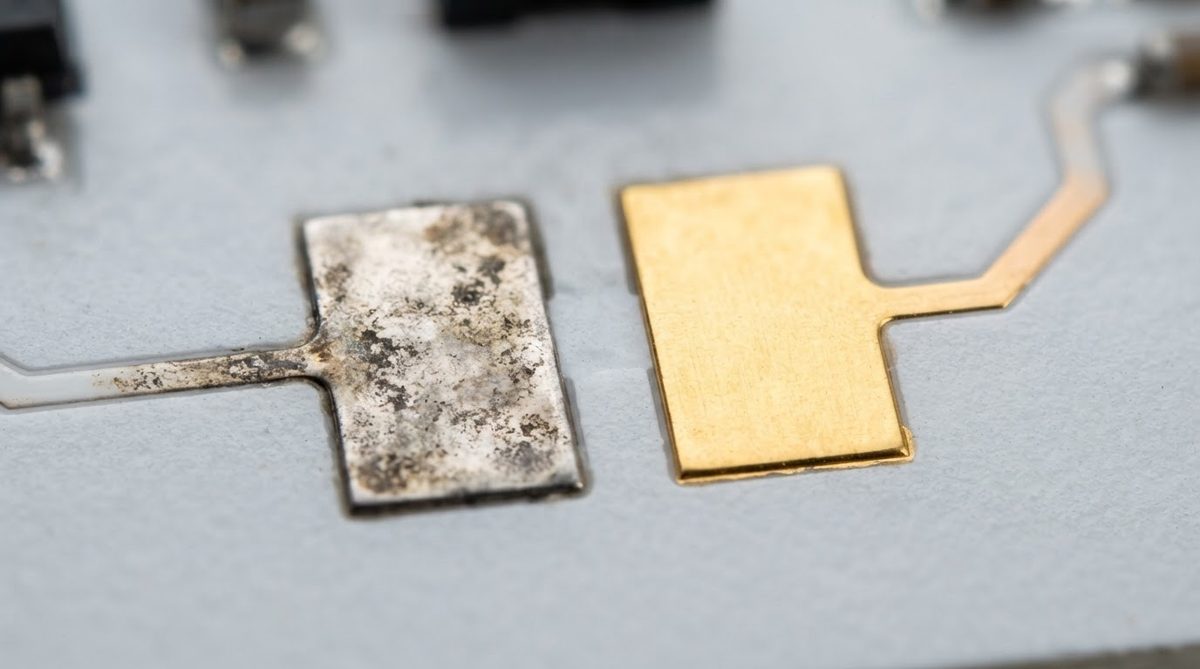
Once metal is applied — whether by DPC, DBC, thick film, or thin film — two degradation mechanisms start the clock:
- Surface finish oxidation. Exposed copper or nickel reacts with atmospheric oxygen and sulfur compounds. The rate depends on temperature, humidity, and pollutant concentration.
- Intermetallic growth in plated finishes. In ENIG, the nickel-gold interface slowly forms Ni₃Sn₄ intermetallics even at room temperature. After extended storage, the solder joint strength drops.
The ceramic underneath is unaffected. If a finish degrades beyond recovery, the substrate can often be stripped and replated — something impossible with an organic laminate.
Shelf Life by Surface Finish
| Surface Finish | Shelf Life (sealed MBB, <30 °C, <60% RH) | Shelf Life (open air, shop floor) | Primary Failure Mode |
|---|---|---|---|
| Bare copper (OSP-free) | 1–2 weeks | Days | Cu oxidation, tarnish |
| OSP over copper | 6 months | ~3 months | OSP breakdown, Cu oxidation |
| ENIG | 12 months | 6 months | Ni oxidation under Au, black-pad risk |
| ENEPIG | 12 months | 6 months | Pd diffusion, Ni corrosion |
| Electrolytic Au (hard gold) | 24+ months | 12+ months | Contamination, not oxidation |
| Ag (thick-film fired) | 6–9 months | 2–4 months | Ag tarnish (Ag₂S), solder dewetting |
Typical values based on IPC J-STD-003 solderability requirements and industry practice. Confirm with your specific finish supplier’s datasheet.
Recommended Storage Conditions
Follow IPC/JEDEC J-STD-033D guidelines adapted for ceramic substrates:
- Temperature: 15–30 °C. Avoid thermal cycling that causes condensation on metal surfaces.
- Humidity: <60% RH. Below 40% RH is ideal for silver-finished boards.
- Packaging: Vacuum-sealed moisture-barrier bags (MBB) with desiccant and a humidity indicator card (HIC). Re-seal after partial use.
- Atmosphere: Nitrogen-purged bags add margin for silver and bare-copper finishes by displacing oxygen and sulfur compounds.
- Handling: Wear lint-free gloves. Skin oils accelerate tarnish on silver and copper.
When to Rebake a Ceramic PCB Before Assembly
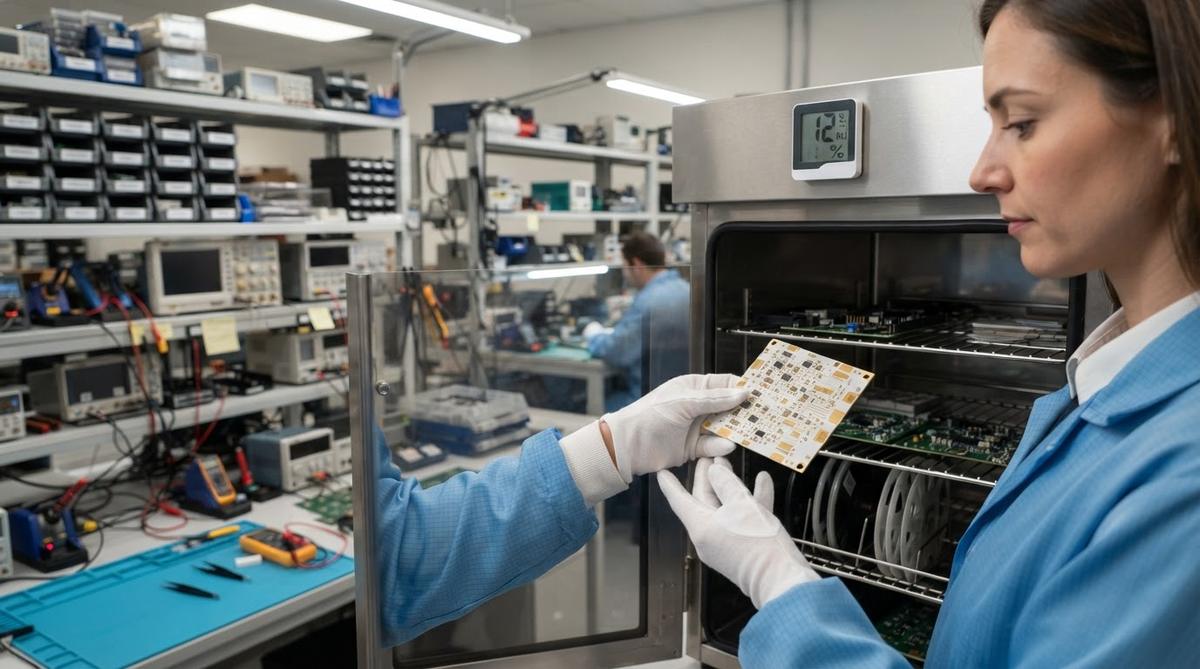
Ceramic substrates absorb negligible bulk moisture, so the aggressive bake profiles used for FR-4 (125 °C for 4–8 hours per IPC-1601) are unnecessary for the substrate itself. However, thick-film dielectric or resistor pastes can absorb surface moisture, and flux residues from prior process steps trap water. A conservative rebake protocol:
- Thick-film boards stored >6 months or exposed to >60% RH: Bake at 125 °C for 2 hours in a clean oven.
- DBC/AMB boards with no organic layers: Rebake is generally unnecessary. A 30-minute preheat at 100 °C before reflow is sufficient to drive off surface condensation.
- Any board with visible tarnish or discoloration on pads: Test solderability per IPC J-STD-003 (wetting balance or dip-and-look) before committing to production assembly.
How to Tell if a Stored Ceramic PCB Is Still Good
Visual inspection catches the obvious cases — green-brown tarnish on copper, yellow-brown haze on silver. Subtler degradation requires testing. A wetting balance test per IPC J-STD-003 measures solder spread force versus time and gives a pass/fail against a defined wetting threshold. If your lot fails, options include chemical cleaning, plasma treatment, or replating the finish.
For boards with ceramic material grades like AlN, also check for surface hydrolysis. AlN reacts slowly with water vapor to form aluminum hydroxide, which appears as a white powdery residue. This degrades thermal conductivity at the interface. If AlN boards were stored unsealed in a humid environment, inspect under 10× magnification and wipe with isopropyl alcohol. Persistent white residue means the surface needs lapping or is scrap.
When Storage Isn’t the Real Problem
If you are building fewer than 50 boards per year and worrying about shelf life, the better strategy is to order closer to your assembly date rather than stockpiling. Ceramic PCB lead times for prototypes are typically 2–4 weeks, short enough to avoid long storage entirely. For high-reliability programs (aerospace, implantable medical), many specs require boards to be assembled within 6 months of manufacture regardless of storage conditions — check your program’s requirements before warehousing inventory.
If your application uses standard FR-4 or metal-core PCBs and you landed here by accident, note that organic laminates have stricter moisture sensitivity rules. Ceramic is the easier material to store. For help deciding whether ceramic suits your project, see our guide on when ceramic PCBs are worth the cost.
Frequently Asked Questions
Does a ceramic PCB absorb moisture like FR-4?
No. Fired ceramic substrates (Al₂O₃, AlN, Si₃N₄) have near-zero moisture absorption — typically <0.01% by weight. The moisture concern applies only to thick-film paste layers and surface finishes, not the substrate bulk.
Can I use a ceramic PCB that has been in storage for two years?
It depends on the surface finish. Hard-gold-finished boards stored in sealed moisture-barrier bags are likely fine. ENIG or silver finishes stored that long should be solderability-tested per IPC J-STD-003 before assembly. The ceramic substrate itself is unaffected by age.
Do I need a dry cabinet for ceramic PCBs?
A dry cabinet (<5% RH) extends shelf life significantly and is recommended if you store boards for more than a few months. It is especially valuable for silver-finished boards, which tarnish quickly in ambient air. For short-term storage under three months, sealed MBBs with desiccant are sufficient.
Is AlN more sensitive to storage conditions than alumina?
Yes. Aluminum nitride undergoes slow surface hydrolysis when exposed to moisture, forming aluminum hydroxide. This does not affect alumina. Store AlN boards in nitrogen-purged, sealed bags and inspect for white surface residue before use.
Can I strip and replate a ceramic PCB whose finish has degraded?
In most cases, yes. Because the ceramic substrate is chemically resistant to plating chemistries, a degraded ENIG or silver finish can be stripped and reapplied. This is a significant advantage over organic PCBs, where stripping damages the laminate. Confirm with your manufacturer that the metallization adhesion layer is intact before replating.