DPC Definition: What Is Direct Plated Copper?
DPC (Direct Plated Copper) is a metallization process that deposits copper directly onto a fired ceramic substrate using vacuum sputtering followed by photolithographic patterning and electroplating. The DPC definition centers on this distinction: copper is built up from a thin sputtered seed layer rather than bonded as a pre-formed foil. That approach achieves trace and space widths as fine as 20 µm — far tighter than thick-film or DBC methods. Understanding the DPC definition is essential when evaluating ceramic metallization options for fine-pitch designs.
How the DPC Process Works
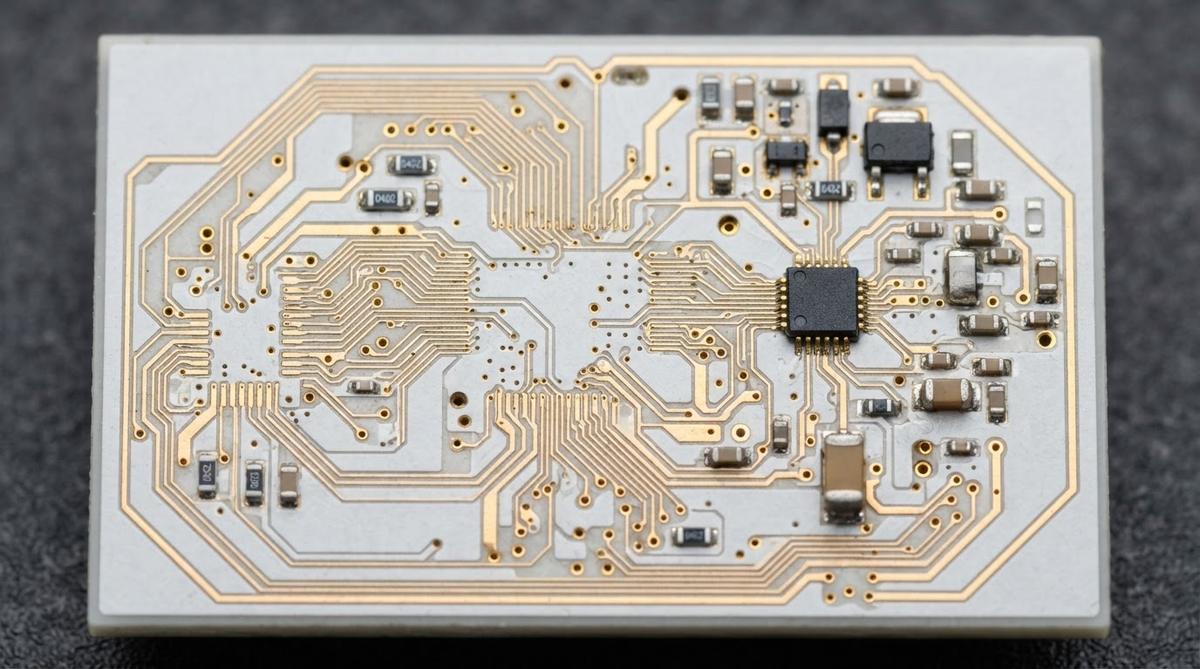
- Substrate preparation. A fired Al₂O₃ (96 % or 99.6 %) or AlN ceramic is cleaned and plasma-treated to improve adhesion.
- Sputtering. A thin adhesion layer (typically Ti or Cr, ~50–200 nm) and a copper seed layer (~200–500 nm) are deposited by magnetron sputtering under vacuum.
- Photolithography. Photoresist is applied, exposed through a mask, and developed to define the circuit pattern.
- Electroplating. Copper is electroplated through the photoresist openings to the target thickness, commonly 10–100 µm.
- Strip and etch. The resist is stripped, and the exposed seed and adhesion layers are etched away, leaving isolated traces.
- Finish. A surface finish such as ENIG or ENEPIG is applied for solderability.
These steps are what give the DPC definition its practical meaning: every trace is photolithographically defined, so position accuracy reaches ±5 µm.
DPC vs. Other Ceramic Metallization Methods
| Parameter | DPC | DBC | Thick Film |
|---|---|---|---|
| Min trace/space | ≤ 20 µm | ~150–300 µm | ~100–150 µm |
| Copper thickness | 10–100 µm | 127–635 µm (5–25 mil) | 10–25 µm (printed) |
| Bond mechanism | Sputtered adhesion layer | Cu–O eutectic bond | Glass-frit or oxide bond |
| Typical substrates | Al₂O₃, AlN | Al₂O₃, AlN, Si₃N₄ | Al₂O₃, LTCC |
| Current-carrying capacity | Moderate | High | Low–moderate |
Typical values for commercially available material, for comparison only. Confirm against the datasheet for your specific grade.
The comparison above highlights why the DPC definition matters in practice. DPC fills the gap between thick-film’s limited resolution and DBC’s bulk copper capability, giving designers fine-pitch routing on a thermally superior ceramic base.
When DPC Is the Right Choice
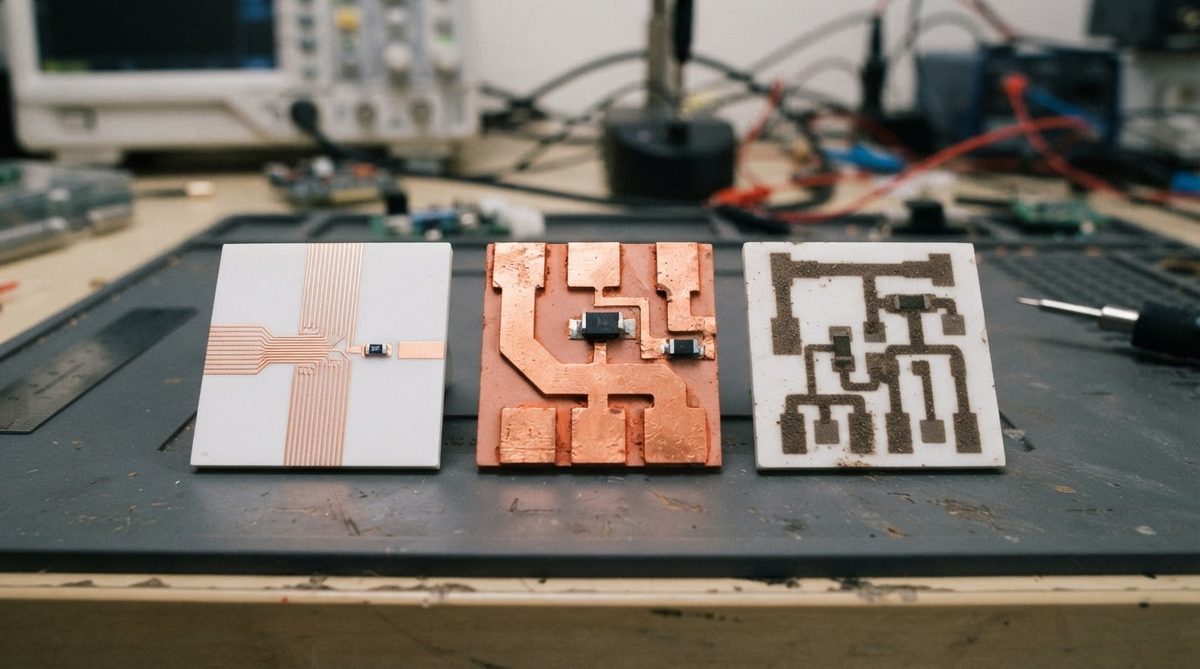
DPC suits applications that need fine-pitch routing on a ceramic base: LED submounts, RF and microwave circuits, MEMS sensor carriers, and high-density power modules where trace precision matters more than bulk current capacity. Its photolithographic patterning holds ±5 µm position accuracy, which is essential for flip-chip and wire-bond pad placement.
When DPC Is Not the Right Choice
If your design carries hundreds of amps through wide copper planes, DBC or AMB with 300–635 µm copper is a better fit. For simple, low-cost heater or resistor circuits, thick-film printing is cheaper. The DPC definition implies vacuum deposition and photolithography steps that add cost, so the process only pays off when you need the resolution it provides.
FAQ
Does DPC work on aluminum nitride?
Yes. AlN is one of the most common DPC substrates, used where both fine traces and high thermal conductivity (170–200 W/mK) are required.
Can DPC copper be thick enough for power applications?
DPC copper is typically plated up to 100 µm. That handles moderate power, but for high-current busbars above ~50 A, DBC’s 300+ µm copper is more practical.
Is DPC the same as thin-film metallization?
DPC is a subset of thin-film processing. Both use sputtering, but the DPC definition specifically refers to the copper circuit formed by sputter-seed plus electroplating, whereas thin-film can also mean resistive or dielectric layers deposited by PVD or CVD.
What surface finishes work on DPC boards?
Standard PCB finishes apply: ENIG, ENEPIG, OSP, and immersion silver are all compatible. The choice depends on your assembly method and shelf-life requirements.