An aluminum nitride AlN PCB for high power LED applications is the preferred substrate when a single package dissipates more than roughly 3–5 W and junction temperature is the binding design constraint. AlN offers 170–200 W/mK thermal conductivity at 25 °C—six to eight times higher than 96% alumina (24–28 W/mK)—letting designers push drive currents higher without exceeding the LED manufacturer’s maximum Tj. Where standard MCPCB dielectric layers conduct only 1–2 W/mK, an aluminum nitride AlN PCB high power LED board makes the substrate nearly transparent to heat flow.
Key Takeaways
- AlN substrates conduct heat at 170–200 W/mK (25 °C, per Maruwa and Kyocera datasheets), compared with 24–28 W/mK for 96% Al₂O₃ and 1–2 W/mK for standard MCPCB dielectric layers.
- The CTE of AlN (4.3–4.7 ppm/°C) closely matches GaN-on-SiC and GaN-on-sapphire LED dies, reducing solder-joint fatigue during thermal cycling.
- AlN costs roughly 3–5× more per unit area than 96% alumina, so it is justified only when thermal headroom is the binding constraint.
- For LEDs below about 1–2 W, standard alumina or even FR-4 metal-core boards are usually sufficient and far cheaper.
Why Aluminum Nitride AlN PCB High Power LED Designs Outperform Alternatives
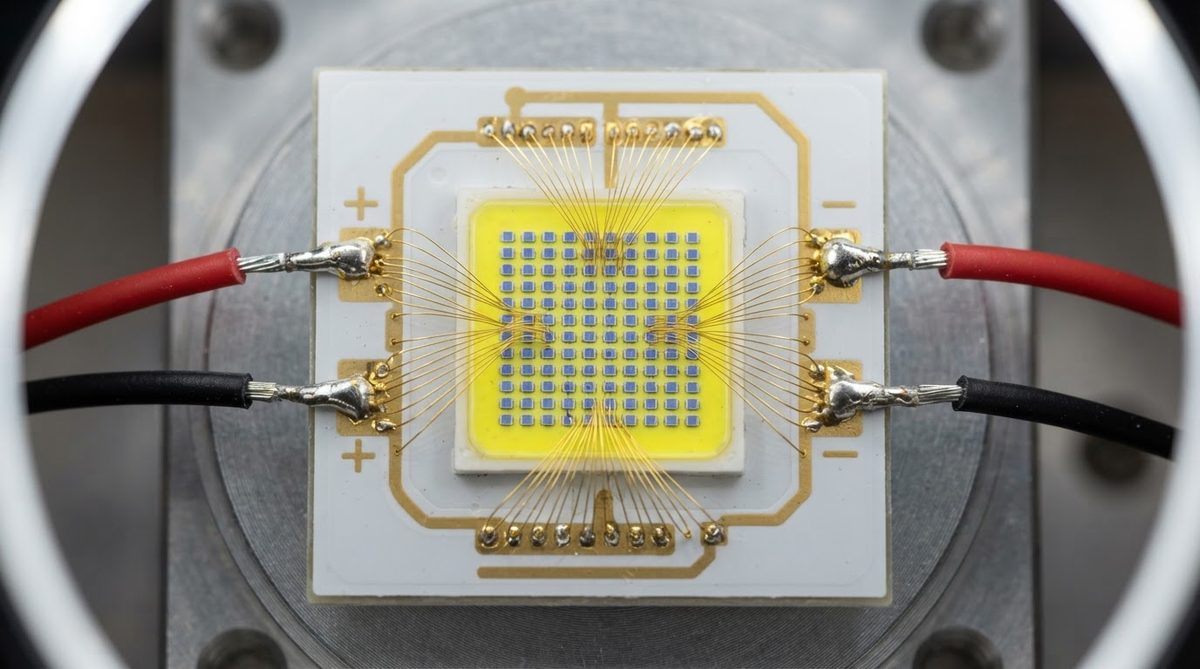
High-power LED packages—COB arrays, UV-C emitters, automotive headlamp dies—convert 50–70% of input electrical power to heat. That heat must travel through the substrate to a heatsink before the junction temperature climbs past the rated limit, typically 125–150 °C for white LEDs and as low as 80–100 °C for some UV-C dies. The substrate’s bulk thermal conductivity and thickness are the two variables the board designer controls.
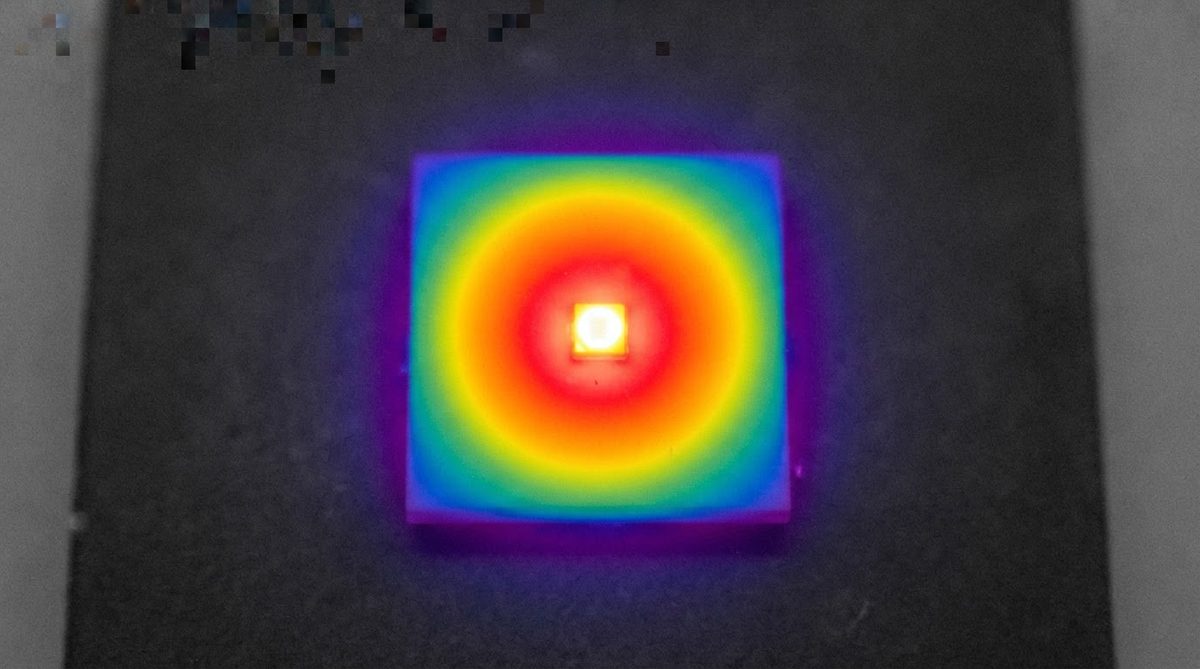
AlN’s 170–200 W/mK makes the substrate itself nearly transparent to heat flow. A 0.635 mm AlN substrate under a 3 mm × 3 mm LED die adds only about 0.5–0.7 °C/W of thermal resistance. The same geometry in 96% alumina adds roughly 3.5–4.5 °C/W. That difference determines whether you can drive an LED at 1 A or must derate to 700 mA. This is why an aluminum nitride AlN PCB for high power LED modules has become the standard choice in demanding thermal applications.
Worked Example: Junction Temperature on AlN vs. Alumina
Consider a single high-power LED die dissipating 10 W over a 3 mm × 3 mm footprint, soldered to a 0.635 mm thick substrate. We estimate the one-dimensional conductive thermal resistance through the substrate as Rth = t / (k × A).
| Parameter | AlN | 96% Al₂O₃ | Unit |
|---|---|---|---|
| Thermal conductivity (k) | 180 | 26 | W/mK |
| Substrate thickness (t) | 0.635 | 0.635 | mm |
| Die footprint area (A) | 9 | 9 | mm² |
| Rth, substrate | 0.39 | 2.72 | °C/W |
| ΔT across substrate at 10 W | 3.9 | 27.2 | °C |
Typical values for commercially available material, for comparison only. Confirm against the datasheet for your specific grade.
With a heatsink base at 60 °C, the AlN path yields a substrate-surface temperature of about 64 °C, leaving ample headroom below a 150 °C junction limit. The alumina path reaches 87 °C at the substrate surface alone—before adding die-attach and junction-to-case resistance. In practice, this often forces a lower drive current or a larger, more expensive heatsink.
Enter your substrate area, thickness, and dissipated power below to estimate junction temperature rise for your own LED design.
AlN Substrate Properties Relevant to LED Design
| Property | Value | Unit | Condition / Standard | Source |
|---|---|---|---|---|
| Thermal conductivity | 170–200 | W/mK | 25 °C, laser flash (ASTM E1461) | Maruwa / Kyocera datasheets |
| CTE | 4.3–4.7 | ppm/°C | 25–400 °C | CoorsTek |
| Dielectric strength | 14–17 | kV/mm | 25 °C, ASTM D149 | Kyocera |
| Flexural strength | 300–400 | MPa | 3-pt bend, ASTM C1161 | Maruwa |
| Volume resistivity | >1014 | Ω·cm | 25 °C | Kyocera |
| Max continuous use temp. | ~1 000 | °C | Inert / N₂ atmosphere | CoorsTek |
| Reflectance (polished surface) | ~70–80 | % | Visible range, surface dependent | Maruwa |
Typical values for commercially available material, for comparison only. Confirm against the datasheet for your specific grade.
AlN’s high reflectance in the visible spectrum is a secondary benefit for LED applications: light emitted downward or sideways reflects off the substrate surface rather than being absorbed, improving overall luminaire efficiency by a few percent.
Metallization Options for LED Die Attach
AlN substrates for high-power LEDs are typically metallized using thin-film sputtering (Ti/Pt/Au or Ti/Ni/Au) or DPC (direct plated copper) processes. Thin-film metallization gives fine-pitch capability down to 20–30 µm lines, useful for multi-die arrays. DPC provides thicker copper (up to ~100 µm) for better lateral heat spreading when the die footprint is small relative to the board area.
Die attach is usually AuSn solder (80/20, melting at 280 °C) or SAC305 for cost-sensitive designs. AuSn delivers lower thermal resistance at the solder interface—roughly 0.1–0.3 °C/W for a 3 × 3 mm die—but costs significantly more. For LEDs below 5 W, SAC305 or even silver-filled epoxy may be adequate.
AlN vs. Alumina vs. MCPCB for High-Power LEDs
| Parameter | AlN | 96% Al₂O₃ | MCPCB (1.5 W/mK dielectric) |
|---|---|---|---|
| Thermal conductivity | 170–200 W/mK | 24–28 W/mK | 1–2 W/mK (dielectric layer) |
| CTE | 4.3–4.7 ppm/°C | 6.5–7.2 ppm/°C | ~17 ppm/°C (aluminum base) |
| Dielectric strength | 14–17 kV/mm | 8–10 kV/mm | 3–6 kV/mm |
| Relative cost (per cm²) | 5–8× | 1× (baseline) | 0.3–0.5× |
| Typical max LED power density | >50 W/cm² | 5–15 W/cm² | 1–5 W/cm² |
Cost multiples are approximate and depend on volume, metallization, and panel size.
The CTE match between AlN (4.3–4.7 ppm/°C) and GaN-based LED dies (~3.2–5.6 ppm/°C depending on substrate) reduces thermo-mechanical stress during on/off cycling. This matters most for automotive and outdoor lighting where the LED may cycle thousands of times per day across a wide ambient range. Choosing an aluminum nitride AlN PCB for high power LED arrays in these environments extends solder-joint life significantly.
Common High-Power LED Applications on AlN
AlN substrates are standard in UV and UV-C LED modules, where die-level power densities are high and organic substrates degrade under UV exposure. For a detailed look at UV-specific requirements, see AlN substrates for UV and UV-C LEDs.
Other frequent uses include automotive adaptive headlamps (multi-die arrays at 20–50 W total), surgical and endoscopic illumination, industrial curing systems, and high-lumen projector light engines. In each case, the common thread is a power density that exceeds what alumina or MCPCB can handle within the allowed junction temperature.
When Not to Use AlN for Your LED Board
AlN is overkill—and an unnecessary cost—for LEDs operating below roughly 1–2 W per package, or where the total board dissipation is under 3–5 W and a reasonable heatsink is available. In those cases, 96% alumina ceramic or even a good-quality MCPCB will keep junction temperatures within spec at a fraction of the cost. For a broader comparison of ceramic substrates for high-power LEDs, including alumina options, start there.
AlN is also brittle (fracture toughness ~2.5–3.0 MPa·m½). If your luminaire design subjects the board to mechanical shock or flexure—portable work lights, for example—consider a metal-core board or an alumina substrate with greater thickness. And if your design requires very large panel sizes (above ~120 mm × 120 mm), AlN panel availability and cost may push you toward tiled alumina sub-mounts on a metal carrier.
Design Tips for AlN LED Substrates
- Keep substrate thickness at 0.25–0.635 mm. Thinner substrates reduce thermal resistance but are more fragile during assembly. 0.385 mm is a common compromise.
- Use thermal vias only if you need lateral spreading. AlN’s bulk conductivity is high enough that through-substrate vias are rarely needed for single-die packages. Multi-die arrays with wide spacing benefit from copper-filled vias.
- Specify surface roughness. A polished AlN surface (Ra < 0.1 µm) improves reflectance and solder wetting. Lapped surfaces (Ra 0.3–0.5 µm) are cheaper but absorb more downward-emitted light.
- Control solder voiding. Voids under the die act as thermal insulators. Target <5% void area per IPC-7095, verified by X-ray inspection.
Frequently Asked Questions
How much does an AlN LED substrate cost compared to alumina?
AlN substrates typically cost 3–5× more per unit area than 96% alumina in production volumes. The exact premium depends on substrate size, metallization type, and order quantity. For low-volume prototypes, the gap can widen to 6–8×.
Can I reflow-solder components onto an AlN PCB?
Yes. AlN substrates with DPC or thin-film metallization are fully compatible with standard SAC305 reflow profiles (peak 245–250 °C). AuSn reflow requires a higher peak temperature (~310 °C) and is typically done in a nitrogen atmosphere to prevent oxidation.
Does AlN degrade under UV exposure?
No. AlN is an inorganic ceramic and does not yellow or delaminate under UV or UV-C radiation, unlike organic MCPCB dielectrics. This is one of the primary reasons AlN is chosen for UV LED substrates.
What surface finish should I specify for LED die attach?
For AuSn eutectic die attach, specify a thin-film Au finish (typically Ti/Pt/Au or Ti/Ni/Au) with a minimum 0.5 µm Au top layer. For SAC305 solder, ENIG or electroless Ni/Au over DPC copper works well and is more cost-effective.
Is AlN suitable for COB (chip-on-board) LED arrays?
AlN is excellent for COB arrays up to roughly 50–100 W total dissipation on a single substrate. Beyond that power level, the substrate size required may exceed standard AlN panel limits, and a tiled approach—multiple AlN sub-mounts on an aluminum or copper carrier—is more practical.
Next Step
If your LED design dissipates more than 3–5 W per package or operates in the UV range, an aluminum nitride AlN PCB for high power LED use is likely the right substrate. Review the full range of ceramic PCB solutions to see how AlN fits alongside other materials, then request a quote with your Gerber files or substrate drawing for a specific price and lead time.