Why UV and UV-C LEDs Need Aluminum Nitride AlN PCB Substrates
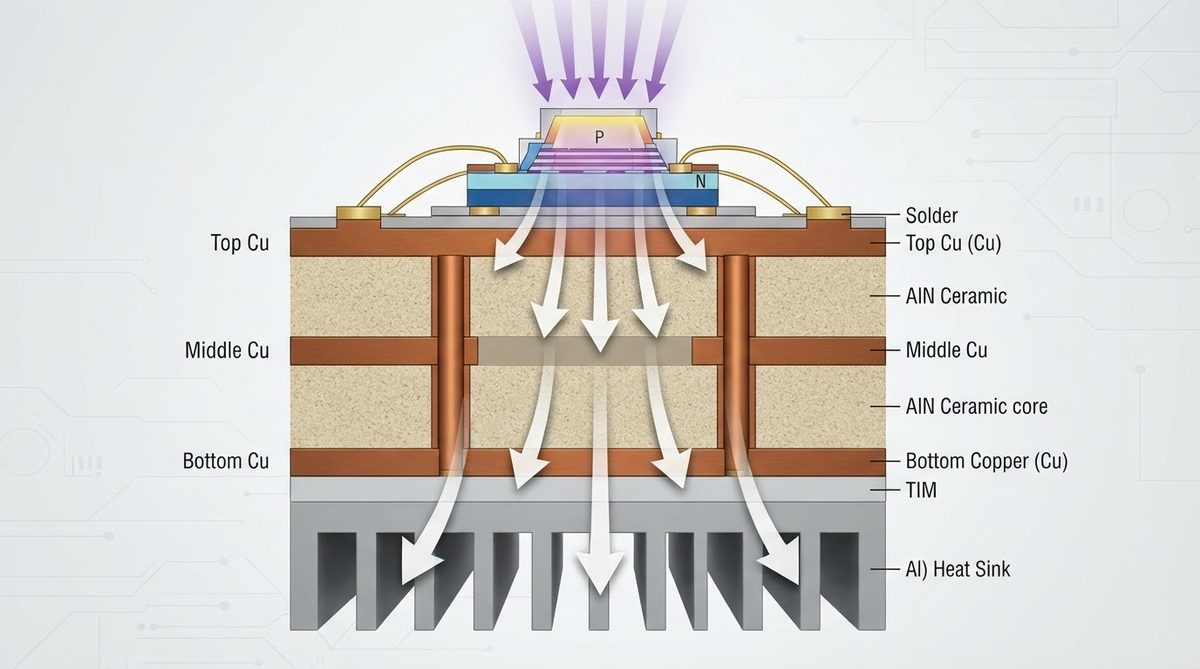
Aluminum nitride AlN PCB substrates are the standard choice for UV LED PCB modules because AlN combines high thermal conductivity (170–200 W/mK) with near-total resistance to UV-induced degradation. UV-C LEDs operating at 200–280 nm wavelengths convert only 3–10% of input power to light; the remaining 90–97% becomes heat concentrated in a die area often smaller than 1 mm². That thermal density demands a substrate that can move heat fast, and AlN does this 6–8× better than 96% alumina.
Equally important, AlN does not yellow, crack, or delaminate under prolonged UV-C exposure. Organic substrates like FR-4 and metal-core PCBs with polymer dielectric layers break down within hundreds of hours at these wavelengths. Even silicone-based encapsulants fail. AlN is purely inorganic and transparent to deep-UV photons, so reflected and scattered UV energy does not attack the substrate itself.
Material Properties That Matter for Aluminum Nitride AlN PCB UV LED PCB Design
| Parameter | AlN | Al₂O₃ 96% | Unit | Condition | Source |
|---|---|---|---|---|---|
| Thermal conductivity | 170–200 | 24–28 | W/mK | 20 °C | Kyocera / CoorsTek datasheets |
| CTE | 4.4–4.7 | 6.5–7.2 | ppm/°C | 20–400 °C | Kyocera SH-30 |
| Dielectric strength | 14–17 | 10–15 | kV/mm | 25 °C, per ASTM D149 | CoorsTek |
| UV transmittance (260 nm) | <1% at 0.38 mm | 0% | % | 0.38 mm thick | Maruwa |
| Flexural strength | 300–400 | 300–380 | MPa | ASTM C1161 | CeramTec |
| Surface roughness (lapped) | 0.1–0.3 | 0.2–0.5 | µm Ra | Lapped finish | Maruwa |
Typical values for commercially available material, for comparison only. Confirm against the datasheet for your specific grade.
The CTE of AlN (4.4–4.7 ppm/°C) closely matches GaN-on-sapphire UV-C LED dies (sapphire CTE ≈ 7.5 ppm/°C, GaN ≈ 5.6 ppm/°C). This reduces solder-joint stress during thermal cycling compared with alumina (6.5–7.2 ppm/°C) or copper MCPCB (17 ppm/°C). For arrays operating in continuous on/off disinfection cycles, that CTE match directly extends solder-joint lifetime.
Thermal Design: A Worked Example for a UV-C LED Array on an AlN PCB
Consider a 10-die UV-C LED module. Each die dissipates 2 W of heat (total 20 W) across a 10 × 10 mm footprint on a 0.635 mm thick aluminum nitride AlN PCB substrate.
Thermal resistance through the substrate:
Rth = t / (k × A) = 0.000635 m / (180 W/mK × 0.0001 m²) = 0.035 °C/W
Temperature rise across the substrate at 20 W: ΔT = 20 × 0.035 = 0.7 °C.
Now the same calculation with 96% alumina (k = 26 W/mK):
Rth = 0.000635 / (26 × 0.0001) = 0.244 °C/W → ΔT = 20 × 0.244 = 4.9 °C.
The 4.2 °C difference may seem small in isolation, but UV-C LED wall-plug efficiency drops roughly 1–2% per °C of junction temperature rise above 25 °C (per Nichia and Seoul Viosys application notes). At 20 W dissipation, that 4.2 °C costs you measurable output power and accelerates lumen depreciation. In a water-purification reactor running 24/7, the cumulative lifetime impact is significant.
Enter your substrate dimensions, material, and dissipated power below to estimate junction temperature rise for your own UV LED PCB design.
UV Degradation Resistance: Why Organic Substrates Fail and AlN PCBs Survive
UV-C photons at 265 nm carry about 4.7 eV of energy, enough to break C–C and C–O bonds in epoxy, polyimide, and silicone. FR-4 and metal-core PCBs with polymer dielectric layers darken and become brittle within 500–2,000 hours of UV-C exposure, depending on intensity and encapsulation. The degradation products outgas, contaminate optics, and eventually cause electrical failure.
AlN is a III-V ceramic with a bandgap of approximately 6.2 eV. Photons below that energy cannot break its lattice bonds. This makes an aluminum nitride AlN PCB inherently stable under UV-A (315–400 nm), UV-B (280–315 nm), and UV-C (200–280 nm) radiation for the practical lifetime of the LED array. Alumina shares this inorganic stability, so for lower-power UV-A applications where thermal demands are modest, ceramic substrates for UV LED modules based on Al₂O₃ can be a cost-effective alternative.
Metallization Options for AlN UV LED PCBs
Most UV LED PCB submounts use one of two metallization approaches on AlN:
- DPC (Direct Plated Copper): Sputtered Ti/Cu seed layer followed by electroplated copper, typically 10–100 µm. Delivers fine line/space (down to 30–50 µm) for dense die-attach pads. The thin adhesion layer preserves AlN’s thermal path with minimal interfacial resistance.
- DBC (Direct Bonded Copper): 0.127–0.3 mm copper foil bonded at high temperature. Better suited for higher-current designs but limited to coarser features (≥150 µm trace/space). DBC on AlN requires careful process control because AlN’s surface oxidation behavior differs from alumina.
For UV-C LED arrays with many small die pads, DPC is the more common choice. Surface finishes are typically ENIG or ENEPIG to ensure reliable gold-wire bonding or AuSn eutectic die attach. Avoid OSP finishes; they are organic and will degrade under UV exposure.
When Not to Use AlN for UV LED Substrates
AlN costs 3–5× more than 96% alumina per unit area. It is not always justified:
- UV-A LEDs below 1 W per die: Junction temperatures stay manageable on alumina or even high-power LED ceramic substrates using Al₂O₃. The cost premium of AlN is hard to recover.
- Single-die indicator LEDs: If total dissipation is under 0.5 W and the LED is not in a sealed, reflective cavity, alumina or even a well-designed MCPCB may suffice.
- Large panels with low power density: If heat flux is below roughly 5 W/cm², alumina’s 24–28 W/mK is often adequate. Run the thermal simulation before defaulting to AlN.
For applications outside UV entirely, AlN’s properties are also valued in RF and microwave ceramic PCB designs and semiconductor packaging, where its low dielectric loss and CTE match to silicon are the primary drivers.
Frequently Asked Questions
Does AlN transmit UV-C light through the substrate?
At typical PCB thicknesses (0.38–1.0 mm), AlN transmits less than 1% of 260 nm light. It is effectively opaque at practical thicknesses, so UV leakage through the substrate is not a design concern. The benefit is that AlN does not absorb UV-C destructively the way polymers do.
Can I solder UV-C LED dies directly to an AlN PCB?
Yes, provided the metallization supports your solder alloy. AuSn (80/20) eutectic solder on ENIG-finished DPC pads is the most common die-attach method for UV-C LEDs. SAC305 reflow is also used for less demanding thermal interfaces. The substrate itself tolerates reflow temperatures well above 300 °C.
How long does an AlN substrate last under continuous UV-C exposure?
AlN does not degrade under UV-C radiation at any practical intensity or duration. The substrate will outlast the LED die, which typically reaches L70 (70% lumen maintenance) at 10,000–30,000 hours depending on drive current and thermal management. Substrate lifetime is not the limiting factor.
Is aluminum nitride safe to handle?
Sintered AlN ceramic is safe to handle with standard ESD and cleanroom precautions. Unlike beryllium oxide, AlN dust is not classified as a carcinogen. Machining AlN does generate fine particles that should be collected with proper ventilation, but the finished substrate poses no special handling hazard.
What is the maximum operating temperature for an aluminum nitride AlN PCB used in a UV LED PCB module?
AlN ceramic itself is stable to approximately 1,000 °C in an inert atmosphere. The practical limit is set by the metallization and solder, not the substrate. DPC copper metallization with ENIG finish is typically rated to 300–350 °C for short excursions; AuSn solder remelts at 280 °C. Design your thermal stack so junction temperature stays below the LED manufacturer’s absolute maximum, usually 125–150 °C.
Next Step
If you are designing a UV or UV-C LED module and need aluminum nitride AlN PCB substrates with DPC metallization, you can request a quote from an aluminum nitride ceramic PCB supplier with your pad layout and quantity. For a broader overview of where AlN substrates are used beyond UV, see ceramic thermal management solutions.