Most ceramic PCB substrates—Al₂O₃, AlN, Si₃N₄—are inherently non-flammable and carry a UL 94 V-0 rating without flame-retardant additives. That simplifies the path to UL certification PCB recognition but does not eliminate it. If your end product requires a UL-listed or UL-recognized printed circuit board, the ceramic substrate and the metallization system both need to appear on a valid UL file under UL 796 (Standard for Printed-Wiring Boards). This article covers what the UL certification PCB process looks like for ceramic boards, what to ask your supplier, and where ceramics differ from organic laminates in the UL framework.
What UL Certification PCB Recognition Means for Ceramic Boards
UL recognition (the backwards “UR” mark) confirms that a component—in this case, the bare printed-wiring board—has been evaluated against a specific UL standard and found compliant. It is not the same as UL listing, which applies to finished products. A UL-recognized ceramic PCB means UL has reviewed the substrate material, the conductor system, and the manufacturing site, and has issued a file number (typically beginning with “E”) that downstream product manufacturers can reference in their own UL listing applications.
The governing standard is UL 796, “Standard for Printed-Wiring Boards.” Ceramic substrates fall under the inorganic category. Because ceramics do not burn, several tests that dominate FR-4 evaluation—such as the UL 94 flammability test—are straightforward passes. The more relevant evaluations for UL certification PCB compliance focus on dielectric withstand voltage, bond strength of the metallization, thermal endurance, and moisture resistance.
How Ceramic Substrates Differ from FR-4 in UL Testing
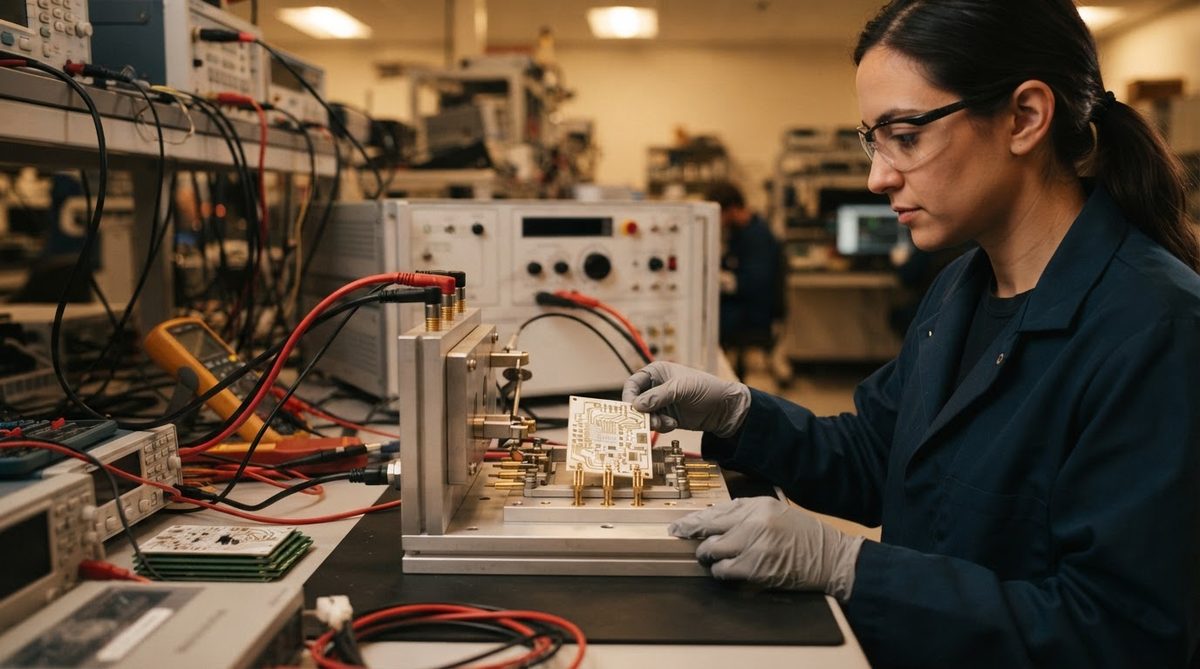
FR-4 laminates earn their UL recognition largely on flammability performance. Ceramic substrates skip that hurdle but face scrutiny in other areas. The table below summarizes the key differences in the UL evaluation process.
| Test / Requirement | FR-4 (Organic) | Ceramic (Al₂O₃, AlN, Si₃N₄) |
|---|---|---|
| UL 94 Flammability | Must achieve V-0 with flame retardants | Inherently V-0; no additives needed |
| Comparative Tracking Index (CTI) | Typically PLC 3–4 (175–399 V) | PLC 0 (≥ 600 V) for most alumina grades |
| Dielectric Withstand (per UL 796) | Depends on laminate thickness and resin system | High intrinsic dielectric strength; 96% Al₂O₃ ≈ 10–15 kV/mm (ASTM D149) |
| Thermal Index (RTI) | 130 °C typical for standard FR-4 | Often rated > 300 °C; limited by metallization adhesion, not substrate |
| Moisture Resistance | Can absorb moisture; tested per IPC-TM-650 | Near-zero moisture absorption (< 0.02%) |
| Bond Strength | Copper foil peel strength per IPC-TM-650 2.4.8 | Evaluated per metallization type (DPC, DBC, thick film, thin film) |
Sources: UL 796, ASTM D149, CoorsTek ADS-996 datasheet for 96% Al₂O₃ properties.
The Relative Thermal Index (RTI) is where ceramic boards have a clear structural advantage in UL certification PCB evaluations. Standard FR-4 tops out around 130 °C. Ceramic substrates themselves remain stable well beyond 800 °C, so the RTI is typically limited by the weakest element in the assembly—often the solder or the conductor-to-substrate bond. For DBC (direct bond copper) on alumina, the copper-ceramic interface can withstand repeated cycling to 300 °C or above, which translates to a high electrical and mechanical RTI on the UL file.
What to Ask Your Ceramic PCB Supplier About UL Certification
Not every ceramic PCB fabricator holds a UL 796 file. Many ceramic substrates are sold as components into power modules or LED assemblies where the module maker, not the board fabricator, holds the UL listing. If your product design requires a UL-recognized bare board, confirm these points with your supplier before placing an order:
- UL file number (E-number): Ask for the specific file number and verify it on the UL Product iQ database. The file should list the exact substrate material, metallization type, and manufacturing location.
- Scope of recognition: A file may cover only certain thicknesses, copper weights, or board sizes. Confirm your specific construction falls within the scope.
- Manufacturing site: UL recognition is site-specific. If the supplier has multiple factories, the file must name the facility producing your boards.
- RTI values: Request the electrical and mechanical RTI on file. For high-temperature applications, this number determines your product’s maximum operating temperature per UL.
If your supplier provides alumina ceramic substrates but does not hold a UL 796 file, you have two paths: request that they initiate UL evaluation (a process that typically takes 8–16 weeks and involves sample submission plus a factory audit), or source from a supplier that already carries the UL certification PCB recognition you need. Reviewing a supplier audit checklist before engaging a new vendor helps ensure UL status is verified early, not discovered missing at the end of a qualification cycle.
The UL Recognition Process for Ceramic Boards
If your fabricator needs to obtain UL certification for a ceramic PCB construction, the process follows these steps:
- Application submission. The manufacturer submits construction details to UL: substrate material and grade, metallization method, conductor thickness range, surface finish, and maximum board dimensions.
- Sample testing. UL tests samples against UL 796 requirements. For ceramics, the critical tests are dielectric withstand, bond strength, thermal aging, and humidity exposure. Flammability testing is minimal due to the inorganic substrate.
- Factory inspection. A UL engineer inspects the production facility to verify process controls, material traceability, and quality systems. UL conducts follow-up inspections quarterly or semi-annually.
- File issuance. UL issues a file number covering the specific constructions that passed testing. The manufacturer can then mark boards with the UR symbol.
Expect the initial evaluation to cost between $10,000 and $30,000 depending on the number of constructions submitted, plus ongoing annual fees for follow-up inspections. These costs are typically amortized across production volume.
When UL Certification PCB Recognition Is Not Required
UL recognition is driven by the end-product certification path, not by the substrate material itself. Many ceramic PCB applications do not require a UL-recognized bare board:
- Military and aerospace: These products follow MIL-PRF-55110 or MIL-PRF-31032, not UL standards. The relevant IPC and military standards for ceramic PCBs take precedence.
- Power modules with module-level UL listing: If the module manufacturer tests and lists the complete assembly, the bare substrate may not need its own UL file.
- Medical devices under IEC 60601: The safety standard is IEC 60601, not UL 796. Some manufacturers pursue both, but it is not automatic.
- Automotive (IATF 16949 scope): Automotive OEMs typically require IATF 16949 and AEC-Q qualification, not UL recognition, for ceramic substrates in powertrain or ADAS modules.
If none of your end-product certifications reference UL 796, spending money on UL certification adds cost without value. Confirm the requirement with your compliance team before asking suppliers to carry UL files.
Compliance Beyond UL: Standards That Apply to Ceramic PCBs
UL certification PCB recognition is one piece of a broader compliance picture. Ceramic boards used in commercial products also need to meet RoHS and REACH requirements, and some applications demand IPC-6012 qualification testing. For boards reaching end of life, understanding ceramic PCB recycling and disposal requirements is increasingly relevant under EU WEEE directives.
Frequently Asked Questions
Does a ceramic PCB automatically have UL certification?
No. The ceramic substrate itself is inherently non-flammable, but UL certification PCB recognition requires formal testing, a factory audit, and an active UL file under UL 796. The substrate material alone does not confer UL status on the finished board.
Can I look up a supplier’s UL file online?
Yes. Search the supplier’s company name or E-number on the UL Product iQ database. The listing shows which constructions, materials, and factory locations are covered.
How long does it take to get UL 796 recognition for a new ceramic PCB construction?
Typically 8 to 16 weeks from sample submission to file issuance, assuming no major test failures. Adding new constructions to an existing file is faster, often 4 to 8 weeks.
Is UL 94 V-0 the same as UL 796 recognition?
No. UL 94 V-0 is a material flammability classification. UL 796 is a product safety standard for printed-wiring boards that includes flammability testing but also covers dielectric strength, thermal endurance, moisture resistance, and bond strength. A V-0 rating does not substitute for full UL certification PCB compliance.
Do DBC and DPC ceramic boards require separate UL files?
Yes, if both metallization types are used in UL-listed products. UL evaluates each construction independently because the conductor bonding method affects bond strength, thermal cycling performance, and dielectric properties. A file covering DBC on 96% Al₂O₃ does not automatically cover DPC on the same substrate.