ENIG Definition: What Does It Mean?
The ENIG definition is straightforward: ENIG stands for Electroless Nickel Immersion Gold, a two-layer surface finish applied to exposed copper or metallization pads on a PCB. The finish consists of a nickel-phosphorus barrier (typically 3–6 µm thick) deposited by autocatalytic reduction, followed by a thin immersion gold layer (typically 0.05–0.15 µm) that protects the nickel from oxidation until soldering or wire bonding. Understanding the ENIG definition matters because this finish is one of the most widely specified options for fine-pitch assembly, BGA pads, and gold wire bonding on both organic and ceramic boards.
Because the gold layer is consumed into the solder joint during reflow, the actual solder bond forms between tin and the underlying nickel. ENIG provides a flat, coplanar surface that suits tight-tolerance component placement.
Layer Structure and Typical Thicknesses per IPC-4552B
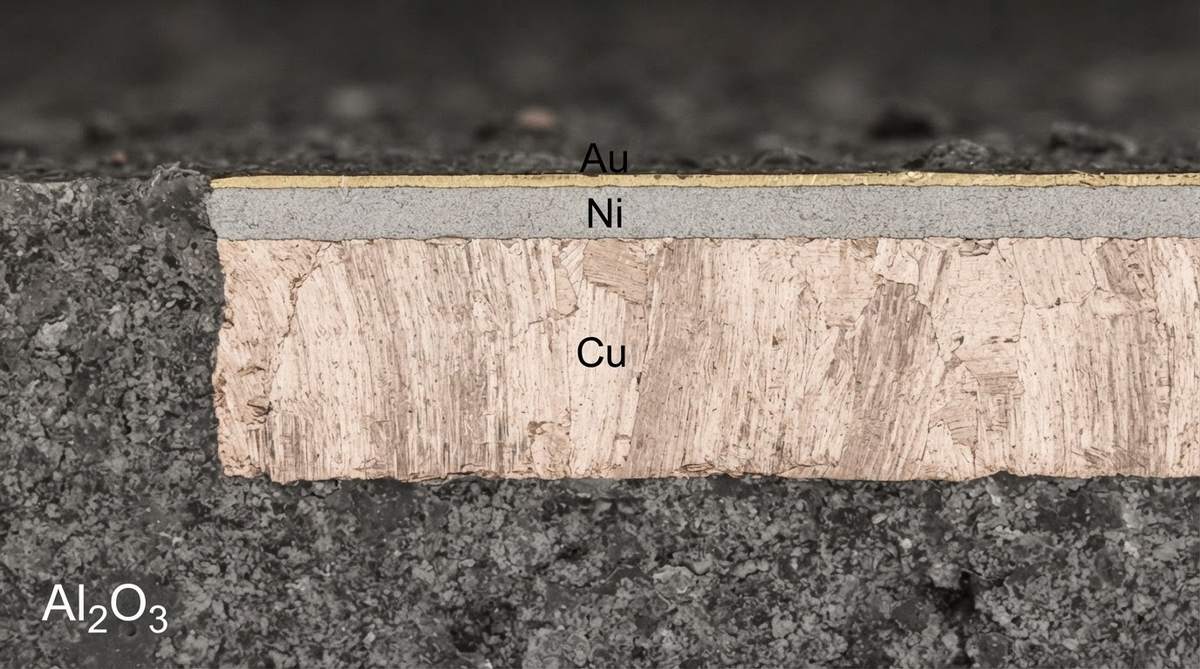
| Layer | Material | Typical Thickness | Reference |
|---|---|---|---|
| Barrier | Electroless Ni-P (mid-phos, 6–9 wt% P) | 3–6 µm | IPC-4552B |
| Cap | Immersion Au | 0.05–0.15 µm | IPC-4552B |
IPC-4552B is the governing specification for the ENIG finish on printed boards. It defines minimum nickel and gold thicknesses, phosphorus content ranges, and acceptance criteria. Any supplier quoting ENIG should be able to certify compliance with this standard.
Key Reasons Engineers Choose ENIG
The ENIG definition covers the chemistry, but the practical reasons engineers specify it come down to a short list of measurable advantages:
- Flat, coplanar pads — critical for fine-pitch BGA and QFN packages where even 10 µm of height variation causes bridging or opens.
- Long shelf life — the gold cap prevents nickel oxidation for 12 months or more under standard storage conditions, far longer than OSP.
- Multi-reflow capability — ENIG withstands three or more lead-free reflow cycles at 260 °C peak without degrading solderability.
- Gold wire-bond compatibility — the gold surface supports thermosonic gold ball bonding directly, with no additional plating step.
- Lead-free compatible — fully compatible with SAC305 and other Pb-free alloys per IPC J-STD-020.
Why ENIG Is Common on Ceramic Substrates
On ceramic PCBs, the base metallization is often sputtered or plated copper or a thick-film conductor. The ENIG process works on these surfaces the same way it works on etched copper traces in FR-4 boards. It is especially useful on ceramic substrates because the flat pad coplanarity supports fine-pitch die attach and wire bonding in power modules, sensors, and RF assemblies.
Engineers designing on alumina or aluminum nitride substrates frequently pair ENIG with other available surface finishes during prototyping to compare wire-bond pull strength and solder joint reliability before locking in a production finish.
Ceramic PCB Max Operating Temperature and ENIG
Because ceramic boards often operate at elevated temperatures, the thermal stability of the finish matters. The nickel-phosphorus layer in an ENIG finish remains stable well above standard reflow temperatures. However, prolonged exposure above roughly 300 °C can accelerate nickel-gold interdiffusion, reducing wire-bond reliability. For boards that must survive sustained high temperatures, confirm the finish specification against your ceramic PCB max operating temperature requirements.
Limitations of the ENIG Finish
Black pad defect. Hyper-corrosion of the nickel during the immersion gold step can create a brittle, dark nickel surface that causes solder joint failure. Proper bath chemistry control reduces this risk but does not eliminate it entirely. For safety-critical joints, some engineers specify ENEPIG (adding a palladium interlayer) instead.
Gold thickness trade-off. Thicker gold improves shelf life and wire-bond reliability but increases cost and can cause gold embrittlement in tin-lead solder joints if the gold exceeds roughly 0.5 µm — well above the immersion gold range, but relevant if additional electrolytic gold is added.
Cost. ENIG is more expensive than OSP or HASL. On large-volume consumer boards where wire bonding is not needed, the added cost may not be justified.
FAQ
Is ENIG lead-free compatible?
Yes. ENIG is fully compatible with lead-free SAC solders and withstands multiple reflow cycles at peak temperatures of 260 °C per IPC J-STD-020.
Can you wire bond to ENIG?
Gold wire bonding works well on ENIG pads. Aluminum wedge bonding is possible but less reliable because the thin gold layer can complicate the Al-Au intermetallic interface. For aluminum wire bonding, bare nickel or ENEPIG is often preferred.
How does ENIG compare to OSP?
OSP (Organic Solderability Preservative) is cheaper and simpler, but it offers a shorter shelf life, is not suitable for wire bonding, and degrades after one or two reflow cycles. ENIG provides a longer shelf life and multi-reflow capability at higher cost.
What does the ENIG definition include beyond chemistry?
The full ENIG definition encompasses not just the electroless nickel and immersion gold chemistry but also the IPC-4552B specification requirements for layer thickness, phosphorus content, and visual and functional acceptance criteria. A finish labeled “ENIG” should meet all of these parameters.