Ceramic Firing Definition
Ceramic firing is the high-temperature heat-treatment step that densifies a shaped ceramic green body into a hard, electrically insulating substrate. Understanding the ceramic firing definition is essential for any engineer specifying ceramic PCB substrates, because firing conditions directly determine the thermal, electrical, and mechanical properties of the finished board. During firing, organic binders burn out and ceramic particles bond through solid-state sintering, shrinking the part by 15–20 % linearly and raising its relative density above 95 %.
Stages of Ceramic Firing
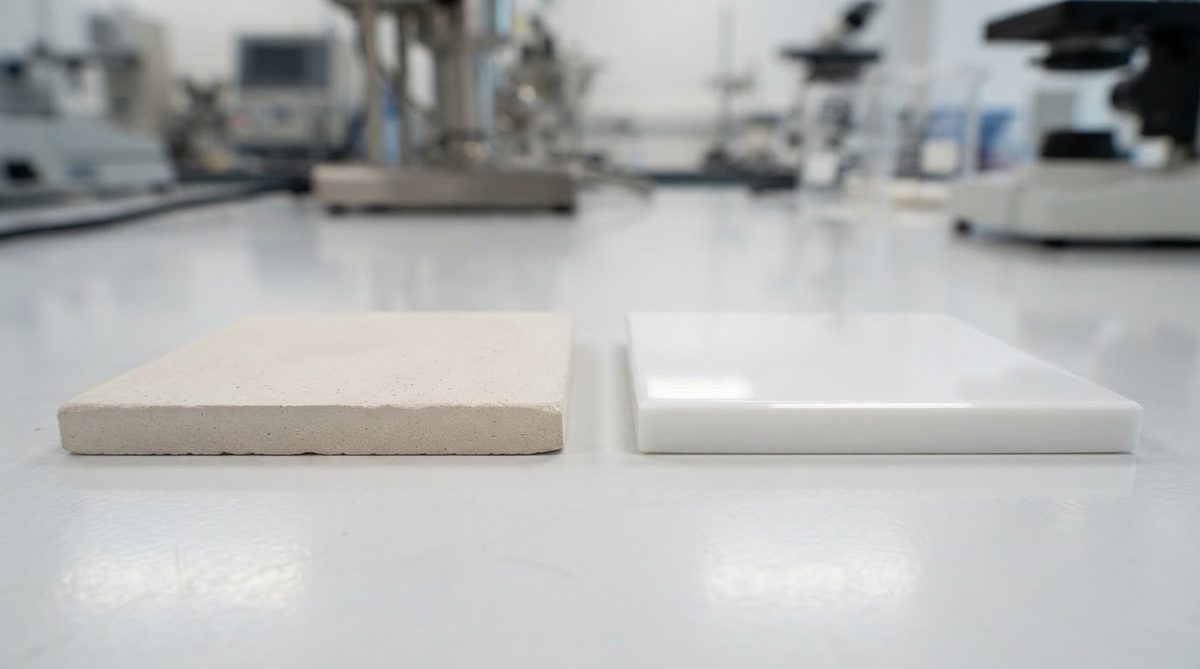
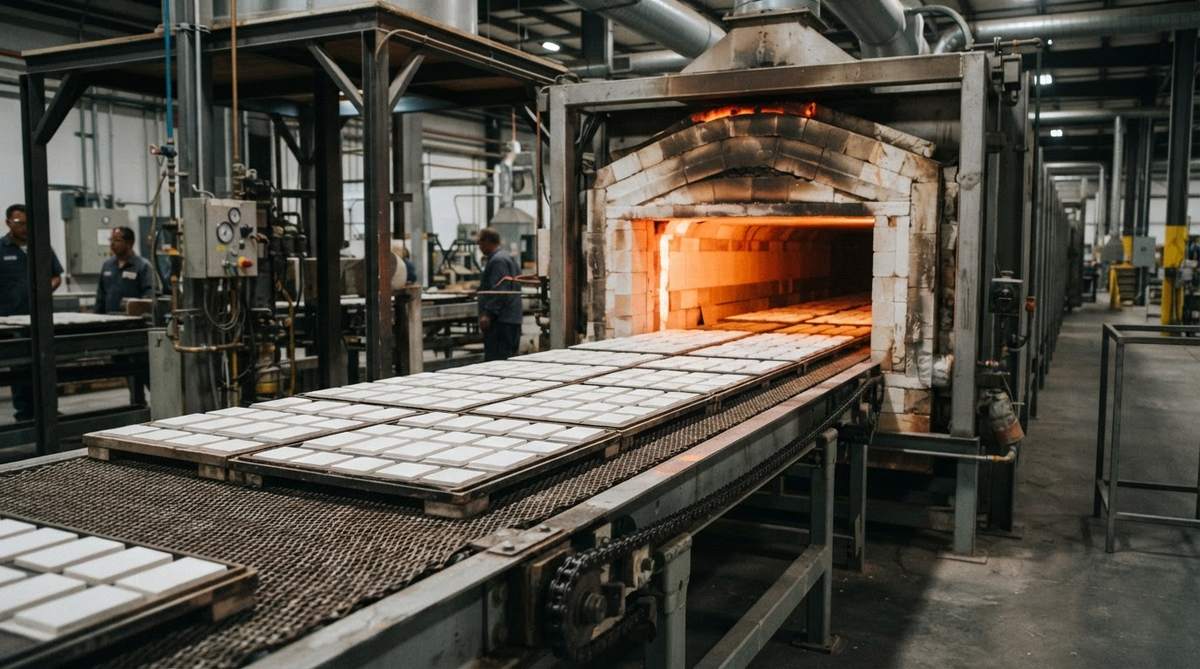
A typical ceramic firing profile has three stages:
- Binder burnout (200–600 °C). Organic binders and plasticizers decompose. Ramp rates are kept slow (1–3 °C/min) to avoid cracking from rapid gas evolution.
- Sintering (peak hold). The part is held at peak temperature long enough for grain growth and pore elimination. Hold times range from 30 minutes to several hours depending on part thickness and material.
- Controlled cooling. The part cools at a managed rate to prevent thermal-shock fractures, especially in alumina and aluminum nitride substrates.
Peak Temperatures by Ceramic Firing Process
| Process | Peak Temperature | Typical Materials |
|---|---|---|
| HTCC (high-temperature co-fired ceramic) | 1 500–1 600 °C | Al₂O₃ 96 %, AlN |
| LTCC (low-temperature co-fired ceramic) | 850–900 °C | Glass-ceramic composites |
| Stand-alone alumina substrate | 1 550–1 650 °C | Al₂O₃ 96 %–99.6 % |
Typical values from CoorsTek and Kyocera published datasheets, for comparison only. Confirm against the datasheet for your specific grade.
Why the Ceramic Firing Definition Matters for PCB Engineers
Firing conditions directly control the substrate properties you design against: thermal conductivity, dielectric constant, flexural strength, and dimensional tolerance. Under-fired alumina, for example, retains porosity that lowers thermal conductivity from the expected 24–28 W/mK range and increases dielectric loss. Over-firing can cause excessive grain growth, reducing mechanical strength.
Shrinkage during ceramic firing also determines final feature accuracy. LTCC tapes typically shrink 12–16 % in X-Y and 15–25 % in Z, per Kyocera published process guidelines. Accurate shrinkage prediction is essential for via registration and cavity dimensions. Engineers who grasp the full ceramic firing definition—including its impact on shrinkage—can set tighter tolerances at the design stage.
Firing vs. Post-Fire Metallization
Substrates that are fired before any metal is applied—such as those used in direct bond copper (DBC) or DPC processes—are called “pre-fired” or “as-fired” substrates. Co-fired substrates (HTCC, LTCC) have conductors printed on the green tape and fired simultaneously, which constrains conductor material choice to metals that survive the peak temperature (tungsten or molybdenum for HTCC; silver or gold for LTCC). The ceramic firing step is therefore the single biggest factor in determining which metallization options are available for a given substrate.
Frequently Asked Questions
What does ceramic firing mean in simple terms?
Ceramic firing means heating a shaped, unfired ceramic part (called a green body) to a high temperature so its particles fuse together into a dense, hard solid. The process removes organic binders and causes sintering, which shrinks the part and gives it its final mechanical and electrical properties.
How long does a ceramic firing cycle take?
A complete ceramic firing cycle typically takes 8–24 hours from start to finish, depending on part size, material, and peak temperature. Most of that time is spent on slow ramp-up and controlled cool-down rather than the peak-temperature hold, which itself lasts 30 minutes to several hours.
Can ceramic firing be repeated or redone?
Once a ceramic substrate has been fully sintered, it cannot be “re-fired” to change its density or fix defects. However, post-fire processes such as thick-film printing do involve additional lower-temperature furnace passes (typically 850–1 000 °C) that do not re-sinter the base ceramic. These secondary firings are part of metallization, not a repeat of the original ceramic firing step.
Does the ceramic firing definition differ between HTCC and LTCC?
The core ceramic firing definition—densifying a green body through heat—is the same for both HTCC and LTCC. The key difference is peak temperature: HTCC fires at 1 500–1 600 °C using high-purity alumina or AlN, while LTCC fires at 850–900 °C using glass-ceramic composites. This temperature gap is what allows LTCC to use silver and gold conductors instead of the refractory metals required by HTCC.