Ceramic PCB design for a medical device PCB starts with one fact: ceramic substrates survive repeated sterilization, produce no outgassing, and hold dimensional stability across temperature and humidity extremes that organic laminates cannot tolerate. If you are designing a Class II or Class III medical device and evaluating substrate options, this article covers the material choices, regulatory context, sterilization compatibility, and layout rules that matter at the board level. Understanding ceramic PCB design medical device PCB requirements early prevents costly respins after biocompatibility or sterilization validation.
Why Ceramic PCB Design Matters for Medical Device PCBs
Medical electronics face a combination of constraints that push designers away from FR-4 and standard metal-core boards. The substrate must survive autoclave cycles at 134 °C, resist chemical attack from hydrogen peroxide plasma or ethylene oxide, produce zero particulate or volatile organic outgassing near tissue, and maintain tight impedance and dimensional tolerances over a 10–20 year service life. Ceramic substrates—alumina (Al₂O₃), aluminum nitride (AlN), and in some cases zirconia (ZrO₂)—meet all of these requirements simultaneously.
Common medical applications for ceramic PCBs include implantable neurostimulators, ultrasonic transducer arrays, endoscope tip electronics, laser driver boards for surgical tools, and sensor and MEMS substrates used in patient-monitoring catheters. In each case, the ceramic substrate is chosen not for one property but for the intersection of thermal conductivity, hermeticity, chemical inertness, and dielectric performance.
Material Selection: Al₂O₃, AlN, or ZrO₂?
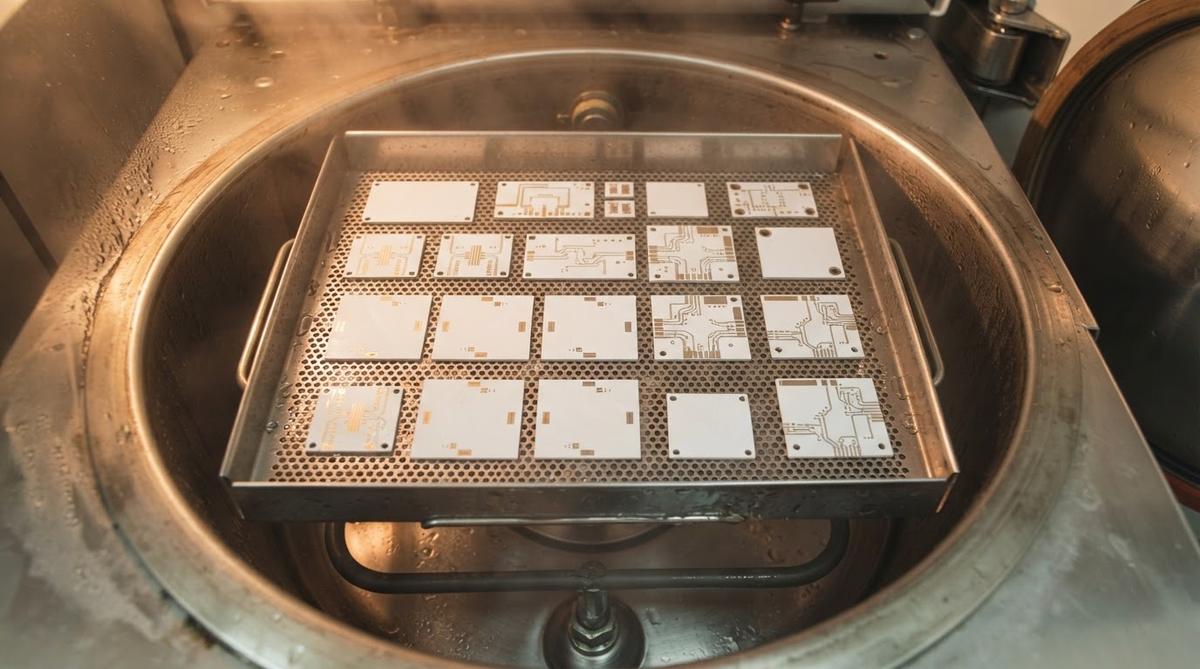
The right ceramic for your medical device PCB depends on the thermal load, the sterilization method, and whether the board will contact tissue or bodily fluids.
| Parameter | Al₂O₃ 96% | Al₂O₃ 99.6% | AlN | ZrO₂ (3Y-TZP) |
|---|---|---|---|---|
| Thermal conductivity (W/m·K, 20 °C) | 24–28 | 30–35 | 170–200 | 2–3 |
| Dielectric strength (kV/mm) | 10–15 | 15–20 | 14–17 | 10–12 |
| Flexural strength (MPa, ASTM C1161) | 300–380 | 380–450 | 300–350 | 900–1200 |
| CTE (ppm/°C, 20–300 °C) | 7.0–7.4 | 7.2–7.6 | 4.4–4.7 | 10–11 |
| Autoclave survival (134 °C, 2 bar) | Yes | Yes | Yes* | Yes |
| Relative cost (Al₂O₃ 96% = 1×) | 1× | 1.3–1.5× | 3–5× | 2–3× |
Typical values for commercially available material, for comparison only. Confirm against the datasheet for your specific grade. *AlN survives autoclaving but can hydrolyze over many hundreds of cycles without a protective passivation layer.
Al₂O₃ 96% is the default for most non-implantable medical electronics: diagnostic equipment, benchtop analyzers, and surgical tool driver boards. It is the lowest-cost ceramic and the most widely available in thin-film and thick-film metallization.
AlN is justified when thermal dissipation is the primary constraint—laser diode drivers in surgical systems, for example, where junction temperature directly affects wavelength stability. For a deeper look at AlN in medical contexts, see the guide on AlN ceramic PCBs for medical electronics.
ZrO₂ is used where mechanical toughness matters more than thermal conductivity: miniaturized probe tips, dental handpiece electronics, and boards that must survive repeated mechanical shock during use.
Sterilization Compatibility for Ceramic PCB Design in Medical Device PCBs
Every reusable medical device must survive a validated sterilization cycle. The substrate and its metallization must tolerate the specific chemistry and temperature involved. Proper ceramic PCB design for a medical device PCB accounts for sterilization from the earliest schematic stage.
| Sterilization method | Conditions | Al₂O₃ impact | AlN impact | Metallization concern |
|---|---|---|---|---|
| Steam autoclave | 134 °C, 2 bar, 18 min | None | Surface hydrolysis over many cycles | Bare copper oxidizes; use ENIG or ENEPIG |
| Ethylene oxide (EtO) | 37–63 °C, 1–6 hr | None | None | Residue absorption in organic conformal coat |
| H₂O₂ plasma | 45–55 °C, 45–75 min | None | None | None significant |
| Gamma irradiation | 25–50 kGy | None | None | Polymeric underfills may yellow/degrade |
| E-beam | 25–50 kGy | None | None | Same as gamma |
Sources: ISO 17665-1 (steam), ISO 11135 (EtO), ISO 11137 (radiation). Impact ratings assume bare ceramic with inorganic metallization.
The key takeaway: ceramic substrates themselves are chemically inert to all common sterilization methods. The weak points are the surface finish and any organic materials bonded to the board—conformal coatings, underfills, and adhesives. Specify inorganic metallization (gold, platinum, or tungsten thick film) and ENIG or ENEPIG surface finish to maximize sterilization cycle life.
Enter your substrate material, sterilization method, and expected cycle count to see estimated finish life and derating factors.
Layout Rules Specific to Medical Ceramic PCB Design
Creepage and clearance for patient-contact devices
IEC 60601-1 (medical electrical equipment safety) defines minimum creepage and clearance distances based on working voltage and pollution degree. Ceramic’s high CTI (Comparative Tracking Index > 600 V per IEC 60112 for Al₂O₃) allows shorter creepage distances than FR-4 at the same voltage, which helps miniaturize patient-contact boards. For designs above 1 kV working voltage, see the high-voltage ceramic PCB design rules page.
Hermeticity for implantables
Implantable electronics require hermetic sealing per MIL-STD-883 Method 1014 (fine and gross leak). HTCC alumina with co-fired tungsten vias and brazed metal lids achieves leak rates below 1 × 10⁻⁸ atm·cc/s He. LTCC can also achieve hermetic packages but requires careful via fill and seal ring design. More detail on seal ring geometry and lid materials is covered in the hermetic ceramic package design guide.
Biocompatibility of substrate and finish
ISO 10993-1 requires biological evaluation of any material in contact with the patient. Fired alumina and AlN ceramics are generally well-tolerated, but the surface finish and solder alloys must also pass cytotoxicity (ISO 10993-5), sensitization, and irritation testing. Gold thick-film metallization is the standard choice for implant-grade boards because gold is bioinert and does not corrode in physiological saline.
Worked example: thermal design for a surgical laser driver
A 5 W laser diode driver on a 10 mm × 10 mm × 0.635 mm Al₂O₃ 96% substrate, bottom side soldered to a copper heat sink:
- Thermal resistance through substrate: Rth = t / (k × A) = 0.000635 / (26 × 0.0001) = 0.244 °C/W
- Temperature rise across the ceramic at 5 W: ΔT = 5 × 0.244 = 1.22 °C
- Switching to AlN (k = 180 W/m·K): Rth = 0.000635 / (180 × 0.0001) = 0.035 °C/W → ΔT = 0.18 °C
For a 5 W load on a 10 × 10 mm footprint, the alumina substrate adds only 1.2 °C. AlN is not justified here unless junction temperature margin is already exhausted by other thermal resistances in the stack. This is the kind of calculation that should drive ceramic PCB design medical device PCB material selection, not a default assumption that AlN is always better.
When Not to Use a Ceramic Substrate
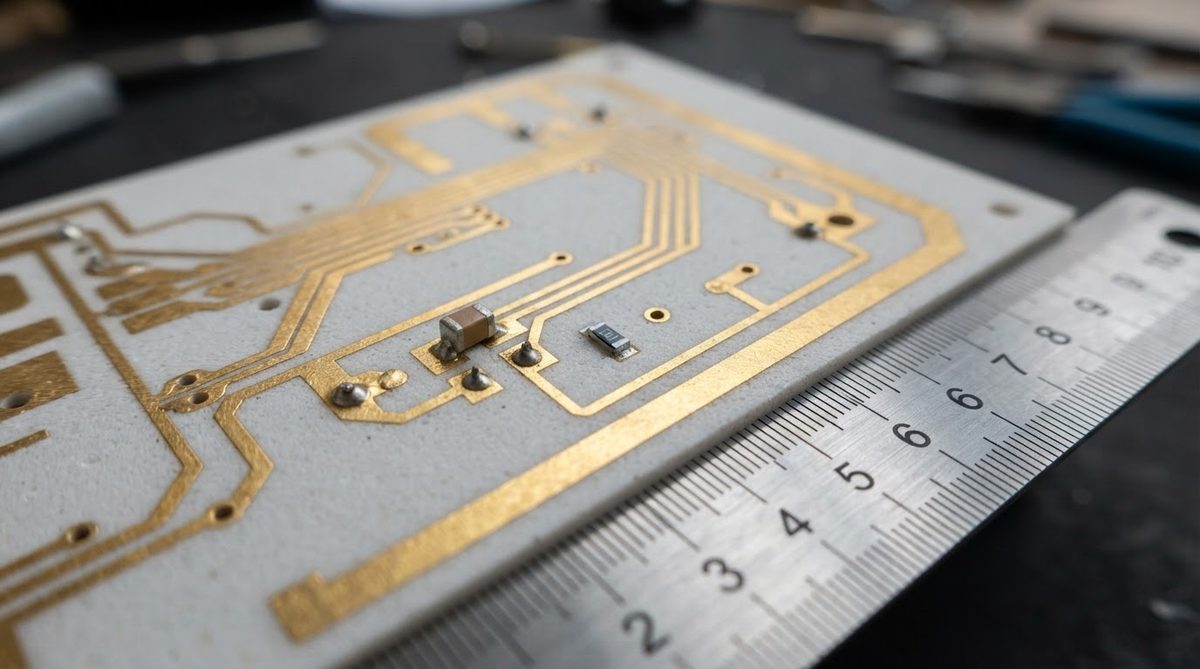
Ceramic is overkill—and an unnecessary cost driver—in several common medical electronics scenarios:
- Single-use disposable devices (glucose test strips, disposable SpO₂ sensors): FR-4 or polyimide flex is cheaper and adequate for a device used once.
- Large-area control boards inside a benchtop analyzer housing, away from the patient, with no sterilization requirement: standard FR-4 or metal-core PCB is the right call.
- High-density digital boards with 1,000+ nets and BGA packages: ceramic panel sizes and layer counts are limited compared to organic HDI. A hybrid approach—ceramic substrate for the sensor or power section, FR-4 for the digital section—often makes more sense.
Regulatory and Documentation Considerations
FDA 21 CFR 820 (Quality System Regulation) and EU MDR 2017/745 require full traceability of materials in a medical device. When specifying a ceramic PCB design for a medical device PCB at Class II or III level, ensure your supplier can provide lot-traceable ceramic blanks, certificate of conformance per lot, and material composition declarations. Biocompatibility test reports (ISO 10993 series) must cover the finished assembly—substrate plus metallization plus finish—not the ceramic alone.
For general layout rules and DFM guidance applicable across all ceramic PCB applications, refer to the ceramic PCB design guidelines.
Frequently Asked Questions
Can ceramic PCBs be sterilized in a standard hospital autoclave?
Yes. Alumina and AlN substrates withstand steam autoclaving at 134 °C and 2 bar pressure indefinitely. The limiting factor is the surface finish: use ENIG or gold thick film rather than bare copper, which oxidizes in steam.
Is alumina ceramic biocompatible?
Fired alumina (Al₂O₃ ≥ 96%) is widely accepted as biocompatible and is used in orthopedic implants and dental prosthetics. However, ISO 10993-1 requires biological evaluation of the complete finished assembly, including metallization, solder, and any coatings.
What surface finish should I specify for an implantable ceramic PCB?
Gold thick-film metallization is the standard for implant-grade boards. Gold is bioinert, resists corrosion in physiological fluids, and survives all common sterilization methods. ENEPIG is an alternative for boards that also require wire bonding.
How small can a medical ceramic PCB be?
Ceramic substrates can be laser-singulated down to approximately 1 mm × 1 mm. Thin-film and DPC processes achieve trace widths below 50 µm, enabling the miniaturization needed for catheter-tip sensors and cochlear implant arrays.
Does ceramic outgas in vacuum or cleanroom environments?
Fired ceramic produces effectively zero outgassing. Total mass loss (TML) values for alumina are below 0.01% per ASTM E595, well within the limits for cleanroom and even space-grade applications. Any outgassing risk comes from organic adhesives or conformal coatings applied to the board.